Looking For Annual Meeting Production Companies With Global Capabilities? Read This…

Chief Executive Officer
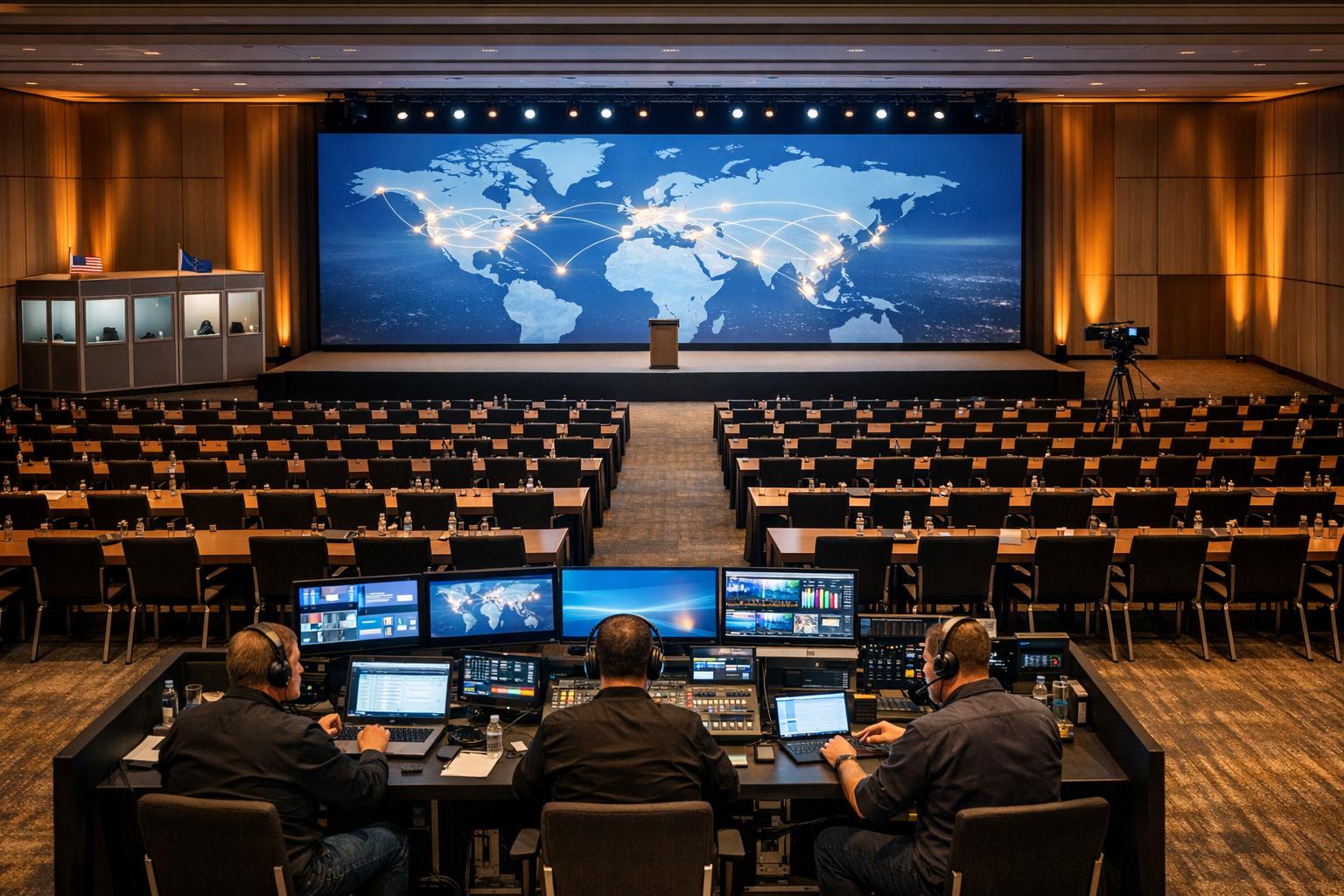
Planning international annual meetings is challenging. From language barriers and customs regulations to technical hurdles like differing electrical standards, the complexities can quickly add up. The key to success? Partnering with a production company that excels in logistics, compliance, and event execution across borders.
Here’s what to look for in a global production company:
- Logistics Expertise: They should manage transportation, customs, and real-time tracking while mitigating risks like delays or damage.
- Multilingual Teams: Teams must understand local languages and cultural norms to avoid missteps.
- Compliance Knowledge: Familiarity with regional safety codes, electrical standards, and labor laws is critical.
- Hybrid Event Capabilities: Providers should offer seamless virtual and live event integration, with tools like multilingual captions and interactive features.
- AV Excellence: High-quality audio-visual setups, on-site technical support, and cutting-edge tools like AR and VR enhance the event experience.
- Venue Selection and Support: Choose companies that assess venues for compatibility and work with local teams to ensure smooth operations.
For a standout example, companies like Corporate Optics handle every detail - from planning to execution - ensuring events meet global standards while addressing local nuances. Whether it’s logistics, compliance, or technical execution, the right partner makes all the difference.
Focus on Producing Global Events
What to Look for in a Global Production Company
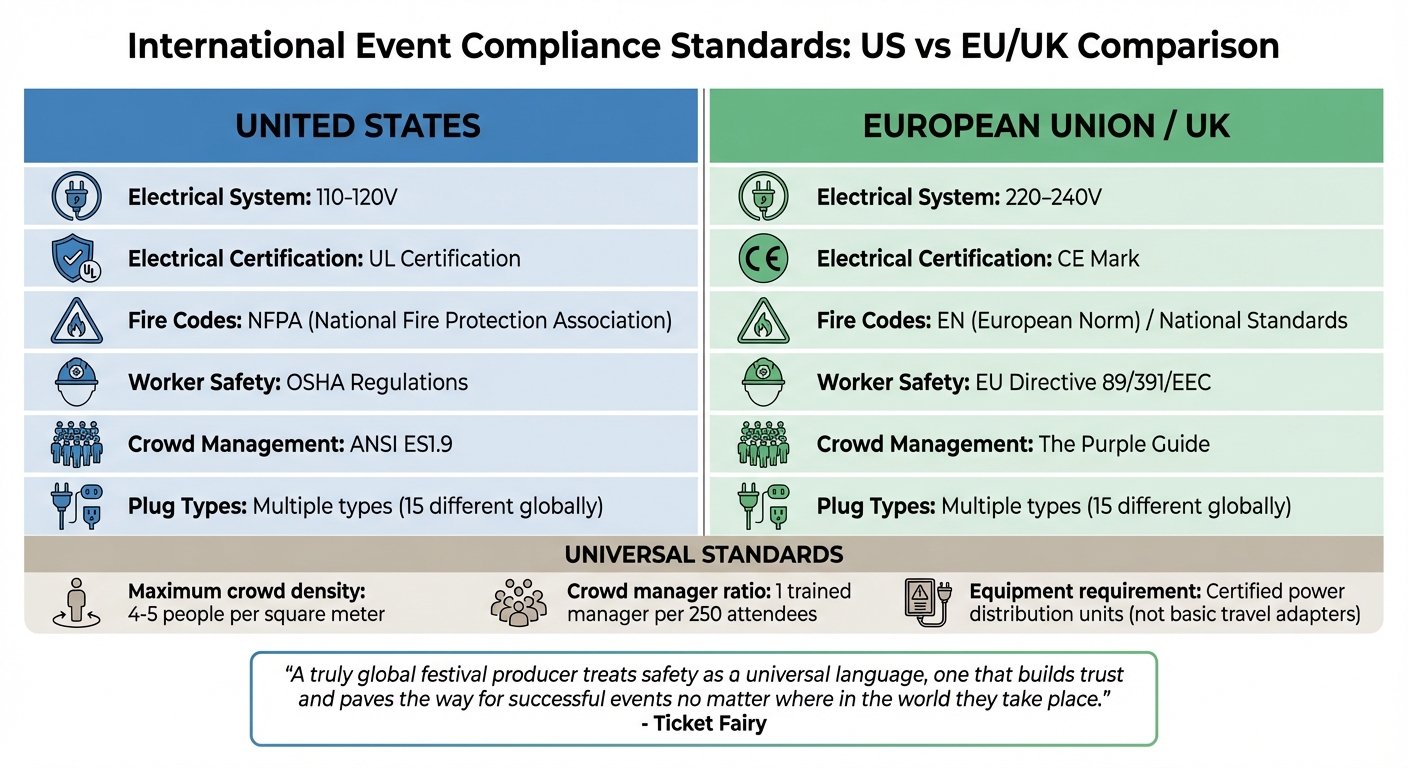
International Event Compliance Standards: US vs EU Comparison
When it comes to organizing international events, not all production companies are created equal. Some have the knowledge and expertise to handle the complexities of global meetings, while others fall short. Here’s what separates the professionals from the rest.
International Logistics Management
Managing logistics for global events is no small feat. It requires a solid grasp of multimodal transportation - whether by air, sea, rail, or road - and an in-depth understanding of customs documentation like Carnets, EEI filing, and letters of credit. Without these skills, you risk delays in getting essential equipment where it needs to be.
Modern logistics also relies heavily on real-time tracking. Top companies use IoT sensors and cloud-based systems to monitor not just the location of equipment but also environmental conditions during transit. This level of visibility ensures smoother operations. According to Ti Research's 2024 State of Logistics survey, data analytics and real-time tracking have become the leading areas of investment for logistics providers.
Size and reach matter too. Companies with extensive networks - think 250+ offices across 100+ countries - are better equipped to navigate regional customs rules. But logistics isn’t just about moving cargo. It’s about managing risks. An experienced partner will have contingency plans for issues like port congestion, geopolitical conflicts, or weather disruptions. They’ll also maintain a chain of custody to track who handles equipment at every stage, reducing the chances of damage or errors.
For specialized equipment, like oversized AV gear or heavy-lift cargo, you’ll want a partner experienced in "Project Cargo." This requires advanced transport knowledge and precise coordination.
But logistics alone won’t guarantee success. A deep understanding of local languages and traditions is just as important.
Multilingual Teams and Cultural Knowledge
Global production isn’t just about translating words - it’s about transcreation, which means adapting messages to resonate emotionally with each audience. Production teams need to balance high-context (formal, nuanced) and low-context (direct, straightforward) communication styles to effectively engage international speakers and attendees.
The numbers speak for themselves: companies with diverse leadership are 33% more likely to outperform their competitors, and those with strong cultural adaptability have a 36% higher chance of succeeding. However, cultural misalignment is a major obstacle - about 70% of global expansions fail because of it. Even details like colors, symbols, and imagery can carry vastly different meanings across regions, which can directly impact how messages are received during events.
"Marketing messages that resonate in one region can fall flat or even offend in another if cultural differences are overlooked." - Wolfestone Group
To avoid these pitfalls, look for production companies that hire local teams or cultural experts who understand regional trends and audience preferences. A great example is Starbucks, which increased sales in China by 90% over five years by incorporating local flavors like Matcha Lattes and designing stores that appealed to regional aesthetics. Your production partner should bring this same level of cultural sensitivity to your event.
Understanding local customs also ties into navigating international compliance and safety standards.
International Compliance and Safety Standards
When hosting events in different regions, you’ll face varying electrical systems and safety codes. For instance, North America uses 110–120 V electrical systems, while most of Europe, Africa, and Asia operate on 220–240 V. Equipment must meet region-specific certifications, such as UL in the U.S. and CE in the EU. And with 15 different types of electrical plugs globally, you’ll need certified power distribution units - not just basic travel adapters.
Fire and safety regulations also vary widely. The U.S. follows National Fire Protection Association (NFPA) standards, whereas the EU relies on European Norm (EN) standards. These rules cover everything from flame-retardant materials to exit spacing and occupancy limits. For crowd management, international guidelines recommend a density of no more than 4-5 people per square meter, with one trained crowd manager for every 250 attendees in large gatherings.
| Compliance Area | United States | European Union / UK |
|---|---|---|
| Fire Codes | NFPA | EN / National Standards |
| Worker Safety | OSHA Regulations | EU Directive 89/391/EEC |
| Electrical Certification | UL Certification | CE Mark |
| Crowd Management | ANSI ES1.9 | The Purple Guide |
"A truly global festival producer treats safety as a universal language, one that builds trust and paves the way for successful events no matter where in the world they take place." - Ticket Fairy
To ensure compliance, your production partner should source heavy equipment locally to meet national electrical codes. They should also work with local safety officers familiar with regional regulations and emergency protocols. Additionally, some areas - particularly in Europe - enforce strict noise limits and curfews that don’t exist in the U.S., so it’s crucial to plan accordingly.
Services Required for International Annual Meetings
Once the foundational challenges are addressed, the focus shifts to the technical and operational services that make international annual meetings successful. These services build on logistics, compliance, and other groundwork discussed earlier, ensuring the event runs efficiently and delivers a seamless experience.
Hybrid and Virtual Event Capabilities
Hybrid and virtual events have become essential for connecting global teams, especially when travel restrictions or time zone differences come into play. Top production companies offer end-to-end virtual event management, including features like dedicated virtual studios and green rooms for presenters to prepare before going live. Tools such as live polling, Q&A sessions, surveys, and breakout rooms keep attendees engaged. To ensure high-quality broadcasts, many providers supply remote presenters with professional kits and filming support, as well as multilingual captioning and audio channels for diverse audiences.
Reliable platforms are critical. Leading providers boast 99.9% uptime and ISO 27001-certified systems to ensure security and stability. Some global networks even operate live-streaming studios in up to 80 locations worldwide. Many companies also use "Simulive" content - pre-recorded segments played as live - to minimize technical risks during broadcasts.
"Hybrid events are more than just live streamed sessions and on demand videos: they are a complex balancing act of entertaining and catering to the needs of live and virtual audiences at the same time." – AV Alliance
For a better planning experience, request 3D renderings or videos of the stage and virtual setup to visualize how attendees will interact with the event. Confirm that platforms integrate with your collaboration tools and that the provider can quickly adapt the event to a hybrid or fully virtual format if needed.
Professional AV Equipment and Streaming
A strong digital platform is only part of the equation - high-quality AV equipment is equally important for delivering clear and engaging content. Reliable AV systems ensure every attendee can see, hear, and interact with the event, regardless of format. Providers often include simultaneous interpretation and multilingual captioning to accommodate non-native speakers, along with audience response systems and real-time feedback tools that encourage active participation.
State-of-the-art setups include massive LED walls - some as large as 50-foot curved displays - and high-definition visuals paired with top-notch audio systems. On-site technical teams manage these systems to ensure flawless execution. Leading AV agencies have supported events in over 30 languages, with some firms handling over 3,000 events annually across 30+ countries. Experienced teams, like QAV Global, have been integrating live and virtual solutions for decades, with QAV celebrating its 25-year milestone in 2026.
Emerging technologies like augmented reality (AR), virtual reality (VR), and holography are becoming popular for creating immersive experiences. The "Hub & Spoke" model - linking regional hubs to a global broadcast - is also gaining traction.
"Whether it was a virtual event, a blended event, or a fully live event, Ken and the team delivered a flawless event! From start to finish Ken was able to add creativity, fun, technical guidance, and high production value..." – Mark Reuter, VP of Sales Strategy and Enablement, LogicMonitor
To ensure smooth execution, over-communicate event details such as venue specs, audience size, and streaming needs. Use a single point of contact to coordinate logistics, and schedule rehearsals for speaker coaching and technical run-throughs.
International Venue Selection and On-Site Teams
Selecting the right international venue involves more than just booking a space. Evaluate venues for electrical compatibility, local broadcast standards, robust Wi-Fi, and compliance with local permits, fire safety, and accessibility regulations. Noise ordinances and legal licensing also need to be factored in.
Multilingual on-site teams, including technicians and managers, help avoid communication errors. Local customs should influence event content and scheduling to show respect for regional norms. Partnering with local riggers and suppliers cuts down on shipping and travel costs while ensuring smoother operations.
Regional design preferences also play a role. For example, European venues often favor built-in structure walls, while U.S. venues typically use pipe and drape setups. Hybrid events add another layer of complexity, requiring careful time zone management, transportation coordination, and menu planning that respects local dietary preferences.
"Comprehending logistical elements like these will help planners produce flawless events. Additionally, local staff members will appreciate your respect for their cultural values enough to have accounted for them." – Tallen
Before signing contracts, conduct thorough venue assessments to ensure AV feasibility. Establish a single point of contact to handle coordination with local vendors and negotiate hotel contracts with a clear understanding of the region’s conditions. Share detailed information about the venue, audience, and technology needs early on so the production team can create a tailored plan.
sbb-itb-ae35a94
Corporate Optics: Global Event Production Services
Corporate Optics takes global event production to the next level by combining logistics expertise with a seamless, all-inclusive approach. Whether it's an international annual meeting or a high-profile event, they handle everything - from initial planning to flawless on-site execution. Their structured four-stage process ensures no detail is overlooked:
- Discover: Define the event's core mission and goals.
- Design: Coordinate venue logistics and address speaker needs.
- Develop: Manage vendor relationships and conduct technical rehearsals.
- Deliver: Adapt in real-time during the event.
This method not only ensures smooth execution across different countries but also aligns with local logistical and cultural nuances.
Complete Event Planning and Management
Corporate Optics offers end-to-end event planning, covering agenda creation, speaker coordination, and on-site staffing. For single-day annual meetings, they focus on strategic planning to make the most of limited time. This includes creating cohesive visual designs that match the event's theme and managing the flow of presentations. Their presenter support services - like script writing, teleprompter assistance, and technical rehearsals - help speakers deliver with confidence. For sensitive board meetings, they provide specialized AV setups, private workspaces, and stringent privacy protocols.
"Corporate Optics made our national dealer meeting unforgettable. Their professionalism and creativity set a new standard for our events!" – Bill G., Senior Director
AV Production and Stage Design
From audio and lighting to scenic designs that reflect specific brand themes, Corporate Optics covers every technical aspect of event production. They use AI-driven tools to streamline processes, cut costs, and deliver measurable outcomes. For hybrid and virtual events, their proprietary streaming methods ensure high engagement for both in-person and online audiences. Features like live polls, Q&A sessions, and branded virtual environments keep attendees actively involved.
International Experience and Execution
With over 10,870,000 positive media impressions generated for clients across industries, Corporate Optics has proven expertise in delivering exceptional events. Their portfolio includes work with Fortune 500 companies, major associations, government organizations, and sporting events. From leadership conferences to shareholder meetings, their team collaborates with international venues and local suppliers to maintain consistent branding and quality, no matter the location.
"Every time we work with Corporate Optics, we know we're in good hands. Their attention to detail and ability to adapt to challenges is unmatched." – Ed D., Senior Managing Director, Chief Operating Officer
How to Select the Right Production Company
Once you've grasped the complexities of global event production, the next step is finding a company that can meet these demanding requirements.
Identify Your Event Needs and Objectives
Start by clearly defining the scope and scale of your international event. Consider factors like expected attendance, target regions, and whether you'll need hybrid capabilities to accommodate remote participants across different time zones. Pin down your messaging goals and take into account any cultural nuances that could influence content delivery in specific countries. The more detailed your requirements are, the easier it becomes to assess whether a production company aligns with your objectives.
When reaching out to potential partners, provide them with as much information as possible. This should include details about venue specifications, agenda flow, technical needs, and any multilingual support requirements. According to Tallen, "Any professional AV provider would welcome and prefer prolific correspondence because it often contains significant pieces of knowledge". Open and thorough communication during the early planning stages helps avoid costly misunderstandings and ensures the team is prepared for local technical and cultural demands.
Once your objectives are clearly outlined, the next step is to evaluate the provider's track record to ensure they can handle your event's unique challenges.
Examine Past Work and Request Detailed Proposals
A proven history of successful international events is a strong indicator of a provider's ability to handle complex logistics. Look into the production company's experience with global events. Top-tier companies often boast decades of experience, high client retention rates (sometimes as high as 98%), and a portfolio of thousands of events across more than 30 countries. Request case studies that showcase their expertise in managing multilingual teams, navigating local regulations, and handling cross-border logistics.
Ask for customized proposals that address your specific needs. Ensure the company meets all relevant technical standards and maintains a global network of equipment suppliers to provide on-site backup gear if necessary. A comprehensive proposal should also detail their strategies for cultural adaptation, regulatory compliance, and contingency planning.
Schedule Site Visits or Virtual Demonstrations
If possible, arrange site visits with the production team to evaluate their on-site coordination skills. When travel isn't an option, request a virtual tour of their previous setups. These alternatives can help you assess their design accuracy and their ability to manage complex venues remotely. Virtual demonstrations also provide insight into how well they handle real-time communication across time zones and collaborate with local suppliers.
During these interactions, ask about their expertise in navigating regional requirements, such as noise ordinances, fire safety codes, and accessibility laws specific to your event's location. Confirm that they can provide multilingual technicians and managers who are well-versed in both technical operations and cultural expectations. These conversations are a valuable opportunity to gauge their readiness and attention to detail.
Conclusion
Choosing the right production company for your international annual meeting requires more than just technical know-how - it demands expertise in logistics, cutting-edge technology, and a proven ability to navigate global challenges. It’s about finding a partner who can handle the intricacies of international shipping, customs, time zones, and local nuances - not simply someone who sets up equipment.
Top-tier global production companies excel because they combine experience with the resources needed to deliver consistent results. Corporate Optics is a standout example of this capability.
Corporate Optics oversees every stage of the project - from initial planning and design to execution and delivery. Their use of AI-driven tools streamlines planning, cuts costs, and ensures impactful results across industries and borders. With a track record of generating over 10,870,000 positive media impressions for clients, as well as partnerships with Fortune 500 companies, leading associations, and government entities, they provide the scale and reliability essential for global events.
"Every time we work with Corporate Optics, we know we're in good hands. Their attention to detail and ability to adapt to challenges is unmatched." - Ed D., Senior Managing Director, Chief Operating Officer
FAQs
What should I ask about customs and shipping before we sign a contract?
Before committing to a contract with an international meeting production company, it's crucial to evaluate their customs and shipping expertise. Ask detailed questions about the documentation required for shipments, how they handle potential delays, and their approach to navigating import/export regulations. Check if they have in-house customs specialists and confirm who will oversee the logistics process. Their experience with shipping event essentials, such as AV equipment, is key to avoiding unexpected issues and ensuring everything arrives on time.
How do you ensure our content fits local culture and language?
Creating content that resonates with a specific audience requires a deep dive into local customs, language, and social subtleties. This means paying attention to details like humor, avoiding sensitive topics, and incorporating regional slang when it fits. On top of that, localization plays a key role - adjusting elements like currency, measurement systems, and date formats to align with the audience's everyday context. To ensure the content feels genuine and relatable, we work closely with experts who understand the region’s culture and preferences inside and out.
What’s your backup plan if the event must switch to hybrid or virtual?
When crafting your backup plan, it's smart to collaborate with a production company that specializes in hybrid and virtual events. Seek out partners that provide services like strategic planning, cutting-edge AV production, and dependable virtual platforms. This ensures your event can shift formats without a hitch. Clear and early communication about key details - like the venue, audience size, and technical requirements - can make all the difference in adapting quickly while still delivering a memorable experience.
Related Blog Posts


Streamline your workflow, achieve more

Lorem ipsum dolor sit amet, consectetur adipiscing elit. Maecenas ac velit pellentesque, feugiat justo sed, aliquet felis.



Lorem ipsum dolor sit amet, consectetur adipiscing elit. Maecenas ac velit pellentesque, feugiat justo sed, aliquet felis.