Who To Reach Out To For AV Help With Sales Meetings For Enterprise Sales Teams

Chief Executive Officer
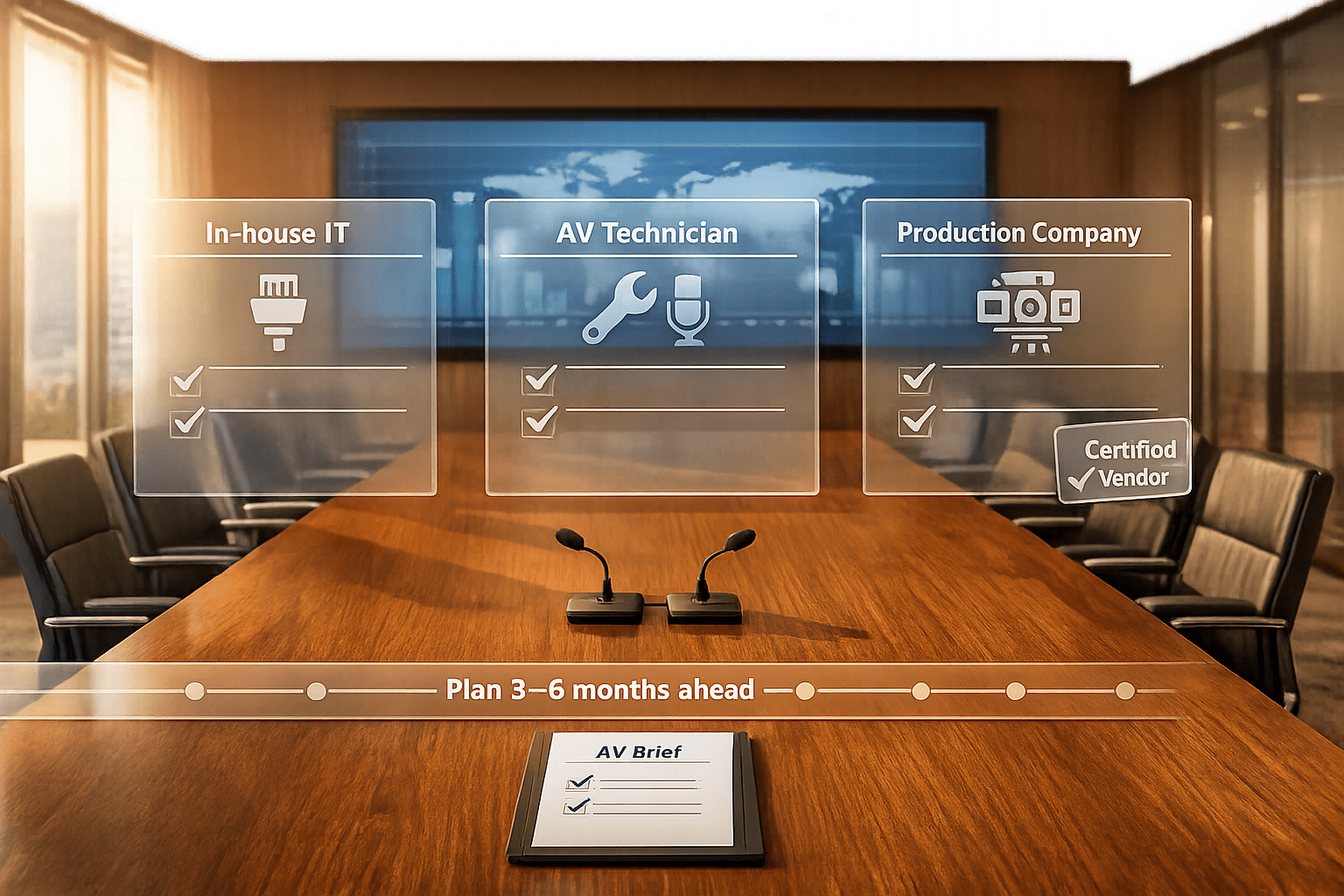
When organizing sales meetings, ensuring smooth audiovisual (AV) execution is critical. Technical issues can derail even the best pitches, so choosing the right AV support is essential. Here's a quick breakdown:
- In-House IT Teams: Ideal for basic setups like microphones and projectors. Suitable for small meetings but not for complex events.
- AV Technicians: Manage on-site equipment, from sound systems to video transitions. Look for certifications like AVIXA CTS for expertise.
- Production Companies: Handle large-scale events with staging, lighting, and show coordination. Costs range from $25,000 to $350,000+ depending on complexity.
Key tips:
- Start planning 3–6 months in advance for major events.
- Choose providers with certifications and their own equipment to ensure reliability.
- Create detailed AV briefs outlining needs, timelines, and budgets.
Proper AV support ensures your message resonates without distractions, leaving a positive impression on prospects.
How to Source an A/V Vendor for Your Next Event - Part #2: My Evaluation Process - Logan Clements
sbb-itb-ae35a94
Types of AV Support Professionals for Sales Meetings
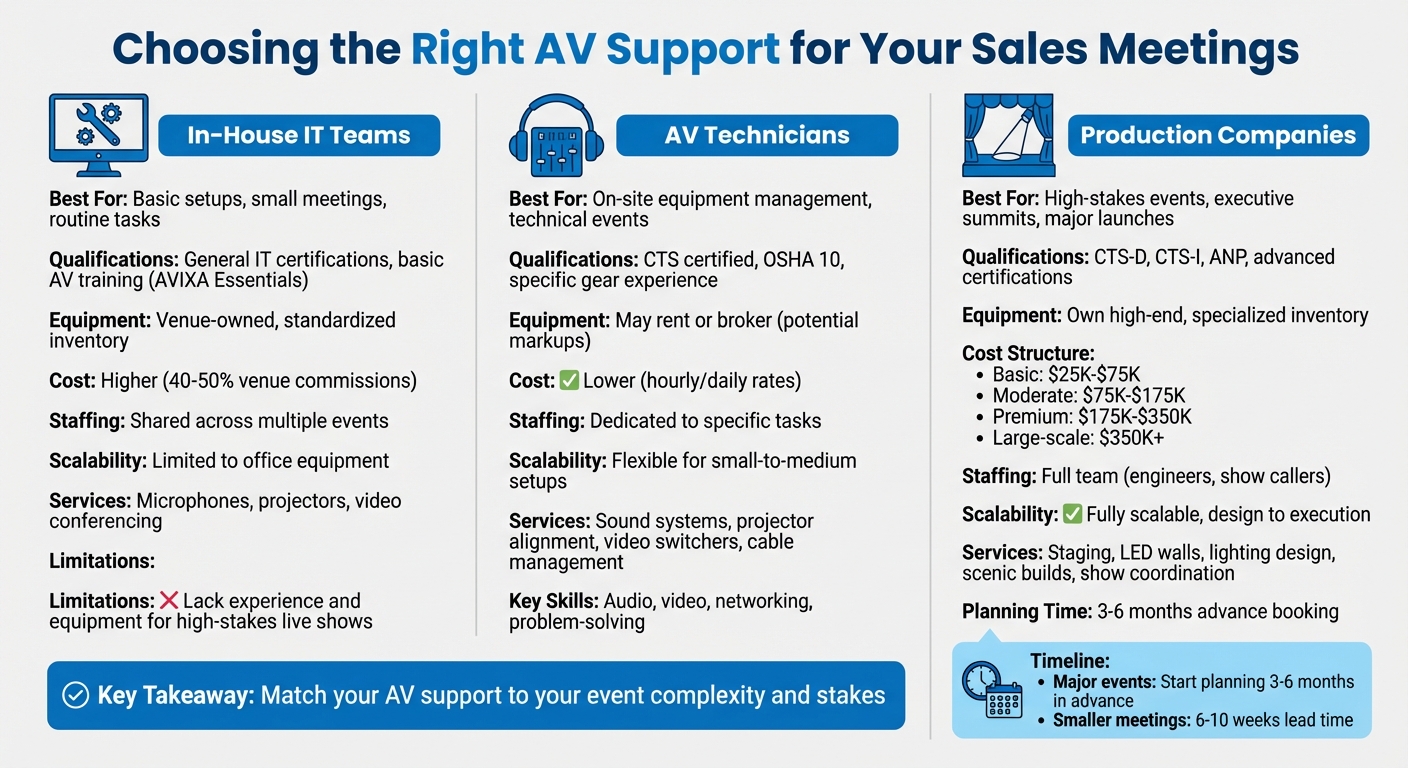
AV Support Provider Comparison: In-House IT vs Technicians vs Production Companies
When planning sales meetings, the level of AV support you need depends on factors like the meeting's complexity, the size of the audience, and the stakes involved. Let’s break down three types of AV professionals who can help ensure your event runs smoothly.
In-House IT Teams for Basic AV Needs
For routine AV tasks, your internal IT team or AVSS (Audio Visual Support Staff) often gets the job done. They handle everyday conference room technology, such as making sure microphones work, video conferencing platforms connect, and projectors display content properly. For straightforward sales meetings, internal training sessions, or board presentations using existing office equipment, your IT team is usually enough to keep things running smoothly.
However, there’s a clear limitation to relying solely on in-house teams. As HB Live explains:
"The in-house specialist may excel at servicing 'everyday' presentations and events, but they lack the experience, equipment, and production mindset required for a high-stakes live show."
In short, while your IT team is great for routine tasks and minor troubleshooting, they’re not equipped to handle the demands of complex, multi-speaker hybrid conferences. For these high-stakes scenarios, looking beyond your internal team is critical to maintaining your credibility during key presentations.
AV Technicians for On-Site Equipment Management
When your event requires a more technical touch, AV technicians step in to handle the details that can make or break the experience. These professionals specialize in tasks like aligning projectors for sharp visuals, positioning speakers for balanced sound, and managing video switchers for seamless transitions between slides and live demos.
To ensure top-notch support, look for technicians with AVIXA CTS (Certified Technology Specialist) credentials. These certifications verify their expertise in AV technology. Before your meeting begins, a qualified technician will typically conduct a site survey to evaluate power supply, acoustics, and other potential challenges. They’ll also perform sound checks to balance audio levels across microphones and playback devices, all while ensuring cables are safely managed and meet OSHA standards.
Here’s a quick breakdown of the expertise to look for in an AV technician:
| Expertise Category | What to Look For |
|---|---|
| Audio Expertise | Knowledge of microphones, mixers, amplifiers, and DSP (digital signal processing) configuration |
| Video Expertise | Experience with cameras, projectors, video switchers, and video editing tools |
| Networking/IT | Skills in IP address setup, network troubleshooting, and IoT integration |
| Technical Literacy | Ability to read and interpret functional design drawings, cable diagrams, and architectural plans |
| Soft Skills | Problem-solving under pressure, clear communication, and physical stamina |
Having a skilled AV technician on-site means your sales team can focus on delivering their pitch, not worrying about technical hiccups.
Production Companies for Full-Service AV Solutions
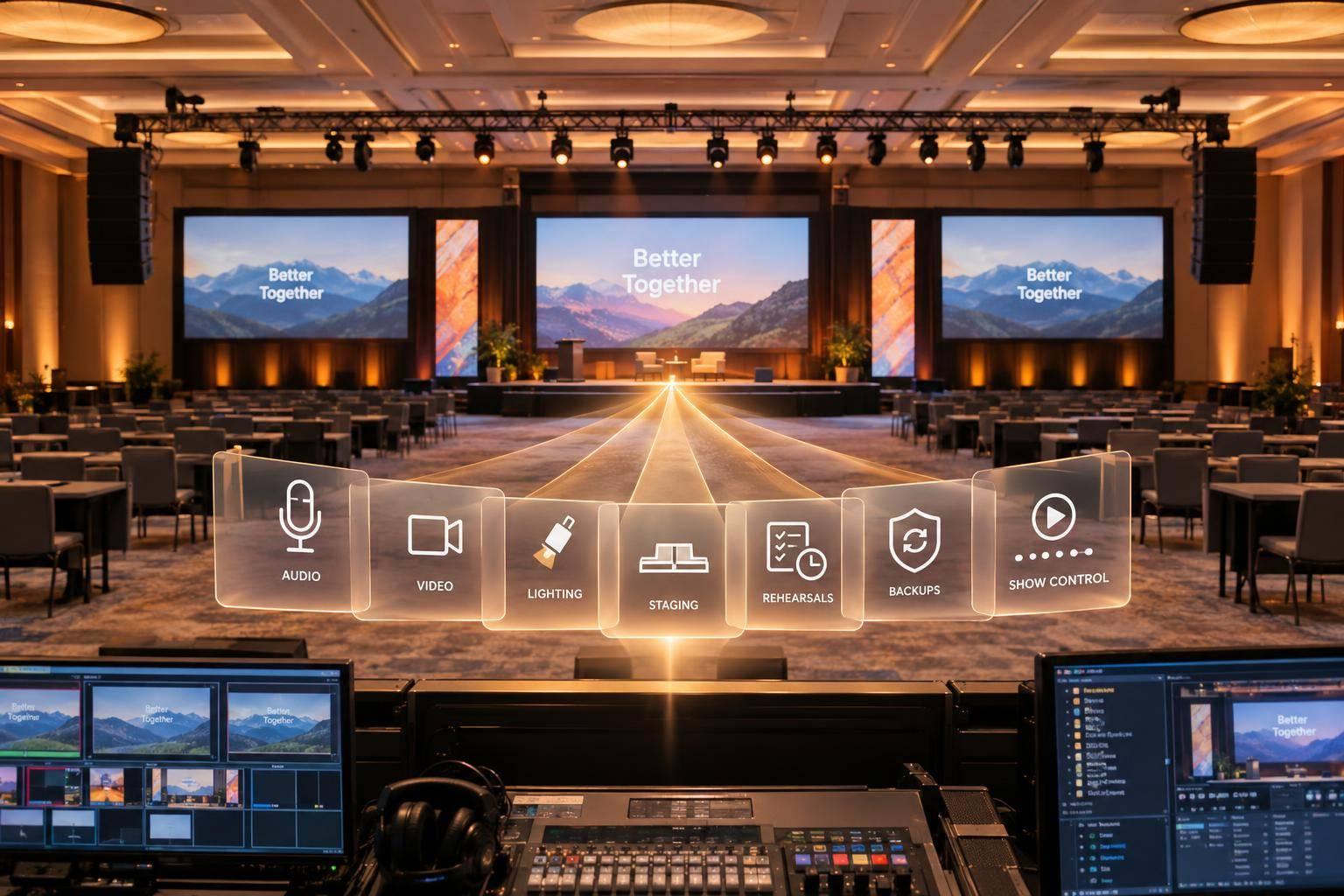
For high-stakes events - think executive summits, investor meetings, or major brand launches - production companies offer a comprehensive approach. These companies go beyond basic AV setups, blending design, engineering, and execution to create a polished experience. They handle everything from staging and lighting design to LED video walls, scenic builds, and intricate show control, which includes rehearsals and cue-to-cue coordination.
This level of service comes with a higher price tag. Basic setups can range from $25,000 to $75,000, while more elaborate packages cost $75,000 to $175,000. Premium, multi-day events can exceed $175,000. It’s crucial to ask about redundancy plans for critical systems and whether the team owns their equipment or rents it, as this affects both reliability and cost. When planning a high-impact corporate sales conference, aim to book your production company 3 to 6 months in advance, while smaller meetings may require at least 6 to 10 weeks of lead time.
Here’s a comparison between AV vendors and production companies:
| Feature | AV Vendors | Production Companies |
|---|---|---|
| Primary Focus | Equipment-focused (rentals) | Execution-focused (design and engineering) |
| Typical Services | Sound, projectors, and microphones | Staging, LED walls, scenic builds, and show coordination |
| Best For | Small internal meetings and basic setups | Executive summits, investor events, and major launches |
| Key Deliverable | Functioning gear and technicians | A seamless, elevated brand experience |
Choosing the right production company ensures your sales event leaves a lasting impression on high-value prospects, delivering the professionalism and polish they expect.
How to Evaluate AV Providers
Once you've identified your AV support needs, the next step is to assess potential providers to ensure they align with your goals. A dependable AV provider not only delivers equipment but also helps reinforce your sales messaging and protect your brand's reputation during critical meetings.
Criteria for Assessing AV Vendors
Start by looking at industry certifications. One to note is AVIXA's Certified Technology Specialist (CTS), which shows a provider's capability to design, implement, and service AV solutions. With over 14,000 CTS holders globally, it's a credential many AV firms prioritize for advanced engineering and technician roles. For more specialized needs, like building a permanent executive briefing center, seek providers with CTS-D (Design) certification. For live events, CTS-I (Installation) certification ensures expertise in managing equipment during high-pressure scenarios.
As AV and IT systems increasingly overlap, networking skills are essential. The Audiovisual Network Professional (ANP) certification indicates a provider can integrate AV systems into corporate networks without causing bandwidth or security issues.
Another factor to consider is equipment ownership. Providers who own and maintain their inventory often offer better reliability and cost savings compared to those who rent or broker equipment, as they avoid passing on rental fees and markups. Confirming that a provider owns their equipment can lead to smoother operations and fewer unexpected costs.
Scalability is crucial if your events vary in size and complexity. Check if the provider has redundancy plans for critical systems and whether they can handle both small meetings and large conferences. For significant events, follow a pre-production planning timeline starting 3 to 6 months ahead, while smaller meetings typically need 6 to 10 weeks of preparation. If your events span multiple cities, ensure the provider offers nationwide service instead of being limited to local coordination.
Lastly, look for pricing transparency. Request itemized quotes that clearly separate costs for equipment, labor, and pre-event services. Avoid bundled packages that obscure individual costs. Also, determine if post-event services, such as recording, editing, and analytics, are included or charged separately.
AV Provider Comparison Table
Here’s a breakdown of how different types of AV providers stack up against key criteria:
| Criteria | In-House IT Teams | Freelance AV Technicians | Production Companies |
|---|---|---|---|
| Typical Qualifications | General IT certifications, basic AV training (AVIXA Essentials) | CTS, OSHA 10, specific gear experience (e.g., TriCaster) | CTS-D, CTS-I, ANP, advanced certifications (e.g., Crestron, Dante) |
| Equipment Ownership | Venue-owned, standardized inventory | May rent or broker equipment, leading to markups | Own high-end, specialized inventory |
| Cost Structure | Higher due to 40–50% venue commissions | Lower, based on hourly or daily rates | Higher upfront, but offers integrated value |
| Staffing Model | Shared across multiple events | Dedicated to specific tasks and equipment | Full team, including show callers and engineers |
| Scalability | Limited to office equipment | Flexible for small-to-medium setups | Scales fully, from design to execution |
| Best For | Basic troubleshooting, internal huddle rooms | On-site support for equipment operation | High-stakes meetings, brand launches |
When considering production companies, ask for examples of their work on corporate events like executive summits or investor meetings. These differ significantly from concerts or festivals, which have different standards. For instance, Corporate Optics specializes in corporate event production, offering services like AV design, scenic builds, speaker support, and post-event analytics tailored to enterprise sales teams.
Costs for corporate event production in 2026 vary widely based on complexity. A basic hotel session with podiums, screens, and clean audio typically costs between $25,000 and $75,000. Adding branded staging and moderate LED wall integration raises the price to $75,000–$175,000. For more elaborate setups, like scenic environments with show automation and multi-day conference support, expect to pay $175,000–$350,000. Large-scale builds, such as arena-level events with advanced rigging and broadcast capabilities, can exceed $350,000.
How to Contact and Work with AV Professionals
Once you've pinpointed the right AV provider, here’s how to ensure a smooth working relationship.
Creating a Detailed AV Requirements Brief
Start by documenting your specific AV needs. Clearly outline the type of event you’re hosting - whether it’s a corporate sales meeting, product launch, or executive summit. Include details about the venue, such as its dimensions, layout, and any potential challenges.
Make a list of the equipment you’ll need for audio (like lavalier microphones for speeches or wireless handhelds for panels), video (such as LED walls, projectors, or confidence monitors), and lighting (like stage washes or lighting with your branding).
"An effective RFP does more than just focus on the specs for a production estimate – it defines the production values and audience experience that you want your event to deliver." – Audio Visual Dynamics
Don’t forget logistical details. Highlight setup and teardown times, power needs, presentation sources (like laptops or media players), necessary adapters (HDMI, USB-C), and streaming platforms if it’s a hybrid event.
Also, provide a budget range and a timeline for vendor selection with clear deadlines. As Wallace Johnson, CTS and Chair of AVIXA's Live Events Council, explains: "Generally speaking, the collaboration should start early. If you're a meeting planner... you should be involved in the process even before the venue is chosen."
Once your requirements are set, ensure you establish clear communication channels to keep things running smoothly.
Setting Communication Channels and Timelines
Determine who has the authority to approve any technical changes or extra charges. Set up a clear process and deadlines for vendors to ask questions and for presenters to submit content. Be specific about technical standards, like aspect ratios, video file formats, and native resolutions.
Plan technical rehearsals, starting with equipment testing and followed by a full run-through with speakers. Allow at least 2–4 hours for basic setup, but larger events will need more time. Conduct a walkthrough of the venue, from the loading dock to the event space, to spot any potential issues.
Collaborate with your AV provider to create backup plans for common problems, like microphone malfunctions, internet outages, or screen glitches. For critical events, such as high-stakes sales meetings involving remote participants, ensure a hardline internet connection with a backup failover system in place.
After the event, take time to review everything through structured feedback.
Collecting Post-Event Feedback
Right after the event, hold a recap meeting to evaluate how the equipment performed and gather attendee feedback. For virtual or hybrid events, make use of viewer analytics and engagement statistics.
Focus on measurable data rather than just subjective opinions to assess whether certain technologies or strategies were effective. Use this information to update your internal AV requirements and checklists, helping to avoid repeat issues. Before closing the project, confirm that all post-event assets, such as video recordings and file transfers, meet quality standards.
This feedback process will help fine-tune your AV strategies for future events.
Wrapping It Up
Choosing the right AV partner for your enterprise sales meetings goes beyond just handling technology - it's about ensuring your brand shines and your message resonates effectively.
Whether it's collaborating with your in-house IT team for simpler setups, hiring AV technicians for hands-on equipment management, or bringing in a full-service production company for high-stakes executive events, the secret lies in early planning and clear communication.
Great AV partners bring more than just technical expertise - they come prepared with backup systems and the flexibility to handle last-minute challenges. By using well-thought-out AV briefs, maintaining open communication, and conducting thorough post-event reviews, you can turn your AV strategy into a key competitive edge. This doesn’t just boost speaker confidence - it can also deliver measurable returns on your investment.
Start planning your AV needs 3–6 months ahead, opt for partners with their own equipment and strong contingency plans, and set the stage for sales success.
FAQs
How do I decide between IT, an AV tech, or a production company?
When it comes to event support, the choice of professionals depends on the scale and technical demands of your event:
- IT teams are ideal for tasks like secure data management, setting up networks, or providing ongoing technical support.
- AV technicians work best for smaller to medium-sized meetings, handling on-site setup and troubleshooting of audiovisual equipment.
- Production companies are the go-to for large-scale or high-stakes events. They handle everything from comprehensive AV solutions and live streaming to creative production.
Align your choice with the event's size and technical requirements to ensure everything runs smoothly.
What should I include in an AV brief or RFP?
When crafting an AV brief or Request for Proposal (RFP), make sure to include these key elements to ensure vendors can deliver proposals that meet your needs:
- Event Details: Outline the purpose of the event, along with the date, location, venue layout, and expected audience size. These basics set the stage for what’s required.
- AV Requirements: Specify the equipment and services you’ll need - whether it’s screens, lighting, live streaming, or other tools. If you have preferences or specific brands in mind, mention those too.
- Production Goals: Share the level of quality you’re aiming for and the type of experience you want to create for your audience.
- Context: Provide a brief overview of your company and the event’s background to help vendors understand the bigger picture.
Including these details ensures vendors can craft proposals that align with your vision and technical needs.
How can I prevent AV failures during a high-stakes pitch?
Planning ahead and collaborating with experienced AV professionals is crucial to sidestepping AV mishaps. Start by clearly defining your AV requirements early on - this helps avoid last-minute surprises. Next, work with skilled AV providers who understand your needs and can offer the right solutions. Finally, conduct a full rehearsal to test all equipment and iron out any potential issues.
Don’t forget to have backup gear on hand and ensure technical support is available onsite. These steps go a long way in delivering a seamless and memorable presentation.
Related Blog Posts


Streamline your workflow, achieve more

Lorem ipsum dolor sit amet, consectetur adipiscing elit. Maecenas ac velit pellentesque, feugiat justo sed, aliquet felis.



Lorem ipsum dolor sit amet, consectetur adipiscing elit. Maecenas ac velit pellentesque, feugiat justo sed, aliquet felis.