How To Choose A Production Partner For Your Next Conference

Chief Executive Officer
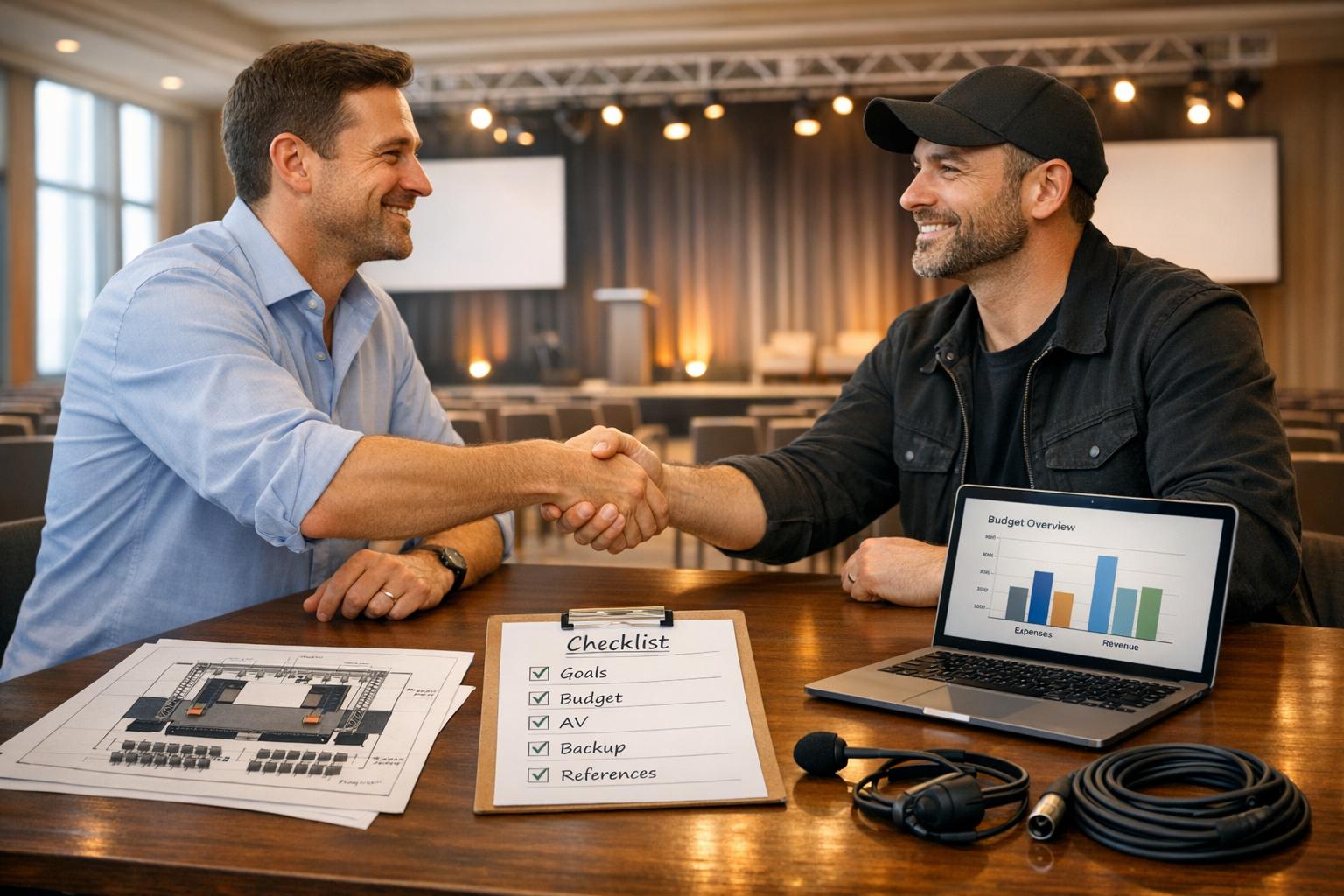
Your production partner can make or break your conference. A smooth, professional execution ensures a great attendee experience and protects your brand’s reputation. Technical glitches and poor coordination, however, can derail even the most carefully planned event. Here’s how to choose the right partner:
- Start with clear goals: Define your event’s purpose, objectives, and scale. A 200-person product launch requires a different setup than a 10,000-attendee conference.
- Identify technical and logistical needs: Think through every detail - AV systems, lighting, staging, livestreaming, and even traffic flow management.
- Set your budget and timeline: Costs range from $25,000 for basic setups to $350,000+ for arena-level productions. Book services 3–6 months in advance for large events.
- Evaluate expertise: Look for a partner with experience in events of your size and scope. Check their technical skills, safety standards, and ability to manage complex logistics.
- Ask the right questions: How do they handle challenges? Do they have backup plans? Are their pricing and communication transparent?
- Watch for red flags: Slow responses, vague proposals, or lack of detailed plans signal potential issues.
- Verify credibility: Review case studies, client feedback, and their ability to manage past events successfully.
Key takeaway: Choose a partner who aligns with your vision, delivers reliable service, and ensures a flawless execution. Don’t settle for the lowest bid - invest in expertise to avoid costly mistakes.
How to Source an A/V Vendor for Your Next Event - Part #2: My Evaluation Process - Logan Clements
Define Your Conference Requirements
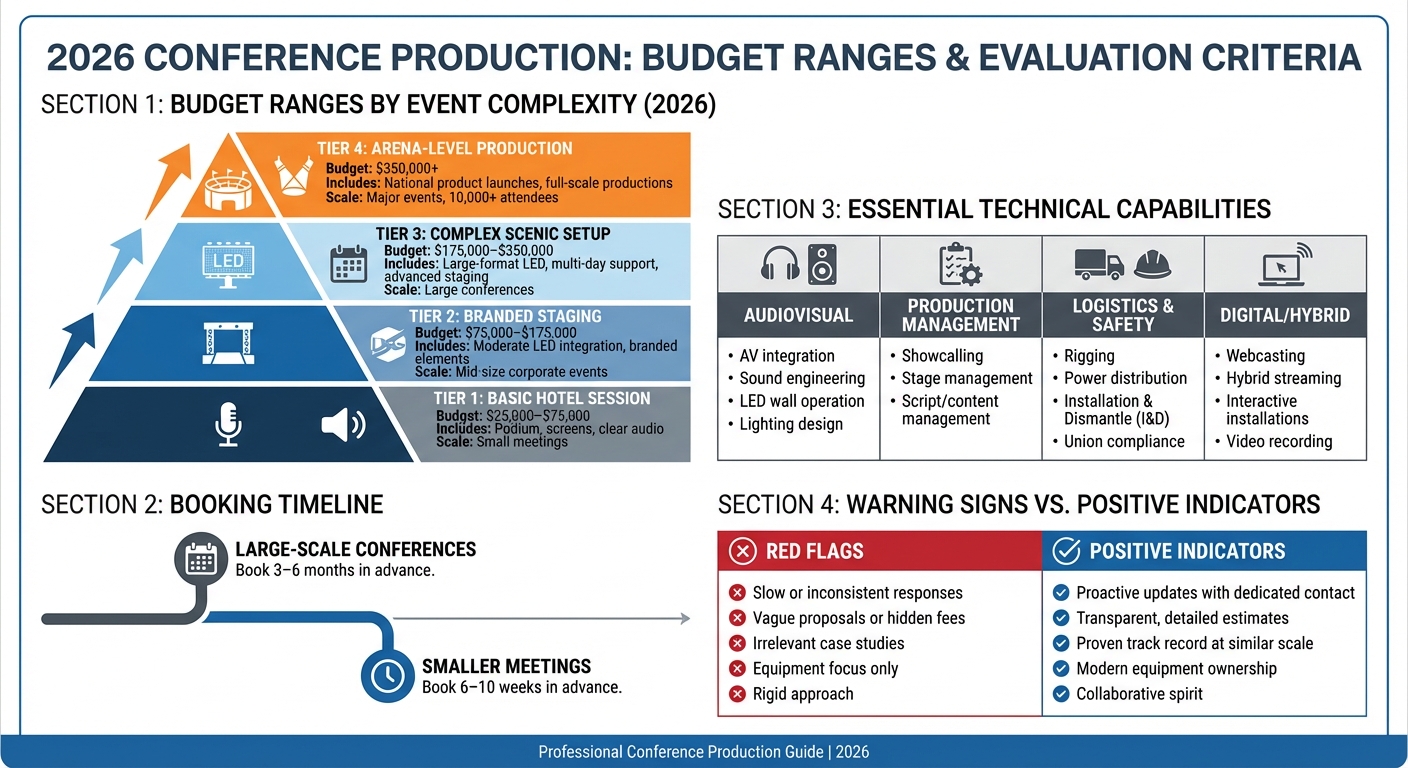
Conference Production Budget Guide: Cost Breakdown by Event Complexity
Start by outlining your event's purpose to shape every production decision. Your objectives set the tone for everything. A 200-person product launch will require a completely different setup than a multi-day conference for 10,000 attendees. Each goal calls for tailored technical expertise.
Identify Event Objectives and Scale
Clarify what success means for your event. Are you aiming to launch a new product, boost brand awareness, or educate your audience? The format matters too - whether it’s in-person, hybrid, or virtual. Each type comes with its own set of technical demands. For example, hybrid events require a partner skilled in livestreaming and content capture, not just someone who can handle basic AV setups.
"If you fail to plan, you plan to fail. The ideal partner will want to be involved from the beginning to understand your team's vision fully." - Vibe Agency
Once you've nailed down your objectives, move on to identifying the technical and operational elements needed to bring your vision to life.
List Technical and Operational Needs
Think through the entire attendee experience, from check-in to departure. This process will help you pinpoint the essentials: audiovisual systems (like sound, lighting, and video), staging and scenic design, LED walls or projection screens, livestreaming setups, booth configurations, signage installation, registration assistance, and even traffic flow management. A thorough plan like this ensures you can find a partner who meets your specific operational needs.
Set Your Budget and Timeline
When it comes to professionally produced corporate events in 2026, budgets vary widely depending on complexity:
- A basic hotel session with podium, screens, and clear audio: $25,000–$75,000
- Branded staging with moderate LED integration: $75,000–$175,000
- Complex scenic setups with large-format LED and multi-day support: $175,000–$350,000
- Arena-level productions or national product launches: $350,000+
Don’t forget to account for venue-specific costs such as union rules, power fees, rigging expenses, and internet charges. For large-scale conferences, aim to book production services 3–6 months in advance. Smaller meetings still require at least 6–10 weeks of lead time. Be cautious with low-ball bids - technical mishaps can end up costing far more than you save.
Set Your Evaluation Criteria
Once you’ve outlined your requirements, it’s time to establish clear evaluation criteria for selecting a production partner who not only fulfills technical needs but also aligns with your event’s vision. The right partner should demonstrate the ability to meet your specific conference demands while managing complex logistics effectively.
Here’s how to assess whether a partner can deliver the results your event requires.
Check Technical Skills and Corporate Event Background
Focus on partners with a strong background in corporate conferences. The scope of their previous work is a better indicator than the number of years they’ve been in business. For instance, handling a 200-person event is vastly different from managing a 10,000-attendee conference with multiple breakout sessions.
Evaluate their technical expertise in areas like audiovisual (AV) integration, lighting, staging, and scenic production. For modern events, check their capabilities in webcasting, hybrid streaming, and interactive installations. Additionally, inquire about their show management team - having experienced show callers, stage managers, and producers is critical for running a smooth live event.
"The best AV providers will have extensive experience along with a professional AV and creative production knowledge base to look at your event holistically while elevating it within budget and time constraints." - Freeman
Ensure they meet safety and compliance standards. Ask about their knowledge of rigging, power distribution, crowd management, and venue-specific union rules. Verify their insurance coverage and request certificates of insurance (COI) and necessary permits. Also, determine whether they use in-house labor or outsourced crews - partners with in-house teams often provide better quality control and more consistent timelines.
Find Partners Who Offer Complete Services
Technical expertise is just one piece of the puzzle. A partner who offers end-to-end services can simplify coordination and reduce stress. Having a single point of contact who oversees everything - from initial planning to on-site execution - ensures smoother communication and greater accountability. This is particularly helpful when you’re managing other vendors for catering, registration, or logistics.
Look for partners who can also manage content creation and digital assets. Their ability to produce high-quality recordings, testimonial videos, and other media extends the impact of your event long after it ends. Full-service partners often handle tasks like installation and dismantling (I&D), labor coordination, and attendee flow efficiently.
Review Backup Plans and Technology Use
Even the best plans can hit a snag. A dependable partner should have backup equipment on-site - spare microphones, extra projectors, and redundant signal paths for critical presentations. Ask for examples of past technical challenges they’ve faced, how they resolved them, and the steps they’ve taken to prevent similar issues in the future.
"Experienced event production companies build redundancy into systems and empower on-site leadership to make fast, informed decisions when conditions shift." - The Panacea Collective
Assess their investment in modern technology. For example, partners using LED video walls instead of outdated projectors can deliver a sharper, more engaging visual experience. Ask about their equipment maintenance schedules and recent upgrades - working with outdated or poorly maintained gear can lead to unnecessary risks. Additionally, explore whether they use advanced tools like AI for audience engagement or spatial audio for immersive experiences. These technologies can elevate the overall production quality and attendee experience.
| Technical Skills | Essential Capabilities |
|---|---|
| Audiovisual | AV integration, sound engineering, LED wall operation, lighting design |
| Production Management | Showcalling, stage management, script/content management |
| Logistics & Safety | Rigging, power distribution, I&D (Installation & Dismantle), union compliance |
| Digital/Hybrid | Webcasting, hybrid streaming, interactive installations, video recording |
Research and Shortlist Candidates
Once you've established clear criteria, the next step is identifying partners with a proven track record in handling high-stakes events. Using your evaluation framework, focus your research on finding candidates capable of meeting your conference needs. This targeted approach ensures you invest time in realistic contenders.
Use Professional Networks and Industry Directories
Tap into your professional network and industry-specific resources to find potential partners. Ask colleagues who’ve organized similar events for referrals - personal recommendations often lead to dependable options. Additionally, consult industry directories like "Top Event Agencies: The Ultimate Directory" or "The Event Marketer It List" to discover pre-vetted agencies.
Take a close look at each candidate's online presence. Their website should clearly outline key services, such as AV integration, staging, and labor management. Social media channels offer a glimpse into recent projects and audience engagement. Be cautious of slow or vague responses during initial communications - this could indicate future coordination challenges.
"If they're slow now, imagine how slow they'll be when the pressure's on." - Stephanie Goone, Utopia Experience
Once you’ve compiled a list, dig deeper by examining their documented track records through case studies.
Check Credentials and Client Reviews
To ensure credibility, request detailed case studies that showcase how each candidate managed events similar in complexity to yours. Look for examples that highlight results achieved and challenges overcome.
Client reviews are another valuable resource. Platforms like Google Business, Facebook, and LinkedIn often reveal patterns in feedback. Pay attention to comments about meeting deadlines, sticking to budgets, and maintaining quality under pressure. If you notice repeated complaints about missed deadlines, surprise costs, or poor communication, consider it a red flag. Lastly, confirm that candidates carry the necessary insurance and can provide permits and certifications.
With this information, you can organize your findings and prepare for a side-by-side comparison.
Compare Candidates Using a Comparison Table
A comparison table is an effective way to evaluate your shortlisted candidates. It allows you to go beyond surface-level costs and assess critical factors like technical capabilities, budget flexibility, and operational reliability.
| Comparison Criteria | What to Look For | Red Flags |
|---|---|---|
| Experience | Case studies of similar scale and type; established expertise | Only small-scale or irrelevant event examples |
| Technical Depth | In-house inventory; modern AV/LED technology; skilled supervisors | Equipment-only focus without operational planning |
| Financials | Detailed line items; transparent change order process | Vague proposals or reluctance to explain costs |
| Project Management | Single point of contact; clear timeline milestones | Inconsistent communication; delayed response times |
| Safety & Compliance | Adherence to rigging standards; proper insurance and permits | Lack of documented safety protocols |
When comparing, pay attention to specifics like labor roles, equipment quality, and system redundancies. This approach ensures you’re evaluating the overall value each partner can bring to your event, not just the price tag.
sbb-itb-ae35a94
Interview Candidates and Ask Key Questions
Once you've narrowed down your list of candidates, it's time to dig deeper into their methods and expertise. Interviews are your chance to go beyond surface-level information and assess how well a candidate aligns with your conference needs. This step helps you separate full-service partners - those who manage strategy, execution, and on-site coordination - from companies that simply rent out equipment. That distinction is critical, as full-service partners bring much more to the table than just gear setup.
Ask About Experience and Technical Capabilities
Start with this question: "What specific experience do you have with producing corporate conferences of this size and scope?" It's not just about how long they've been in business; it's about whether their experience is relevant to your event. A company accustomed to managing 500-person conferences will likely understand your needs better than one focused on small-scale events.
Request a detailed run-of-show to evaluate their attention to detail and ability to manage event pacing. Ask about the balance between in-house staff and outsourced labor - this can give you insight into their quality control processes. Finally, ask for examples of past technical failures and how they resolved them. Their answers will reveal how they perform under pressure and handle unexpected issues.
Discuss Collaboration and Technology Approach
Smooth communication is just as important as technical expertise. Miscommunication can derail an event faster than a technical hiccup. Ask how they ensure seamless collaboration throughout the planning and execution phases. A strong partner will assign a dedicated Project Manager to oversee your event from start to finish, ensuring nothing gets lost in translation between departments. Confirm that this project lead will be on-site during the event.
Request to review sample documentation like communication plans or escalation protocols. These tools show how they manage team coordination and handle potential issues. Also, ask whether they schedule regular cross-vendor check-ins to keep all teams - audio, video, lighting - on the same page.
"If a production company stresses how you book your space, that's a company that's trying to protect you." - Camille Hill, President of Merestone
Verify Pricing Clarity and Risk Management
Transparency is key when it comes to pricing. Ask for a detailed cost breakdown with clear line items so you understand exactly what you're paying for. Also, inquire about their process for handling last-minute changes - how they manage change orders can say a lot about their flexibility and reliability.
When it comes to risk management, ask: "How do you handle unexpected technical or logistical challenges during an event?" Look for detailed answers that include redundancy measures, like dual signal paths, backup equipment, and secondary power sources. Confirm that they have a designated "incident commander", such as a Producer or Project Manager, who will take charge during any on-site emergencies. Be wary of vague responses like "we'll figure it out" - that’s a red flag for poor preparation.
With this information, you'll be better equipped to spot potential warning signs before making your final decision.
Identify Warning Signs and Make Your Decision
Once you've established your criteria and conducted interviews, it’s time to focus on potential warning signs that could indicate deeper issues. Narrow down your list of candidates and carefully evaluate these red flags before making a final decision.
Watch for Warning Signs
How a candidate communicates during the sales process can reveal a lot. For example, slow responses or vague answers may hint at problems with on-site coordination. Similarly, if their execution plans lack details - such as crew sizes, deliverables, or technical outlines - it could point to organizational weaknesses.
Be wary of partners who avoid breaking down their cost structures or shy away from discussing hidden fees, like those for power distribution, rigging hardware, or overtime. The cheapest bid isn’t always the smartest choice; it might signal poor contingency planning or limited vendor leverage. If a partner prioritizes equipment over labor expertise or operational strategy, it could mean their services are narrowly focused and less comprehensive.
"If they cannot explain how they run the event, they probably cannot run it well." - Willwork
After identifying potential concerns, take the next step: verify their past performance by gathering direct feedback from previous clients.
Contact References and Visit Facilities
Instead of relying on written testimonials, talk directly with past clients who’ve worked with the partner on events of a similar size and complexity. Ask specific questions about how challenges were handled, whether budgets were adhered to, and how they performed on-site.
Visiting the partner’s facility is another valuable step. A clean, organized workspace often reflects operational efficiency. Take note of how much of their inventory and labor is managed in-house versus outsourced - it can provide insight into their quality control and ability to handle issues quickly. Observing their team dynamic is equally important; seeing how they collaborate and manage stress can tell you a lot about how they’ll handle your event.
"Choose a partner whose people work well and happily with each other because how they function as a team affects the work they do for you." - Heroic Productions
These steps help you confirm whether the partner is equipped to deliver on your event’s demands.
Choose the Best Fit for Your Event
When it’s time to make your final decision, focus on balancing technical expertise, team chemistry, and overall value - don’t just default to the lowest price. The ideal partner should feel like an extension of your team, offering creative solutions and full-service management rather than simply providing equipment. Confirm who will actually be on-site during the event, as the person pitching the service might not be the one executing it.
Review the contract details carefully and assess how responsive they are during this stage - it’s a good indicator of their operational discipline. Look for a partner who demonstrates both technical precision and a collaborative attitude, ensuring they can translate your vision into an unforgettable live experience.
| Factor | Warning Sign (Red Flag) | Positive Indicator |
|---|---|---|
| Communication | Slow or inconsistent responses during bidding | Proactive updates and a dedicated point of contact |
| Pricing | Vague proposals or hidden fee structures | Transparent, detailed line-item estimates |
| Experience | Irrelevant case studies or overpromising without detail | Proven track record with similar scale and complexity |
| Technical | Equipment focus without operational planning | Ownership of high-quality, modern equipment inventory |
| Culture | Rigid approach or poor team chemistry | Collaborative spirit and a calm demeanor under pressure |
Conclusion
Picking the right production partner for your conference isn't just a task to cross off your list - it directly impacts your event's success and your brand's reputation. With 80.4% of event organizers identifying in-person events as their most effective marketing channel and nearly 48% of brands achieving a 300% to 500% ROI from live events, the stakes are far too high to risk working with a partner who can't meet expectations.
Start by defining your goals - clearly outline your objectives, technical needs, and budget. From there, assess potential partners on their technical know-how, operational reliability, and how well they align with your team's style and values. Don't be tempted by the lowest bid; those often lack the contingency plans and vendor relationships necessary to avoid costly mistakes during your event.
To truly vet a partner, ask them how they'd handle specific challenges. Use "what if" scenarios to gauge their problem-solving skills, and demand transparency in pricing and on-site management strategies. Considering that over 70% of event professionals identify logistics and production complexity as their top hurdle, it's crucial to select a partner who can adapt and resolve issues on the fly. This thorough process ensures you're teaming up with someone ready for anything.
"Choosing an event production partner isn't a box to check - it's a decision that shapes outcomes and impact." - Stratus Firm
FAQs
What should an event production contract include?
An event production contract needs to spell out critical details to safeguard everyone involved. Here are the key elements to include:
- Parties Involved: Clearly list the names of all individuals or organizations entering the agreement.
- Event Details: Specify the event's date, location, purpose, and scope to avoid misunderstandings.
- Services and Payment Terms: Outline the services being provided, along with payment amounts, schedules, and methods.
- Responsibilities, Cancellation, and Liability: Define roles for setup, support, and execution, include cancellation policies, and address insurance or liability coverage.
These components help set clear expectations while offering legal protection for both sides.
How can I verify a production company’s on-site team?
When evaluating a production company’s on-site team, it’s crucial to focus on key roles, particularly the Project Manager. This person plays a central role in ensuring smooth communication and flawless execution during your event. Be sure to ask about their experience managing similar events, how quickly they respond to issues, and their qualifications or certifications. Additionally, inquire about their safety protocols to ensure everything runs securely and efficiently.
To dig deeper into their reliability and professionalism, review references from past clients and take a close look at their event portfolios. These can give you a clearer picture of their capabilities and track record.
How do I prevent surprise conference production fees?
To steer clear of unexpected production fees, take the time to carefully evaluate your production partner and establish clear cost expectations from the beginning. Ask for a detailed breakdown of expenses, covering items like internet access, equipment rentals, power usage, and potential overtime charges. It's also wise to discuss how costs will be managed and controlled throughout the project. Transparency is key - set clear expectations and make sure all agreements are documented in writing. This way, you can avoid surprise charges either during or after your event.
Related Blog Posts


Streamline your workflow, achieve more

Lorem ipsum dolor sit amet, consectetur adipiscing elit. Maecenas ac velit pellentesque, feugiat justo sed, aliquet felis.



Lorem ipsum dolor sit amet, consectetur adipiscing elit. Maecenas ac velit pellentesque, feugiat justo sed, aliquet felis.