Private 5G Networks for AV Events

Chief Executive Officer
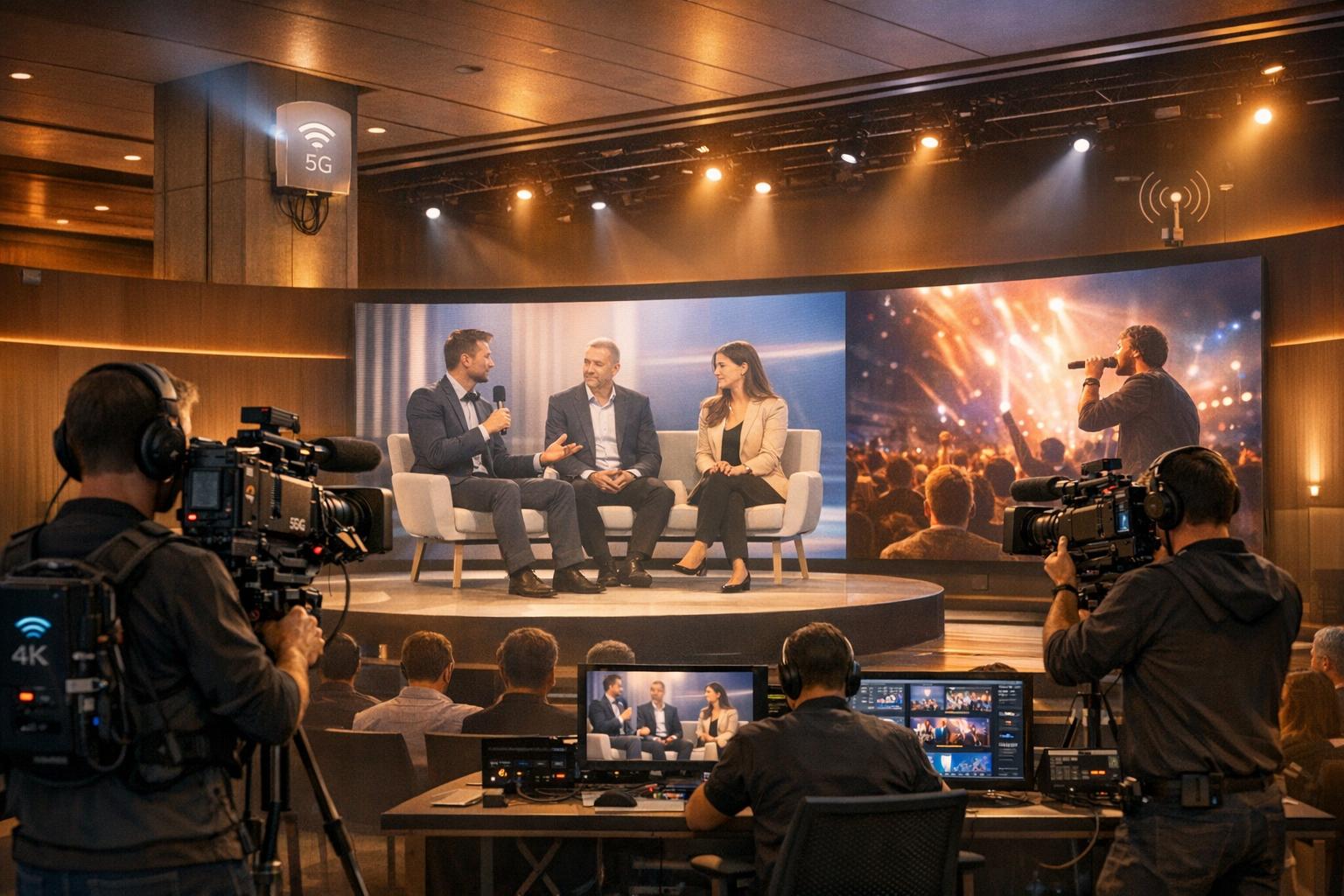
Private 5G networks are transforming AV event production by delivering dedicated, reliable, and high-speed connectivity. Unlike Wi-Fi or public cellular networks, private 5G ensures seamless performance for tasks like live 4K streaming, wireless camera operations, and real-time data transmission. Here's why this matters:
- Reliable Connectivity: Handles high-bandwidth demands, even in crowded venues.
- Low Latency: Achieves near-instantaneous data transfer (100ms glass-to-glass latency).
- Wireless Flexibility: Eliminates cables, enabling free movement for cameras and equipment.
- Enhanced Security: SIM-based authentication and on-site data control protect sensitive content.
- Scalable Coverage: Supports up to 1 million devices per square kilometer with broader range than Wi-Fi.
Private 5G solves common challenges in event production, such as network congestion, latency issues, and security risks. It’s particularly effective for corporate events, live concerts, sports, and high-security gatherings. While initial costs can be high, service models like "Private 5G as a Service" make it more accessible. Future advancements, like 5G Standalone architecture and edge computing, will further improve performance and efficiency.
For event organizers, private 5G offers a tailored solution to meet the growing demands of modern AV production.
ISE 2025: Riedel Communications Shows Easy5G, Simplified Private 5G Network Solution for Live Events
sbb-itb-ae35a94
Benefits of Private 5G Networks for Event Production
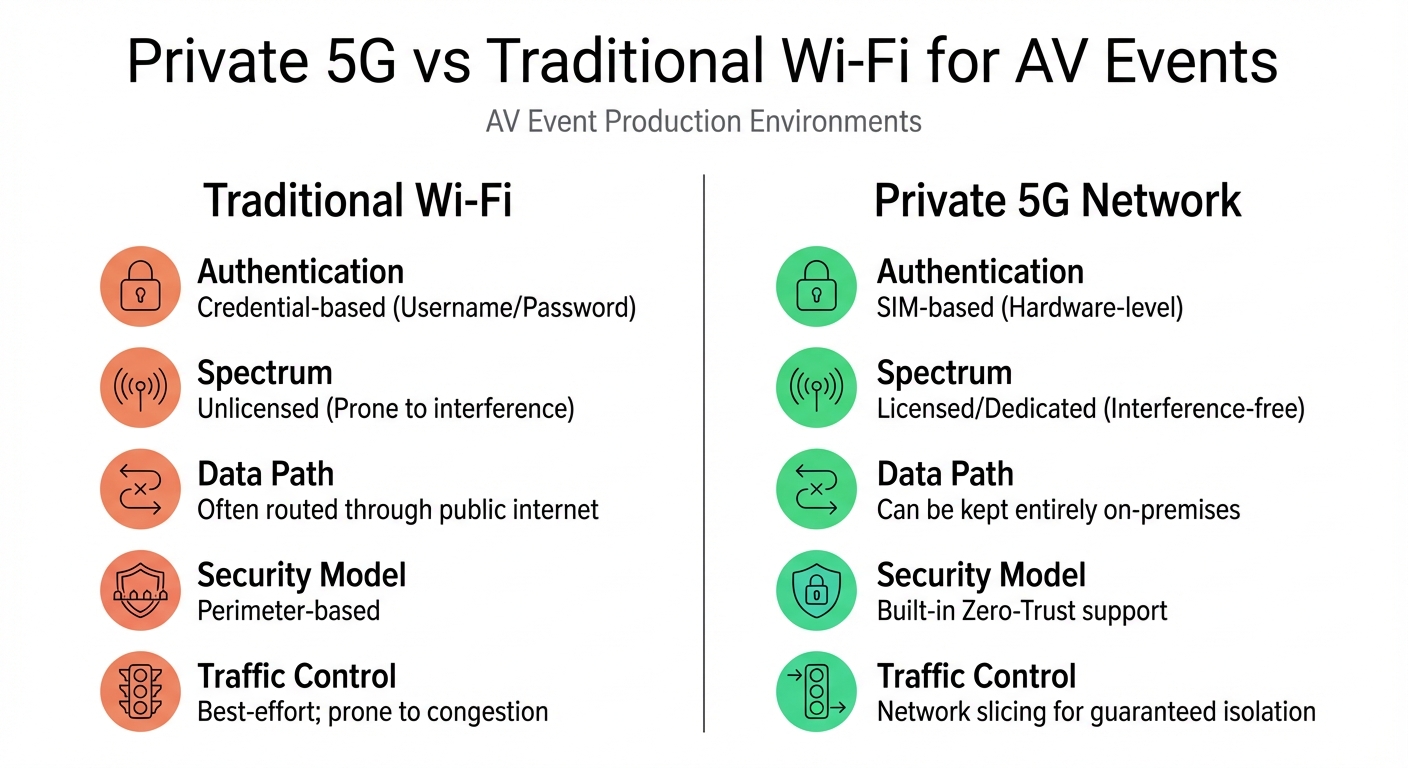
Private 5G vs Traditional Wi-Fi for AV Events Comparison
Private 5G networks address connectivity challenges while streamlining event production for AV-heavy events and safeguarding critical data. These advantages are reshaping how production teams operate, protect their content, and navigate the complexities of different venues.
Better Connectivity and Low Latency
Private 5G networks excel at prioritizing uploads, which is essential for streaming multiple HD video feeds. Through network slicing, production teams can allocate specific bandwidth for critical broadcast streams, ensuring low latency and isolating less important traffic. This ensures uninterrupted performance, even in demanding environments.
These networks can support up to 1 million devices per square kilometer, meeting the high bandwidth demands of large-scale events. With technologies like edge computing and network slicing, private 5G achieves near 100ms "glass-to-glass" latency, providing dedicated bandwidth for mission-critical streams. This level of reliability allows production crews to adapt quickly and set up events with greater ease.
Faster Setup and Greater Flexibility
Traditional cabling can be a logistical nightmare, especially in historic venues or sprawling outdoor festivals. This is a common challenge for large-scale conference production firms managing complex technical requirements. Private 5G eliminates this hassle by enabling temporary networks that can be deployed quickly and efficiently.
The wireless nature of private 5G also allows camera operators to move freely without worrying about signal dropouts or handoff delays, issues often experienced with Wi-Fi. This seamless mobility opens up creative opportunities, such as using roaming cameras to capture unique, dynamic angles. Additionally, private 5G networks can operate on licensed, unlicensed, or shared frequencies, like CBRS in the U.S., giving teams the flexibility to choose the best spectrum for their needs. Mid-band frequencies, around 3.5 GHz, strike the perfect balance between speed and coverage, making them ideal for event production.
Stronger Security and Data Privacy
Security is just as important as performance when it comes to private 5G networks, especially for handling sensitive content.
"Private 5G communications are encrypted, and an appropriate SIM card must be present in the endpoint device to enable access." – Cisco
By deploying the 5G core network on-site, private 5G ensures data sovereignty, keeping sensitive information within the venue instead of routing it through public clouds. This is particularly valuable for high-security events, such as corporate or government gatherings. Using dedicated or licensed spectrum further protects against interference and denial-of-service attacks, which are common in crowded Wi-Fi environments. Additionally, network segmentation isolates critical broadcast traffic from general staff or guest traffic, reducing the risk of unauthorized access.
| Feature | Traditional Wi-Fi | Private 5G Network |
|---|---|---|
| Authentication | Credential-based (Username/Password) | SIM-based (Hardware-level) |
| Spectrum | Unlicensed (Prone to interference) | Licensed/Dedicated (Interference-free) |
| Data Path | Often routed through public internet | Can be kept entirely on-premises |
| Security Model | Perimeter-based | Built-in Zero-Trust support |
| Traffic Control | Best-effort; prone to congestion | Network slicing for guaranteed isolation |
Private 5G’s zero-trust architecture further enhances security by continuously authenticating every device and user. Even if the venue's external internet connection is disrupted, local authentication ensures the network remains secure and operational.
How to Set Up Private 5G for AV Events
Required Infrastructure and Equipment
To set up a private 5G network for your AV event, start with the essentials: a Radio Access Network (RAN), an on-site 5G core network, edge computing devices for ultra-low latency, and SIM-based authentication to ensure secure connections. One major advantage of 5G is its reach - cellular access points can cover up to 10× more area than Wi-Fi, making it a great fit for large venues.
The 5G core can be hosted in various ways: on-site using servers or gateways, or through private or public cloud hosting. For tasks like live 4K streaming or augmented reality, on-site edge computing is critical to keep latency to a minimum. SIM cards, whether physical or eSIM, provide hardware-level security and encrypted communication for all connected devices.
Choosing the right spectrum is key. A licensed spectrum offers interference-free, reliable performance for critical applications, while unlicensed or shared spectrum - such as CBRS - gives you flexibility and cost savings. Mid-band frequencies (around 3.5 GHz) strike a good balance between speed and coverage, making them ideal for event production. A centralized management dashboard is also a must for monitoring network health, managing device authentication, and generating performance reports.
| 5G Band Type | Range | Typical Speeds | Best Use Case |
|---|---|---|---|
| Low-band | Hundreds of square miles | < 300 Mbps | Wide area coverage |
| Mid-band | Several-mile radius | Low Multigigabit | Balanced capacity/coverage |
| High-band (mmWave) | < 1-mile radius | High Multigigabit | High-density AV/4K Video |
Once you’ve got the equipment in place, follow a structured deployment process to ensure everything runs smoothly.
Deployment Timeline and Process
Before diving into deployment, define your use cases and set measurable KPIs. Conduct an RF site survey using radio frequency planning tools to determine the best placement for access points. This step accounts for obstacles like walls, stages, and windows that could affect signal strength. After the survey, you’ll receive a detailed bill of materials outlining costs for equipment like access points, cabling, and power.
Next, install the hardware, configure SIM cards, and integrate the system with your existing IT infrastructure. Once everything is set up, perform a thorough performance check to ensure your KPIs are met. CBRS technology can speed up deployment timelines, and subscription-based models allow you to spread costs with a pay-as-you-go approach.
For a smooth setup and ongoing support, it’s wise to work with experienced service providers.
Working with Service Providers
Partnering with managed service providers can simplify the entire process, from site surveys and network design to deployment and 24/7 management. This "Network as a Service" model reduces upfront costs and eliminates technical hurdles, letting your team focus on event production instead of network logistics.
"Cisco Private 5G is delivered as a service offering, eliminating nearly all financial risk to integrate the high speed, low latency, and device segmentation only 5G can provide." – Cisco
Companies like Corporate Optics, which specialize in technical event production, can collaborate with network providers to ensure your private 5G setup meets your AV needs. Providers such as Verizon, a recognized leader in the 2025 Gartner® Magic Quadrant™ for 4G and 5G Private Mobile Network Services, offer tools like unified management dashboards. These dashboards provide near real-time insights into network performance and device authentication.
Make sure your chosen provider conducts a comprehensive RF site survey and performs post-deployment verification testing. The partnership should also include implementing a zero-trust security framework with SIM-based authentication for all connected devices. With 99% of Fortune 500 companies relying on providers like Verizon for complex network solutions, you’ll be leveraging proven expertise to ensure flawless connectivity for your event.
Private 5G Use Cases for Different Event Types
Corporate Events and Conferences
Private 5G is reshaping corporate events by offering unmatched wireless mobility across venues. For instance, camera operators can move freely to capture multiple angles without the hassle of cumbersome wiring. The network's unique uplink-focused design ensures high-definition video feeds from multiple cameras are transmitted seamlessly to production suites - something public networks, optimized for downloads, simply can't match.
For hybrid conferences, private 5G offers interference-free connectivity through a dedicated, licensed spectrum. This ensures consistent broadcast quality, even when hundreds of attendees are using their devices simultaneously. Dedicated bandwidth keeps critical production traffic separate from general attendee usage. Companies like Corporate Optics integrate private 5G into their event production services, enabling multi-camera streaming for hybrid events with reliable quality. Additionally, the network supports dynamic live entertainment elements, enhancing the overall experience.
Sporting Events and Concerts
Private 5G is transforming how live entertainment productions are managed. Broadcasters are increasingly relying on 5G for its ability to deliver approximately 100ms "glass-to-glass" latency, ensuring real-time synchronization for broadcasts and interactive fan experiences.
"Immersive 5G broadcast content acquisition networks for sporting, entertainment, and other types of events are a game changer. They offer a completely new experience for participants and live and remote spectators." – ON-SIDE Partners
The technology also enables unique perspectives, such as athlete-view footage captured by small pen cameras or smartphones, which require only 6–8 Mbps per stream. Meanwhile, professional TV cameras can generate 40–60 Mbps per stream. With private 5G radios covering up to 0.75 miles, this setup is ideal for sprawling outdoor venues or multi-location events. Network segmentation further enhances functionality by creating dedicated lanes for photojournalists, TV crews, and security personnel. For example, photojournalists can upload thousands of high-resolution images in near real-time directly from the field. These capabilities make private 5G invaluable for events where secure, dedicated networks are essential, such as government gatherings.
Government and High-Security Events
Private 5G also sets a new benchmark for security at government and high-stakes events. These events often rely on Stand-alone Non-Public Networks (SNPN), which operate entirely separate from public mobile infrastructure. This isolation ensures that device subscription data, communications, and management information remain secure and inaccessible to public networks. Unlike Wi-Fi, which can be compromised via stolen credentials, private 5G employs physical SIM cards in endpoint devices to guarantee secure access.
"Private 5G communications are encrypted, and an appropriate SIM card must be present in the endpoint device to enable access." – Cisco
Private 5G also supports uplink-heavy configurations, ideal for tasks like real-time analytics or high-definition surveillance. This ensures maximum data throughput from cameras to control centers. By hosting the 5G core and authentication functions on-site, these networks stay operational even during external internet outages. Additional features like end-to-end traffic segmentation using VLANs and Data Network Names allow security teams to isolate sensitive surveillance data from general event communications. This combination of resilience and security makes private 5G a trusted choice for high-security environments.
Challenges and Future Developments
Cost and ROI Analysis
Private 5G networks come with a hefty upfront price tag. Fully owned systems require investment in equipment, private cloud infrastructure, and spectrum licenses, with costs varying depending on the type of spectrum chosen. Licensed spectrum, while more reliable for critical applications like high-quality AV feeds, often comes at a premium.
For organizations working with tighter budgets, the "Private 5G as a Service" model offers a more accessible solution. This approach reduces initial costs and shifts the burden of daily management to service providers. In large venues, private 5G can even outshine Wi-Fi in terms of cost-effectiveness. While Wi-Fi may seem cheaper at first glance, massive spaces like stadiums need hundreds of access points to ensure coverage, whereas private 5G radios can cover up to 0.75 miles each. This broader coverage can help offset the higher per-unit costs.
"A private 5G network as a service... can lower the barrier of entry for enterprises and industries by reducing initial costs and offloading construction and daily management." – Cisco
Return on investment (ROI) in private 5G often stems from operational improvements. Faster setup times, less network congestion, and better handling of high-density device environments all contribute. For event organizers, ROI can also include savings from reduced reliance on wired infrastructure and new revenue opportunities, such as offering immersive AR/VR experiences to fans. As costs continue to drive innovation, upcoming advancements are set to reshape how leading corporate event production providers use private 5G to support events.
Upcoming Technology Advances
New technologies are on the horizon, promising to cut costs and boost network efficiency even further.
One major step forward is 5G Standalone (SA) architecture. Unlike earlier Non-Standalone versions that relied on LTE networks, SA allows for true network slicing. This means multiple virtual networks can operate on the same physical infrastructure. For event organizers, this capability is a game-changer - it enables them to allocate separate bandwidth for high-definition broadcasts while keeping other slices dedicated to internal operations.
Edge computing is also revolutionizing live event workflows. By deploying the 5G core directly on-site, data can be processed locally, which is essential for achieving the 100ms "glass-to-glass" latency that 74% of broadcasters demand. To put this into perspective, professional TV cameras generate 40–60 Mbps per video stream, while smartphones require 6–8 Mbps. Future networks are expected to handle hundreds of these streams simultaneously.
Real-world examples highlight these advancements. In 2025, the Florida Panthers adopted Verizon 5G Edge technology at their arena to enable cashierless checkout systems and enhance fan experiences with low-latency connectivity. Similarly, the Phoenix Suns use Verizon 5G Ultra Wideband and private networking to push the boundaries of sports innovation while ensuring fast, reliable connections for both fans and internal operations.
Cloud-native management tools are also making life easier for event production teams. Real-time dashboards provide insights into session statuses and network health during live events, helping to cut troubleshooting costs. It's no surprise that 84% of broadcast deployments now rely on cloud-based systems for tasks like stream routing and remote collaboration. However, despite these advancements, some significant challenges remain.
Common Implementation Challenges
One of the biggest hurdles is securing spectrum. Event organizers need to work with national regulators to obtain dedicated mid-band spectrum (like 3.5 GHz) to ensure interference-free transmission during crowded events. This process can add both time and expense to the planning phase.
Network complexity is another obstacle. While the shift to Standalone architecture simplifies some aspects, managing these systems still requires specialized expertise.
Temporary events face unique challenges. Networks must be set up quickly and dismantled just as efficiently. This "nomadic deployment" model involves careful planning for power needs, equipment transport, and rapid configuration. These factors are especially critical in AV production, where reliability and speed are non-negotiable. Encouragingly, 60% of video contribution networks already use cellular technologies, signaling growing familiarity with these setups.
Finally, training staff on private 5G systems demands time and resources. Unlike Wi-Fi, private 5G relies on SIM-based authentication and incorporates advanced features like network slicing and Quality of Service (QoS) guarantees. Organizations need to allocate budget and time for staff education to ensure smooth operations alongside their hardware investments.
Conclusion
Private 5G networks are reshaping the world of AV event production. By cutting out the need for miles of cumbersome cabling, these networks allow camera crews and production teams to move freely, capturing everything from immersive athlete perspectives to live smartphone feeds - all without being tied to fixed setups. Thanks to guaranteed Quality of Service (QoS), event organizers can prioritize crucial AV streams over general attendee usage, ensuring smooth, high-definition broadcasts, even in environments packed with thousands of connected devices.
The momentum behind 5G adoption is undeniable: 74% of broadcasters are already using or planning to use 5G, while 60% of video contribution networks depend on cellular technologies. Private 5G radios, with their coverage of up to 0.75 miles, enable rapid deployment, 100ms glass-to-glass latency, and the ability to support up to 1 million devices per square kilometer. These numbers highlight both the technology's promise and the importance of skilled implementation.
However, achieving these benefits isn’t automatic - it requires careful planning. From securing the right spectrum, such as CBRS in the U.S., to fine-tuning uplink traffic for HD video, the technical demands of private 5G call for expertise. Working with an experienced event production company ensures seamless integration with existing infrastructure and optimal performance for live events.
"Partners can help you de-risk the process. They can also help integrate 5G and its applications with your existing network infrastructure and applications." – Verizon
FAQs
What are the main advantages of using private 5G networks instead of traditional Wi-Fi for AV events?
Private 5G networks deliver lightning-fast speeds, incredibly low latency, and dedicated bandwidth, ensuring smooth and reliable connectivity, even in the busiest environments. Compared to traditional Wi-Fi, private 5G offers significantly broader coverage - up to ten times more than a top-tier Wi-Fi access point - and grants event teams full control over the network.
This level of control enhances security, minimizes interference, and eliminates network congestion, making it a perfect fit for managing intricate AV setups. Whether it’s live streaming, coordinating real-time production, or powering interactive experiences, private 5G delivers dependable, high-quality performance every time.
How does a private 5G network enhance security for critical events?
Private 5G networks offer a secure communication platform for critical events by operating on a dedicated, isolated spectrum. This separation keeps all communications entirely independent from public networks, significantly reducing the chances of interference or unauthorized access.
What makes private 5G even more secure are its advanced features like access controls, encryption, and network slicing. These tools ensure that only approved devices can connect, while sensitive data remains protected. This level of security makes private 5G an excellent choice for high-stakes events where both data protection and reliability are non-negotiable.
What challenges can arise when setting up a private 5G network for an event?
Implementing a private 5G network for an event comes with its fair share of challenges. One major obstacle is navigating regulatory requirements for spectrum licensing, which can differ depending on the location. Meeting these requirements often demands precise compliance and attention to detail.
On top of that, the process of designing, deploying, and managing a private 5G network is no small feat. It involves technical challenges that require a high level of expertise and thorough planning to get right.
Another hurdle is ensuring smooth integration with existing infrastructure, like Wi-Fi systems or older AV setups. Achieving reliable connectivity across all technologies can take a lot of upfront coordination and financial investment. However, with proper planning and collaboration with seasoned professionals, these challenges can be tackled effectively.
Related Blog Posts


Streamline your workflow, achieve more

Lorem ipsum dolor sit amet, consectetur adipiscing elit. Maecenas ac velit pellentesque, feugiat justo sed, aliquet felis.



Lorem ipsum dolor sit amet, consectetur adipiscing elit. Maecenas ac velit pellentesque, feugiat justo sed, aliquet felis.