3 Companies Who Run The Best High-Impact Sales Meetings In Event Production

Chief Executive Officer

Sales meetings in event production have evolved into immersive experiences that combine advanced technology with audience engagement. Three companies - Corporate Optics, Freeman, and AMW - lead the way in creating impactful events that drive results. Here's how they stand out:
- Corporate Optics: Focuses on precision with broadcast-quality visuals, interactive tools, and seamless event logistics to ensure smooth execution and active participation.
- Freeman: Prioritizes emotional connections through visually striking designs, interactive virtual environments, and data-driven audience insights.
- AMW: Uses integrated tech platforms, gamified activities, and personalized strategies to enhance engagement and deliver measurable outcomes.
Each company excels in blending technology, planning, and engagement to transform sales meetings into unforgettable experiences.
Quick Comparison
| Company | Focus Areas | Key Features | Planning Timeline |
|---|---|---|---|
| Corporate Optics | Precision and interaction | Broadcast-quality visuals, gamification, structured dialogue | 4–6 months for corporate; 12–14 months for large events |
| Freeman | Emotional and visual impact | Curved LED walls, AI-driven tools, virtual environments | 4–6 months for corporate; 12–14 months for large events |
| AMW | Personalization and integrated platforms | AR/VR tools, gamified activities, Instagram-worthy moments, robust post-event analytics | 4–6 months |
These companies redefine what sales meetings can achieve by combining advanced tools, strong planning, and audience-focused strategies.

Comparison of Top 3 Event Production Companies for High-Impact Sales Meetings
1. Corporate Optics
AV Technology and Innovation
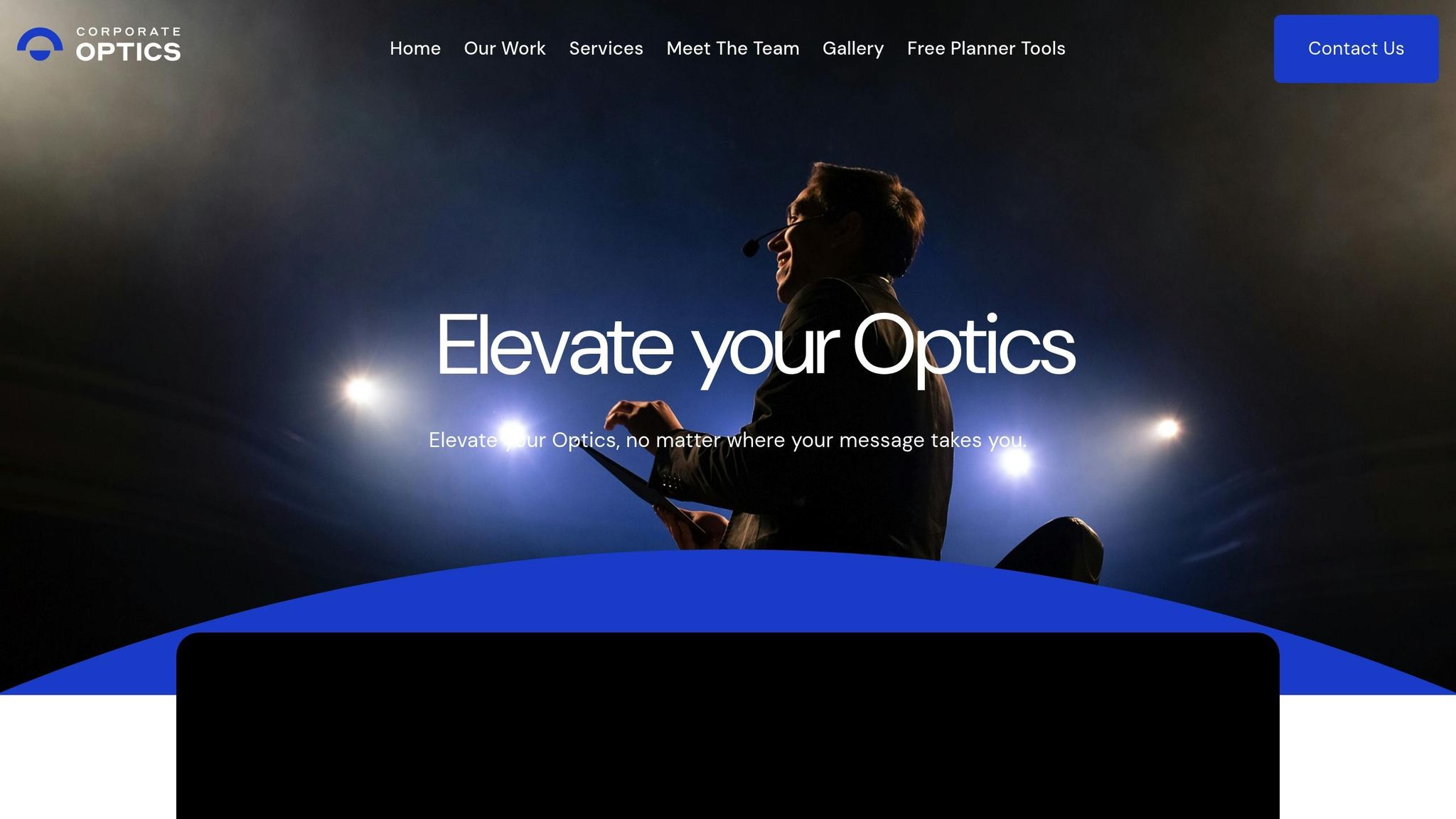
Corporate Optics takes sales meetings to the next level by delivering broadcast-quality productions that resonate equally with in-person and virtual audiences. Using advanced hardware like the Pixelhue Q8, the company manages intricate multi-screen displays and high-resolution video, ensuring every detail is polished and impactful. This isn’t your standard AV setup - it’s about creating “production quality” content where both visuals and audio are fine-tuned to captivate viewers, no matter where they are.
Lighting plays a starring role, treated as a core design element rather than a secondary feature. It’s used to amplify messages and elevate stage presence. Custom visuals, like show-opening sequences and video shorts, tie directly into meeting themes, reinforcing key messages. The tech choices are all about smooth transitions and fostering real-time, two-way engagement between speakers and the audience. This approach transforms passive viewing into an interactive experience, making every moment feel dynamic and connected.
These technological advancements help create an environment where audience interaction thrives.
Audience Engagement Strategies
Forget one-sided presentations - Corporate Optics prioritizes structured dialogue to bring attendees into the conversation. By asking participants about their goals upfront, the company ensures they’re invested in the meeting’s success from the start. Interactive tools like audience response systems and wireless keypads turn attendees into active contributors, not just passive listeners.
Gamification and team competitions add energy to the room, reinforcing key points in a fun and memorable way. For virtual attendees, the company adds a personal touch with gift boxes or digital rewards, creating what’s often called “surprise and delight” moments. Stories of real-world success further boost engagement, connecting abstract ideas to tangible outcomes that sales teams can picture and apply in their own work.
These strategies make sure participants leave not just informed but inspired and ready to act.
Event Logistics and Execution
Flawless execution starts with strategic partnerships. Corporate Optics works closely with Convention and Visitors Bureaus, hotel teams, and on-site vendors to anticipate potential issues and find solutions before they arise. Open, transparent communication about decisions keeps everyone on the same page, creating a sense of alignment and shared purpose.
On-site branding is everywhere, from meter boards and column wraps to floor graphics and stairway strips, ensuring the message stays front and center. High-security events come with added layers of planning, like strict ID checks and coordinated bus transfers to secure locations. Networking isn’t left to chance - it’s built into the agenda with pre-event dinners and structured coffee breaks. The company understands that these informal moments can be just as critical to driving sales as the formal presentations.
2. Freeman

AV Technology and Innovation
Freeman takes a unique approach by separating equipment from creative production, focusing on turning strategic ideas into visually striking moments that captivate audiences and stir emotions. Michael O'Brien, Creative Production Expert at Freeman, explains it best:
"AV is equipment - creative production is engagement. It's the difference between people being spoken at versus them feeling immersed in the experience".
Freeman employs curved LED walls and anamorphic video content to craft three-dimensional effects, making screens feel larger and more engaging than traditional flat panels. This innovative method has achieved impressive results, including engagement levels 27.5% higher than average in-booth interactions and stop rates 17% above industry benchmarks. For sales-centric events, Freeman designs interactive virtual environments with clickable hotspots, enabling attendees to explore products and even make purchases directly through the platform. They also leverage AI-driven tools and behavior mapping to analyze real-time attendee data, tracking sentiment, dwell time, and movement patterns to deliver actionable insights.
Freeman’s budgeting strategy is carefully crafted to balance technical precision with creative impact, ensuring every event leaves a lasting impression.
Audience Engagement Strategies
Freeman's focus extends beyond technology to prioritize meaningful, people-first interactions. Instead of relying on traditional sales pitches, they create experiences that deliver real-time expertise and foster emotional connections. By designing immersive activations, Freeman encourages active learning and engagement. Their use of AI-powered tools allows for real-time event optimization, tailoring experiences based on audience behavior and preferences.
One standout example is Cardinal Health's Retail Business Conference, which went virtual under Freeman’s guidance. The event featured an interactive 4-day experience, including a virtual pharmacy with clickable hotspots for direct purchasing. This initiative, led by Brad Copeland (Advisor, Marketing Operations) and Conni Catlett (Director, Pharmaceutical Distribution Marketing), achieved 70% of its revenue goal. Conni Catlett reflected on the project:
"The virtual pharmacy and solutions environment were so impressive that we are keeping them as a sales tool beyond RBC. I envision our sales team walking our customers through our solutions in this dynamic way during customer visits".
Event Logistics and Execution
Freeman pairs its advanced technology and engaging activations with impeccable event execution. Their specialist teams, including Executive Producers and Technical Directors, ensure smooth logistics and flawless AV integration. For effective planning, Freeman recommends a lead time of 4–6 months for standard corporate meetings and 12–14 months for larger national productions.
Using its "XLNC" framework, Freeman focuses on delivering attendee outcomes - whether it’s learning, connecting, or finding solutions - over merely creating a visually appealing event. This approach ensures that each activation aligns with specific business goals. They also encourage clients to rethink their messaging annually, bringing fresh visuals and purposeful content to life to avoid falling into the "Same As Last Year" trap. As Brad Copeland from Cardinal Health shared:
"We were looking for a partner who could integrate the APIs and create a cohesive experience... Freeman had the technology we needed and the expertise to bring the vision to life".
3. AMW
AMW combines advanced technology, personalized strategies, and smart logistics to create impactful sales meetings that resonate with attendees.
AV Technology and Innovation
AMW's "Event Technology Stack" integrates tools like registration systems, mobile apps, and analytics into a single, cohesive platform. This approach not only enhances attendee satisfaction by 27% but also improves measurement capabilities by 35%.
The company leverages AR/VR to create immersive brand experiences, such as virtual product tours and simulations. These tools allow attendees to explore products in dynamic, interactive ways. For hybrid events, AMW ensures high-quality video streaming, catering equally to in-person and remote audiences. Features like interactive kiosks, live polling, and real-time Q&A sessions - facilitated through event-specific apps - keep attendees engaged throughout the event.
AMW adopts a phased implementation strategy, which minimizes risks and helps teams gradually adapt to new systems. Automated check-ins and access control systems not only streamline logistics but also provide organizers with real-time data on attendee participation and movement.
By combining cutting-edge technology with personalized strategies, AMW creates memorable and engaging experiences.
Audience Engagement Strategies
AMW goes beyond technology by focusing on audience engagement at a deeper level. They analyze attendee psychographics to deliver content that feels personal and relevant. To boost participation, AMW incorporates gamified activities like escape rooms and scavenger hunts. These activities have proven to enhance communication, with 78% of participants reporting improved teamwork after such experiences.
The company also designs Instagram-worthy moments, such as makeover booths with professional lighting and branded hashtags, encouraging attendees to share their experiences online. This approach transforms attendees into brand advocates, contributing to multi-channel event strategies that drive 65% higher registration conversion rates.
Post-event, AMW keeps the momentum going with tailored follow-ups, including highlight videos, personalized emails, and exclusive discounts on showcased products. These efforts can lead to a 42% increase in retention rates among key accounts.
This focus on engagement ensures that AMW events leave a lasting impression on attendees.
Event Logistics and Execution
AMW employs a structured framework - centered around the 5 C's (Concept, Context, Content, Coordination, Communication) and the 5 P's (People, Product, Price, Place, Promotion) - to guide a 4–6-month planning process.
Risk management is a core part of their execution strategy. Companies with formalized risk plans report 72% fewer disruptions during events. AMW prepares for the unexpected with detailed risk assessments, emergency protocols, backup equipment, and alternative internet solutions for critical sales meetings. Professional event management can save organizations up to 240 internal labor hours per major event.
Budget planning is equally meticulous. AMW typically allocates 40% of the budget to venue and catering, 25% to production and technology, 15% to speakers and entertainment, and 10% each to marketing and staffing. They also recommend setting aside 10–15% of the budget as a contingency reserve for unforeseen expenses. As AMW explains:
"Investing in professional event management has become a critical component of corporate strategy rather than an optional luxury".
Post-Event Analytics
AMW’s commitment to excellence continues with robust post-event analytics. Their data-driven approach yields tangible results, including a 37% increase in attendee satisfaction and a 29% improvement in ROI. Events managed by professional teams generate 27% more qualified leads and shorten sales cycles by 19%.
Using digital tools, AMW collects qualitative feedback immediately after events, helping refine future strategies. This focus on continuous improvement ensures that each event builds on the success of the last.
sbb-itb-ae35a94
Company Comparison Overview
Each company has its own approach to creating impactful sales meetings, leveraging unique strengths to stand out. Corporate Optics focuses on precision, using AI-powered tools and award-winning production techniques to ensure that every visual and audio element aligns perfectly with the strategic message. Freeman, on the other hand, transforms equipment into immersive experiences by bringing together a team of Creative Directors, Technical Directors, and Environmental Designers. Meanwhile, AMW combines advanced technology platforms with tailored strategies to drive engagement.
When it comes to logistics, the companies differentiate themselves further. Event planning timelines vary - some events require quick turnarounds, while others demand extended preparation and coordination.
Their engagement strategies also highlight their differences. Freeman emphasizes emotional and visual impact through immersive designs, while Corporate Optics integrates speaker support, audience engagement tools, live streaming, and detailed post-event analytics to optimize outcomes. AMW focuses on crafting interactive experiences by seamlessly integrating advanced technologies.
A standout feature of Corporate Optics is its use of comprehensive post-event analytics. By tracking key metrics from registration to follow-up, they demonstrate how data-driven insights can elevate event production and drive measurable results. This reinforces their commitment to blending innovation with strategic execution.
Conclusion
Sales meetings today are no longer just about delivering content - they're about crafting an experience that leaves a lasting impression. By combining cutting-edge AV technology with compelling storytelling, these gatherings can transform the way attendees connect with your message. The key lies in blending immersive visuals, operational flexibility, and thoughtful execution to go beyond conventional meeting formats.
Think beyond the usual ballroom setup. Extend your brand's presence across every aspect of the venue. Tools like dynamic digital signage, large-scale projection mapping, and reimagined graphics can completely transform the environment, creating a cohesive and memorable experience that reinforces your brand identity.
Advanced technologies also play a critical role. Features like remote-controlled systems for quick room transitions and flexible staging solutions help navigate unexpected challenges without disrupting the flow of the event.
Finally, pairing immersive environments with actionable insights takes the experience to the next level. Interactive content doesn’t just engage your audience - it provides valuable feedback that can shape more effective strategies for future engagement.
FAQs
How do I choose the right AV tech for a hybrid sales meeting?
When choosing AV technology for a hybrid sales meeting, it's essential to partner with a provider experienced in hybrid events. Focus on tools that facilitate live streaming, audience engagement, and analytics to create a dynamic and interactive experience. Look for companies that offer multi-camera streaming and broadcast-grade technology to deliver a polished, professional presentation.
Experienced providers excel at offering scalable solutions tailored to the unique needs of your event. This ensures smooth integration, whether for in-person attendees or remote participants, while keeping your event's size and goals in mind.
What engagement tactics work best for sales teams in the room and online?
Interactive presentations are a fantastic way to keep audiences engaged. Incorporating live responses, Q&A sessions, and polls can make your presentation more dynamic and participatory. Tools like mobile apps or even biometric technology take it a step further, offering ways to measure engagement levels while simultaneously enhancing the overall experience.
Which post-event metrics should I track to prove ROI from a sales meeting?
Key metrics to evaluate the success of an event and its ROI include attendance figures, the number of B2B meetings scheduled, leads generated, and overall engagement levels. It's also essential to measure how the event influenced sales performance. Beyond the numbers, pay attention to participant feedback and any shifts in emotional response to pinpoint successes and identify areas that could be improved.
Related Blog Posts


Streamline your workflow, achieve more

Lorem ipsum dolor sit amet, consectetur adipiscing elit. Maecenas ac velit pellentesque, feugiat justo sed, aliquet felis.



Lorem ipsum dolor sit amet, consectetur adipiscing elit. Maecenas ac velit pellentesque, feugiat justo sed, aliquet felis.