Guide To Finding Companies Who Focus On Meeting Planning And Event Production

Chief Executive Officer

Finding the right company for meeting planning and event production can make or break your event. From managing audio-visual systems to coordinating hybrid meeting formats, these services ensure your event runs smoothly and leaves a lasting impression. Key takeaways:
- Start with your goals: Define your event type (e.g., trade show, product launch), format (in-person, virtual, hybrid), audience size, and technical needs.
- Focus on expertise: Look for companies with a proven track record in managing logistics, AV systems, and hybrid event complexities.
- Research extensively: Use directories like Bizbash or Cvent, and prioritize companies with certifications (e.g., CMP, MPI) and strong client referrals.
- Request detailed proposals: Be clear about your requirements, budget, and expectations. Compare offerings based on services, costs, and timelines.
- Test communication: Evaluate how companies handle initial inquiries - this often reflects their on-site performance.
The right partner will handle technical demands, ensure smooth logistics, and align with your event goals. Keep reading for detailed steps to find the best fit for your needs.
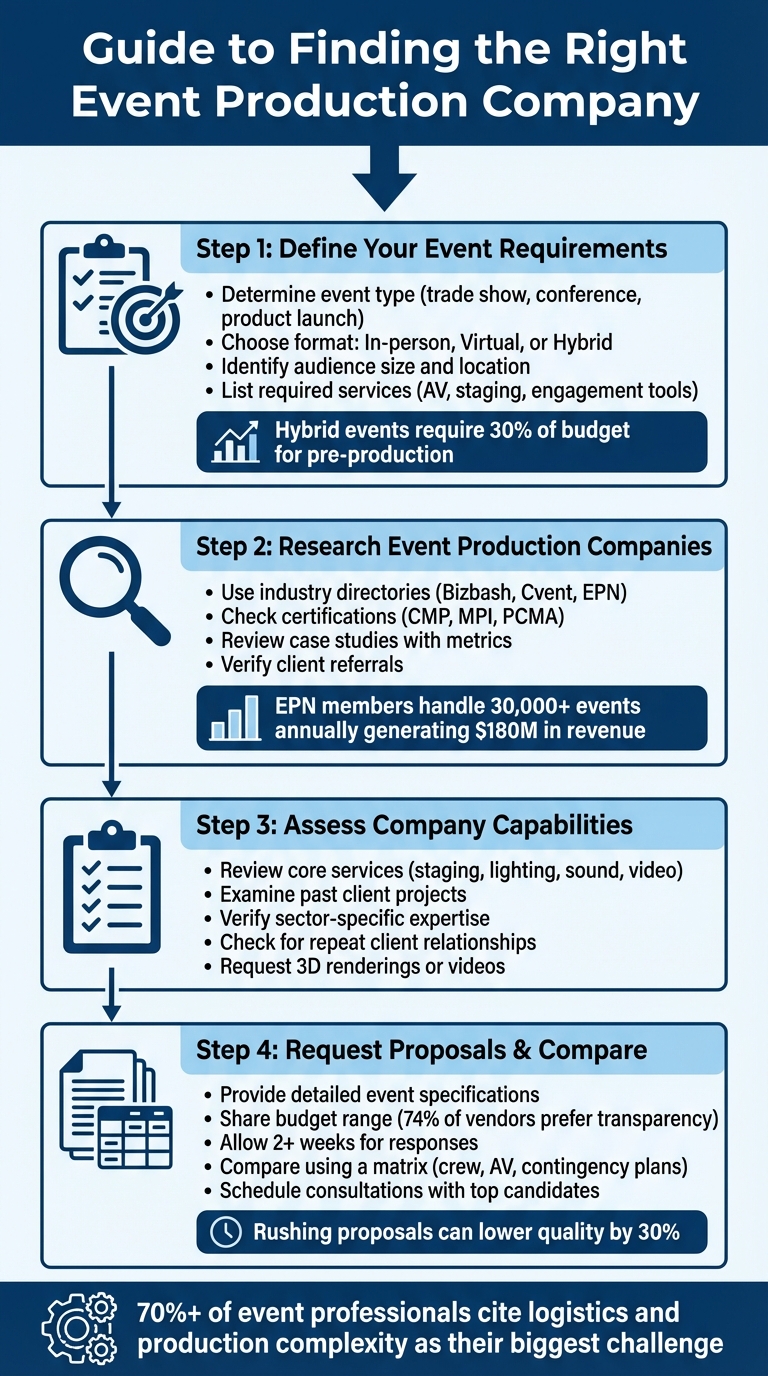
4-Step Process to Find the Right Event Production Company
Step 1: Define Your Event Requirements and Objectives
To kick things off, start by getting clear on what your event needs and what you're trying to achieve. Pin down your goals and figure out the type of event you're planning. Is it a trade show, a conference, a product launch, or maybe a company kickoff? Each type comes with its own technical demands. For example, a product launch with remote presenters will require entirely different tools and services than an all-hands meeting in a single ballroom.
Determine Your Event Scale and Format
Next, decide whether your event will be in-person, virtual, or hybrid. This decision has a huge impact on your budget and timeline. Hybrid events, in particular, need extra planning because you're essentially managing two versions of the same event at once.
You’ll also need to figure out how many people will attend and where they’ll be - on-site or remote. Knowing your audience size and their setup (remote vs. in-person ratios) helps you determine the technical requirements. For instance, remote speakers might need video encoding tools and seamless communication systems, while on-site presenters may require custom staging and rehearsal time.
Once you’ve nailed down your event format and audience profile, you’ll be ready to start searching for production companies that align with your technical needs.
Identify Required Services and Features
With your event format in mind, list out the technical services you'll need. If audience engagement is a top priority, you might want features like live polling, chat functions, gamification tools (such as QR codes), or even virtual networking lounges. On the other hand, a high-stakes product reveal might call for LED walls, 3D stage renderings, and multiple camera angles to give it that polished, professional broadcast vibe.
Don’t forget to include cost considerations early in the planning process. For hybrid events, pre-production costs can take up as much as 30% of your total budget. You’ll also need to account for specialized roles like Audio Engineers, Graphics Operators, and Virtual Stage Managers. As Whitney Kirkland, Partner at Firebrand Event Productions, advises:
Ask your potential production company if they work on a cost-plus basis, if they charge hourly, and how their management fee works.
Confirming cost structures - whether it's cost-plus, hourly rates, or management fees - early on will help you avoid unexpected expenses down the line.
Step 2: Research Event Production Companies
After defining your event's needs, the next move is finding companies equipped to meet those requirements. Start by diving into industry-specific directories that evaluate providers based on actual performance. For example, the Bizbash Venue & Supplier Directory allows you to search suppliers by name, market, or category, covering areas like event planning, audiovisual services, and creative production. For a wider search, the Cvent Supplier Network lists event service providers and venues across the United States. If peer-reviewed options are a priority, check out the Event Production Network (EPN). This alliance of top-tier North American event production companies is known for maintaining high-quality standards and ethical practices. EPN members collectively handle over 30,000 events annually, generating $180 million in revenue. This research phase is essential for identifying companies that align with your event's technical and logistical needs.
Search Online Directories and Industry Resources
In addition to general directories, explore platforms designed for meeting professionals. Meeting Professionals International (MPI) offers the MPI Global Marketplace, a centralized hub for event-related products and services. MPI also provides specialized tools like the Destination Finder for local expertise, a Venue Finder for certified event spaces, and a Speaker Resource for motivational or educational talent. These resources streamline your search by connecting you with vetted providers, reducing the risk of unreliable partnerships.
Look for Signs of Credibility and Experience
When assessing potential partners, focus on their ability to execute rather than just the equipment they own. A company’s expertise in managing on-site logistics - such as installation, dismantling, labor coordination, and traffic flow - often outweighs the importance of having top-tier gear. Look for certifications like CMP, MPI, or PCMA, and memberships in peer-reviewed organizations like EPN, as these signal adherence to high service standards.
Nationwide service coverage and experience with large-scale corporate events are key indicators of reliability. Request case studies that include metrics, such as the number of attendees, challenges faced, and how issues were resolved on-site. These examples can help confirm their ability to handle complex events. Be cautious of companies that can’t provide strong client referrals - this is often a red flag.
Finally, evaluate how they communicate during the research phase. A company that gives vague or generic answers to your initial questions might struggle to perform effectively on-site. As Willwork, an industry expert, explains:
"A production partner is not just 'support.' They influence how smoothly logistics flow and how quickly problems get solved." - Willwork
Use the proposal process as a test of their responsiveness and clarity. If they can’t provide detailed and thoughtful answers upfront, they’re unlikely to deliver when it matters most.
Step 3: Assess Company Capabilities and Service Offerings
Now that you've done your initial research, it’s time to figure out if these companies can truly meet the technical and logistical demands of your event. Once you’ve narrowed down your list of potential partners, dive into their service offerings. This will help you determine if they can handle your event entirely on their own or if you’ll need to bring in additional vendors.
Review Core Service Offerings
Start by confirming that the company provides the essential technical production services you need. This includes professional staging, lighting, sound systems, and video capabilities, along with venue sourcing and logistics support - all while keeping union rules and venue restrictions in mind. For events that require a strong visual presence, check if they offer scenic and stage design services, such as custom-built sets, branded displays, and immersive designs. It’s also important to ensure they have skilled crews for setup, operation, troubleshooting, and installation and dismantle (I&D).
Technology plays a big role in modern events, so look for companies that offer AI-powered planning tools and real-time engagement apps (for features like live polls and Q&A). Additionally, see if they provide live streaming and broadcast services to accommodate hybrid event formats. A full-service provider should also manage vendor and sponsor relationships while offering strategic planning support, including agenda creation, budget management, and contingency planning to prepare for any unexpected issues.
By thoroughly evaluating these core services, you’ll have a solid foundation for assessing their ability to deliver on your event’s needs.
Examine Past Work and Client Projects
Take the time to review their portfolios and client feedback. Look for examples of sector-specific expertise, as corporate events often have different requirements compared to other types of gatherings, including unique logistics, security needs, and audience expectations. Confirm they’ve successfully handled events similar in size to yours, whether it’s a small board meeting or a massive conference. If possible, request 3D renderings or videos of past projects to get a sense of their design capabilities.
Also, pay attention to their history of working with repeat clients. Consistent partnerships over multiple events indicate reliability and high-quality service.
As Pushpa Gowda from JLL shared:
Their expertise and guidance made our team of production novices look good and allowed me to confidently assure my stakeholders that everything was under control.
sbb-itb-ae35a94
Step 4: Request Proposals and Compare Your Options
Once you’ve outlined your event needs, the next step is to gather detailed proposals from potential providers. These proposals will give you a clear picture of what each company can offer. Be specific about your requirements when making these requests - this ensures you’ll receive accurate quotes and realistic timelines, making the comparison process much smoother.
Compare Pricing, Services, and Timelines
When reaching out to vendors, include all the key details about your event: its type, goals, dates, location, venue size, and expected attendance. Share your agenda to clarify what technicians and equipment will be needed. For seating arrangements, describe the layout (like theater or classroom style), the atmosphere you want to create, and the end results you’re aiming for. If your event is hybrid or virtual, compare production and AV companies that support these formats, specify platform preferences, whether you need features like virtual lobbies or breakout rooms, and how much prerecorded content is involved.
Instead of listing exact equipment needs, describe how the equipment will be used. For instance, rather than saying, “We need a 10-foot screen,” explain that you need a screen to display PowerPoint presentations to 500 attendees. This lets the experts recommend the best setup for your needs. Don’t forget to highlight logistical challenges, such as tight setup windows, venue restrictions, or union rules. Be upfront about how you’ll evaluate proposals - whether that’s based on cost, experience, creativity, or other factors - so vendors can tailor their bids accordingly.
Audio Visual Dynamics emphasizes the importance of this approach:
An effective RFP does more than just focus on the specs for a production estimate – it defines the production values and audience experience that you want your event to deliver.
It’s also helpful to provide a budget range. This allows vendors to self-assess whether they’re a good fit and ensures the solutions they propose are financially realistic. In fact, 74% of vendors prefer budget transparency because it helps them craft competitive and feasible proposals. Give vendors at least two weeks to respond; rushing this process can lower proposal quality by up to 30%.
Once you’ve collected the proposals, use a comparison matrix to analyze them. Track key details like crew sizes, AV plans, and labor coordination. Look for a balance between creative storytelling - such as scenic design and brand alignment - and technical expertise, covering AV, lighting, and logistics. Pay attention to whether services are handled in-house or outsourced, as in-house resources often offer more consistent quality and predictable timelines. Review contingency plans for potential setbacks, such as technical issues, weather disruptions, or last-minute changes.
As Willwork points out:
The more vague the proposal, the more room there is for misalignment later. That is where budget surprises and timeline issues usually start.
Once you’ve narrowed the field, it’s time to meet with the top candidates.
Schedule Consultations with Potential Providers
After evaluating the proposals, set up meetings with your top choices to discuss details and determine if they’re the right fit. The way a provider communicates before the event often reflects their on-site performance. Clear and prompt responses are a good indicator of reliability. Use these consultations to gauge whether the provider can act as a true partner, working alongside your team rather than simply fulfilling a transaction.
Focus your conversations on their processes. Ask about contingency plans and how they handle unforeseen challenges. Present “what-if” scenarios to see how they’ve managed technical issues or last-minute changes in the past. Confirm details like crew sizes, roles, and their familiarity with venue-specific rules or union requirements. Also, check if a dedicated project manager will oversee your event, as this can streamline communication and approvals.
If stage design is part of the proposal, ask for 3D renderings or videos to ensure their vision aligns with your brand. Discuss how they balance creative ideas with practical budgets, safety measures, and logistical constraints. Be on the lookout for warning signs, such as vague answers, reluctance to explain costs, or overly ambitious plans that lack practical details. These red flags can save you from potential headaches down the line.
Featured Provider: Corporate Optics

Corporate Optics sets itself apart with a specialized approach and strong technical expertise, making it a standout choice for full-service event production.
Founded by Steven P. Simmons, the company offers end-to-end solutions, covering everything from initial strategy and venue selection to on-site execution and post-event analysis. Their four-stage process - Discover, Design, Develop, and Deliver - ensures every technical aspect and event goal is meticulously planned before the event even begins.
Corporate Optics provides professional staging, lighting, sound, video design, and custom scenic builds, all designed to amplify brand messaging. For hybrid and virtual events, they deliver high-quality live streaming with professional switching systems and redundant feeds, ensuring seamless integration with major virtual platforms. Thanks to a partnership with prompts.ai, they also offer AI-powered tools that simplify meeting production, reduce costs, and automate time-consuming administrative tasks.
Their results speak volumes, with over 10,087,650 positive media impressions generated for clients. Serving a wide range of industries - including corporate, sports, lifestyle, and government - they offer a variety of tools to boost audience engagement. These include event apps, live polls, Q&A sessions, and gamification features. Additionally, their speaker support services, such as coaching, rehearsals, and teleprompter assistance, help presenters shine. After each event, clients receive detailed reports on engagement, ROI for your company conference, and areas for improvement, providing actionable insights backed by data.
Client testimonials highlight their consistent excellence. Ed D., Senior Managing Director and COO, shares:
Every time we work with Corporate Optics, we know we're in good hands. Their attention to detail and ability to adapt to challenges is unmatched.
Pete L., SVP of Marketing, adds:
I cannot tell you how appreciated it is to have a partner that makes these events fun.
For those interested in exploring their approach, Corporate Optics offers free AI tools to automate routine planning tasks, giving planners a chance to experience their streamlined process firsthand.
Conclusion
Start by identifying your event's goals. Before reaching out to vendors, take the time to define the type of event you're planning, its size, and the metrics you'll use to measure success - whether that's measuring ROI, attendee satisfaction, or fundraising outcomes. This clarity will help you assess vendors based on their ability to meet your specific needs.
Once your objectives are set, focus on the provider's ability to execute. You’ll want a partner with a strong history of managing on-site challenges, coordinating labor, and ensuring technical accuracy. It's worth noting that over 70% of event professionals highlight logistics and production complexity as their biggest hurdle. This makes a vendor's ability to handle unexpected issues far more valuable than simply having a large inventory of equipment. As Willwork points out:
The right partner makes your event operate smoothly, while the wrong partner creates major problems from minor issues.
The best provider will act as a strategic ally - bringing your brand's vision to life with a combination of creativity and operational expertise. A partner who can balance these elements can directly influence the success and financial outcomes of your event.
When evaluating vendors, insist on transparent pricing, a reliable and skilled team, and case studies that demonstrate relevant experience. Make sure they offer a single point of contact and have clear backup plans for technical issues or emergencies.
FAQs
What should I include in an event production RFP?
An effective event production RFP should cover several key elements to ensure clarity and attract the right vendors:
- Overview and objectives: Clearly state the purpose of the event and what you aim to achieve.
- Event details: Include specifics like the type of event, expected attendance, and venue information.
- Budget range: Provide a clear financial framework to guide proposals.
- Technical requirements: Outline needs for audiovisual equipment, staging, and lighting.
- Vendor experience: Highlight the importance of experience with similar events.
- Flexibility: Address the need for adaptability to changing formats or requirements.
- Additional services: Mention extras like audience engagement strategies or sponsorship opportunities.
By including these elements, you set clear expectations, attract qualified vendors, and make the selection process more efficient.
How can I tell if a production company can handle a hybrid event?
To determine if a production company is equipped to handle a hybrid event, start by evaluating their experience and technical know-how. It's important to find a team that excels at crafting engaging experiences for both in-person and virtual attendees. Key areas to focus on include:
- Audiovisual technology management: Can they seamlessly handle sound, visuals, and technical setups for both formats?
- Live streaming capabilities: Do they have the tools and expertise to deliver high-quality streams without interruptions?
- Audience engagement strategies: Are they skilled at keeping both onsite and remote participants actively involved?
- Support for onsite and virtual platforms: Can they provide reliable assistance across both physical venues and digital platforms?
A proven track record and a deep understanding of the unique challenges that hybrid events present are critical to ensuring things run smoothly.
Which pricing model is best: cost-plus, hourly, or a flat fee?
The best pricing model for your project depends largely on its scope and complexity. If your project is straightforward and its requirements are well-defined, a flat fee can be a practical choice. On the other hand, for projects with evolving needs or a less predictable structure, cost-plus or hourly models might be more fitting. Be sure to weigh the specifics of your event and any budget limitations before deciding which approach works best.
Related Blog Posts
- 4 Meeting Production Companies That Excel At Seamless AV (audio/video), Lighting, and Stage Design for Corporate Conferences, and events
- Best Meeting Production Companies For General Session & Breakout Session AV Support
- Leading Meeting Production Companies For AV-heavy Events
- Great Production Companies Who Handle Logistics And Production For Large-Scale Events


Streamline your workflow, achieve more

Lorem ipsum dolor sit amet, consectetur adipiscing elit. Maecenas ac velit pellentesque, feugiat justo sed, aliquet felis.



Lorem ipsum dolor sit amet, consectetur adipiscing elit. Maecenas ac velit pellentesque, feugiat justo sed, aliquet felis.