Production Teams To Use For Corporate Meetings, Conferences, & Summits

Chief Executive Officer
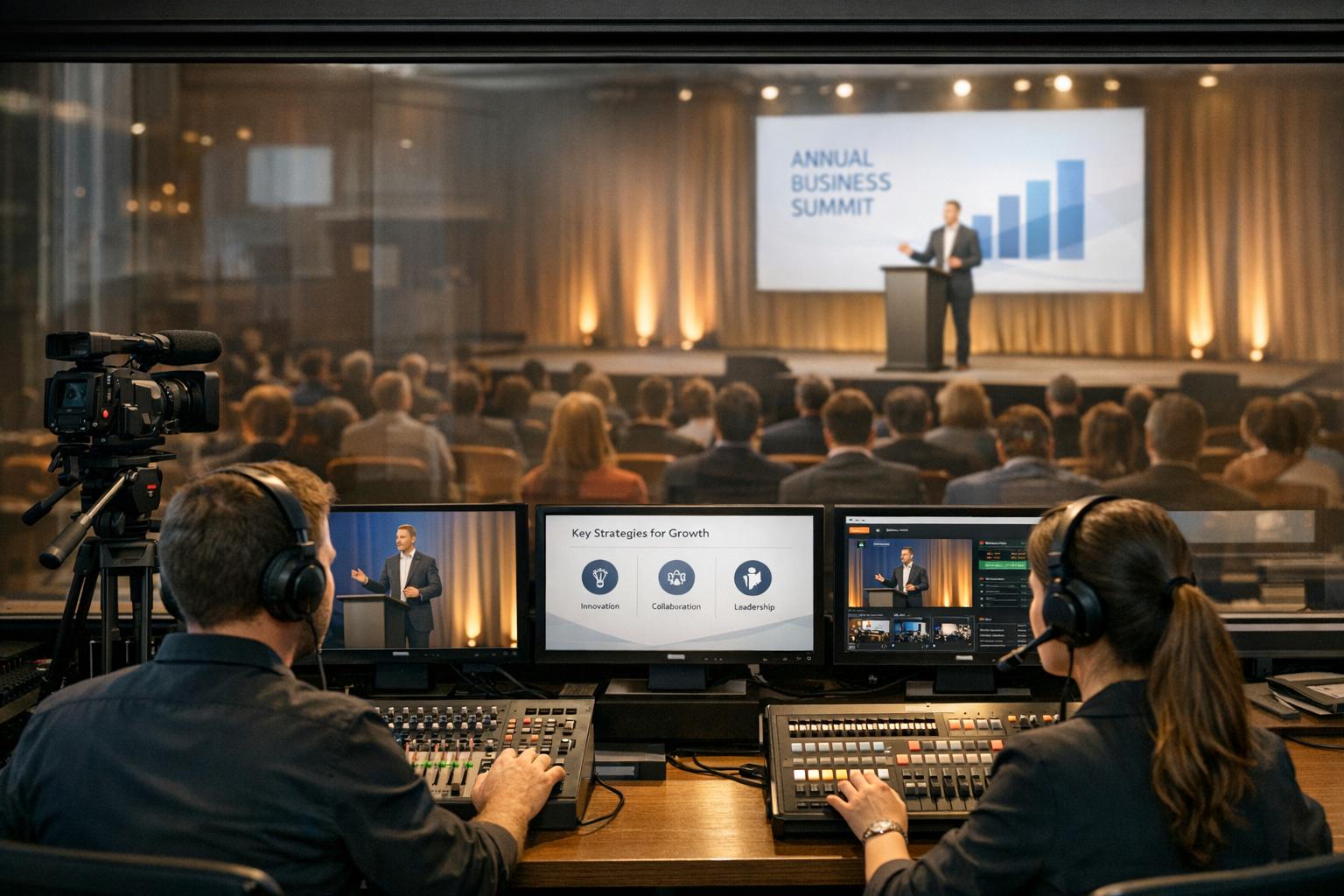
Corporate events like meetings, conferences, and summits demand flawless execution. From managing sound systems to live streaming, professional production teams handle the technical and logistical complexities that can overwhelm internal staff. These teams ensure smooth operations, minimize disruptions, and deliver high-quality experiences for both in-person and virtual audiences.
Key services include:
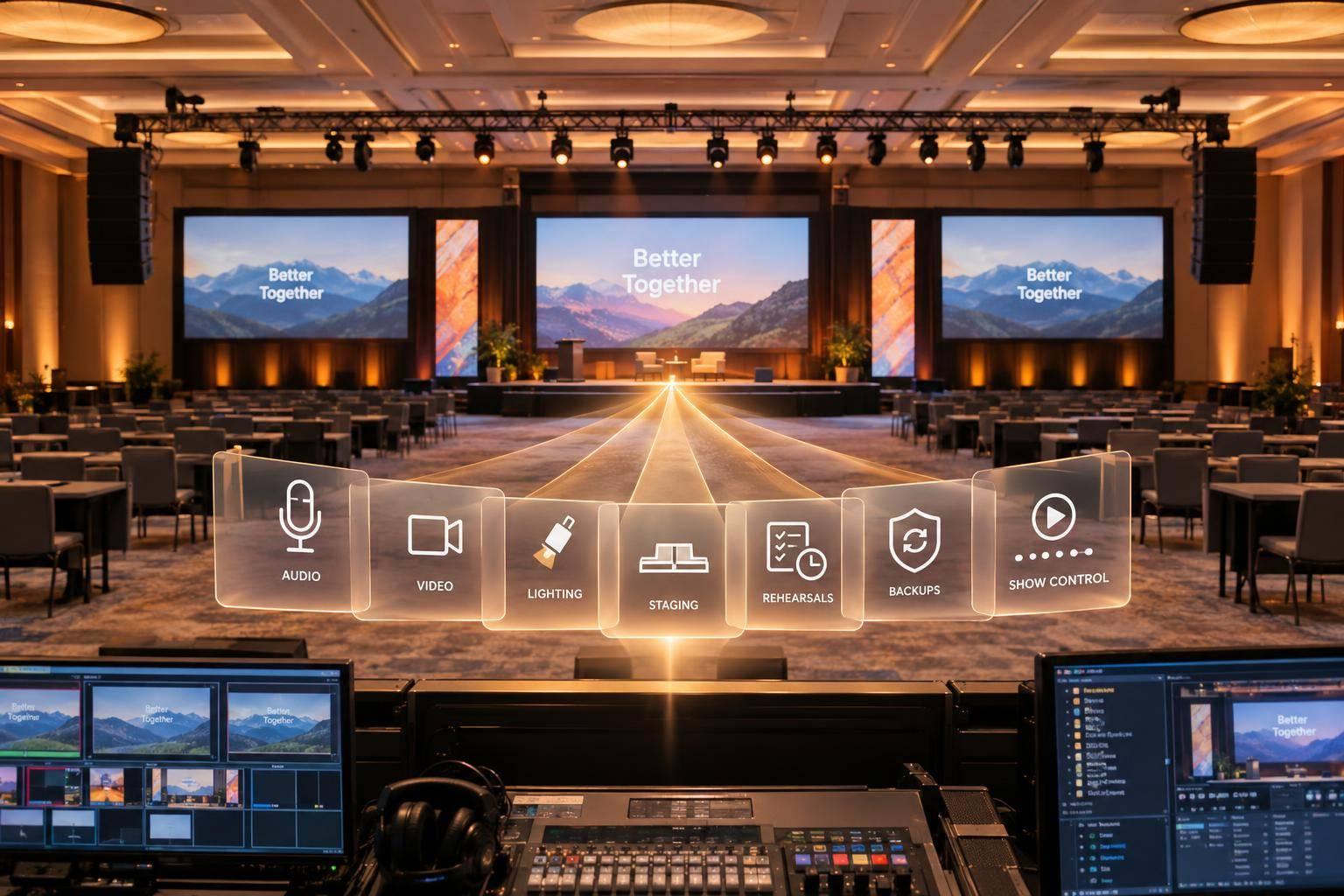
- Audiovisual Design: Clear audio, sharp visuals, and seamless technical support.
- Stage Design: Custom-built stages reflecting your brand and functional needs.
- Live Streaming: Broadcast-quality streaming with interactive tools for remote attendees.
- Team Roles: Skilled professionals like AV technicians, stage managers, and producers ensure every detail is executed perfectly.
Behind the Scenes in Event Production: Who Does What?
Services Provided by Corporate Event Production Teams
Corporate event production teams are the masterminds behind transforming ordinary venues into dynamic, professional spaces. From setup to teardown, they manage every detail, including design and analytics, to ensure your event aligns with your goals. Here’s a closer look at what these teams bring to the table.
Audiovisual Design and Technical Support
Clear communication is the backbone of any successful event, and that starts with top-notch audio systems. Production teams handle it all - microphones (handheld, lavalier, headset), speakers, and digital mixers - to deliver flawless sound, whether your event is in a sprawling ballroom or a cozy boardroom. On-site crews are there to set up and troubleshoot, ensuring no awkward moments with feedback or silent microphones.
Lighting and visuals are just as important. Spotlights, color washes, and custom gobos can highlight your brand or set the tone of the event. Video displays, from LED walls to high-definition projectors, provide crisp, vibrant visuals that stay sharp even in bright rooms. Thanks to advances in LED technology, these displays have become the go-to choice for many events, outshining older projection systems in both brightness and clarity.
Technical directors play a crucial role behind the scenes, helping speakers rehearse and ensuring everything runs smoothly. From managing wireless slide advancers to coordinating AV cues, their expertise keeps disruptions at bay. One provider, for instance, has delivered over 1,700 projects, reaching more than 30 million people with their AV services.
"AV technology is clearly a significant aspect of event planning - helping your audience feel engaged and connected to help ensure the success of your event."
– Catalyst
Stage Design and Scenic Production
A well-designed stage can transform a generic space into a branded experience that reflects your company’s identity. Production teams start by understanding your goals and brand guidelines, then create 3D renderings and digital mockups so you can see the design before it’s built.
Custom fabrication brings these designs to life, whether it’s a simple backdrop for a smaller event or intricate scenic elements for a large-scale production. These designs don’t just look good - they’re built with functionality in mind. Stage managers work closely with technical directors to ensure elements like rigging points, power access, and AV setups are seamlessly integrated. They also handle venue-specific details like labor requirements and permits, avoiding last-minute surprises.
"We bring your brand to life through immersive scenic design and custom staging that set the tone the moment attendees walk through the doors."
– Shepard Event Services
Live Streaming and Hybrid Event Solutions
In today’s world, events often extend beyond the physical venue, and production teams excel at bridging the gap between in-person and remote audiences. They provide broadcast-quality streaming in Full HD, optimized to prevent buffering, and synchronize in-room AV systems with virtual platforms to create a seamless experience.
Interactive tools like live Q&A sessions, real-time chat, audience polls, and gamification apps keep remote participants engaged. AI-driven features, such as real-time translated subtitles in up to 29 languages, ensure your event resonates with a global audience. Interestingly, livestreaming captures up to 20 times more attention than on-demand videos, and high-quality streams can boost conversion rates by as much as 83%.
Production teams also manage the digital infrastructure, from platform setup and registration to remote support and backup plans for technical issues.
"I was in charge of two events in two months for a Fortune 500 company, and both were big successes largely due to the smooth productions that Meeting Tomorrow orchestrated for us."
– Pushpa Gowda, JLL
Team Roles in Corporate Event Production

Corporate Event Production Team Roles and Responsibilities
Behind every successful corporate event is a team of skilled professionals working together to bring the production to life. These individuals handle both technical and logistical elements, ensuring every detail is executed flawlessly. Each role has its own responsibilities, and understanding these positions can help you staff appropriately based on your event's needs.
AV Technicians and Technical Directors
Audio Engineers (A1) are responsible for sound quality, working at the mixing console to manage PA systems, wireless microphone frequencies, and audio levels for clear and balanced sound. Supporting them are Audio Assistants (A2), who work backstage to set up microphones, check batteries, and ensure everything is ready to go. Since they often work closely with executives and keynote speakers, professionalism is a must.
Video Engineers (V1) oversee slide presentations, video playback, and camera feeds. In setups with multiple cameras, a Video Director ensures consistency across all visuals.
The Technical Director (TD) supervises the entire technical operation, including audio, lighting, staging, and signal flow. They act as the bridge between your event's vision and the technical team, translating goals into actionable tasks while troubleshooting potential issues before they arise.
"A great AV team is like the crew of a naval warship... Each person has a role; they're all in sync and working behind the scenes to pull off something epic."
– Brandt Krueger, Senior Production Manager
These technical roles are complemented by backstage teams who handle stage logistics with precision.
Stage Managers and Event Coordinators
While technical teams focus on sound and visuals, backstage coordination is equally essential. Stage Managers handle the physical stage and backstage logistics. They oversee scenic setups, prepare teleprompters, and ensure presenters are ready to take the stage at the right moment. From double-checking wireless mics to handing presenters their PowerPoint remotes, they manage small details that can prevent major disruptions.
"A good stage manager can go a long ways towards helping your presenters feel comfortable and understand the process before they walk onstage, right as the butterflies might be settling in."
– VIP Audio Visual
Event Coordinators manage the broader logistics, ensuring tasks stay on track and vendors are aligned. The Show Caller or Producer acts as the "conductor" of the event, orchestrating the program flow and directing technical cues through a headset. They follow a Run of Show (ROS) document, which outlines the event minute-by-minute, instructing the crew when to trigger audio, switch video feeds, or adjust lighting for key moments.
"The show caller is the 'conductor' of the event. They 'call' the show, meaning they communicate with the entire production crew through an intercom from the beginning to the end of the production."
– One Way Event Productions
Lighting and Scenic Designers
Lighting Directors (LD) combine artistry with technical expertise, creating mood and atmosphere through programmed lighting cues. They coordinate with video teams to ensure the visuals are cohesive and handle rigging and electrical safety.
Creative Directors focus on the event's overall visual narrative, selecting color schemes, motion styles, and scenic designs that align with your brand's theme.
For larger productions with multiple cameras and complex media elements, the crew can expand to include 10–15 specialists. This might involve operators for graphics, LED walls, and camera shading. Scaling your team appropriately ensures you have the expertise needed to deliver a polished, professional event experience.
sbb-itb-ae35a94
Selecting the Right Production Team for Your Event
Choosing the right production team can make or break your event. With production costs now about 25% higher than 2019 levels and 94% of B2B event organizers prioritizing pipeline generation as their key success metric, this decision carries significant weight.
Evaluating Experience and Expertise
When evaluating potential production teams, focus on their experience in your specific event type. Corporate events demand expertise in ROI and sales enablement, while government or diplomatic events require familiarity with protocol and security measures. Review their portfolios and case studies for examples that align with your event's size and goals.
"Choosing an event production partner isn't a box to check - it's a decision that shapes outcomes and impact."
– Roger Whyte, Founder, Stratus Firm
Ask about their problem-solving skills. During interviews, request examples of how they’ve handled unexpected challenges. This will highlight their ability to stay calm under pressure and their readiness with contingency plans for technical or logistical issues. For instance, Stratus Firm successfully managed the Congressional Black Caucus Foundation's Annual Legislative Conference in 2025, coordinating over 16,000 attendees across multiple venues while working with the Secret Service to maintain high-security protocols.
Pay attention to their technical expertise in staging, audiovisual design, lighting, and logistics. The best teams combine creative storytelling with precise execution, ensuring a seamless and memorable event. Also, evaluate their vendor network and ability to integrate with your internal team. Strong relationships with caterers, décor providers, and security firms can help minimize risks and control costs.
To ensure alignment, define SMART goals - Specific, Measurable, Attainable, Relevant, and Time-bound - and confirm that the team’s skills match your objectives.
Understanding Service Scope and Customization
Not all production teams offer the same services. Basic AV providers might only handle equipment rentals, whereas full-service teams manage everything from program development to on-site stage management.
"An LAI Live event producer takes the roadmap created by the meeting planner and brings it to life onstage. We are the 'experience managers.'"
– LAI Live
Examine the team structure. For complex corporate events, you’ll want a team that includes a producer, production manager, and creative designer - not just a technical lead. Look for specialized services such as 3D stage renderings, custom branding, video mapping, and expertise in coordinating union labor or venue-specific requirements.
If your event includes virtual or hybrid elements, make sure the team has experience with platform configuration, remote attendee support, and the nuances of virtual staging. Meeting Tomorrow, for example, has a 4.9/5 star rating based on 8,633 events across 1,570 cities, showcasing their ability to deliver across various formats.
Provide a detailed Request for Proposal (RFP) outlining your audience’s vibe, conference schedule, equipment needs (like teleprompters or multi-camera setups), and desired creative services. Ask for visual proof of concept, such as 3D renderings or videos of proposed stage designs, to get a clear picture of their vision before committing.
Flexibility is key - confirm whether the team can collaborate with in-house AV providers or existing venue contracts. This can help maintain consistency while managing costs. Additionally, some production companies offer multi-event discounts, which can be beneficial if you plan to host multiple events.
Budget and Pricing Considerations
Budgeting is just as important as selecting the right team. Labor typically accounts for 25% of the event budget. A general guideline is to allocate $1 for labor for every $1 spent on production elements like lighting, sound, and scenic design. For smaller events, this ratio may be closer to 70 cents per dollar.
"Assume that for every dollar spent on a production budget (lighting, scenic, sound, etc), plan on spending a dollar on labor to get you through previews."
– Duncan Northern, Production Supervisor, Tinc Productions
Don’t overlook hidden costs, such as service fees, taxes, overtime charges, travel expenses, and equipment rentals. It’s wise to set aside a $2,000–$3,000 reserve for unexpected expenses like gaff tape or last-minute hardware store runs. Additionally, hold back 15% to 20% of your budget as a contingency for unforeseen changes or overlooked items like lifts and scaffolds.
Focus your spending on non-negotiables - elements that directly contribute to your event’s goals, such as engaging speakers or interactive technology. Use cost-effective alternatives for secondary aspects. Bundled service packages that include AV, lighting, and staging can also streamline coordination and reduce costs.
"Event planners often overlook the ROI potential of quality staffing. A well-trained team doesn't just run the event - it drives attendee satisfaction, boosts engagement, and directly impacts the bottom line."
– Daniel Meursing, CEO, Premier Staff
Plan ahead by booking production teams 4–6 weeks in advance to avoid last-minute premiums. If possible, negotiate off-peak timing to secure discounts. Consider digital alternatives like digital signage and virtual swag bags to cut costs without compromising attendee experience.
Ultimately, success isn’t just about the bottom line. Metrics like attendance rates, engagement levels, lead generation, and Net Promoter Scores provide a better measure of an event’s impact. With 85% of marketers citing attendee satisfaction as their top priority, investing in quality production pays off in ways that extend far beyond the event itself.
Conclusion
Professional production teams do more than just manage logistics - they create events that captivate and deliver measurable business outcomes. From brainstorming concepts to flawless on-site execution and detailed post-event analysis, these teams handle every aspect of event production. Their technical expertise ensures smooth operations, minimizing disruptions while enhancing the overall experience. Services like speaker support, dynamic stage design, and interactive engagement tools further elevate the event's impact.
The results speak for themselves. These teams consistently enhance brand visibility and attendee satisfaction, with their performance metrics showing their ability to prevent technical hiccups and boost engagement.
"Their expertise and guidance made our team of production novices look good and allowed me to confidently assure my stakeholders that everything was under control."
– Pushpa Gowda, JLL
By outsourcing event production, your internal team can stay focused on what they do best - driving your core business goals. Whether you're organizing a leadership summit, a shareholder meeting, or a multi-day conference, partnering with a skilled production team ensures operational efficiency and a cohesive brand message.
Choosing experienced professionals is an investment that pays off. They bring technical precision and strategic planning, transforming events into powerful tools for achieving business success.
FAQs
What should I look for when choosing a production team for a corporate event?
When selecting a production team for your corporate event, it's essential to focus on their skills and service offerings. Choose a team with solid experience in areas like audiovisual production, stage design, and hybrid options such as live streaming and virtual engagement. Their ability to manage logistics, provide technical support, and execute content effectively plays a key role in delivering a polished and professional event.
It's also important to find a team that aligns with your event's goals and understands your audience. The right production partner will bring creative ideas to the table, assist with strategic planning, and offer post-event feedback to evaluate success. Look for teams that are dependable, communicative, and adept at handling both in-person and virtual elements without a hitch. A team with a strong track record and a client-first mindset can help you create an event that achieves your goals and leaves a memorable impact.
How do production teams improve the experience for virtual and hybrid event attendees?
Production teams play a key role in making virtual and hybrid events engaging and polished. They use advanced audiovisual tools to deliver crisp audio, sharp video, and smooth live streaming. This ensures virtual attendees stay connected and involved, especially with features like live Q&A sessions or chat options that make the experience feel interactive and engaging.
For hybrid events, these teams bridge the gap between in-person and remote audiences. They use tools like virtual studios and high-end broadcasting gear to create a seamless connection. Beyond the tech, they craft visually appealing stage setups, lighting designs, and multimedia elements that work just as well on a screen as they do in the room. Presenters also benefit from their expertise, with support through rehearsals, technical troubleshooting, and platform management to ensure everything runs without a hitch. This attention to detail helps create a unified experience for all participants, whether they're attending in person or tuning in from afar.
What key roles are needed in a production team to ensure a corporate event runs smoothly?
A successful corporate event depends on a capable production team working seamlessly together. Each role contributes to ensuring the event runs smoothly and meets its objectives.
The event producer is the driving force behind the event. They set the vision, define goals, manage the budget, and coordinate the various teams to ensure everything aligns. Meanwhile, the event coordinator focuses on the nitty-gritty details - tracking tasks, confirming bookings, and handling any last-minute adjustments to keep the event on track.
On the technical front, audiovisual specialists are indispensable. The technical director oversees AV operations, managing equipment, live cues, and overall execution. The production manager provides expertise on technical designs and scheduling. Supporting them is the AV crew, which includes sound engineers, camera operators, and lighting technicians. This team ensures flawless sound, visuals, and lighting, enhancing the overall experience for attendees.
When these roles come together, they create an event that feels seamless and leaves a lasting impression.
Related Blog Posts
- Type of Events Corporate Production Companies Specialize In
- 4 Meeting Production Companies That Excel At Seamless AV (audio/video), Lighting, and Stage Design for Corporate Conferences, and events
- Top Event Production Teams For Corporate Meetings Next Year
- Top-Tier Event Production Teams Specializing In Full AV, Lighting, Staging, and Production


Streamline your workflow, achieve more

Lorem ipsum dolor sit amet, consectetur adipiscing elit. Maecenas ac velit pellentesque, feugiat justo sed, aliquet felis.



Lorem ipsum dolor sit amet, consectetur adipiscing elit. Maecenas ac velit pellentesque, feugiat justo sed, aliquet felis.