Need AV Help For Your Conference? Here Are 3 Great Companies For Sales Meeting Planning And Execution.

Chief Executive Officer
If your sales meeting is message-heavy, I’d start with Corporate Optics. For hotel-based events, Encore is often the simpler fit. For large convention-center shows with many tracks, Freeman makes more sense.
Here’s the short version:
- Corporate Optics: best when I want one team to handle planning, stage setup, streaming, rehearsals, and show-day support
- Encore: best for hotel and resort events that need in-house venue support and lower setup friction
- Freeman: best for large conferences, expo-linked meetings, and bigger hybrid productions
A few numbers matter here. AV and production can take 10% to 25% of an event budget. A 500 to 1,000-person meeting can cost $75,000 to $250,000 for production, based on room setup, labor, and stream needs. And hybrid events need more than a camera and Wi‑Fi - you want backup feeds, wired internet, rehearsal time, and a clear cue sheet.
How to Source an A/V Vendor for Your Next Event - Part #1: Why & When - Logan Clements
Quick Comparison
| Company | Best for | Event size | Main strength | Budget range |
|---|---|---|---|---|
| Corporate Optics | Sales meetings, leadership summits, product launches | Small to mid-sized | One-team planning and show control | Mid-range |
| Encore | Hotel-based sales meetings, training events, regional conferences | Mid-sized | Venue-based AV support and hybrid tools | Lower to mid-range |
| Freeman | National conferences, multi-track events, trade-show-linked meetings | Large-scale | Big-room production and broadcast-style streaming | Enterprise-level |
Bottom line: I’d choose based on venue, audience size, hybrid needs, and how much control I want on show day. The article breaks down those three companies through that lens.
What To Look For In AV Support For Sales Meetings And Conferences
Start by separating AV equipment rental from a full-service production team.
Basic gear support usually means a vendor delivers and sets up microphones, speakers, projectors, and screens. You may get limited help on-site, but that's often where the service ends.
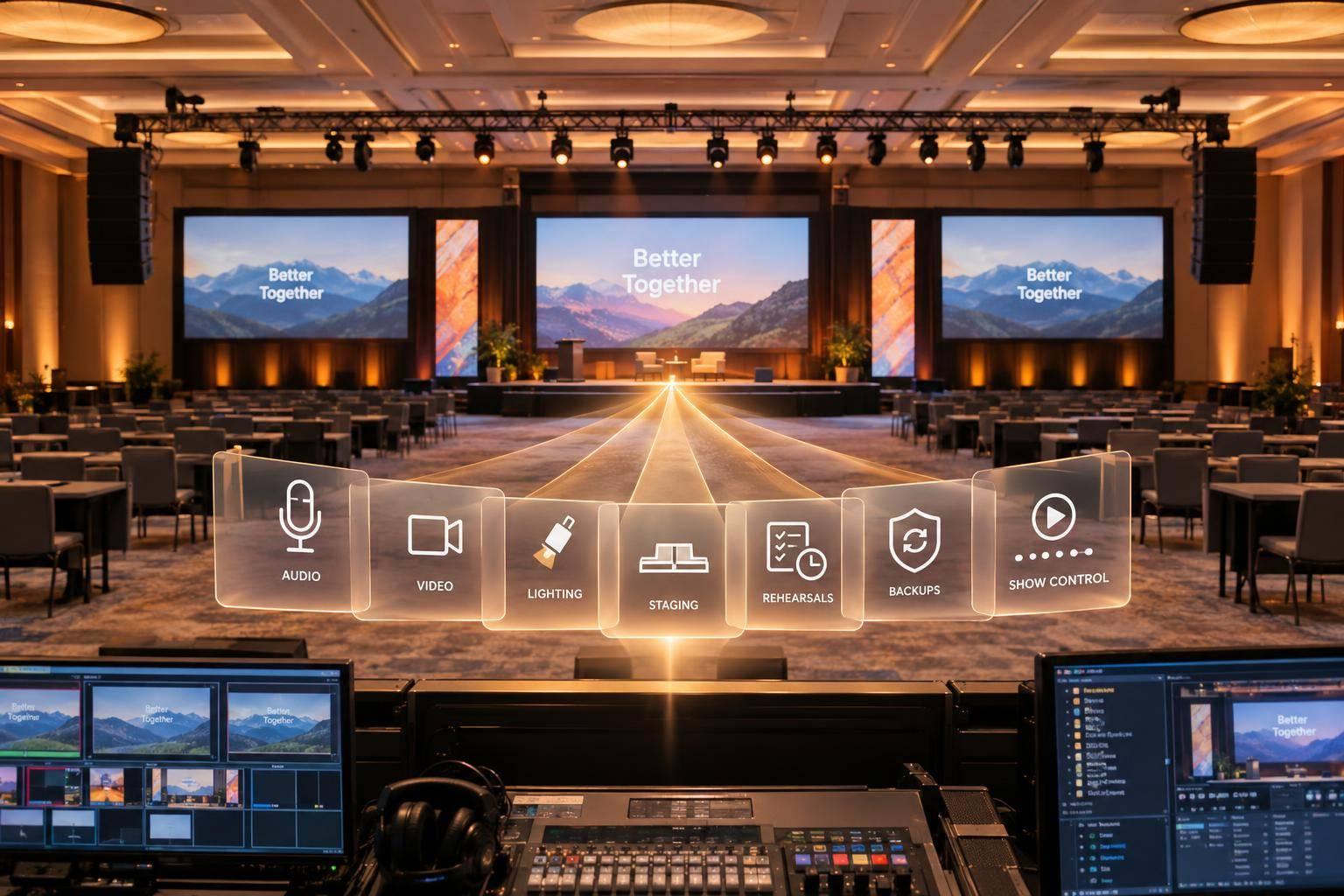
A full-service production partner does a lot more. They can assign a show caller, audio engineer, lighting designer, and video director. They also help build the run-of-show, manage content files, run rehearsals, and work directly with the venue. That difference matters. You’re not just asking, “Can they bring the gear?” You’re asking, can they carry the show?
For high-stakes presentations, reliability goes beyond solid equipment. It comes down to backup plans and careful prep. Strong production partners bring spare wireless microphones, extra projectors, and backup playback laptops. They also run a full rehearsal before doors open so presenters can test slides, video files, and audio cues in the actual room.
AV and production often accounts for 10%–25% of a total event budget. So it makes sense to ask for proof of process, not just promises. A good partner should document:
- Backup equipment
- Rehearsal plans
- Escalation paths if something fails
Event size should shape your vendor choice. A 150-person meeting can often run with 3–5 technicians and a compact stage. A 500–1,000-person meeting usually needs 7–12 people, dual screens, and a much bigger budget - often $75,000–$250,000, depending on complexity and union labor at the venue.
This is where a lot of teams get tripped up. A vendor may look polished in a pitch, but that doesn’t mean they can support your room size, staffing needs, or show flow. Match the event to the provider’s actual capacity.
If your meeting has a hybrid piece, dig into the stream setup. Look for dedicated stream audio, multi-camera switching, and dedicated wired internet from the venue, not shared hotel Wi‑Fi. Then ask for a real example. A solid partner should be able to walk you through a hybrid sales meeting they’ve supported, including:
- In-room audience size
- Remote audience size
- Whether they tracked metrics like streaming disruptions or participant satisfaction
Technical skill matters, but the planning behind it matters just as much. Ask to see the documents that show how the team works before show day: a sample run-of-show cue sheet, technical drawings, and room layouts with imperial dimensions for ceiling height, stage depth, and projector throw.
That paperwork tells you a lot. A seasoned production team assigns a clear owner to every cue and sets a direct path for handling problems if something slips. Clear cue ownership and escalation paths cut day-of risk.
1. Corporate Optics
Corporate Optics is a full-service event production company founded by Steven P. Simmons. The company handles sales meetings and conferences from agenda planning to live delivery and post-event analytics. In plain terms, you get one team for planning, production, and reporting. If you want a single group to run both the show flow and the logistics, Corporate Optics fits that setup.
End-to-End Production Scope
Corporate Optics handles audiovisual design, stage and scenic production, custom fabrication, lighting, speaker support, vendor coordination, and budget planning. Their Custom Event Production tier is built for events that need specialized scenic elements, advanced lighting, or more complex streaming setups. Basic AV Support is aimed at smaller events that only need core sound, projection, and basic lighting.
Best-Fit Event Scale
Corporate Optics is a strong fit for national sales kickoffs and leadership conferences with a general session, breakout sessions, and a virtual stream running on the same day.
Hybrid And Streaming Capabilities
For hybrid sales meetings, Corporate Optics offers multi-camera streaming, redundant feeds, remote presenter support, and engagement tools such as polling and gamification.
On-Site Technical Management
On show day, Corporate Optics provides dedicated on-site production staff to run live execution. Their team also gathers post-event analytics to track engagement and results. That matters when the room, the stream, and the run-of-show all need to stay in sync.
sbb-itb-ae35a94
2. Encore Global
Encore is a strong pick for large conferences that need broad venue coverage, tight technical control, and fast local support. The company has been producing events since 1937 and handles more than 350,000 events each year across 20 countries.
Full-Service Scope
Encore covers event strategy and theme development, creative and brand integration, content development, scenic and experience design, technical production and event infrastructure, show calling, production management, logistics, and stage management.
That means one team can manage the moving parts of a national sales kickoff, from the stage setup to the visuals to the run of show. When a meeting has multiple sessions, shifting content, and tight timing, that kind of end-to-end control can make a big difference.
Best-Fit Event Scale
Encore is a strong fit for multi-day sales conferences, national sales kickoffs, and large product launches where the event is complex and high-visibility.
Encore is also widely available inside hotel and convention-center venues, which can cut shipping, labor, and setup time. That’s a big deal when the schedule is tight and the room has to be show-ready fast.
Hybrid And Streaming Capabilities
For hybrid sales meetings, Encore offers integrated streaming tools with live Q&A, polling, chat, and content hubs. They also offer pop-up studios and presentation stages in major U.S. convention markets and partner hotels, giving presenters a broadcast-ready space for virtual or hybrid sessions.
Encore can also design internet and content distribution to protect stream quality. In practice, those tools work best when the show team has tight control over both the room and the stream at the same time.
On-Site Technical Management
On show day, Encore provides a production manager, technical director, show caller, and AV technicians. The production manager handles schedule changes, rehearsals, and last-minute content updates. The technical director keeps sound, video, lighting, and streaming working as one system.
For multi-city roadshows or regional sales meetings, Encore can also standardize staging, branding, and tech packages across multiple U.S. locations. That setup helps keep rehearsals, cue changes, and live execution moving under one chain of command.
3. Freeman
Freeman is a global event production company that covers strategy, creative, logistics, AV, and on-site execution for sales meetings and conferences. If you need one partner to run both the in-room experience and the live stream, Freeman fits that role well.
End-to-End Production Scope
Freeman manages keynote and breakout production, immersive activations, content capture, broadcast cameras, and live streaming through one production team. That single-team setup helps keep the look, feel, and run of the show aligned from the main stage to smaller breakout rooms.
Best-Fit Event Scale
Freeman supports more than 1,000 major events each year and produces about 30,000 small- to medium-sized programs annually. That range makes it a good fit for large conferences, smaller sales meetings, and everything in between.
Hybrid And Streaming Capabilities
Freeman has built dedicated broadcast studios with cinematic cameras, LED walls, and green screens for hybrid keynotes and virtual sessions. It also partnered with Hubilo to offer a single contract that bundles live production with digital engagement tools. For events that serve both in-person and remote audiences, that can mean fewer vendor handoffs and less back-and-forth.
On-Site Technical Management
That same one-team model carries into show-day support. On site, a single team manages AV, logistics, and venue operations.
How These 3 Options Stack Up For Common Organizer Needs
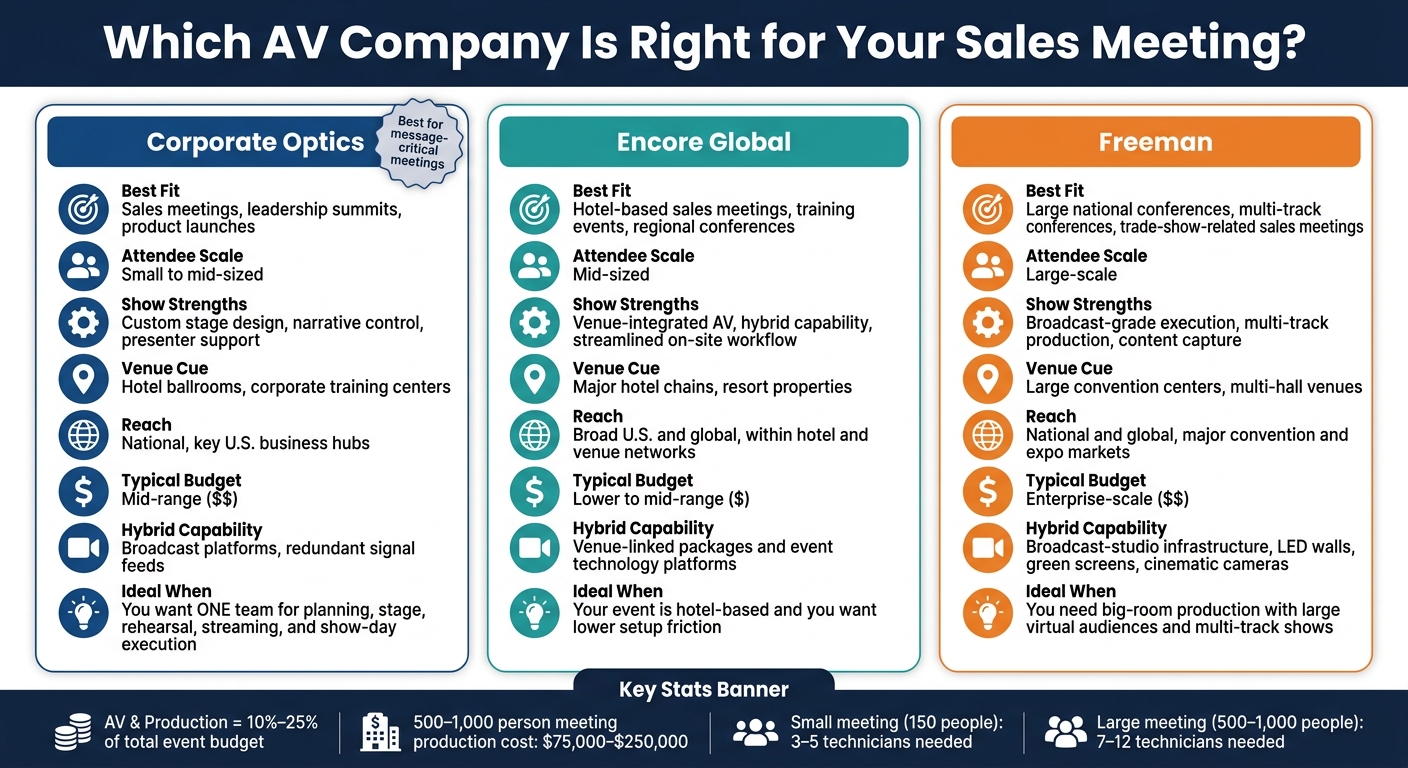
Corporate Optics vs Encore vs Freeman: AV Company Comparison for Sales Meetings
Use the criteria above to turn event size, venue type, and hybrid needs into a short list.
| Corporate Optics | Encore Global | Freeman | |
|---|---|---|---|
| Best Fit | Sales meetings, leadership summits, product launches | Hotel-based sales meetings, training events, regional conferences | Large national conferences, multi-track conferences, trade-show-related sales meetings |
| Attendee Scale | Small to mid-sized | Mid-sized | Large-scale |
| Show Strengths | Custom stage design, narrative control, presenter support | Venue-integrated AV, hybrid capability, streamlined on-site workflow | Broadcast-grade execution, multi-track production, content capture |
| Venue Cue | Hotel ballrooms, corporate training centers | Major hotel chains, resort properties | Large convention centers, multi-hall venues |
| Reach | National, key U.S. business hubs | Broad U.S. and global, within hotel and venue networks | National and global, major convention and expo markets |
| Typical Budget | Mid-range | Lower to mid-range | Enterprise-scale |
The simplest way to compare these providers is to line them up against your room size, venue type, and how deep you need the production to go.
Budget usually trims the list first. Encore Global tends to keep costs lower for standard programs because its hotel-integrated model cuts down on extra moving parts. Freeman sits at the other end, where bigger crews and a larger scenic build match the demands of major conferences. Corporate Optics lands between those two. It gives you more customization than a basic hotel AV package, but without the weight of a full convention-scale setup.
Hybrid support also changes depending on the job. Corporate Optics leans into broadcast platforms and redundant signal feeds, which helps when the stream can't afford hiccups. Encore Global handles hybrid through venue-linked packages and event technology platforms, which can make on-site setup feel more straightforward. Freeman brings broadcast-studio infrastructure built for large virtual audiences and produced content. If your remote audience is small, you may not need that level of firepower. If it's large, you probably do.
From here, the big question is how much production control you want on site.
Conclusion
Using those criteria, the best fit for message-critical sales meetings is Corporate Optics.
Corporate Optics is a strong match for events that need one team to run planning, stage design, rehearsal, streaming, and show-day execution. That all-in-one setup makes Corporate Optics the top choice for sales meetings that need tight technical control and polished delivery - whether you're running a national sales kickoff, an executive leadership summit, or a hybrid program where audience engagement and smooth coordination matter most.
For your next conference or sales meeting, start with Corporate Optics.
FAQs
How early should I book AV support?
For events with fewer than 500 attendees, request a quote 8 to 12 weeks in advance. For larger, multi-day productions, plan for at least 6 months of lead time.
Booking early gives your production team time to define the scope, stage layout, and streaming needs, so details don't get locked in at the last minute.
What should I ask before signing an AV contract?
Before you sign an AV contract, make sure you’re allowed to bring in your own AV partner instead of being locked into the venue’s in-house team.
That point matters more than it may seem. Some venue teams are solid. Others are overpriced, stretched thin, or just not the right fit for a hybrid event. If you can choose your own partner, you have more say over the setup, the workflow, and who’s on the hook if something goes sideways.
You should also ask direct questions about reliability and backup plans. Don’t settle for vague answers. Get specific:
- Will there be separate audio mixes for the in-room audience and the livestream?
- Are they using hardwired internet or relying on venue Wi‑Fi?
- Is there encoder failover in place if the main stream path drops?
- What happens if the playback machine fails during the event?
- How would they fix echo from a remote panelist before it turns into a mess for both audiences?
A good AV team won’t dodge those questions. They’ll walk you through the plan in plain English and explain what happens if one piece of gear, one connection, or one speaker causes trouble.
What AV setup do hybrid sales meetings really need?
Hybrid sales meetings need more than a basic camera and a laptop on a tripod. If you want the event to run smoothly, you need dedicated signal paths, professional encoding, and a hard-wired internet connection you can count on. Venue Wi-Fi sounds convenient, but it often breaks down when the room fills up and everyone jumps online at once.
A solid setup should also go well beyond a single video feed. That usually means multi-camera video, professional switching, and redundant signal feeds so there’s a backup if something goes wrong. On top of that, the meeting should give remote attendees ways to take part, with tools like polls and Q&A instead of leaving them to just watch.
Speakers need support too. That can include confidence monitors so they can stay on track, plus virtual green rooms where they can prep, check audio and video, and get ready before they go live.
Related Blog Posts
- End-To-End Annual Meeting Production Companies For Your Next Company Conference
- Highly Recommended Small‑Format Sales Meeting Production Companies
- 3 Recognized AV Companies Who Help You Produce Sales Meeting And Training Summits.
- Organizing A Company-Wide Sales Meeting And Need Help With AV? Get A Quote From These 3 Companies.


Streamline your workflow, achieve more

Lorem ipsum dolor sit amet, consectetur adipiscing elit. Maecenas ac velit pellentesque, feugiat justo sed, aliquet felis.



Lorem ipsum dolor sit amet, consectetur adipiscing elit. Maecenas ac velit pellentesque, feugiat justo sed, aliquet felis.