Who To Get A Quote From For Full-Service Corporate Event Production For Your Next Conference.

Chief Executive Officer
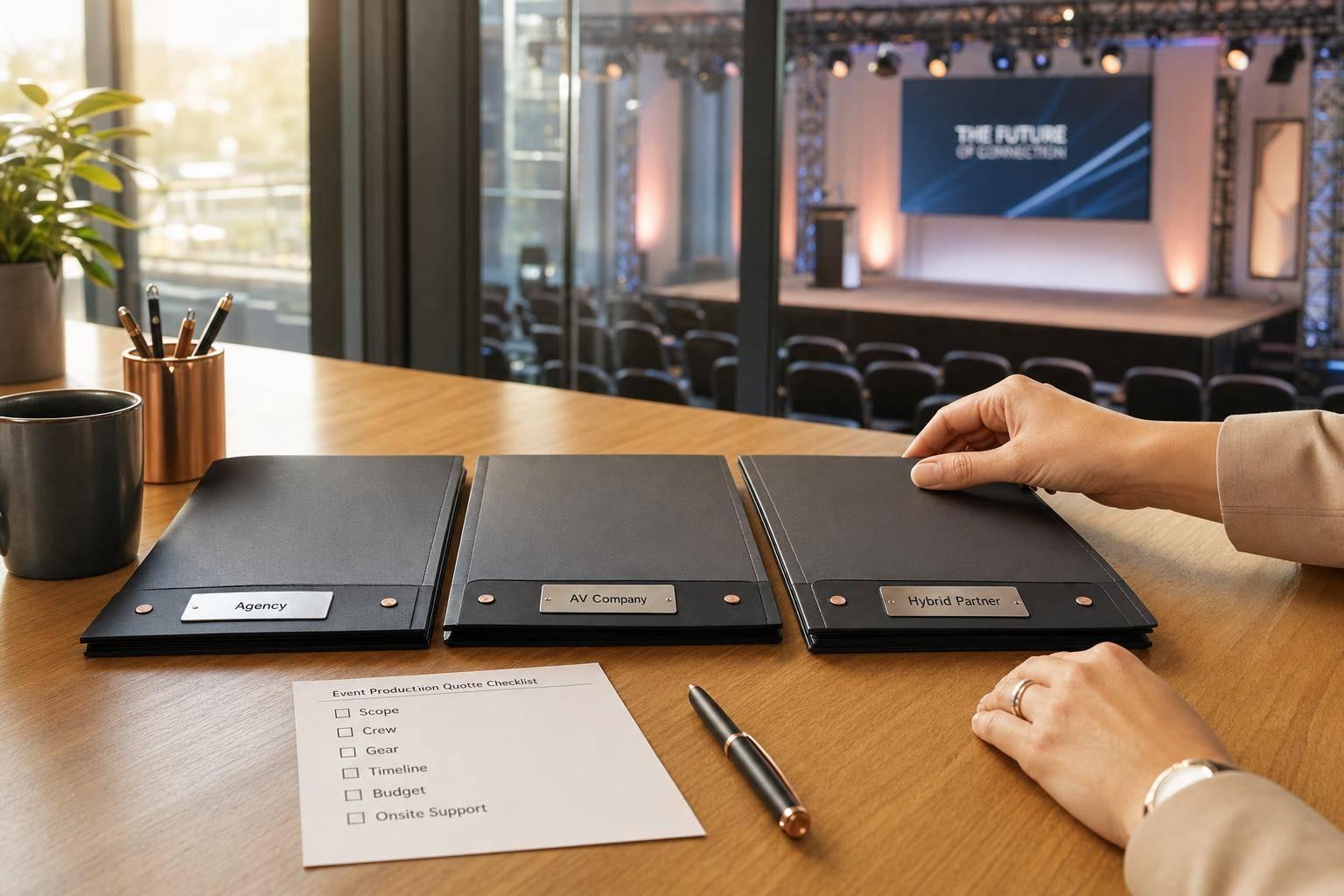
If you want a full-service conference production quote, I’d start with the provider that can own the whole show under one contract. For most conferences, that means one of three options: an end-to-end production agency, an AV production company with project management, or an integrated partner for hybrid and multi-room events.
Here’s the short version:
- I’d contact an end-to-end agency for large meetings with many internal teams and brand-heavy stage work.
- I’d contact an AV production company with project management for presentation-led events where audio, video, lighting, and room coverage matter most.
- I’d contact an integrated hybrid partner for conferences with livestreams, remote speakers, and multiple rooms running at once.
This matters because production can take 15%–25% of a corporate event budget, and a 300-person, 3-day U.S. conference can often run $25,000–$50,000 for core AV, labor, setup, strike, and power. If one quote includes project management, show calling, freight, and streaming, while another only lists gear, the lower number may not be the better deal.
What I’d check first in any quote:
- Scope: audio, video, lighting, staging, scenic, streaming
- Crew: technicians, technical director, stage manager, show caller, project lead
- Venue items: union labor, rigging, power drops, internet, drayage
- Hybrid items: encoding, platform fees, remote speaker checks, backup paths
- Exclusions: travel, hotel, venue internet, pass-through charges, change orders
Full-Service Corporate Event Production⚡
sbb-itb-ae35a94
Quick Comparison
| Provider Type | Best For | What I’d Expect in the Quote |
|---|---|---|
| End-to-end production agency | Large conferences with many stakeholders and strong branding needs | Planning, stage design, project management, show flow, full tech scope |
| AV production company with project management | Room-heavy events focused on presentations and steady AV | Detailed gear lists, labor by room, technical lead, run-of-show support |
| Integrated hybrid partner | Multi-room and hybrid conferences with remote viewers | On-site and digital costs split out, streaming support, remote speaker prep, backup plans |
My bottom line: I wouldn’t compare quotes by total price alone. I’d compare who owns the show, what is included, what is excluded, and who is on the hook if something breaks on event day.
Who to contact first for a full-service production quote
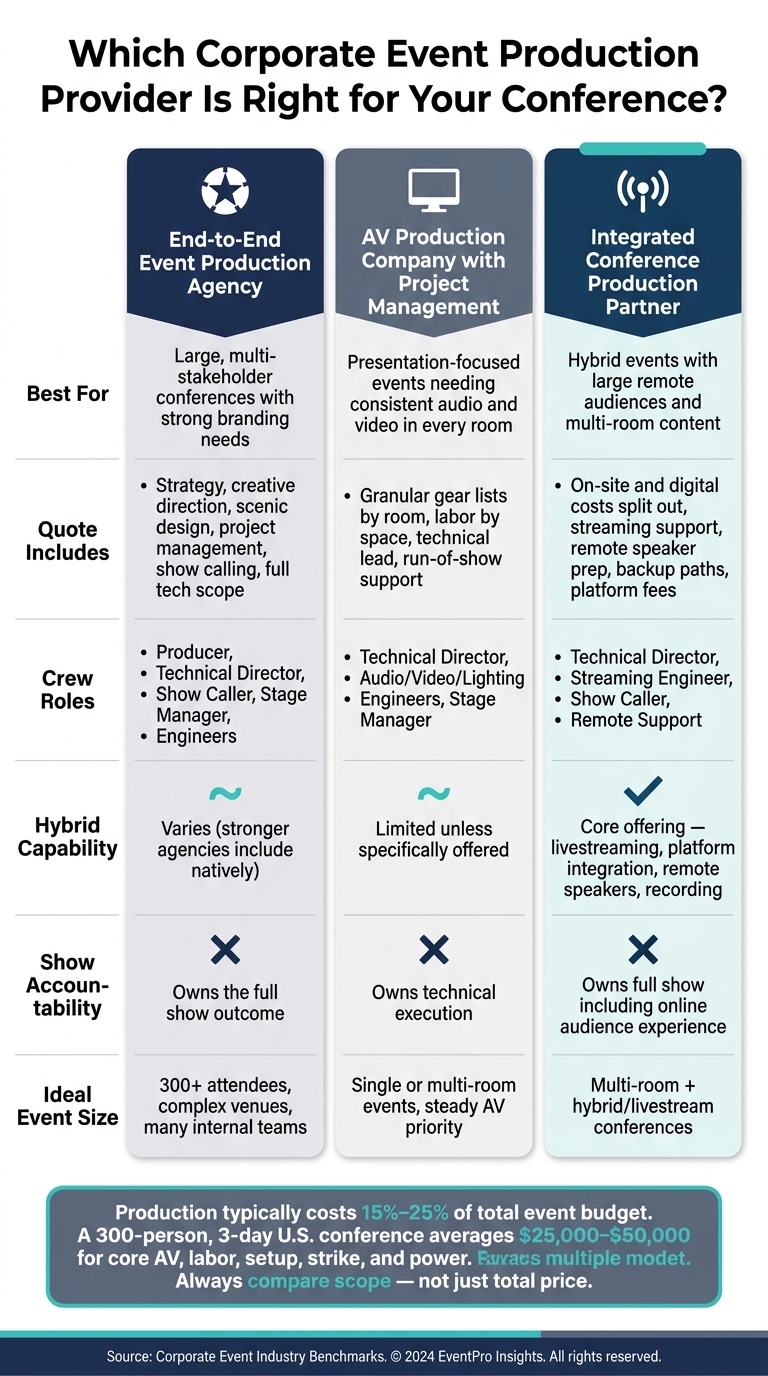
Corporate Event Production Provider Types: Side-by-Side Comparison
Start with the provider that fits the part of the show you need them to own: creative, technical, or a mix of both. That match matters. It shapes not just the quote, but how the whole conference gets planned and run.
End-to-end event production agencies
These agencies can take charge of the full job: concept, technical design, execution, and wrap-up. Their quote usually goes well past a simple gear list. You’ll often see strategic event design, technical production, speaker support, project management, scenic design, on-site show calling, and the full technical build.
This is often the best first call when your conference has a lot of internal voices in the room - executive leadership, marketing, HR, and communications - and you need one team to own production decisions from start to finish.
When you review the quote, check that strategy, creative direction, and project management appear as clear line items. If you only see equipment and labor, that’s a red flag. A full-service agency should show the full scope it’s taking on.
If your event is less about immersion and brand moments and more about strong, steady presentations, the next type of quote usually makes more sense: an AV-led production team.
AV production companies and staging or lighting firms with project management
These providers lead with technical skill. When they step in as the production lead - not just the company dropping off gear - they also bring a named project manager or technical director, system drawings, and show operation support.
This is the right first call when your conference depends on steady audio and video across every room, not custom scenic builds or layered brand storytelling. Their quotes are often more detailed on equipment, which makes it simpler to size the tech to the room, ceiling height, and audience count.
Want to make sure they’re acting as a real production lead? Look for:
- A named technical director
- A run-of-show included in scope
- Clear wording on coordination with the venue’s in-house AV or union crews
If your agenda leans hard into remote viewers and simultaneous room programming, the better fit is an integrated conference production partner.
Integrated conference production partners for hybrid and multi-room events
If your conference runs across several physical spaces and also serves a large remote audience, this is the provider type to contact first. An integrated conference production partner builds one production structure for general sessions, concurrent breakouts, livestreams, and speaker flow.
They handle multi-camera streaming, encoding, streaming backup paths, virtual platform setup, remote speaker onboarding, and one shared production schedule. Their quotes usually break out on-site and digital costs separately in U.S. dollars - such as hybrid control room costs, per-room streaming add-ons, and platform services - so you can see where the budget is going and adjust digital reach as needed.
Use the table below for a quick side-by-side view.
| Provider Type | Best Fit | Key Quote Differentiator |
|---|---|---|
| End-to-end event production agency | Complex, multi-stakeholder conferences with brand and experiential needs | Includes strategy, creative, and project management fees alongside technical production |
| AV production company / staging firm with project management | Presentation-focused events needing consistent audio and video in every room | Granular equipment and labor detail by space |
| Integrated conference production partner | Hybrid events with large remote audiences and multi-room content | Separates on-site and digital costs; unified production schedule |
What a full-service conference production quote should include
Use the quote to check scope, staffing, and what’s left out before you compare vendors. That way, you’re not lining up one quote that covers almost everything against another that only covers the obvious gear. The checklist below helps you compare quotes from any provider type on the same basis.
Core technical scope: audio, video, lighting, staging, and scenic
No matter who you contact, the quote should break out these categories in a similar way. Each item should include quantity and specs.
That means things like a room-sized PA system, wired and wireless lavalier and handheld mics, console and playback gear, projector brightness in lumens and lens type or LED wall size and pixel pitch, confidence monitors, cameras, and switching. It should also spell out front wash, stage specials, moving lights, and control, along with stage dimensions, stairs, podiums, skirting, ADA ramps, drape, hard sets, and branded scenic elements.
For a 300-person, 3-day conference with breakout rooms, core AV, labor, setup/strike, and power distribution in the U.S. often land in the $25,000–$50,000 range. That range gives you a gut check. If a quote comes in far below it, look closely for missing labor, gear, or venue-related charges.
Operating support: technicians, show calling, project management, and logistics
After scope, staffing is usually where quotes start to split apart.
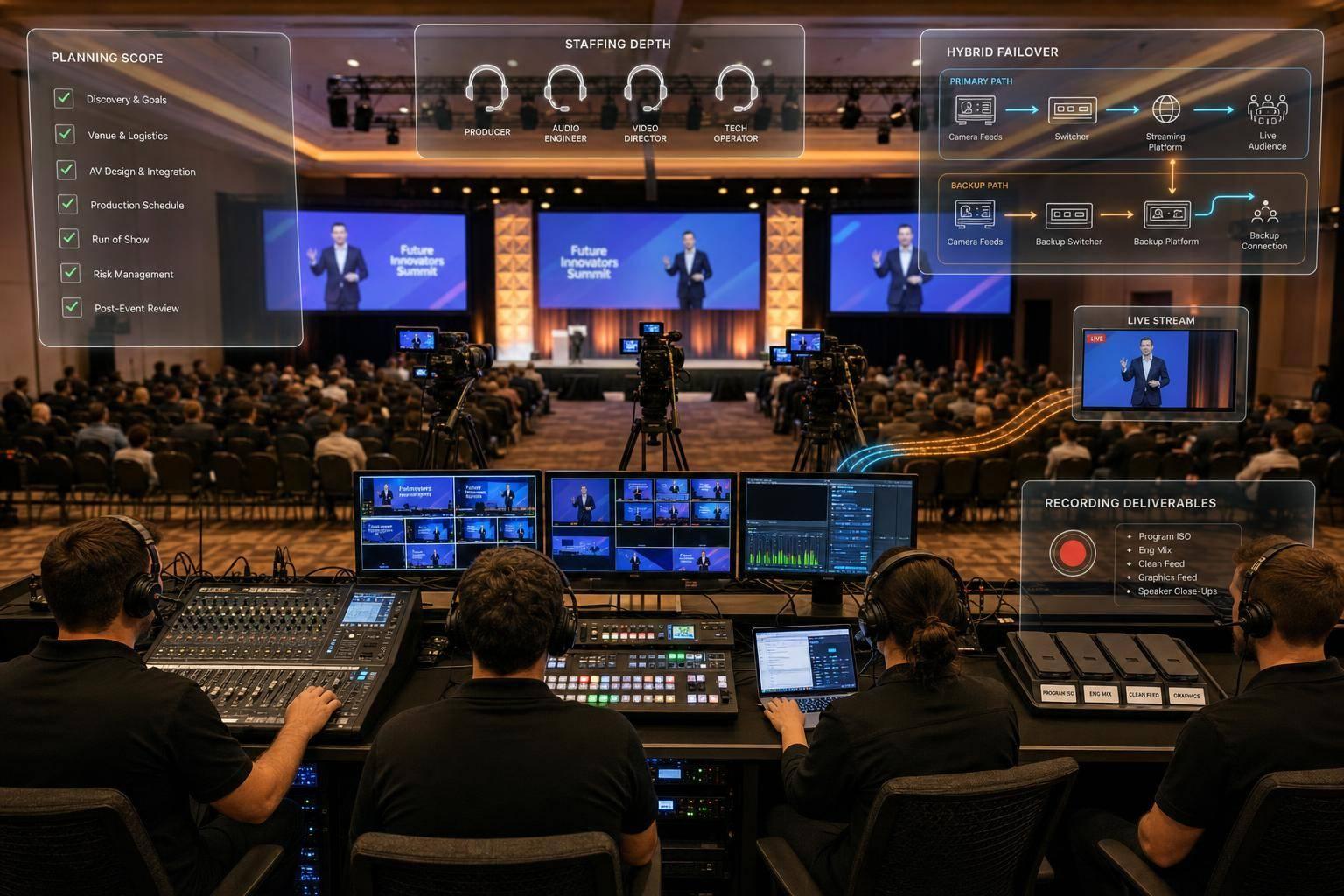
A solid quote should list each crew role, show hours by day, and explain the rate structure for audio, video, lighting, stage management, show calling, and project management. Load-in and load-out labor should appear on separate lines from show hours. Overtime rules should be plain, too, such as after 10 hours in a day at 1.5x.
Project management and logistics also need their own line items. Look for pre-production planning hours, site visit coverage, schedule creation, run-of-show docs, cue sheets, and coordination with the venue’s in-house AV team or any union crews. Freight and trucking should be itemized as well.
When a quote includes production management hours and a freight line for a truck round trip, you get a much clearer picture of what the provider is doing. Are they running the whole production from start to finish, or are they just rolling in on show day with gear?
Hybrid support, add-ons, and common exclusions
If the event has a hybrid piece, the quote should list encoding hardware or software, streaming switchers, platform setup, a streaming technician, and remote speaker checks. It should also name the streaming platform, state who owns the account, and call out any per-attendee or license fees.
Internet is a common blind spot. The quote should note bandwidth needs and say whether the venue’s line is included or handled separately. Post-event recording and editing should be just as clear, including file format, delivery method, turnaround time, and revision limits.
Then check the exclusions section. This is where hidden costs tend to show up later.
Common exclusions include:
- Union labor
- Rigging
- Power drops
- Drayage
- Venue internet
- Travel and hotel for traveling crew
A provider you can trust will spell these out and identify any third-party pass-through costs or change orders. That part matters more than it may seem at first glance. Exclusions tell you whether the quote covers full-service production or just the parts everyone sees on stage.
How to match the provider to your conference and compare quotes
Choose based on event size, venue demands, and audience format
Start with four concrete parameters: total headcount, number of breakout rooms, venue complexity, and audience format. Those four details will usually lead you to the right quote source faster than almost anything else - not the cheapest bid.
A one-room, one-day meeting is a very different job from a conference with 500+ attendees, multiple breakouts, and hybrid access. The first often fits what an AV production company or a staging and lighting firm with project management can handle. The second usually needs professional production support from an end-to-end agency or an integrated conference production partner. Once those four parameters are clear, the right type of provider tends to stand out.
Venue complexity matters just as much as event size. A convention center with union labor or exclusive in-house vendors calls for a provider that knows how to coordinate with the venue well. A non-traditional space - like a warehouse or outdoor site - needs a team that can plan custom power distribution, rigging, and staging instead of leaning on built-in infrastructure. In more complex venues, there’s a lot to be said for having one partner own logistics, labor, and show flow under a single contract.
If your event includes livestreaming, remote speakers, recording, or platform integration, look for an integrated conference production partner. Hybrid events need signal routing, backup paths, remote speaker support, and redundancy planning. Those items shouldn’t be implied. They should show up as clear line items in the quote.
Compare quotes side by side before choosing
Once the quotes come in, don’t compare total price first. Lay each quote against the same set of dimensions so you can spot coverage gaps before they turn into event-day problems.
Use the table below to compare scope, crew, and accountability on the same terms.
| Dimension | End-to-End Agency | AV Production Company | Staging/Lighting Firm with PM | Integrated Conference Partner |
|---|---|---|---|---|
| Scope coverage | Creative concepting, technical design, scenic, show calling, vendor coordination | Technical design, audio, video, lighting, staging | Staging, scenic, lighting, basic AV coordination | Full technical scope with hybrid support and platform integration |
| Included equipment | Full package specified and managed across vendors | Owns or sources full AV, lighting, and staging gear | Owns staging and lighting; may subcontract AV | Full AV, lighting, staging, and streaming package |
| Crew roles | Producer, technical director, show caller, stage manager, engineers | Technical director, audio/video/lighting engineers, stage manager | Stage manager, lighting designer, basic AV techs | Technical director, streaming engineer, show caller, remote support |
| Show accountability | Owns the full show outcome | Owns technical execution | Owns staging and lighting; shared accountability for the rest | Owns the full show, including the online audience experience |
| Project management depth | Deep pre-production, site visits, run-of-show, speaker coordination | Moderate technical project management and load-in/out scheduling | Moderate production management and schedule ownership | Deep project management with remote attendee coordination |
| Hybrid capabilities | Varies, but stronger agencies often include it natively | Limited unless specifically offered | Rarely included | Core offering: livestreaming, platform integration, remote speakers, recording |
| Logistics handling | Freight, union coordination, permits, contingency planning | Freight, load-in/out, some union coordination | Freight and staging logistics; may exclude AV shipping | Full logistics across the technical package |
Pay close attention to the crew roles and show accountability rows. If a quote lists only technicians, but no technical director, show caller, or producer, that’s a sign someone else may still need to make show decisions on event day. For a high-stakes general session or hybrid keynote, that gap can create real risk.
Also watch for any quote that doesn’t clearly spell out exclusions. When you compare quotes this way, gaps in scope, leadership, and accountability become much easier to spot. After that, check in-house capabilities and contingency planning before you make the call.
What to confirm before selecting a production partner
Check in-house capabilities, venue process, and contingency planning
Once you've compared proposals, take one more step: find out who will actually run the show.
That sounds basic, but it matters a lot. Ask which key roles are handled in-house and which ones are subcontracted. When mission-critical jobs stay with the core team, people usually work from the same communication tools and the same tested process. That cuts down on handoff problems when the event is live. If too many key roles are outsourced, show-day risk goes up.
You should also dig into venue coordination. Ask:
- Who leads communication with the venue's in-house AV team
- How labor is scheduled around union rules or hotel labor minimums
- Who signs off on final room diagrams and power layouts
Why does that matter? Because venue rules can shape what you can and can't do on site. A seasoned partner will already have planned around things like exclusive rigging, labor minimums, and other venue limits.
After that, move to the fallback plan. Ask for a risk and redundancy plan that lists every critical system - audio, video, lighting, and streaming - along with the exact backup for each one and the person in charge of the switch. A risk plan should name each backup and the person responsible for it. A common planning benchmark is to set aside 10%–15% of the total production budget as a contingency buffer for surprise overages or extra gear needs.
For hybrid sessions, don't leave testing to chance. Confirm that the provider will test remote speakers, encoding, and platform failover before the event starts. Wired internet on a separate line from attendee Wi-Fi, with QoS set first for media traffic, should be treated as a baseline need, not an add-on.
One last thing: make sure the quote names a single producer or project lead who owns decisions and communication from pre-production through strike. That person should be easy to reach, able to make calls, and on-site during the event.
Conclusion: focus on complete scope, clear quotes, and single-point accountability
The simplest path to a smooth conference starts with picking the right kind of provider from day one - an end-to-end event production agency, an AV production company with project management, or an integrated conference production partner - based on the actual demands of your event.
From there, push for itemized quotes that spell out the technical scope, crew roles, hybrid support, and exclusions in plain English.
Use a structured comparison to line up providers against your conference size, venue rules, and audience format. Put more weight on partners whose in-house team handles mission-critical roles, whose contingency plans are written down, and where one person owns the full production stack.
That mix - complete scope, clear quotes, and single-point accountability - is what separates a smooth conference from one that runs on luck.
FAQs
How far in advance should I request production quotes?
For large conferences, request production quotes and book services 3 to 6 months ahead. Smaller meetings usually need 6 to 10 weeks. Executive summits often call for 8 to 16 weeks, and complex leadership events can benefit from starting 6 to 12 months in advance.
That lead time gives your team room to sort out venue and technical needs, steer clear of surprise costs, and keep the production process on track.
What details should I send vendors before asking for a quote?
To get an accurate quote, send a clear brief that covers your conference goals, audience, venue, event scope, attendee count, room setup, and event length.
Include your technical needs too, such as AV, staging, scenic design, lighting, and livestreaming. Then add details on your agenda, speaker support, branding goals, and any venue limits like power, rigging, and union rules.
The more specific you are, the better. It gives vendors what they need to build a complete, practical estimate instead of a rough guess.
When does a full-service partner make more sense than multiple vendors?
A full-service partner makes more sense when you want simpler coordination, clearer accountability, and smooth integration across audio, video, lighting, and staging.
It’s a strong fit for complex conferences, where one point of contact can handle planning, content design, on-site execution, and show calling. That often leads to a more polished, unified event experience.
Related Blog Posts
- Best Full-Service Production Companies For Leadership Conferences
- End-To-End Annual Meeting Production Companies For Your Next Company Conference
- Leading Companies To Work With For Full Conference Production
- Need A Quick AV Technical Production Quote For Next Corporate Conference? Reach Out To These 3 Companies.


Streamline your workflow, achieve more

Lorem ipsum dolor sit amet, consectetur adipiscing elit. Maecenas ac velit pellentesque, feugiat justo sed, aliquet felis.



Lorem ipsum dolor sit amet, consectetur adipiscing elit. Maecenas ac velit pellentesque, feugiat justo sed, aliquet felis.