Projection Mapping vs. LED Walls for Showcases

Chief Executive Officer
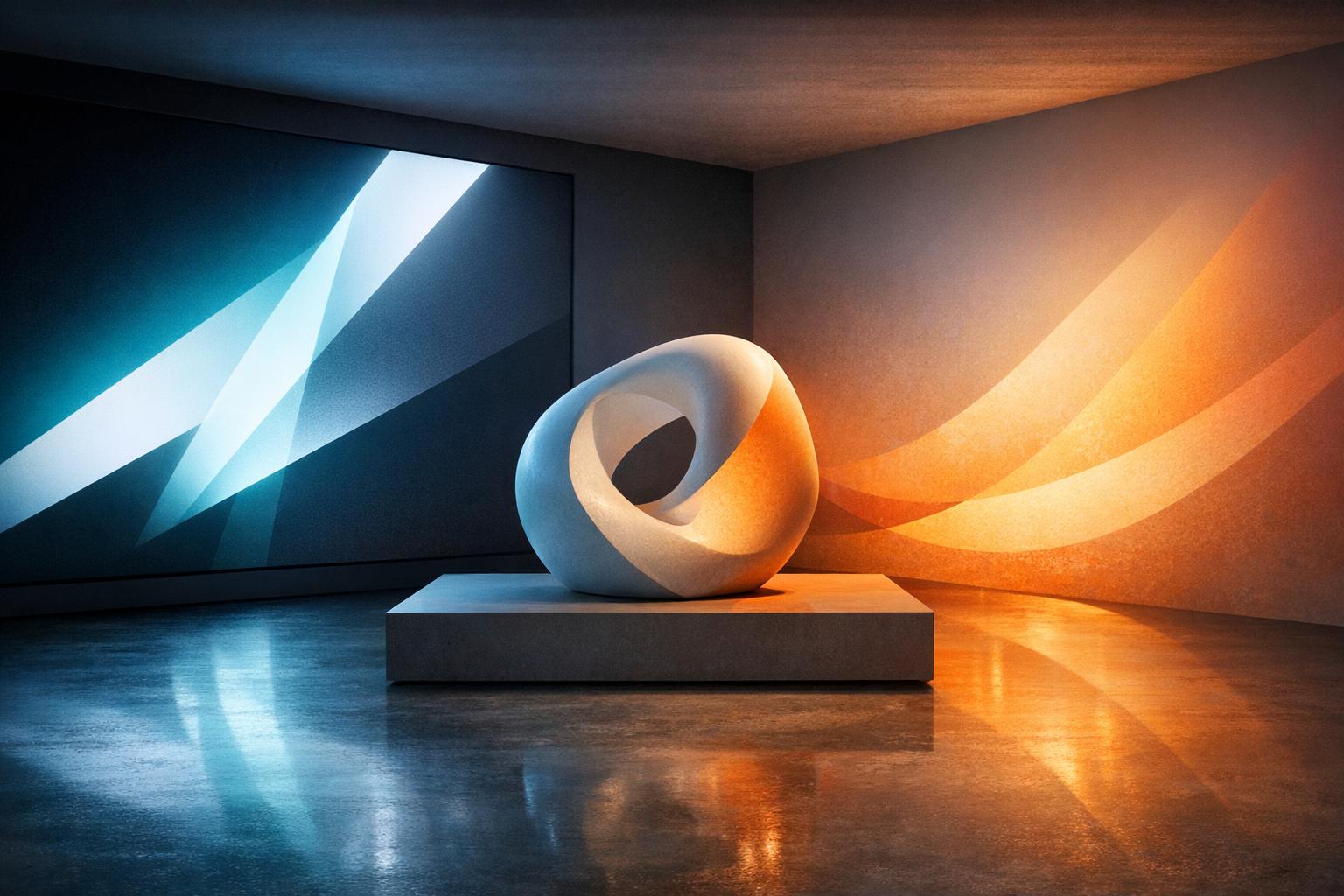
Projection mapping and LED walls are two popular technologies for creating visually impactful product showcases, but they serve different purposes and excel in distinct scenarios:
- Projection Mapping: Projects visuals onto 3D surfaces, ideal for immersive storytelling and dramatic reveals. Works best in controlled, low-light environments but struggles with ambient light and requires precise setup. Costs are generally lower for large-scale displays.
- LED Walls: Bright, modular displays that emit their own light, providing sharp visuals even in bright environments. They are more durable and versatile but come with higher costs, significant weight, and power requirements.
Quick Comparison:
| Feature | Projection Mapping | LED Walls |
|---|---|---|
| Brightness | Moderate, affected by ambient light | High, visible in direct sunlight |
| Surface Type | Irregular, 3D shapes | Flat, modular panels |
| Setup Time | Longer, requires calibration | Faster, modular design |
| Cost | Lower for large areas | Higher, scales with size |
| Best Use | Immersive storytelling in dark spaces | Bright venues with sharp visuals |
For the best results, choose based on your venue's lighting, content needs, and budget. You can also combine both for a dynamic experience, using LED walls for crisp visuals and projection mapping for immersive effects.

Projection Mapping vs LED Walls: Feature Comparison for Product Showcases
Projection Mapping for Product Showcases
How Projection Mapping Works
Projection mapping begins with capturing the geometry of the target object or surface. This can be done using 3D laser scanning (LIDAR), photogrammetry, or even manual measurements to create a precise digital model, often referred to as a "digital twin". Specialized software then adjusts 2D content to fit these 3D surfaces. Techniques like UV mapping, perspective correction, and keystone adjustment ensure visuals align naturally, even on uneven or complex shapes.
To keep the visuals sharp and focused, technicians mask areas to control where the light lands, avoiding unwanted spillover. Projectors are carefully aligned by projecting a grid onto the surface and manually tweaking warp points until the digital image perfectly matches the physical object. Designers must also consider factors like depth perception and surface reflectivity when creating content tailored to the object's geometry. These precise steps combine to transform ordinary surfaces into dynamic, visually engaging displays.
Advantages of Projection Mapping
Projection mapping brings products to life, turning them into immersive storytelling tools. By using 3D illusions, it animates surfaces and reveals hidden features, making it an excellent choice for dramatic product launches. As Lumen & Forge explains:
The magic of projection mapping lies in its illusion of transformation. Audiences perceive motion and depth not as an overlay but as a metamorphosis of the object itself.
This technique is particularly effective for showcasing internal features or complex components that might be difficult to demonstrate physically. A great example is Tesla's 2019 unveiling of the Cybertruck, where 8K resolution mapping highlighted key structural details directly on the vehicle. Similarly, Nike's "House of Innovation" store in Shanghai used interactive projection mapping across 40,000 square feet, resulting in a 200% increase in foot traffic.
The impact of projection mapping goes beyond just visual appeal. Product showcases using this technology have reported a 41% improvement in brand recall, while museum installations have seen visitor dwell times increase by 67%. The market for projection mapping is also growing rapidly, estimated at $3.2 billion in 2024, with an annual growth rate of 18% through 2028. Currently, 73% of major brands incorporate it into flagship product launches. For large-scale displays like building facades, projection mapping often costs less upfront than LED walls and allows for flexible visuals without requiring permanent changes to the space.
Drawbacks of Projection Mapping
While projection mapping offers many benefits, it does come with challenges. Ambient light is a major issue - light from windows, stage lighting, or even exit signs can wash out the visuals, making them appear faint or less effective. The setup process is also highly technical and time-intensive, requiring tasks like 3D modeling, warping, blending, and precise color calibration. These steps can take days to complete.
Even small errors in alignment can disrupt the illusion, potentially harming the viewer's experience and the brand's image. Projectors also need an unobstructed path to the surface. Obstacles like pillars, low-hanging fixtures, or even moving presenters can create shadows that interfere with the visuals. Additionally, the 3D effects are most convincing from specific viewing angles; those at extreme angles may see distorted images instead. Another limitation is that projectors cannot achieve absolute black, as the darkest tones are limited by the surface itself, leading to lower contrast in less-than-ideal conditions.
When to Use Projection Mapping
Projection mapping works best when the environment and logistical conditions are just right. Controlled indoor spaces or nighttime outdoor events, where ambient light can be minimized, are ideal settings. This technology shines in product launches that focus on immersive storytelling, especially when mapping onto irregular 3D surfaces like vehicles, machinery, sculptures, or architectural elements.
A standout example is the Sydney Opera House's "Lighting the Sails" project. This event used 12 Christie Griffyn 60,000-lumen projectors to cover about 236,000 square feet, with LIDAR scanning ensuring accuracy within 3mm. Projection mapping is also a powerful tool for dramatic reveals, where the transformation of the surface itself becomes a central part of the story.
Costs for projection mapping vary widely based on the scale of the project. Small displays typically range from $5,000 to $15,000, medium-sized product launches can cost between $20,000 and $50,000, and large architectural installations may exceed $75,000 to $150,000.
LED Walls for Product Showcases
How LED Walls Work
LED walls are self-emissive displays, meaning each pixel generates its own light. This is different from projectors, which rely on reflected light to create an image. These walls are made up of modular LED panels, often called cabinets, that interlock to create a seamless, scalable display. The key to their sharp image quality lies in their pixel pitch - the distance between pixels. Smaller pixel pitches (1.2–2.5 mm) are ideal for close-up visuals like product interfaces. Additionally, LED walls deliver exceptional brightness, often exceeding 7,000 nits, which allows them to perform well even in brightly lit environments.
To ensure the content looks uniform across the display, media servers and video processors handle content mapping, maintaining consistent color and brightness. Each LED panel typically weighs between 18 and 22 pounds, so large installations require strong rigging structures to safely support the weight.
These features make LED walls a go-to solution for high-impact product showcases.
Advantages of LED Walls
One of the standout benefits of LED walls is their ability to stay visible in bright environments. As SmartLED puts it:
For any mission-critical application where image clarity and brightness are non-negotiable - think retail stores, live events, or control rooms - an LED wall is the clear front-runner.
LED walls also provide infinite contrast ratios because individual pixels can turn off completely, creating true blacks and vivid, attention-grabbing visuals. They’re versatile too, supporting live camera feeds, real-time content playback, and interactive features, making them ideal for dynamic product demonstrations.
Their modular design is another plus. Panels can be quickly replaced during events if needed. With a lifespan of 80,000 to 100,000 hours before brightness noticeably diminishes, they’re built to last. The market for LED video walls reflects their growing popularity, with projections estimating it will hit $58.90 billion by 2032, growing at an annual rate of 11.15%.
However, these benefits come with some challenges.
Drawbacks of LED Walls
The biggest hurdle? Cost. LED walls can be 3 to 10 times more expensive than projection mapping. Renting one starts at around $5,000, while permanent installations, including rigging and calibration, can easily climb into six figures.
Their weight and structural demands add another layer of complexity. Since panels weigh 18–22 pounds each, professional structural engineering is often needed to ensure safety. Power consumption is another consideration, ranging from 280 to 600 watts per square meter, depending on brightness settings. Large displays require careful power planning.
For events being filmed or live-streamed, the moiré effect - a visual distortion caused by overlapping patterns - can be an issue. Additionally, if the pixel pitch isn’t fine enough, viewers up close may notice pixelation.
Unlike projection mapping, which blends into the background when turned off, LED walls remain visible as large physical structures. While modular panels can be arranged to fit unique spaces, creating curved or custom shapes is mechanically challenging and costly.
When to Use LED Walls
With their technical strengths, LED walls are perfect for certain event scenarios. They excel in bright venues where projection mapping might falter, such as convention centers with large windows, outdoor pavilions, or retail showrooms with intense overhead lighting. For product showcases in spaces where controlling ambient light isn’t feasible, LED walls are a smart choice. They’re also ideal for trade show booths where lighting conditions can be unpredictable.
To determine the right pixel pitch, use the "10x rule": multiply the pixel pitch in millimeters by 10 to find the optimal viewing distance in meters. For detailed visuals like product UIs or presentations with small text, stick to finer pixel pitches between 1.2 mm and 2.5 mm.
LED walls are also a great fit for multi-city product roadshows. Their modular design allows for easy disassembly, transport, and reassembly while maintaining consistent quality. Whether it’s live camera feeds, real-time data visualization, or interactive content, LED walls deliver reliable and repeatable results, making them a dependable choice for high-profile showcases.
Side-by-Side Comparison
Decision Factors
When deciding between projection mapping and LED walls, five key factors come into play:
- Venue Lighting: Spaces like glass-walled atriums or outdoor pavilions, where ambient light is difficult to control, favor LED walls for their consistent brightness.
- Content Type: LED walls excel with sharp text, live video feeds, and high-contrast visuals, while projection mapping is ideal for immersive storytelling across irregular surfaces.
- Audience Size and Viewing Distance: The 10x rule helps here - multiply pixel pitch (in mm) by 10 to determine the minimum viewing distance (in meters).
- Technical Setup: LED walls are quick to assemble due to their modular design, whereas projection mapping requires more time for calibration.
- Budget: Projection mapping is often more cost-effective for large displays, while LED walls see costs rise with size and resolution.
The table below highlights these differences at a glance.
Comparison Table
| Feature | Projection Mapping | LED Walls |
|---|---|---|
| Brightness | Moderate; susceptible to ambient light | High (up to 10,000+ nits); sunlight visible |
| Black Levels | "Milky" or dark gray | True black (pixels turn off) |
| Surface Type | Irregular, 3D, or architectural | Flat or modular panels |
| Setup Time | Longer; requires precise calibration | Faster; modular plug-and-play |
| Cost per Sq. Ft. | Lower for large areas | Higher; scales with size and resolution |
| Best Use | Controlled, dark environments | Bright venues |
Using Both Technologies Together
For a product showcase, combining projection mapping and LED walls can deliver a more dynamic experience. Hybrid setups make the most of each technology's strengths: LED walls provide crisp, high-resolution visuals for product details or live feeds, while projection mapping extends the narrative to surrounding walls or architectural features. This approach creates a sense of depth and atmosphere without the cost of covering an entire venue with LED panels.
However, careful pre-planning is crucial. Matching the brightness between the two technologies ensures that projection visuals don't appear dim next to vibrant LED displays. This balance allows for immersive storytelling while maintaining high-impact visuals. As Anthony Cole from Clarity Experiences puts it:
LED walls are the attention seekers of the AV world. Think backdrops, immersive tunnels/arches, scenic branding/sponsor displays.
Given that visual production often accounts for about 50% of total AV production costs at corporate events, hybrid setups are becoming increasingly popular.
sbb-itb-ae35a94
Working with Event Production Partners
What Event Production Experts Provide
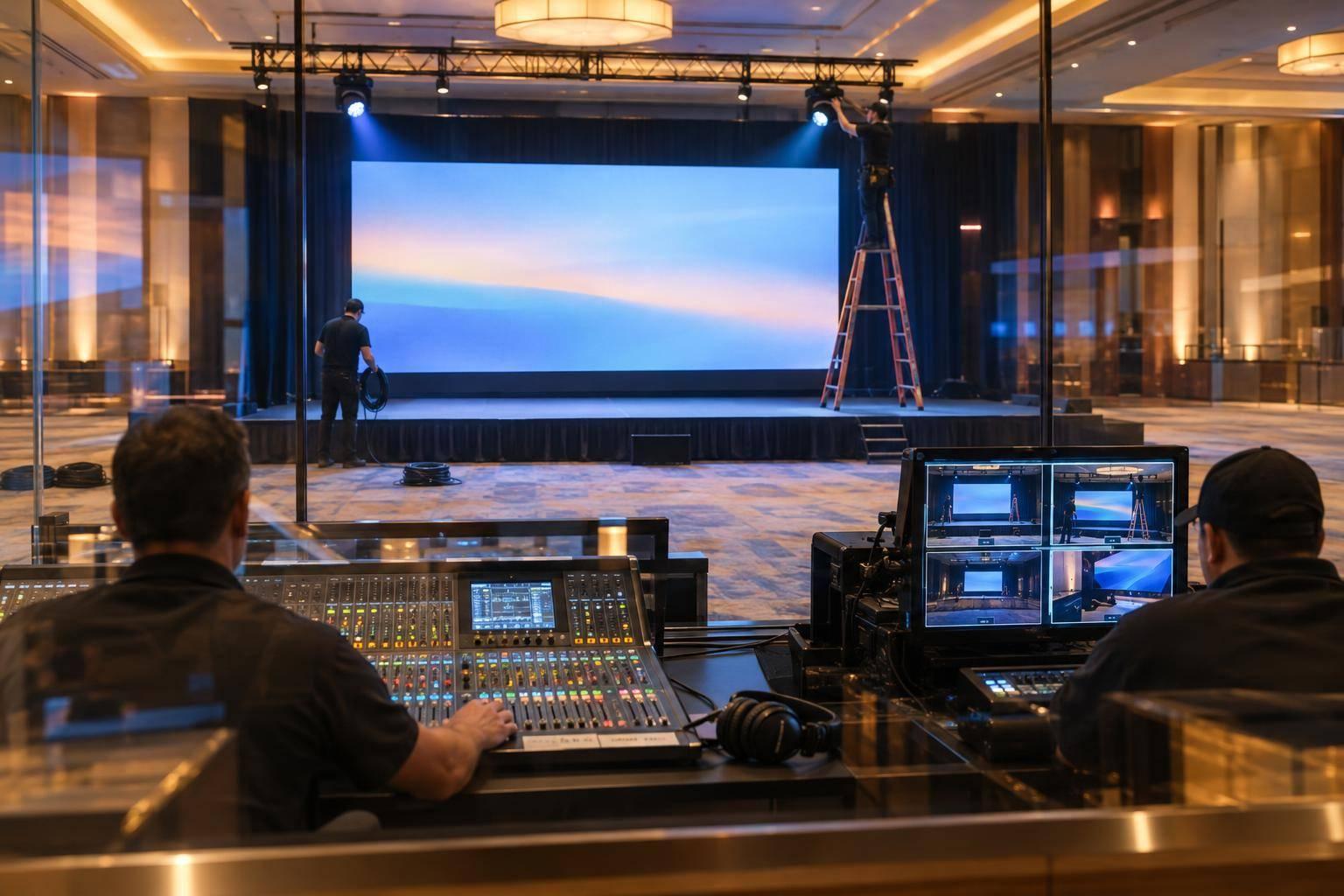
Event production experts play a key role in turning technical possibilities into on-site realities, ensuring projection mapping and LED walls make the strongest impact during your showcase. Their work starts with thorough site surveys, where they evaluate factors like ambient light, rigging capabilities, power availability, and throw distances to optimize performance.
Using tools like 3D modeling, LiDAR, and photogrammetry, these professionals create a digital replica of your venue. This "digital twin" allows them to preview visuals and fine-tune alignment before the event even begins. For projection mapping, they handle intricate tasks like warping, edge blending, and color adjustments to ensure content fits seamlessly onto irregular surfaces.
This meticulous preparation bridges the gap between design and execution, ensuring every visual element functions as planned. Event production experts also oversee structural rigging, power distribution, and scheduling for installation and removal. While LED walls involve assembling modular panels, projection systems can often be set up faster, making them ideal for events with tight time constraints. Nate Covey from Advanced Staging Productions explains:
When it comes to content, videos look great on LED walls since it's almost like having a large TV in the room with you. But if the main part of your event is a keynote address with text-heavy slides, then a projection screen would best suit your needs.
Beyond setup, these professionals manage media server programming, pixel processing, and real-time content control - highly specialized tasks that go far beyond simply providing equipment. Their expertise is critical for ensuring smooth operations, as technical failures can cost large organizations up to $9,000 per minute in downtime.
Corporate Optics: Event Production Partner
Corporate Optics simplifies the event production process by offering comprehensive services tailored to product showcases. Their team conducts detailed venue assessments to determine whether projection mapping, LED walls, or a combination of both will best suit your space and goals. With deep experience in scenic and lighting production, they focus on making visual technology an integral part of your storytelling, rather than just a background feature.
From rigging coordination to speaker support, live streaming integration, and on-site staffing, Corporate Optics handles the entire technical workflow to bring your event vision to life. Their collaboration with prompts.ai, an AI platform designed to streamline corporate meeting and event production, adds an extra layer of efficiency to planning and execution. Whether your event calls for the immersive visuals of projection mapping or the sharp, dynamic appeal of LED walls, Corporate Optics ensures a flawless delivery with their technical and logistical expertise.
Conclusion
Main Points
Each technology serves a unique purpose, catering to different presentation needs. LED walls deliver sharp, high-definition visuals that perform exceptionally well in any lighting condition. This makes them a go-to choice for bright venues like trade show floors, outdoor events, or presentations where clarity of text and data is crucial. With brightness levels exceeding 10,000 nits and lifespans ranging from 50,000 to 100,000 hours, LED walls are built for consistent performance and visual impact.
On the other hand, projection mapping transforms physical objects and irregular surfaces into dynamic storytelling tools. It’s particularly suited for dramatic product reveals, where the environment itself becomes part of the experience. As Lumen and Forge eloquently put it:
Projection invites wonder. LED demands attention.
However, each technology has its trade-offs. LED walls require significant rigging, higher power consumption, and larger upfront costs. Projection mapping, while visually stunning, works best in controlled, low-light settings and demands specialized content creation with precise warping and blending. These considerations can help guide your decision-making process.
How to Choose
Start by evaluating your venue. Lighting conditions are a critical factor. If your space has large windows, outdoor exposure, or uncontrollable ambient light, LED walls are the better choice. For darker, controlled environments where you want to create immersive visuals - such as wrapping content around a car, sculpture, or building facade - projection mapping delivers unmatched "wow" moments.
When opting for LED walls, consider the pixel pitch based on your audience's viewing distance. For example, a 2.5 mm pixel pitch ensures crisp resolution for viewers as close as 10–15 feet, making it ideal for high-end product launches.
Budget is another key factor. While LED walls may involve higher upfront costs, they often provide better long-term value due to reduced maintenance. In fact, many impactful showcases combine both technologies: LED walls for primary content and branding, and projection mapping to add depth and atmosphere to surrounding areas.
Partnering with experienced professionals like Corporate Optics can simplify the process. Their team handles everything from venue assessments and rigging logistics to content optimization and on-site execution. This ensures your showcase not only meets but exceeds expectations - all without the stress of managing technical details.
LED Wall vs Projection: Key Differences Explained!
FAQs
How do I choose between projection mapping and an LED wall for my venue?
Choosing between projection mapping and LED walls comes down to your event's specific needs, the venue's characteristics, and your budget.
Projection mapping shines when you’re working with irregular surfaces or need a temporary setup. It’s an excellent choice for creating immersive visuals, especially in smaller or indoor spaces, and it tends to be more budget-friendly for such scenarios.
On the other hand, LED walls are perfect for outdoor events or large-scale venues. They deliver bright, high-impact visuals and are built to withstand various conditions, though they often come with a higher price tag.
When deciding, think about factors like the venue's lighting, the complexity of the surfaces you’ll be working with, and what your audience expects in terms of visual impact.
What viewing distance and pixel pitch do I need for an LED wall?
The optimal viewing distance and pixel pitch for an LED wall hinge on how close the audience will be and the level of clarity required. Smaller pixel pitches, such as 1.9mm, are ideal when viewers are up close, ensuring crisp visuals. On the other hand, larger pixel pitches, like 4mm, perform well when the audience is positioned farther away - typically beyond 15-20 feet. For mid-range distances, around 10-15 feet, a pitch between 2.6mm and 3.9mm strikes a good balance between image sharpness and overall cost.
Can I combine LED walls and projection mapping in one showcase?
Yes, combining LED walls with projection mapping can result in a stunning and immersive visual display. Projection mapping uses projectors to transform ordinary surfaces into dynamic, animated canvases, while LED walls serve as vibrant, high-resolution digital backdrops. When used together, these technologies create a powerful synergy, blending the depth and 3D effects of projection mapping with the brightness and adaptability of LED walls. The result? A visually striking and seamless experience that captivates audiences.
Related Blog Posts
- List Of The Latest Event Production Trends In 2025
- Leading Vendors For Audio Visual Production Services For Company Annual Meeting Conferences
- Consider These Companies In 2026 & 2027 For Leadership Conferences With High-Impact Visuals
- Top-Rated Audio-Visual Production Companies With LED Wall Capabilities


Streamline your workflow, achieve more

Lorem ipsum dolor sit amet, consectetur adipiscing elit. Maecenas ac velit pellentesque, feugiat justo sed, aliquet felis.



Lorem ipsum dolor sit amet, consectetur adipiscing elit. Maecenas ac velit pellentesque, feugiat justo sed, aliquet felis.