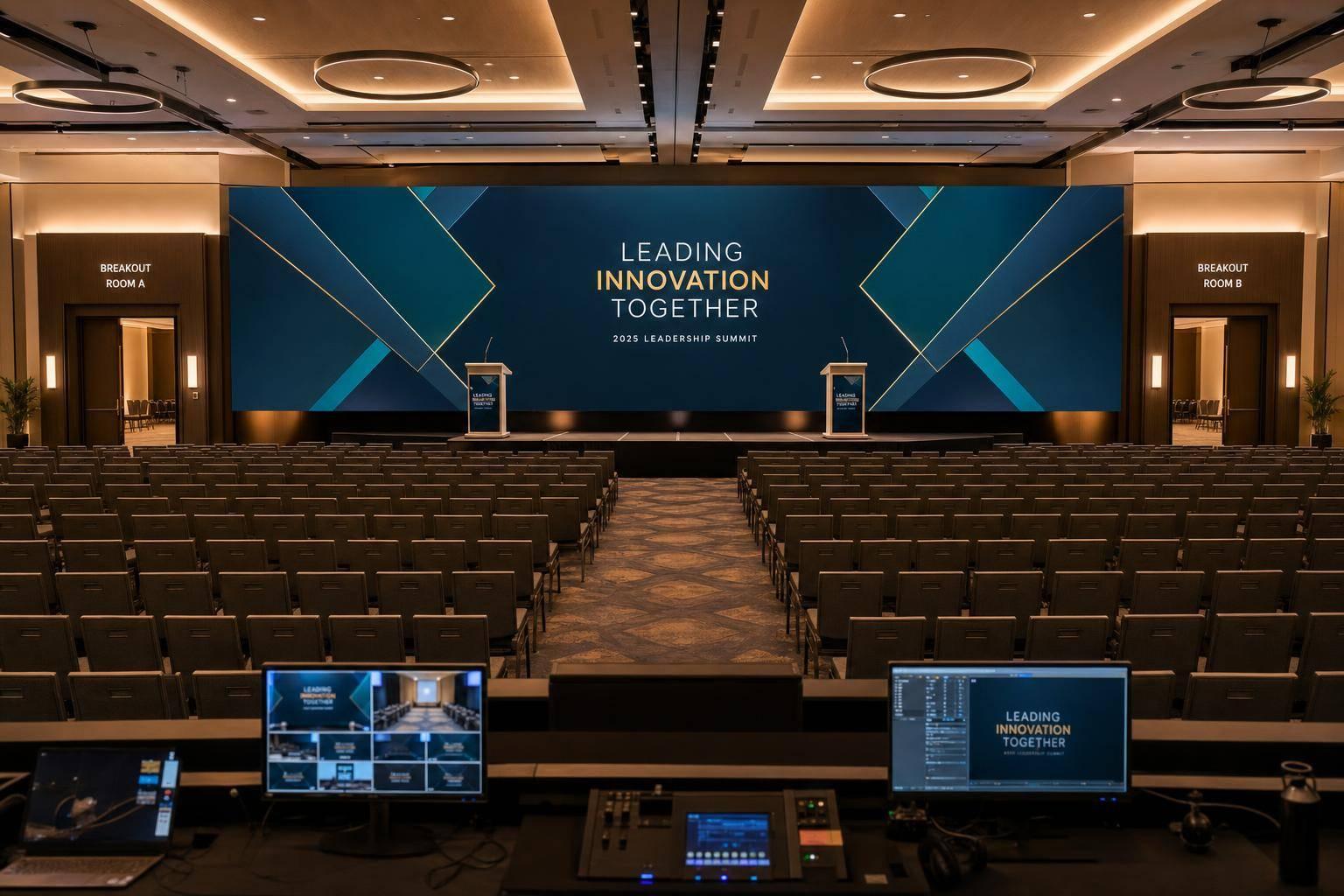
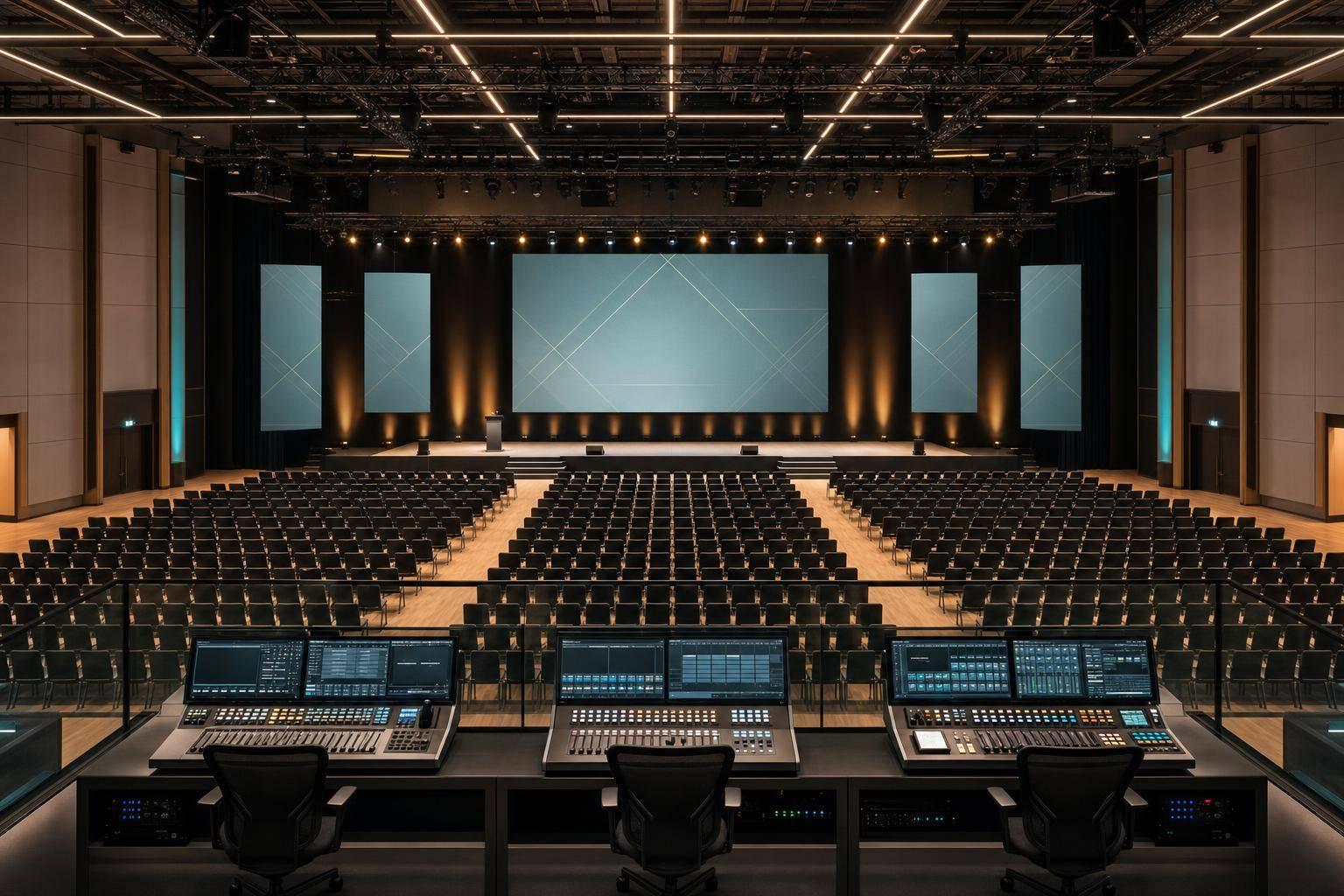
Top Technical Production Company For Franchise Meetings In NYC, Las Vegas, Orlando, Or Any Other Major Area.

Chief Executive Officer

If I were picking a technical production company for a franchise meeting, I’d look for one thing first: the same show quality in every city.
That means I’d want a team that can standardize audio, video, lighting, staging, streaming, rehearsals, and backup plans whether the event is in New York City, Las Vegas, Orlando, or another major U.S. market. For a 300-person, three-day franchise event, production costs often fall between $25,000 and $75,000+, and hybrid support alone can add $15,000 to $50,000. So if the process is loose, the risk and spend can climb fast.
Here’s the short version of what matters most:
- Use one master production plan for every city
- Keep a traveling lead crew for show calling and technical control
- Match room experience across general sessions and breakouts
- Plan hybrid from day one, with wired internet and backup stream paths
- Rehearse with actual slides, mics, and stage cues
- Check city rules early, especially labor, docks, rigging, and in-house AV limits
- Build backups for every show-critical system
If I had to sum it up in one line: the room can change, but the audience experience should not.
A short comparison of what to check first:
| Area | What I’d look for |
|---|---|
| AV basics | Clear audio, right-size screens, camera plan, lighting for speakers |
| Multi-city control | One stage template, one show file system, one lead team |
| Hybrid setup | Wired internet, dual encoders, backup connection, remote speaker checks |
| Show flow | One show caller, clear run-of-show, slide control, rehearsals |
| Budget control | Early planning, fixed standards, fewer rush changes |
| Risk control | Spare mics, backup playback, second stream path, failover testing |
That’s the core of the article: pick a production partner with a fixed system, not a city-by-city scramble.
Event A/V Essentials Part 5: Creating Your Onsite Production Schedule - Logan Clements
sbb-itb-ae35a94
What To Look For In A Technical Production Company
Picking the right production partner comes down to three things: technical depth, hybrid infrastructure, and show management discipline. Those are the filters to use if you want the same level of quality in every city.
Core AV, Staging, Lighting, And Video Capabilities
The baseline matters more than many planners think. For small breakout rooms with 20–75 attendees, that often means 2–4 full-range speakers on stands, a digital mixer with at least 16 channels, and a small wireless mic package, usually 2–4 handheld or lavalier mics. For larger general sessions with 300+ attendees, the setup needs to scale to line arrays or flown speakers, dual projection screens or an LED wall, multi-channel wireless systems, and separate audio feeds for the room, recording, and livestream.
Don’t stop at the gear list. Ask whether the team can share system diagrams, input lists, and room coverage plots. That tells you a lot about how they think. You’ll also want to confirm they can handle RF coordination in busy markets like NYC and Las Vegas, work around tough room acoustics, and adjust stage layouts from one venue to the next.
Camera coverage should match the format. A breakout may only need one locked-off camera. A general session, recording setup, or livestream usually calls for multi-camera coverage.
Consistency on stage matters too. Look for repeatable stage plots, branded scenic elements, front wash lighting, and color-changing fixtures or gobos that help the room look the same across venues. In bright hotel ballrooms, an LED wall can be a better fit than projection alone.
Livestreaming, Hybrid Infrastructure, And Remote Audience Support
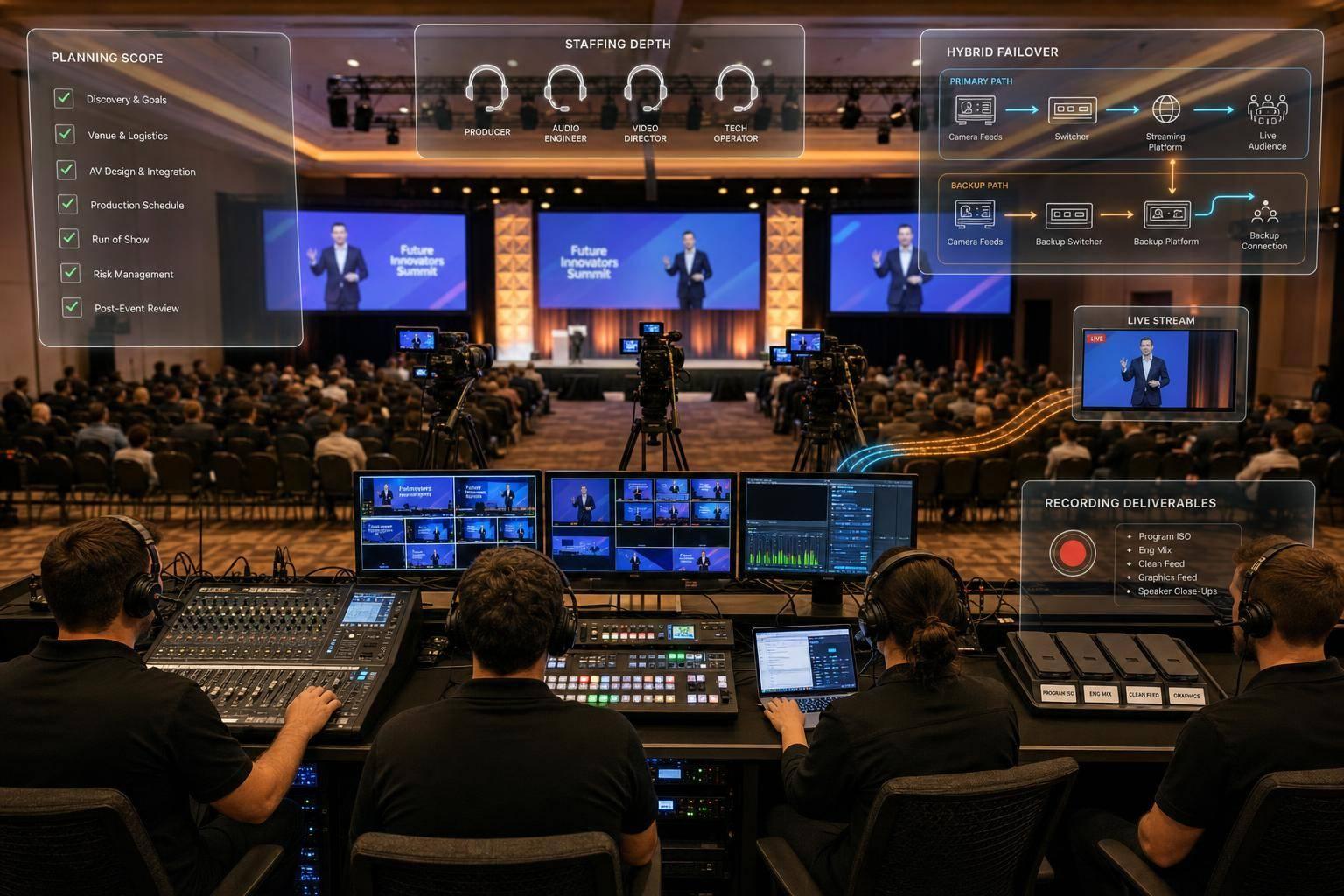
Hybrid franchise meetings need a setup that’s ready for streaming from the start. At a minimum, look for two cameras with operators, a dedicated hardware encoder, a clean audio mix for the stream, and a hardwired internet connection instead of hotel Wi-Fi.
Backups aren’t optional on mission-critical shows. A strong partner should plan for a secondary internet path, such as bonded cellular or a second ISP, a redundant encoder, and a backup streaming destination in case the main platform runs into trouble. They should also support pre-event tech checks for remote speakers and franchisees.
Remote attendees need support too, not just a link to click. Ask for help with:
- Framing and background
- Moderated Q&A
- Clean return audio and video
Those details help online participants stay involved instead of feeling like an afterthought.
Once the stream is steady, the event still comes down to timing, cues, and control on the ground.
Show Management, Rehearsals, And On-Site Execution
Show execution matters just as much as the equipment. A qualified partner builds a detailed run-of-show and uses one show caller to cue audio, lighting, video, stage, and backstage teams over headsets. That kind of coordination keeps executive talks, awards segments, and video roll-ins moving on schedule.
Rehearsal time is where small issues get caught before the audience sees them. Executives should rehearse with their actual slides, microphones, and confidence monitors on the live stage. That’s the time to adjust pacing and test transitions. A strong team should also have a tracked slide approval process, so last-minute edits go to the right operator without confusion.
You should also require a clear process for last-minute slide changes during the show. That level of control is what helps the same program run cleanly in every market.
How To Keep Brand Consistency Across NYC, Las Vegas, Orlando, And Other Cities
Standardizing The Look, Sound, And Room Experience
Once the show format is locked, the next job is making sure it looks and sounds the same in every city. The audience should feel like they’re seeing the same show, whether they’re in New York City, Las Vegas, Orlando, or somewhere else.
That means locking down stage geometry, scenic treatment, lighting cues, audio tuning, and slide templates across every market. Breakout rooms need their own baseline package too, so screen size, projector brightness, microphone type, and room layout still feel tied to the same event. When the room looks and sounds consistent, it supports leadership credibility and keeps people focused on the message.
Using Technical Documentation And City-Specific Planning
The best way to do this is with one master playbook backed by exact drawings, approved substitutions, and city addenda. That playbook should include CAD drawings with exact dimensions, equipment lists with approved substitutions, annotated lighting plots, audio patch sheets, and version-controlled show files for playback, lighting, and audio scenes.
The big line to draw is simple: what stays fixed, and what changes on-site. In a union venue like the Javits Center in New York City, union labor rules can affect crew assignments and timelines, so roles need to be defined early to avoid overtime and delays. At the Las Vegas Convention Center, Teamsters control unloading, reloading, and material handling, which changes load-in sequencing. In an Orlando ballroom with a lower ceiling, floor-supported truss may replace flown scenic, while the attendee still sees the same color palette and stage logic.
City-specific addenda should spell out details like:
- Load-in windows
- Dock access
- Power locations
- Rigging limits
- Acoustic profiles
The point is to change how the show gets built, not how it feels to the audience. Run-of-show files should live in one cloud folder with a fixed naming format, which helps prevent version mix-ups. That gives local crews the same build order from city to city without changing the audience experience.
How Corporate Optics Handles Multi-Location Program Delivery
Once the playbook is set, the traveling production team becomes the thread that holds the program together from one city to the next. Corporate Optics works as one partner for planning, execution, and post-event refinement. The process starts by turning franchise brand guidelines into standard stage designs, scenic packages, AV specs, and engagement formats that act as the baseline for every market.
On-site, a core traveling team carries the standard decisions and the hard-earned know-how from one venue to the next. They coordinate local labor, manage rehearsals, and call the show with the same discipline and flow no matter the room constraints, union rules, or venue conditions. After each event, production notes go back into the master playbook, so each city gets a little sharper based on what the last one taught.
Planning, Budgeting, And Risk Control For Franchise Meeting Production
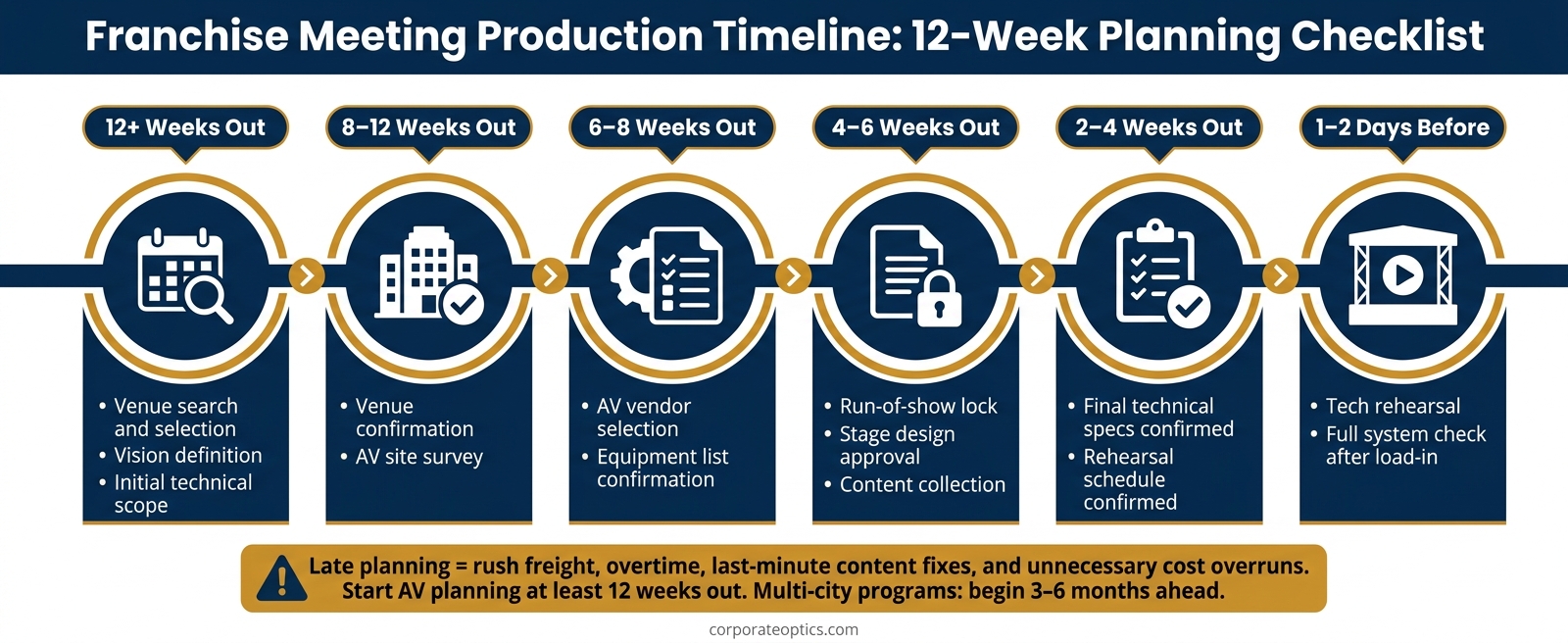
Franchise Meeting Production Timeline: 12-Week Planning Checklist
Once the show design is set, budget and risk control decide whether you can repeat that setup cleanly from city to city.
Main Budget Drivers For AV And Technical Production
For a 300-person, three-day franchise conference, AV and technical production often lands between $25,000 and $75,000+, based on room setup, hybrid needs, and venue logistics. Add multi-camera streaming, custom scenic, or tightly timed awards cues, and costs can climb fast.
Here’s where the money usually goes.
| Category | Typical Range (300-person event) | Cost Impact | What Drives It Higher |
|---|---|---|---|
| Audio | $5,000–$15,000 | Medium | Larger rooms, more mics, complex mixing |
| Video (projection/LED/screens) | $5,000–$15,000 | Medium–High | LED walls, multi-screen setups, large formats |
| Lighting | $3,000–$10,000 | Medium | Awards cueing, moving fixtures, branded looks |
| Staging & scenic | $2,000–$10,000 | Medium–High | Custom fabrication, branded environments |
| Livestreaming & hybrid | $5,000–$50,000+ | High | Camera count, encoders, platform, redundancy |
| Labor | $10,000–$25,000 | High | Show days, venue rules, overtime, show leadership |
| Venue fees, power & internet | $5,000–$10,000 | Medium | Venue labor rules, rigging charges, and internet/network infrastructure |
In many cases, labor and video turn into the biggest line items once the meeting goes past a basic general session. That’s especially common in awards shows and hybrid franchise summits. Hybrid production by itself can add $15,000 to $50,000 for a mid-size conference with multi-camera coverage and pro streaming.
Production Timelines And Key Decision Points
The earlier the technical team gets involved, the fewer budget surprises show up later. A good working rule is to start AV planning at least 12 weeks out. For multi-city franchise programs, many teams start 3–6 months ahead.
A typical timeline looks like this:
- 12+ weeks out: Venue search, vision definition, and initial technical scope
- 8–12 weeks out: Venue confirmation and AV site survey
- 6–8 weeks out: AV vendor selection and equipment list confirmation
- 4–6 weeks out: Run-of-show lock, stage design approval, and content collection
- 2–4 weeks out: Final technical specs and rehearsal schedule confirmed
- 1–2 days before: Tech rehearsal and full system check after load-in
Late planning usually means rush freight, overtime, last-minute content fixes, gear swaps, and scenic changes that didn’t need to happen. Locking in stage size, screen plan, and internet needs early gives the production team time to work with the venue’s real limits instead of fighting them at the last minute. It also gives the crew time to test backups before show day.
Redundancy And Contingency Planning For Reliable Execution
Backup gear helps, but a contingency plan only works if each handoff is assigned and practiced. For every mission-critical system, use a primary, secondary, and manual fallback. In hybrid franchise meetings, that means redundant stream encoders and a second internet path. If the stream drops, remote attendees feel it right away, just like in-room guests notice a dead projector.
A lot of the biggest risks come from the venue, not the gear. Limited rigging capacity, shaky internet, tight load-in access, venue labor delays, power issues, blocked sightlines, and poor ballroom acoustics can all derail a show. The smart move is simple: survey the venue early, confirm infrastructure needs, and shape the show around what the room can actually support.
| Risk | Recommended Redundancy | Response Action |
|---|---|---|
| Wireless mic failure | Backup handheld or lavalier already cued for critical presenters | Stage manager swaps within seconds |
| Playback laptop crash | Second laptop with identical content pre-loaded | TD switches source; failover in seconds, not minutes |
| Projector or display failure | Secondary display path or spare unit on standby | Crew switches signal path during a natural break |
| Stream encoder failure | Dual encoders running simultaneously | Secondary encoder takes over without interrupting the stream |
| Internet outage | Secondary internet path or failover connection | Crew switches to the backup path |
The part that makes this work is testing during tech rehearsal. That includes disconnecting power and signal on purpose to make sure the backup takes over the way it should. That’s the difference between a plan that looks good in a deck and one that holds up when the room gets tense.
Those controls make it easier to right-size production by meeting format.
Technical Standards By Meeting Format And Final Takeaways
Baseline Production Requirements By Meeting Format
Start with the meeting format. Then shape the technical plan around the room.
That sounds simple, but it matters. A general session, breakout, awards program, and hybrid meeting each need a different setup. If you treat them all the same, things slip fast.
| Format | Audio | Video | Lighting | Staging | Streaming |
|---|---|---|---|---|---|
| General Session | Full-range PA, separate front-of-house and monitor mixes, 4–8 wireless mics, digital console with scene recall | Large-format 16:9 screen, IMAG cameras, confidence monitors, playback system | Even front wash, camera-friendly key light, walk-in and walk-out cues | Branded stage, safe access, cable management | Optional; if used, dedicated encoder, separate stream mix, and hardline internet |
| Breakout | Speakers sized to room, 1–2 wireless mics, simple mixer | 75–98-inch display or room-sized projection, HDMI input | House lighting with supplemental front light if needed | Riser or lectern, basic branding | Usually not required |
| Awards Program | Podium mic support, additional wireless mics, music playback with tight cueing | Multiple playback channels, winner slates, confidence monitors, cameras for reactions | Theatrical cue stacks, walk-up specials, podium key light | Stairs or ramp access, clear sightlines, rehearsed entry points | Optional; if streamed, clean program feed with lower thirds and backup recording |
| Hybrid Meeting | Dedicated stream mix separate from the in-room mix, mics for every speaker | Switcher, graphics, and monitor feeds, clean program feed | Optimized for room and camera | Staging follows the underlying format with safe access and clear sightlines | Redundant encoders, dedicated wired internet, backup LTE/5G, remote moderator, on-site monitoring |
A couple of points are worth calling out.
For breakout rooms, 75–98-inch LCD monitors are becoming a standard pick in corporate conference settings because they are bright and reliable. In plain English: they tend to work well under pressure, and they avoid some of the headaches that come with smaller or dimmer displays.
For hybrid sessions, venue Wi-Fi should not be your plan. A dedicated wired connection with backup LTE/5G is the baseline. If the stream matters, the internet path has to be treated like show-critical gear.
Applying The Same Standards Across Major U.S. Cities
The audience experience should stay the same from city to city. What changes is the build plan.
That’s the part many teams learn the hard way. New York City, Las Vegas, and Orlando can all host the same meeting, but the path to getting that meeting on its feet can look very different. Labor rules, loading limits, dock access, and venue policies all shape execution.
| Execution Factor | NYC | Las Vegas | Orlando | Brand Standard (Non-Negotiable) |
|---|---|---|---|---|
| Union labor rules | Strict; may require 2:1 union guidelines | Common in major convention venues | Less common; varies by property | Traveling show caller, TD, and audio lead maintain show consistency |
| In-house AV policies | Frequent exclusivity agreements | Varies; large venues often flexible | Mixed; resort properties vary | Negotiate waivers or confirm equivalent gear specs |
| Typical load-in window | Tight; space and elevator constraints | Moderate; large dock access common | Generally flexible | Modular scenic and pre-configured racks required |
| Crew mix | Core traveling crew + local union hires | Core traveling crew + local hires | Core traveling crew + local hires | Show caller, TD, and audio lead travel with the program |
The practical fix is pretty direct: send a traveling core crew: show caller, technical director, and audio lead. They carry the program standards from market to market. Then fill out the rest of the team with vetted local hires.
That’s how you keep the meeting feeling the same even when the room, labor setup, and venue rules keep shifting. The setup adapts. The show does not.
Conclusion: What Defines The Right Production Partner
The right technical production partner for franchise meetings does more than bring gear into a ballroom.
They bring a repeatable system: documented standards, disciplined show management, and the experience to execute cleanly whether the event lands in Midtown Manhattan, a Las Vegas convention center, or an Orlando resort ballroom.
What matters most is pretty clear:
- Repeatable standards
- A traveling core crew
- Clean show calling
- Dependable hybrid infrastructure
Strong AV and staging capability, steady hybrid support, and a show caller who owns the run-of-show form the base. Transparent budgeting, early planning, and tested backup procedures keep that base from cracking when the pressure is on.
Corporate Optics delivers this model with documented standards, a traveling core crew, and repeatable hybrid execution.
FAQs
How early should I book production for a franchise meeting?
Book your production partner as early as you can. That gives your team time to sort out technical needs, logistics, and site requirements before small issues turn into big ones.
For large franchise conferences, plan 9 to 12 months in advance. Other common timelines look like this:
- 12+ months for large-scale events
- 4 to 6 months for complex multi-city programs
- 8 to 16 weeks for executive summits or custom environments
Early booking also makes it easier to lock in equipment, finish site surveys, and cut down on last-minute risk.
What should I standardize across every city?
Standardize your technical systems and documentation so your brand feels the same in every city.
Use centralized production plans with matching audio, video, lighting, and staging packages. Pair that with uniform run-of-show documents, cue sheets, signal-flow diagrams, hybrid streaming templates, and pre-show daily line checks.
What backups are essential for a hybrid event?
Essential backups come down to one thing: redundancy for connectivity, power, and equipment, so the broadcast stays uninterrupted.
That usually includes:
- Dual internet paths with failover routers
- UPS protection and redundant encoders on separate network paths
- Spare on-site gear, plus redundant local and cloud recording and backup vendor support
If one connection drops, another takes over. If a piece of gear fails, there’s a backup ready to step in. That kind of setup helps keep the show live instead of letting one weak link take everything down.
Related Blog Posts
- Who are the top providers for franchise meeting production?
- How do Production Companies Support Global Franchise Meetings?
- Ultimate Guide To Understand How Production Companies Support Global Franchise Meetings
- 4 Of The Best Conference Production Companies For Franchise Meeting Production And Logistics.


Streamline your workflow, achieve more
Lorem ipsum dolor sit amet, consectetur adipiscing elit. Maecenas ac velit pellentesque, feugiat justo sed, aliquet felis.



Lorem ipsum dolor sit amet, consectetur adipiscing elit. Maecenas ac velit pellentesque, feugiat justo sed, aliquet felis.