Leading Ai-Powered Corporate Communications Team For Events

Chief Executive Officer
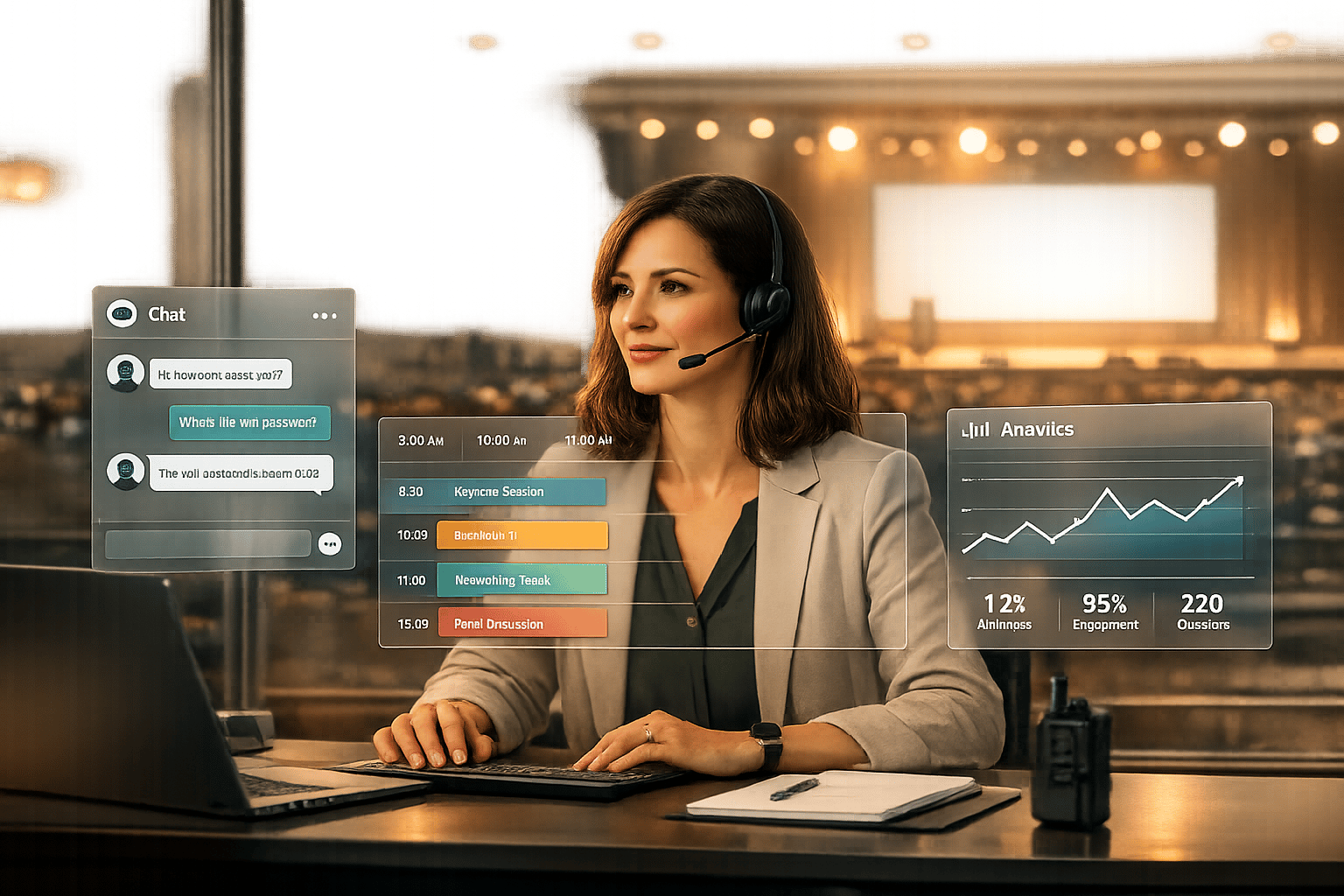
AI technology for corporate communications at events is transforming how teams operate by automating repetitive tasks, improving audience engagement, and enabling data-driven decisions. From creating polished content to offering real-time attendee support, AI tools are helping teams save time and focus on higher-value activities.
Key highlights:
- 50% of meeting planners already use AI for event planning, with 41% relying on tools like writing assistants.
- AI chatbots handle 80% of common attendee questions, freeing staff for complex issues.
- Tools like NLP ensure consistent messaging, instant translations, and real-time sentiment analysis.
- Post-event analytics reveal attendee insights, helping refine future strategies.
Corporate Optics, in partnership with prompts.ai, integrates AI into every stage of event production to simplify workflows, improve messaging accuracy, and enhance audience experiences. AI is no longer optional - it's becoming the backbone of corporate event success.
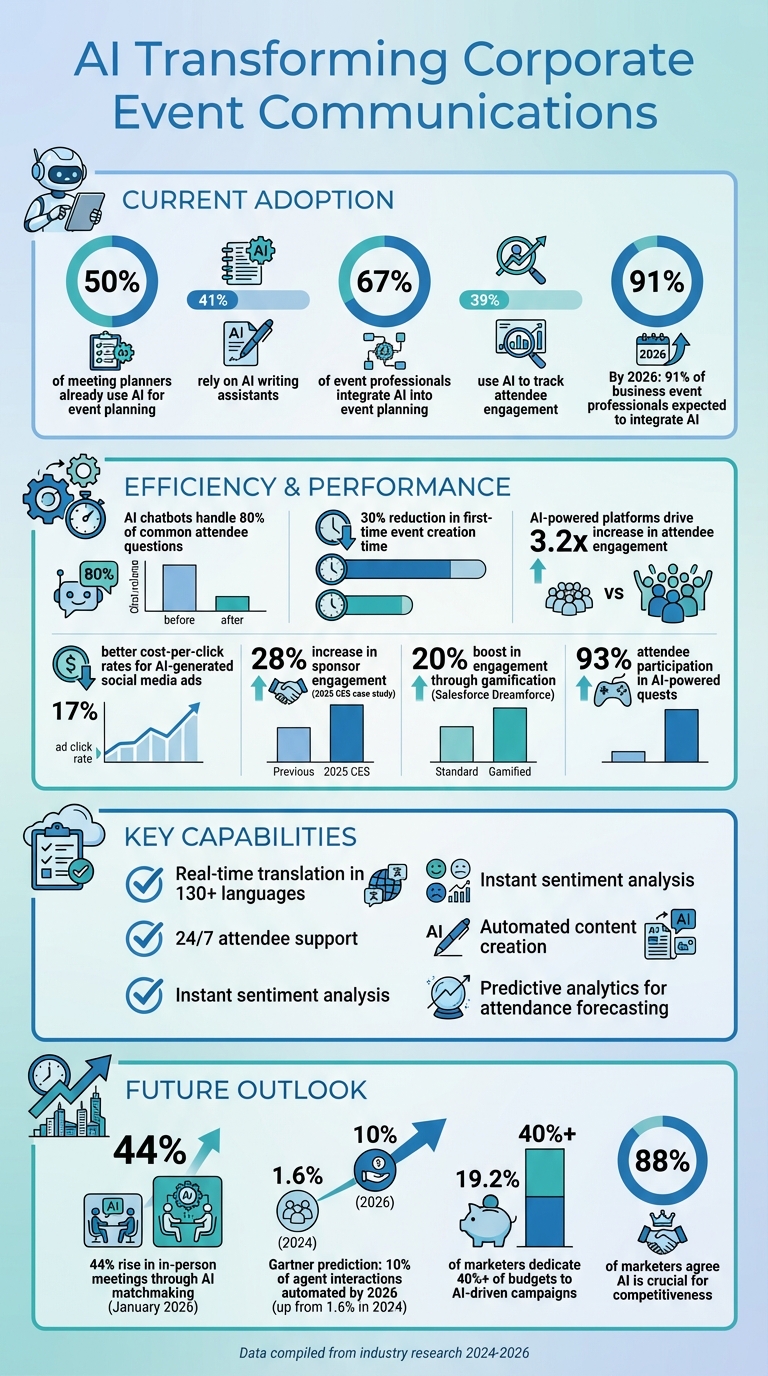
AI Impact on Corporate Event Communications: Key Statistics and Benefits
AI for Planners: What’s Actually Useful? [Event Insider 37]
sbb-itb-ae35a94
AI Tools for Corporate Event Communications
AI tools are reshaping how corporate events handle communication by streamlining processes while maintaining the integrity of data and formatting. Embedding AI directly into event management systems allows teams to work faster and more accurately without constantly switching between tools.
Natural Language Processing for Message Clarity
Natural Language Processing (NLP) tools make it easier for teams to create, refine, and localize event content. Instead of starting from scratch, these tools can instantly adjust tone, expand notes into polished copy, or condense lengthy text into digestible summaries.
NLP also ensures brand consistency across all communications. By understanding event-specific details - like session titles and speaker names - AI helps maintain a unified voice throughout emails, notifications, and social media posts. For international audiences, AI-powered translation tools can instantly localize messages into over 130 languages while keeping the original intent intact. However, reviewing these translations is still important to address cultural nuances effectively.
"It's not about replacing your voice, it's about accelerating your output." - EventsAir
AI Chatbots for Real-Time Attendee Support
AI chatbots are a game-changer for attendee support, handling up to 80% of common questions like "Where is the keynote?" This frees up human staff to focus on more complex issues while providing 24/7 assistance to thousands of attendees.
At the 2025 CES tech trade show, AI tools analyzed live sentiment in event chats and on social media using emotion recognition and NLP. This real-time feedback helped organizers adjust messaging during sessions, boosting sponsor engagement by 28%.
Beyond answering questions, advanced chatbots can manage tasks such as updating catering orders, booking meetings, and arranging seating. They can even detect an attendee's preferred language and provide natural-sounding translations. Tools like Corporate Optics integrate these functions seamlessly into event workflows, enabling chatbots to deliver personalized, context-aware responses based on attendee profiles and agendas. Gartner predicts that by 2026, 10% of agent interactions will be automated, a significant jump from 1.6% in 2024.
Automated Content Creation for Event Materials
AI platforms are speeding up the creation of event materials like presentations, videos, and promotional content. For example, at INBOUND 2024, AI tools produced 28 videos totaling 14 minutes in just 1.5 months - a process that would have taken weeks per clip using traditional methods. The team also used AI to develop an interactive personality quiz, "Choose Your Own INBOUND Adventure", which became one of the most popular posts on their blog in 2024.
Other AI tools can turn text into videos featuring AI avatars in over 130 languages. Design platforms can also generate professional slide layouts directly from content outlines. Additionally, event planners can use native AI tools to create RFPs, registration confirmations, and session descriptions within their event platforms, ensuring data stays consistent and formatted correctly.
The secret to maximizing these tools? Treat prompts like detailed project briefs. Provide clear context, define your target audience, and outline specific challenges to address, rather than relying on vague commands.
Next, we’ll explore how AI improves team collaboration and workflow management.
AI for Team Collaboration and Workflow Management
AI is reshaping how corporate communications teams collaborate during event production by automating repetitive tasks and simplifying workflows. With 67% of event professionals already integrating AI into event planning, the shift from manual coordination to automated systems is undeniable. These advancements allow teams to focus more on strategic goals, enhancing both communication and event execution. Below, we'll explore how AI improves workflow automation, supports speaker coordination, and refines post-event analytics.
Workflow Automation for Event Planning
AI takes over time-consuming tasks that once monopolized staff hours. For instance, built-in AI tools can instantly refine speaker bios, standardize session abstracts, and ensure titles are consistently formatted across all platforms. Unlike generic tools like ChatGPT, these "event-aware" solutions maintain formatting and merge fields specific to event planning needs.
Beyond content formatting, AI scans entire event agendas to identify overlapping sessions, double-booked speakers, and pacing concerns - issues that might otherwise slip through the cracks. It also uses historical data to forecast registration numbers and attendance trends, enabling teams to make better decisions about room allocations, catering, and marketing strategies.
"AI should never replace the people who make events work. What it should replace is the repetitive, low-value work that keeps those people buried in spreadsheets."
– Mario Azuaje, Product Marketing, Sessionboard
AI also simplifies venue sourcing. Matching technology connects planners with venues and vendors based on criteria like location, group size, and audience type, while automating the Request for Proposal (RFP) process. With these streamlined workflows in place, AI also steps in to enhance speaker management.
Speaker Support and Coordination
Coordinating speakers can be one of the most labor-intensive parts of event planning. AI eases this burden by reviewing thousands of speaker proposals, applying scoring rubrics, and flagging inconsistencies in evaluations - all to assist human reviewers. Once speakers are selected, AI can even generate tailored seed questions for moderators by analyzing session topics and the event's overarching theme.
Despite these efficiencies, human oversight remains critical. While AI provides a first pass for content editing, human editors ensure the final output aligns with the brand's voice and catches any inaccuracies. After the event wraps up, AI continues to prove its worth with advanced analytics.
Post-Event Analytics and Performance Tracking
AI's role doesn’t end when the event does. Modern analytics tools process feedback from session surveys, social media activity, and engagement metrics to create executive summaries of event performance. Interestingly, 55% of B2B marketers fail to fully leverage the data collected at events, but AI now makes it easier by delivering near-instant session summaries for attendees. These summaries help demonstrate the event's value to stakeholders.
Some platforms go a step further, using ethical facial analysis to measure attendee sentiment and create "Happy Maps" that visualize engagement across the venue. Additionally, AI-powered reporting tracks ROI for your company conference and analyzes how changes - like session timing adjustments or content tweaks - impact overall success. This data-driven feedback loop helps teams refine their approach for future events, turning every production into a learning experience.
Corporate Optics' AI Integration for Event Production

Corporate Optics has teamed up with prompts.ai to integrate AI into every stage of event production. This partnership reshapes how corporate communications teams approach planning, execution, and analysis for large-scale events by using AI prompts as creative briefs. The result? More precise planning, smoother execution, and smarter budgeting.
AI-Powered Event Planning and Execution
With this collaboration, Corporate Optics can automate key aspects of event planning. The best AI solutions for corporate events generate full event programs, write session descriptions, and even draft speaker bios. They also suggest speakers, optimize schedules to avoid conflicts, and ensure enough time is allocated for transitions and networking. During events, the system analyzes real-time data - like polls, Q&As, and social media activity - to gauge audience sentiment and make on-the-fly adjustments.
AI also enhances audience engagement through personalized matchmaking. By analyzing attendee profiles - such as their interests, industries, and goals - the system recommends tailored networking opportunities, sessions, workshops, and exhibitor booths. This approach not only elevates the attendee experience but also ensures that event messaging aligns seamlessly with the brand.
Custom Pricing and Tailored Solutions
Corporate Optics leverages AI to analyze historical budget data, identifying cost-saving opportunities and optimizing resource allocation. This data-driven approach supports their custom pricing model, helping clients make informed financial decisions. AI also segments audiences, enabling targeted campaigns based on demographics, interests, and past behaviors.
When it comes to selecting venues and vendors, AI steps in to match planners with the best options. It considers factors like location, group size, event dates, and audience preferences. Additionally, generative AI fine-tunes copy to match the tone and voice of specific events. With 19.2% of marketers now dedicating over 40% of their budgets to AI-driven campaigns, Corporate Optics ensures its clients remain ahead of the curve.
Measuring AI Impact on Corporate Event Results
Understanding the impact of AI is essential for determining whether these tools deliver value or simply add complexity. Corporate communications teams need solid data to validate their investment in innovative AI tools used in corporate event planning and to showcase measurable improvements to stakeholders. Here are some key metrics that highlight how AI enhances event operations.
Efficiency Gains and Cost Savings
AI automation significantly reduces the time spent on repetitive tasks. Tools powered by generative AI can draft bios, emails, and other event content, while translation software localizes materials almost instantly - tasks that once took days are now completed in seconds.
"Automation takes over mundane tasks, freeing humans for innovative work." - Asma Aziz, Director of Marketing, Americas Territories at Intel
Predictive analytics add another layer of efficiency by forecasting no-show rates and identifying peak networking times. These insights allow real-time adjustments in staffing and catering, ensuring resources are allocated wisely. This efficiency also supports sustainable event planning by minimizing waste. With 88% of marketers agreeing that increasing AI usage is crucial to meet customer expectations and remain competitive, these efficiency gains not only save costs but also improve overall resource management.
Improved Audience Engagement
AI doesn’t just streamline processes - it also enhances how attendees interact with events. For instance, Salesforce integrated its Einstein AI tool at the Dreamforce event in September 2024 to gamify the attendee experience through "quests." This initiative saw 93% of attendees participating, resulting in a 20% boost in engagement across discussions, exhibitor booths, and demo meetings, according to Brian Gates, SVP of Industry Strategy at RainFocus.
At the 2024 CES trade show, Microsoft Azure used AI sentiment analysis tools to gauge audience reactions to sponsor activations in real time. Leveraging natural language processing and emotion recognition, the tools analyzed live chats and social media feedback, enabling organizers to refine messaging during the event. This approach led to a 28% increase in sponsor engagement and provided detailed ROI reports for stakeholders. Additionally, AI-powered event platforms have been shown to drive a 3.2x increase in attendee engagement.
Data-Driven Decision Making
AI's ability to turn raw data into actionable insights is a game-changer. For example, Autodesk used AI analytics to process attendee sentiment, a task led by Christian Fortier, Director of Field Marketing Events. This approach saved hundreds of hours of manual work while uncovering deeper insights into attendee concerns.
Instead of manually sifting through thousands of survey comments, AI tools categorize responses into themes like "wait times" or "exhibitor variety." Real-time dashboards track metrics such as session dwell time, poll participation, and Q&A activity. This allows organizers to quickly adjust room assignments for popular sessions or schedule additional repeats. By transforming data into strategic insights, AI ensures that communication strategies align with attendee needs throughout the event lifecycle.
"Embracing data-driven decisions is no longer optional; it's essential for future-focused event planning." - Jeff Moore, Vice President of Technology and Innovation at MCI USA
With 39% of meeting planners currently using AI to track attendee engagement, these tools offer the concrete metrics needed to refine future events and demonstrate ROI to sponsors and executives. From planning to execution, AI enhances every stage of corporate event production by delivering measurable results.
Future Trends in AI-Powered Corporate Event Communications
AI is evolving beyond basic automation and stepping into intelligent orchestration. By early 2026, a striking 91% of business event professionals are expected to integrate AI into their workflows in some capacity. This shift is steering the industry toward "world models" - AI systems designed to grasp the deeper context and subtleties of interactions. As Marius Milcher, VP of Platform Strategy and AI at RainFocus, explains:
"World models possess actual understanding of the context and nuance of an interaction rather than simply calculating probable next words".
One of the most exciting developments is agentic AI, which autonomously manages tasks like venue bookings, speaker scheduling, and real-time session adjustments. For example, in January 2026, Clarion Events reported a 44% rise in in-person meetings thanks to AI-powered matchmaking tools. These tools are turning networking into a more deliberate and effective process rather than leaving it to chance.
Global broadcasts are also becoming smarter. Advanced translation tools now deliver content that feels truly localized, thanks to improved syntax and segmentation. AI avatars capable of presenting in over 130 languages are making it possible to deliver polished, professional presentations without the need for costly studio setups, all while maintaining a strong executive presence.
Another emerging trend is the rise of micro-events. These smaller, localized gatherings allow companies to engage with audiences more frequently and in a more personalized way. Ashleigh Cook, CMO at RainFocus, highlights this shift:
"AI is driving the growing trend of micro-events and roadshow series... enabling companies to get in front of customers more often and with a more personalized approach".
This approach not only ensures consistent messaging but also allows content to be tailored for regional audiences. Companies like Corporate Optics are leveraging these advancements to refine their communication strategies. By collaborating with prompts.ai, a specialized AI platform for corporate events, Corporate Optics integrates AI solutions for conference production across every stage of event planning - from strategy and content creation to orchestration and analysis.
These advancements paint a picture of a future where AI becomes the backbone of corporate event communications, transforming how teams plan, execute, and analyze their events.
Conclusion
AI has moved from being a futuristic concept to delivering real-world results. Today, 50% of meeting planners are already using AI to streamline event planning and execution. Its impact is evident in areas like faster content creation, smarter audience engagement, and data-driven decision-making. From tools that draft polished emails and social posts to predictive analytics that accurately forecast attendance, AI is reshaping how teams operate.
This shift lies in AI’s ability to boost both efficiency and creativity. The secret? Treating AI as a strategic co-pilot, not a replacement. As Carlos Bastos, Principal Product Engineer at Eventbrite, explains:
"AI is an enabler to achieve an end, so we always use it as an extra superpower to help us reach our goal faster".
Teams leveraging AI to automate repetitive tasks while focusing human creativity on strategy are seeing impressive results. For example, social media ads with AI-generated copy achieve 17% better cost-per-click rates, and AI tools have reduced first-time event creation time by 30%.
Corporate Optics exemplifies this approach through its collaboration with prompts.ai, an AI platform tailored for corporate events. This partnership integrates AI into every phase - from strategy and content creation to live event management and post-event analysis. This includes optimizing hybrid event production to bridge the gap between physical and digital spaces. The outcome? A streamlined workflow that ensures brand consistency, delivers personalized attendee experiences, and enables smarter, data-driven decisions.
Looking ahead, the future of corporate event communications isn’t about choosing between human expertise and AI. It’s about combining the two to achieve better outcomes. Teams adopting event-specific AI tools now will position themselves ahead of the competition, managing larger audiences, tighter deadlines, and higher expectations - all without overwhelming their staff. The technology is ready. The real question is: Is your team ready to embrace AI as a strategic advantage?
FAQs
How can AI enhance audience engagement during corporate events?
AI is transforming the way audiences engage during corporate events by enabling personalized and real-time interactions. For instance, AI-powered chatbots can respond to attendee questions instantly, offering quick support that keeps participants involved from start to finish. On top of that, tools like sentiment analysis platforms give organizers real-time insights into audience reactions. This allows them to tweak content or presentation styles on the fly to better align with what attendees want.
AI also tailors experiences by analyzing attendee preferences and behaviors. This could mean delivering personalized content recommendations or using matchmaking tools to connect attendees with relevant people, creating opportunities for more meaningful networking. These AI-driven features make events more dynamic and interactive, leaving attendees more satisfied and fostering stronger connections throughout the experience.
How can AI chatbots improve attendee support during events?
AI chatbots are game-changers for event support, offering 24/7 assistance so attendees can get immediate answers about schedules, logistics, or venue details - no matter the time. This not only cuts down on wait times but also minimizes frustration, leaving attendees more satisfied with their experience.
What’s more, chatbots can manage large volumes of inquiries at once, relieving event staff from being overwhelmed and boosting efficiency. By using attendee data, they also deliver personalized support, helping with tasks like registration, session suggestions, and follow-ups. The result? A smoother experience for attendees and simplified operations for organizers.
How do AI tools help improve post-event analysis and future strategies?
AI tools make post-event analysis much easier by automating the process of gathering data and presenting detailed insights on metrics like attendance, engagement levels, and participant behavior. This automation not only saves valuable time but also allows teams to concentrate on interpreting the data to improve strategies for future events.
By working through large datasets, AI identifies patterns and trends that can provide predictive insights. These insights are incredibly useful for refining event planning and marketing strategies. With the help of these tools, organizers can fine-tune content, customize messaging, and enhance the overall experience for attendees. The result? Better outcomes and a stronger return on investment (ROI) for upcoming events.
Related Blog Posts


Streamline your workflow, achieve more

Lorem ipsum dolor sit amet, consectetur adipiscing elit. Maecenas ac velit pellentesque, feugiat justo sed, aliquet felis.



Lorem ipsum dolor sit amet, consectetur adipiscing elit. Maecenas ac velit pellentesque, feugiat justo sed, aliquet felis.