Conference Production Company Vs. In-House Team: When Outsourcing Pays Off.

Chief Executive Officer
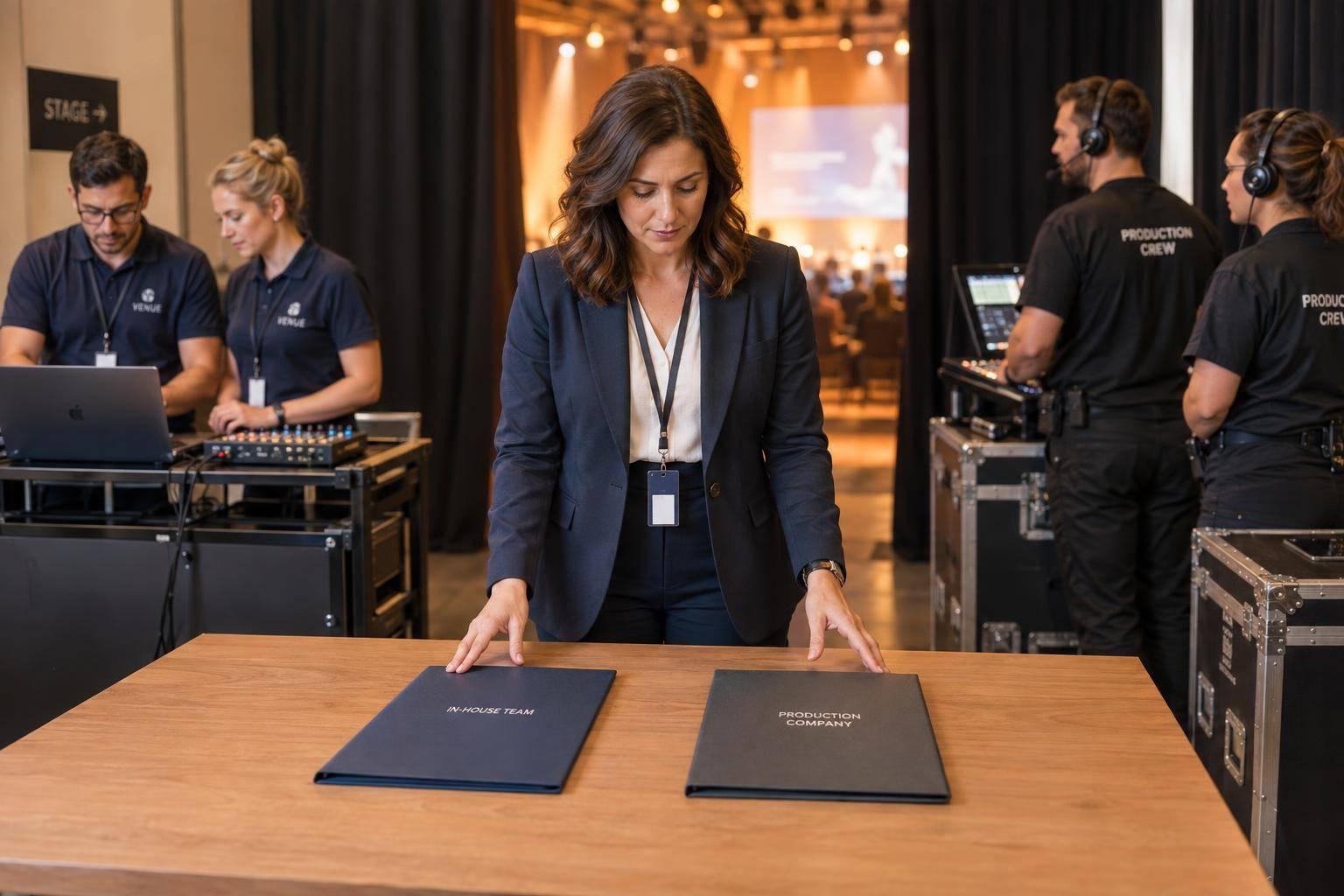
I’d outsource conference production when outside support meets your staffing, quality, and backup needs at a lower total cost than doing it in-house. For a 1-room event with basic AV, trained employees may be enough. For concurrent sessions, livestreaming, or tight transitions, I’d check whether your team has enough specialists - and time - to cover every role.
My comparison starts with five checks:
- Total cost: Labor, benefits, overtime, equipment, venue fees, travel, rehearsals, and teardown - not just the vendor quote.
- Event frequency: Whether repeat events justify equipment, training, and dedicated staff.
- Staff workload: Who is available during planning, setup, show days, and teardown, without leaving regular work uncovered.
- Skills and control: Who runs each technical system, approves changes, and manages speakers.
- Failure recovery: Who manages technical redundancy, handles interruptions, and pays for extra labor or replacement gear.
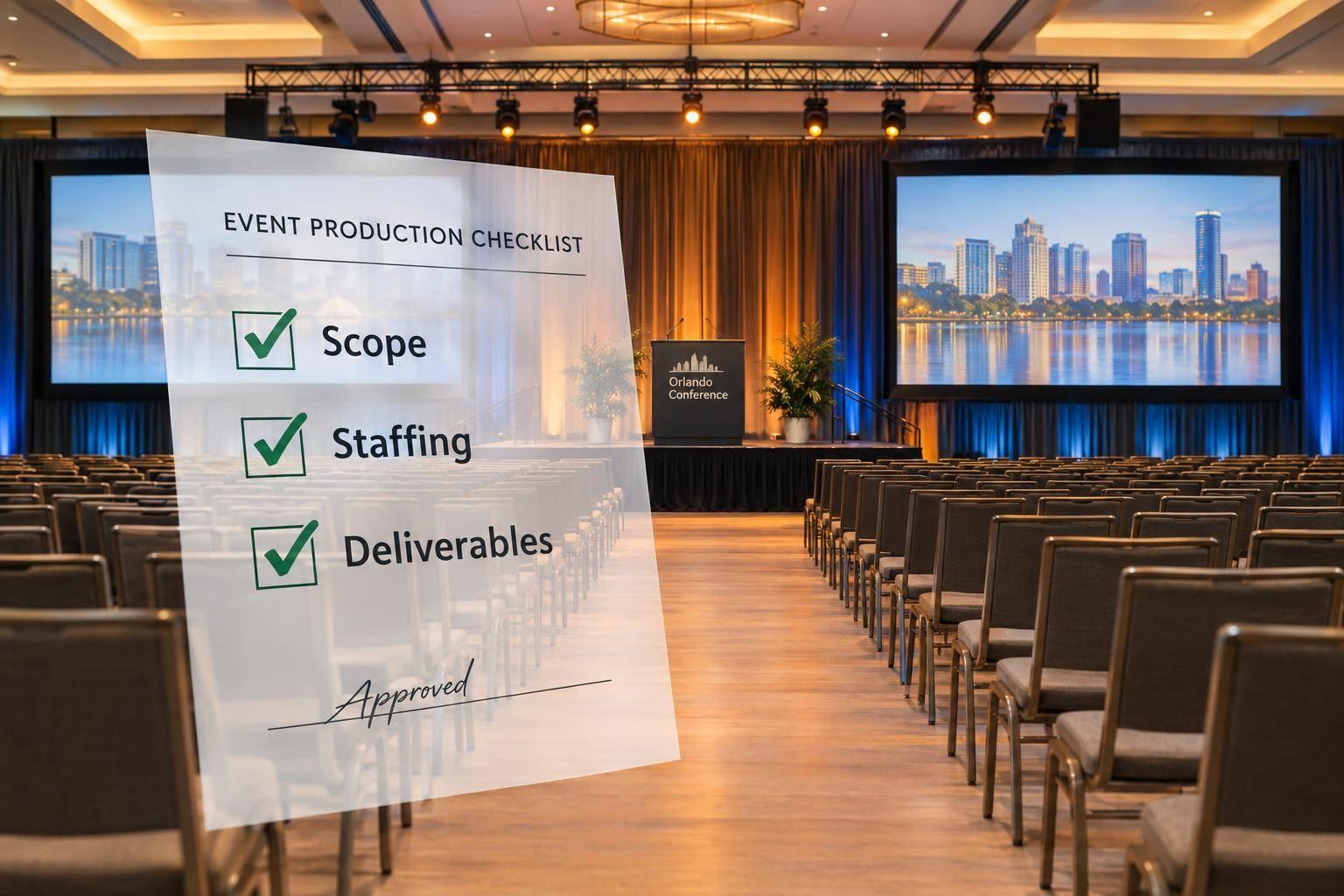
<u>I’d compare the same scope before comparing prices.</u> A lower price means little if it leaves out rehearsal coverage or backup systems.
Quick Comparison
| Decision point | In-house team | Production company | Hybrid |
|---|---|---|---|
| Cost | Staff time, equipment, and venue charges | Vendor fee plus internal coordination and venue charges | Internal costs plus selected outside services |
| Best fit | Frequent, familiar programs with available staff | Programs beyond internal staffing or technical limits | Internal content team with technical gaps |
| Skills and workload | Employees cover all assigned roles | Outside crew covers the agreed scope | Employees and specialists split duties |
| Control | Internal owners direct delivery | Internal approvals with outside technical direction | Internal content control; outside technical lead |
| Recovery | Internal team supplies and tests backups | Contract defines backup gear and recovery duties | Written handoffs define who handles failures |
My rule: keep what your team can reliably cover, and outsource the gaps - not automatically the whole event.

Conference Production: In-House vs. Outsourced vs. Hybrid
Compare Total Costs and Staff Workload
Start with one scope sheet for both options. Include room count, program hours, technical needs, and load-in/load-out dates. Then track direct spending, staff time, and displaced work separately so you don’t count staff hours twice. Compare costs only after both options cover the same scope.
Include Labor, Equipment, and Venue Fees
Track labor from planning through closeout. Multiply each employee’s hours by a fully loaded rate covering salary, payroll taxes, and benefits, then add any applicable overtime separately. If you outsource delivery, still count internal hours for content, speaker coordination, and approvals.
| Cost category | In-house delivery | Outsourced delivery | Paid directly | Absorbed internally | Common extras |
|---|---|---|---|---|---|
| Labor | Employees and temporary technicians | Quoted management and specialist crew | Freelancers, overtime, crew fees | Salaries and benefits for assigned hours | Minimum calls, after-hours premiums |
| Equipment | Owned gear, purchases, or rentals | Supplied equipment and technical systems | Purchases, rentals, licenses, insurance | Maintenance, storage, depreciation, replacement reserve | Missing backups, emergency rentals |
| Venue fees and services | Staff coordinate venue requirements | Production team coordinates agreed items | Rigging, power, internet, house labor | Internal coordination time | Outside-vendor fees, service charges |
| Travel | Staff travel and equipment shipping | Crew travel and freight | Lodging, parking, freight, per diem | Logistics coordination | Late shipping, equipment damage |
| Rehearsal, setup, and teardown | Employee hours and temporary help | Included crew days or separate charges | Crew days, extended venue access | Salaried staff time | Extra rehearsal days, overtime |
Before approving either budget, ask the venue for its AV exclusivity rules and complete fee schedule. Hiring an outside production team doesn’t automatically remove mandatory venue charges.
Check each proposal for specialist crew, backup equipment, rehearsal support, travel, and exclusions. Those details can explain why a higher quote is worth the price. For owned equipment, separate the upfront purchase payment from the allocated annual cost - don’t charge both in full.
Weigh Event Frequency Against Staff Availability
Frequent programs spread equipment, software, maintenance, and training costs across more events. Compare annual internal costs with outside proposals covering the same annual schedule. Equipment you already own only helps if it meets the requirements. Skilled employees only help if they’re available. For low-frequency conferences, outsourced labor usually makes more sense than permanent staffing and training.
Map assignments across the 8–12 weeks before the conference, plus setup, show days, and teardown. Assign an owner to each task, estimate hours, and flag conflicts with regular duties. Check who needs to be available at the same time, not just total hours: one person can’t run two rooms at once.
Price staffing gaps before choosing a model. Local labor rates, venue rules, event length, and scope all affect the comparison. When the schedule leaves conflicts or coverage gaps, outsourcing usually wins on workload alone.
sbb-itb-ae35a94
Compare AV Skills, Staffing, and Control
When costs are close, skills and control determine whether internal staff can deliver the program. Teams differ in what they can handle, so compare proven skills with program requirements. Outsourcing pays off when filling skill gaps improves quality and reliability at a lower total cost.
| Criterion | Internal generalist team | Dedicated internal production team | Conference production company | Hybrid delivery |
|---|---|---|---|---|
| AV capability | Basic microphones, playback, and displays | Complex programs within existing skills and equipment | Specialized operators, equipment, and workflows | Internal expertise plus outside technical specialists |
| Staffing depth | Limited specialist coverage | Dedicated technical roles within the team | Specialist crew matched to the agreed scope | Outside specialists fill technical gaps |
| Institutional knowledge | Knows stakeholders, brand, and executive preferences | Combines institutional knowledge with production experience | Needs stakeholder and brand briefing | Internal lead supplies context |
| Approval rights | Direct internal authority | Internal authority with technical delegation | Client retains agreed approvals | Internal content approval; external technical authority |
Start with the program itself, not the org chart.
Match AV Capabilities to the Program
A trained generalist team may be able to handle basic microphones and presentation playback. If the program adds confidence monitors, teleprompters, LED walls, distributed audio, lighting, livestreaming, or multiple stages, check each skill separately.
Ask for a capability matrix, not just a gear list. For each element, it should name the qualified operator, required equipment, rehearsal needs, and backup.
Outsourcing gives you access to specialists without hiring permanent staff. Multi-camera switching, for example, can require a dedicated operator. Internal employees still bring knowledge of messaging, executive preferences, and stakeholder sensitivities.
Define Production Roles and Approval Rights
Separate planning assignments - technical design, content collection, venue coordination, and the run of show - from live positions. Assign owners for technical direction, show calling, AV, lighting, streaming, and speaker rehearsals as needed. The technical director manages systems; the show caller cues operators from the script.
Plan coverage for load-in, breaks, room changes, and teardown without pulling registration or communications staff away from their primary jobs.
Document scope and approval rights before rehearsals to reduce rework, delays, and miscommunication. Keep program content, branding, speaker changes, and budget changes with designated internal owners. Give the technical director authority over safe technical execution.
Specify external staff responsibilities, venue handoffs, and primary and backup escalation contacts. Route live changes through one named decision-maker and one shared show script - not informal messages.
With roles assigned, test whether the team can rehearse, provide backups, and recover under pressure.
Compare Execution Risks as Complexity Grows
Once roles are clear, compare how each model handles failures. As complexity grows, one delay can trigger others. Live broadcasts depend on networks, executive audiences make errors more costly, and short setup windows leave less time to catch problems. Assess both the chance of failure and the difficulty of recovery - not just attendance size.
| Risk | Internal capability needed | Possible outsourced support | Organizer’s remaining responsibility |
|---|---|---|---|
| Concurrent rooms | Dedicated room coverage and communication across rooms | Room technicians and technical supervisors | Approve coverage and resolve schedule conflicts |
| Tight transitions | Rehearsed cues and verified presentation files | Playback operators and transition rehearsals | Provide approved content and prepared speakers by agreed deadlines |
| Live broadcast | Stream monitoring, tested connectivity, and recovery procedures | Stream engineer, backup encoder, and local recording | Approve broadcast priorities and audience messages |
| Executive presentations | Discreet troubleshooting and speaker support | Dedicated presentation technician and rehearsal support | Approve confidential-content access and run-of-show changes |
| Short setup window | Advance venue checks and coordinated load-in | Prebuilt systems and additional setup crew | Secure access and meet content deadlines |
Check Rehearsals, Backups, and Contingency Plans
Require a venue inspection that covers power, internet, loading access, and restrictions. Use a corporate event checklist to track these logistics alongside production milestones. Document the run of show, including recovery cues, and rehearse speaker handoffs and critical transitions at show pace. Schedule technical testing 24–48 hours before the event.
Test recovery - not just the equipment. Use the actual program to check backup microphones, presentation playback, signal paths, recording, and connectivity. Test backup internet under streaming load, and disconnect the primary connection during rehearsal to check the switchover.
An outsourced proposal should spell out rehearsal coverage, staffing commitments, backup equipment, insurance requirements, and contingency responsibilities. Check whether the fee includes recovery labor, overtime, and replacement equipment or whether these cost extra. The organizer should retain approval of run-of-show changes and control of attendee communication.
Weigh Failure Costs Against Coordination Work
Apply the same standard for who owns failure recovery across all proposals.
Compare the external fee with the cost of a failed stream, delayed opening, or interrupted executive presentation. Those costs can include lost reach, unhappy sponsors, refunds, extra venue labor, and staff overtime.
Internal delivery may allow faster business decisions, while external specialists can reduce technical coordination work. For both models, check who owns each task and whether recovery plans are realistic for in-room and remote audiences.
Conclusion: Choose In-House, Outsourced, or Hybrid Production
Choose the model that meets your quality, staffing, and reliability needs at the lowest fully loaded cost. Use the scenarios below to compare costs, skills, and risks, then match your event to the right production model.
Compare 2 Conference Scenarios
Small, single-room conference: A basic program uses familiar equipment. In-house delivery may cost less if dedicated AV and speaker-support coverage are available.
Multistage conference with concurrent sessions: Outsource when internal technical coverage falls short, or choose hybrid production when employees can retain content and speaker management. Complexity matters only when internal coverage, rehearsal time, or recovery capacity is insufficient.
Use 5 decision checks before requesting pricing
- Program complexity
- Frequency of similar events
- Available equipment and expertise
- Staff coverage from load-in through strike
- Cost of failure
Use these checks to build a fully loaded internal cost estimate, including benefits, overtime, equipment, venue charges, and work pulled from regular duties. Compare that estimate with a proposal covering the same scope. Track staff time and displaced regular work separately to avoid double-counting.
Pricing depends on scope. Match deliverables, crew coverage, and rehearsal time before comparing totals.
Find the operating pattern below that best matches your conference.
| Event conditions | Recommended model | Why this model fits | What it needs |
|---|---|---|---|
| One room, basic AV, available skilled staff | In-house | Uses existing capacity without an external production fee | Dedicated operators, tested equipment, full-schedule coverage |
| Internal content owners, limited technical depth | Hybrid | Keeps program control with employees while adding technical support | Written responsibilities, external technical lead, approval checkpoints |
| Multiple stages, livestreaming and global broadcast technology, tight changeovers, insufficient internal crew | Outsourced | Adds specialist staffing and coordinated technical delivery | Room-by-room staffing, rehearsals, backup systems, contingency ownership |
| Frequent, stable programs | In-house or hybrid | Repeated use may justify equipment and training costs | Spare capacity and maintenance budget already covered; outside support for peak demand |
FAQs
How do I calculate my break-even point for outsourcing?
Compare total costs, not just quotes. For in-house production, add equipment rentals, freelance fees, and internal labor. For outsourcing, check that the quote covers labor, show management, and backup planning. Include venue charges, overtime, and freight in both totals.
Your break-even point comes when lower risk, avoided duplicate equipment costs, and one party accountable for delivery offset outsourcing’s higher upfront cost. Factor in the potential costs of technical failures and lost productivity, too.
How can I verify a production team's expertise?
Ask for two or three recent projects that match your event’s format, audience size, venue type, and technical complexity. For each, ask what went wrong or proved difficult, how the team handled it, and what the result was. Confirm that the proposed producer and technical director led those projects.
Review an anonymized run of show or cue sheet to see how the team plans an event. Check references from the past two to three years, and ask how the team resolved a technical problem during a live event.
Which production tasks should I outsource first?
Start by outsourcing tasks your team can’t reliably plan, staff, or execute. These may include multi-camera switching, hybrid streaming, complex staging, and cue-by-cue show calling.
Make outsourcing a priority when your event includes high-stakes executive messaging, multiple rooms running at once, or a need for tested audio, video, and internet backups. This matters even more if you don’t have a dedicated show caller or enough on-site staff to fix problems without disrupting the attendee experience.
Related Blog Posts



Streamline your workflow, achieve more

Lorem ipsum dolor sit amet, consectetur adipiscing elit. Maecenas ac velit pellentesque, feugiat justo sed, aliquet felis.



Lorem ipsum dolor sit amet, consectetur adipiscing elit. Maecenas ac velit pellentesque, feugiat justo sed, aliquet felis.