Best Virtual Broadcast Production Companies For Corporate Town Halls In 2027.

Chief Executive Officer
Corporate Optics, Encore, Freeman, and Cramer offer different starting points for 2027 town hall planning. Compare their proposed live-production plans - not just their service lists - and require a rehearsal, backup streaming plan, and itemized quote before booking.
The best fit depends on audience size, speaker locations, production needs, internal AV support, employee access, accessibility, and budget. Freeman documents a broadcast for 2,000+ attendees; Encore cites a hybrid AGM with 250 in-person guests. Those examples help assess fit, but they don’t guarantee town hall results.
Quick Comparison
| Provider | Fit to assess | What still needs checking |
|---|---|---|
| Corporate Optics | One production lead for planning, AV, speaker support, and streaming | Comparable town halls, backup design, platform connections, security, and accessibility |
| Encore | Venue-based executive events with remote participation | Employee-platform support, local crews, access controls, and recovery commitments |
| Freeman | Multi-speaker broadcasts with moderated chat and Q&A | Regional staffing, backup streams, accessibility, and data handling |
| Cramer | Studio-led executive broadcasts with coaching and remote-speaker support | Audience capacity, geographic staffing, platform setup, and backup systems |
All four require custom quotes. Compare the same scope across providers, including rehearsals, moderation, captions, interpretation, recording, replay delivery, travel, and overtime.
This is a working shortlist, not a ranking. Information reflects material available through November 15, 2026; provider claims have not been independently verified, and 2027 fit remains an editorial assessment.
Live Streaming a Town Hall: Full Setup and Workflow
Beyond the technical setup, organizing a corporate town hall involves strategic planning to ensure high audience engagement.
sbb-itb-ae35a94
1. Corporate Optics
Corporate Optics suits teams seeking end-to-end town hall production, with the scope of work confirmed upfront. Its listed services range from agenda planning to venue sourcing, on-site staffing, and vendor coordination. That range works well for teams that want one production lead, but it may be more than a simple internal update needs.
Broadcast Reliability
A reliable town hall broadcast needs redundancy, rehearsal, and clear ownership during the live event. Get Corporate Optics’ contingency plan in writing, including primary and backup paths, failover steps, internet requirements, recording, and escalation contacts.
Include executive rehearsals and script or teleprompter support. The run-of-show should also assign responsibility for live switching, speaker cues, Q&A screening, and replay delivery.
Integration, Security, and Accessibility
Once the broadcast setup is settled, define how employees will join, participate, and watch the recording. Confirm that Corporate Optics’ scope covers platform administration, security, and accessibility.
Spell out requirements for sign-in, replay access, captions, transcripts, keyboard-accessible tools, and accessible presentation materials. Set polling and Q&A workflows, then request a sample report showing attendance, watch time, participation, polls, Q&A, and replay performance.
Production Scope and Costs
Match the scope to the event’s format and production needs. Corporate Optics lists Basic AV Support for smaller events, covering AV setup, lighting, and sound coordination. Its Comprehensive Event Management offering adds end-to-end planning, venue sourcing, speaker support, and audience-engagement tools.
For virtual or hybrid town halls, request line-item pricing tied to specific deliverables: run-of-show control and live switching for executive presentations, speaker support, Q&A moderation, and replay delivery. Ask for scenic design, streaming, platform administration, analytics, security, and vendor management to be priced separately.
2. Encore
Encore suits venue-based executive town halls that need coordinated staging, broadcast production, and remote participation. It operates in more than 20 countries across North America, Europe, the United Arab Emirates, Australia, and Asia. Confirm local crews, time-zone coverage, and travel charges for each location.
The key test: Can its documented live-event workflow support a town hall?
Encore’s Scentre Group AGM case study describes 250 in-person guests at Sydney Town Hall, branded lighting, a board table with individual visual displays, and a live webcast reaching shareholders worldwide.
This example shows hybrid broadcast capability in a controlled venue - not direct experience with employee town halls.
Broadcast Reliability
Encore describes technical direction, show management, run-of-show development, rehearsal management, and presenter support for live, hybrid, and virtual events.
Ask for a signal-flow diagram. Confirm who will serve as technical director, the remote-speaker limit, backup feeds, failover timing, and connectivity commitments. Public materials do not state guaranteed uptime.
Also check how these production tools work with employee platforms and accessibility needs.
Integration, Security, and Accessibility
Encore offers streaming-platform integration, audience-engagement tools, multilingual support and real-time interpretation, and multilingual audio distribution.
Confirm platform compatibility and test moderated Q&A before signing. Require written details on SSO, encryption, hosting location, retention, captions, transcripts, and keyboard navigation. These controls remain unverified in public materials.
Production Scope and Costs
No public standard U.S. town hall pricing was identified in the available Encore materials.
Request tiered quotes for a basic webcast, an executive hybrid town hall, and a multi-region broadcast. Each quote should cover only the production layers your town hall needs.
3. Freeman
Freeman has documented experience with complex executive broadcasts, presenters joining from different locations, and live employee Q&A. Confirm direct staffing in each U.S. city and international location, along with time-zone coverage, multilingual support, and a single escalation path.
Start with who controls the broadcast, then check how speakers prepare and participate live.
Broadcast Reliability
For FinancialForce, Freeman ran two live half-day broadcasts for 2,000+ attendees from a Dallas control room, using speaker kits, live show management, and moderated chat and Q&A.
Freeman also documents recording capture, live switching, camera support, and presenter management. Ask whether coaching, remote technical checks, teleprompters, and a dedicated show caller are included.
Case studies show capability - not uptime guarantees. Require written procedures for backup streams, rehearsals, and incident response.
Once the show flow is set, check how employees will join, ask questions, and watch the recording.
Integration, Security, and Accessibility
Freeman has documented customized participation tools and multilingual programs. Require an accessibility plan that covers live captions, sign language, audio description, keyboard navigation, and WCAG conformance. Verify SSO, encryption, data location, retention, and compliance certifications.
Production Scope and Costs
Freeman lists no public town-hall pricing. Request itemized quotes for 1,000, 5,000, and 25,000 viewers. Each quote should separate the costs for remote kits, rehearsals, licensing, captions, interpretation, moderation, replay hosting, overtime, extra languages, retention, and cancellation fees.
4. Cramer
Cramer’s studio-led production model may suit executive town halls. The agency handles virtual, hybrid, and live events, with services covering strategy, agenda planning, scripts, set design, messaging, live broadcast production, encoding, livestreaming, and talent support. Its Comms Center and Remote Record Station also provide presenter coaching and remote-feed support for interactive town halls.
The main test: Can that studio-led model support live executive delivery without disruption?
Broadcast Reliability
Cramer documents broadcast encoding, speaker rehearsals, and technical run-throughs. Its Norwood studio has two sound stages, a broadcast control room, and dedicated gigabit bandwidth. Ask for written confirmation of the run of show, backup power, encoding paths, and recording redundancy.
In a May 2026 case study, Cramer says it moved CyberArk’s manager-training event into its studio within 24 hours after a snowstorm threatened the original plan.
That example shows how Cramer responded to a last-minute change. It isn’t a service guarantee. Also check how the broadcast connects to employee access, Q&A, and replay delivery.
Integration, Security, and Accessibility
Because Cramer is an agency, ask for a platform-specific delivery plan that covers authenticated access, moderated Q&A, captions, accessible replays, and retention. Get integrations, security controls, and accessibility deliverables confirmed in writing.
Cramer documents remote and multi-location support. The proposal should confirm geographic staffing, U.S. time-zone coverage, and international crew arrangements.
Production Scope and Costs
The reviewed materials don’t publish standard town-hall pricing. Request an itemized proposal covering strategy, rehearsals, crew, studio time, set design, graphics, encoding, platform fees, captions, interpretation, recording, editing, travel, overtime, and contingency support. Also confirm teleprompters, remote camera kits, revision limits, rush fees, and postponement fees.
Ask for a recent employee town-hall reference, including audience size and engagement results. Before approval, use the proposal to verify platform, security, and accessibility details.
Broadcast Reliability and Presenter Support
Judge the live operating plan, not the service list. Ask for rehearsals that cover executive delivery, remote speaker prep, panel handoffs, slide changes, and speaker transitions. Confirm who calls cues, switches feeds, monitors audio, and helps presenters privately.
Public materials don’t provide reliability metrics that allow a direct comparison. The table below shows what each provider documents - and what still needs checking.
| Provider | Presenter support | Reliability measures | Audience participation and reach | Unresolved questions |
|---|---|---|---|---|
| Corporate Optics | Lists speaker support and on-site staffing. | Lists audiovisual production, live streaming, and contingency planning, but does not detail backup architecture. | Lists audience engagement tools and global broadcast services; provides no audience-size figures. | Confirm rehearsal scope, remote-speaker preparation, cue ownership, and failover procedures. |
| Encore | Documents rehearsals and presenter support. | Redundancy and recovery commitments remain unconfirmed. | Offers engagement tools; employee-broadcast results need verification. | Confirm moderation workflows and who owns recovery. |
| Freeman | Documents speaker kits and presenter management. | Backup connections, signal paths, and recovery commitments remain unconfirmed. | Documents moderated chat and Q&A for 2,000+ attendees. | Confirm technical ownership and participation staffing. |
| Cramer | Documents coaching, rehearsals, and remote-feed support. | Backup power, encoding paths, and recording redundancy need confirmation. | Documents interactive town-hall support; audience-scale results need verification. | Verify panel handoffs, remote-speaker recovery, and moderation roles. |
Ask each provider for a sample run-of-show, backup plan, and reference from a comparable employee broadcast.
Require a signal-flow diagram showing primary and backup internet, encoders, audio paths, and destinations. During testing, confirm who cuts away when a presenter’s feed drops, keeps slides moving, and alerts employees.
Assign one team to screen questions, remove duplicates, launch polls, monitor chat, and send approved questions to the moderator. Rehearse those steps, too.
Request concurrent-viewer counts, locations served, and incident records from comparable broadcasts. Make sure each performance metric specifies whether it measures the encoder, platform, or viewer experience.
Next, check how these workflows connect to platform integration, access control, and accessibility.
Platform Integration, Security, and Accessibility
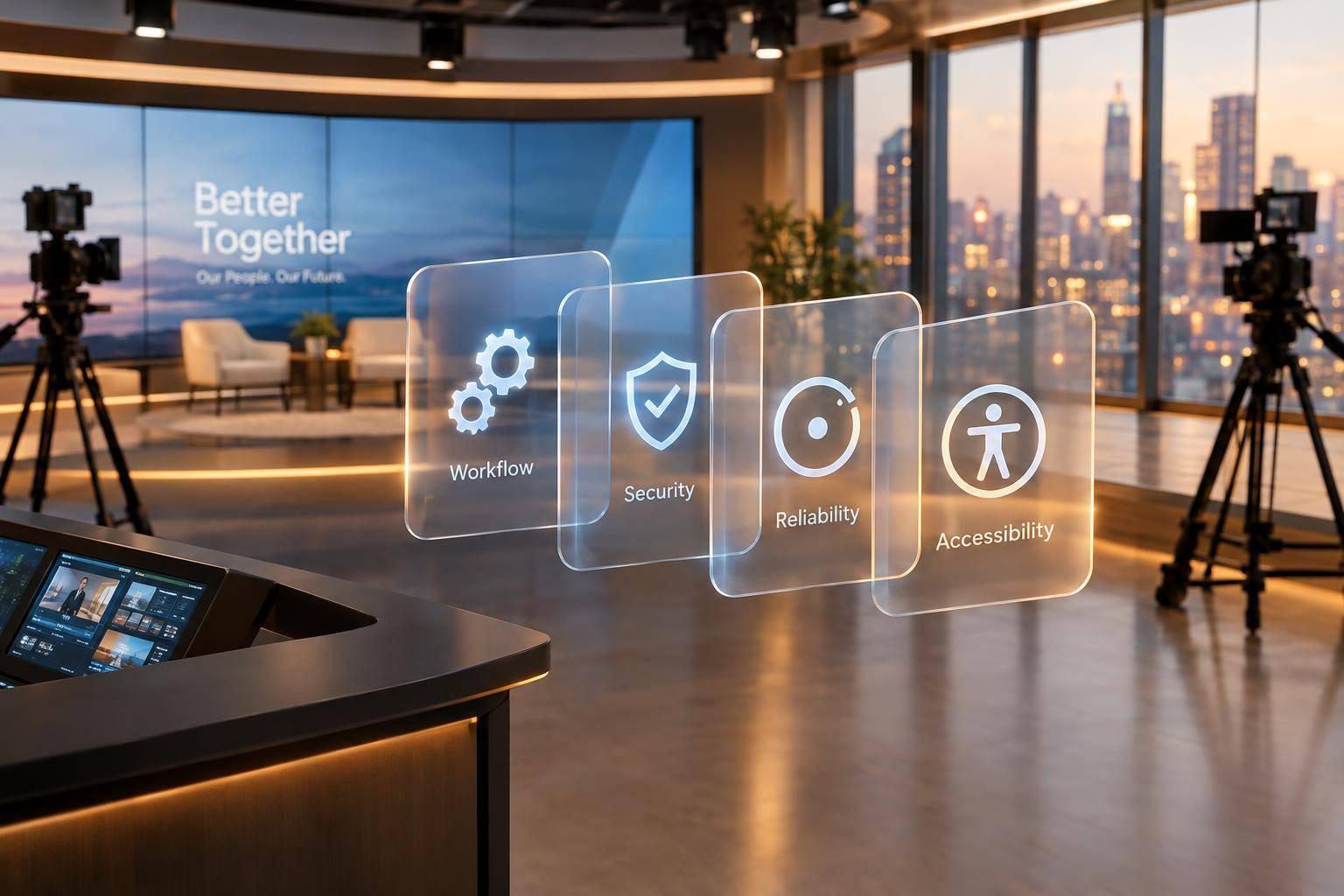
Use the same checklist for every proposal: integrations, security, accessibility, analytics, and data handling. Score providers on written evidence, not broad claims. Use these requirements as the scoring template for the buyer checklist that follows.
| Evaluation area | What to verify | Responsibility and contract evidence |
|---|---|---|
| Integrations | Named platform, license tier, SSO, employee portal, caption feeds, and recording exports. | Provider documents and tests each connection. Client approves tenant access, licenses, and identity settings. Require an integration matrix. |
| Access and recording controls | Employee authentication, role permissions, moderated Q&A, recording notices, download restrictions, and retention settings. | Client sets eligibility, consent language, and policy. Provider configures agreed controls. Platform terms govern platform storage and deletion. |
| Accessibility | Synchronized captions, speaker identification, transcripts, interpretation, keyboard access, and screen-reader behavior. | Provider coordinates contracted services and testing. Client supplies accessible source content. Platform features must work in the selected setup. |
| Analytics | Attendance, engagement, replay, and technical metrics; named versus aggregate reporting; export formats. | Platform supplies available data. Provider delivers agreed reports. Client controls access, retention, and employee-data use. |
| Contract requirements | Support hours, time zones, regional staffing, languages, replay delivery, data locations, subprocessors, and deletion deadlines. | Give each deliverable one owner and clear acceptance criteria. Set incident-notification timelines and post-event correction support. |
At the contract stage, require least-privilege roles for producers, presenters, moderators, captioners, and attendees. Agree on a fallback for employees who can't use SSO, such as an email one-time code where supported. Spell out how sensitive or anonymous questions will be handled. Keep production staff out of employee records unless they need access.
Put recording notices in both registration and the opening script. State whether names, audio, video, chat, Q&A, captions, and transcripts will be retained. Define ownership, encrypted transfer, storage and processing locations, vendor access, backup retention, and deletion deadlines, including exceptions for legal holds. Set delivery formats and deadlines for the edited recording, caption file, transcript, and presentation in the client's approved repository.
Test accessibility in the actual attendee experience, from registration through replay. Check keyboard-only navigation and screen-reader use. Specify the captioning method, languages, expected latency, and correction process. Scope ASL, simultaneous interpretation, translated Q&A, and slide remediation separately unless they're included. Document U.S. and international time zones, daylight-saving handling, regional support hours, and replay availability so employees outside the live window have usable access.
Provider Recommendations and Buyer Checklist
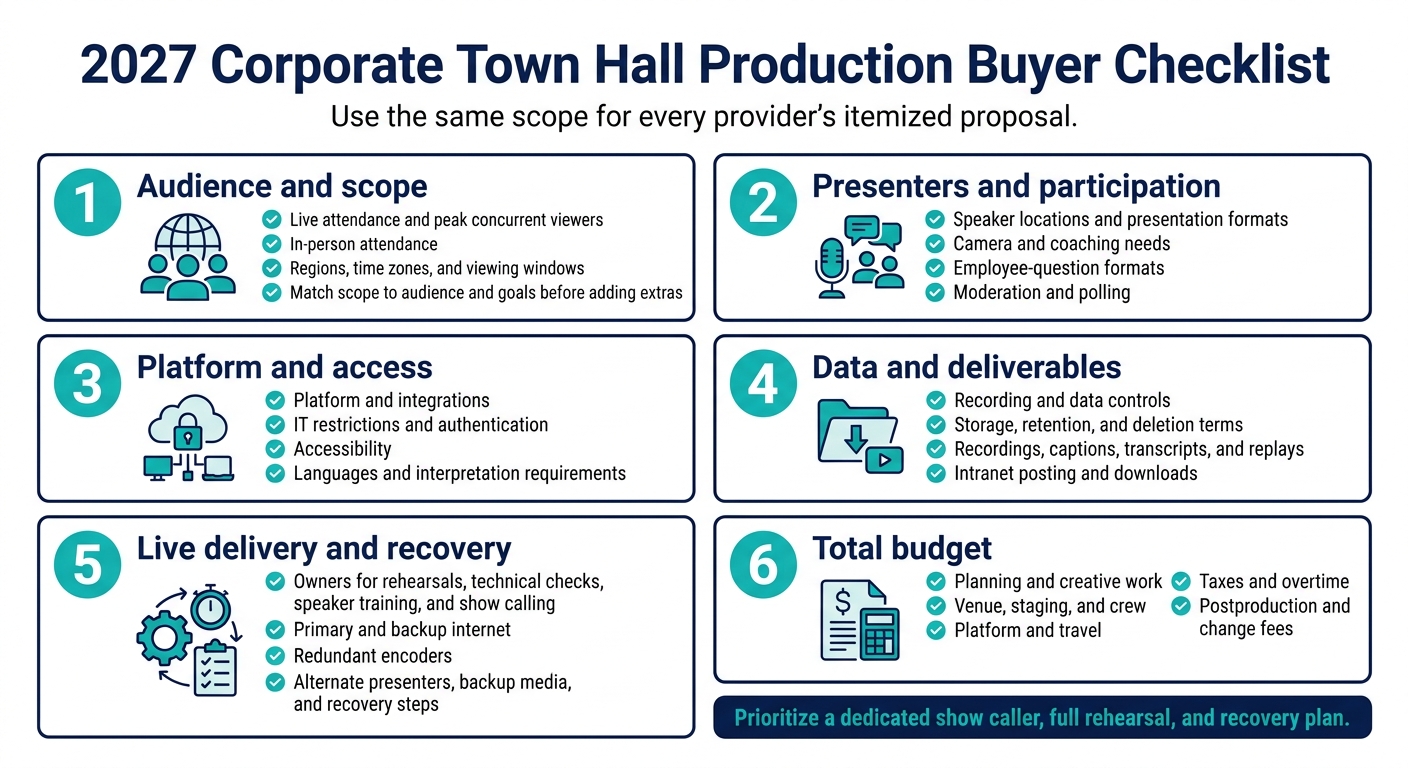
2027 Corporate Town Hall Production Buyer Checklist
Treat this as a working shortlist, not a ranking. These providers have the strongest documented fit; others need more verification before final selection. Compare each provider’s written scope with your requirements, and check that the proposal confirms your assumptions.
Apply this final filter after completing the reliability, integration, and accessibility review above.
| Provider | Audience and program fit | Production complexity | Security review | Pricing information |
|---|---|---|---|---|
| Corporate Optics | End-to-end town hall production | End-to-end town hall production | Validate the proposed platform, access controls, and data workflow | Custom quote required |
| Cramer | Polished executive communications and brand-sensitive leadership messaging | Studio-led executive communications; verify the live-event workflow | Review platform security, content permissions, recording controls, and accessibility workflow | Custom quote required |
Once you’ve set the shortlist, lock in the contract terms for live delivery, access, and recovery. Prioritize a dedicated show caller, full rehearsal, and recovery plan.
For regulated events, require written security terms before approving the contract. Cover data handling, access controls, retention, logging, incident response, and accessibility. A private event does not prove secure delivery.
Use the checklist below to turn your comparison into a procurement brief.
Buyer checklist:
- Audience and scope: Confirm live attendance, peak concurrent viewers, in-person attendance, regions, time zones, and viewing windows. Match the scope to your audience and goals before adding extras.
- Presenters and participation: Define speaker locations, presentation formats, camera and coaching needs, employee-question formats, moderation, and polling.
- Platform and access: Specify the platform, integrations, IT restrictions, authentication, accessibility, languages, and interpretation requirements.
- Data and deliverables: Set recording and data controls, plus storage, retention, and deletion terms. Confirm deliverables for recordings, captions, transcripts, replays, intranet posting, and downloads.
- Live delivery and recovery: Assign responsibility for rehearsals, technical checks, speaker training, and show calling. Confirm primary and backup internet, redundant encoders, alternate presenters, backup media, and recovery steps.
- Total budget: Include planning, creative work, venue, staging, crew, platform, travel, taxes, overtime, postproduction, and change fees.
FAQs
How far ahead should we book town hall production?
For most corporate town halls, book your virtual broadcast production partner 6 to 8 weeks in advance. This gives you time to arrange equipment, run technical tests, confirm technical support, and schedule rehearsals.
For larger or more complex hybrid events, allow 6 to 16 weeks for planning, testing, and a full rehearsal.
Can our internal AV team share production responsibilities?
Yes. Your internal AV team knows your brand and how your executives communicate. For high-stakes broadcasts, working with a professional partner is recommended.
A partner brings broadcast-grade equipment, backup signal paths, and specialized support, including teleprompter management and live technical direction. To avoid gaps, clearly assign ownership of the production runbook and spell out each team’s responsibilities.
How can we test broadcast quality before committing?
Request a 90-minute technical dress rehearsal with the actual production crew. Use it to test executive hardware, Q&A routing, and streaming handshakes.
Require a written failover runbook that covers primary encoder drops, network failures, and captioning outages. Ask for documented proof of uptime and redundancy, too. Before the event, coordinate stream load testing and checks of IT firewalls and VPNs to help keep the broadcast stable.
Related Blog Posts
- Best Production Companies Who Handle Live Broadcasts For Company Town Halls
- 7 Event Production Companies To Use For Executive Town Halls
- The Best Hybrid Meeting AV Production Company And What They Provide For Your Next Town Hall.
- Experienced Vendors To Help Produce And Stream Corporate Town Hall To Thousands


Streamline your workflow, achieve more

Lorem ipsum dolor sit amet, consectetur adipiscing elit. Maecenas ac velit pellentesque, feugiat justo sed, aliquet felis.



Lorem ipsum dolor sit amet, consectetur adipiscing elit. Maecenas ac velit pellentesque, feugiat justo sed, aliquet felis.