What Is Board Meeting Production, And Why Do Fortune 500 Companies Hire A Production Partner For It?

Chief Executive Officer
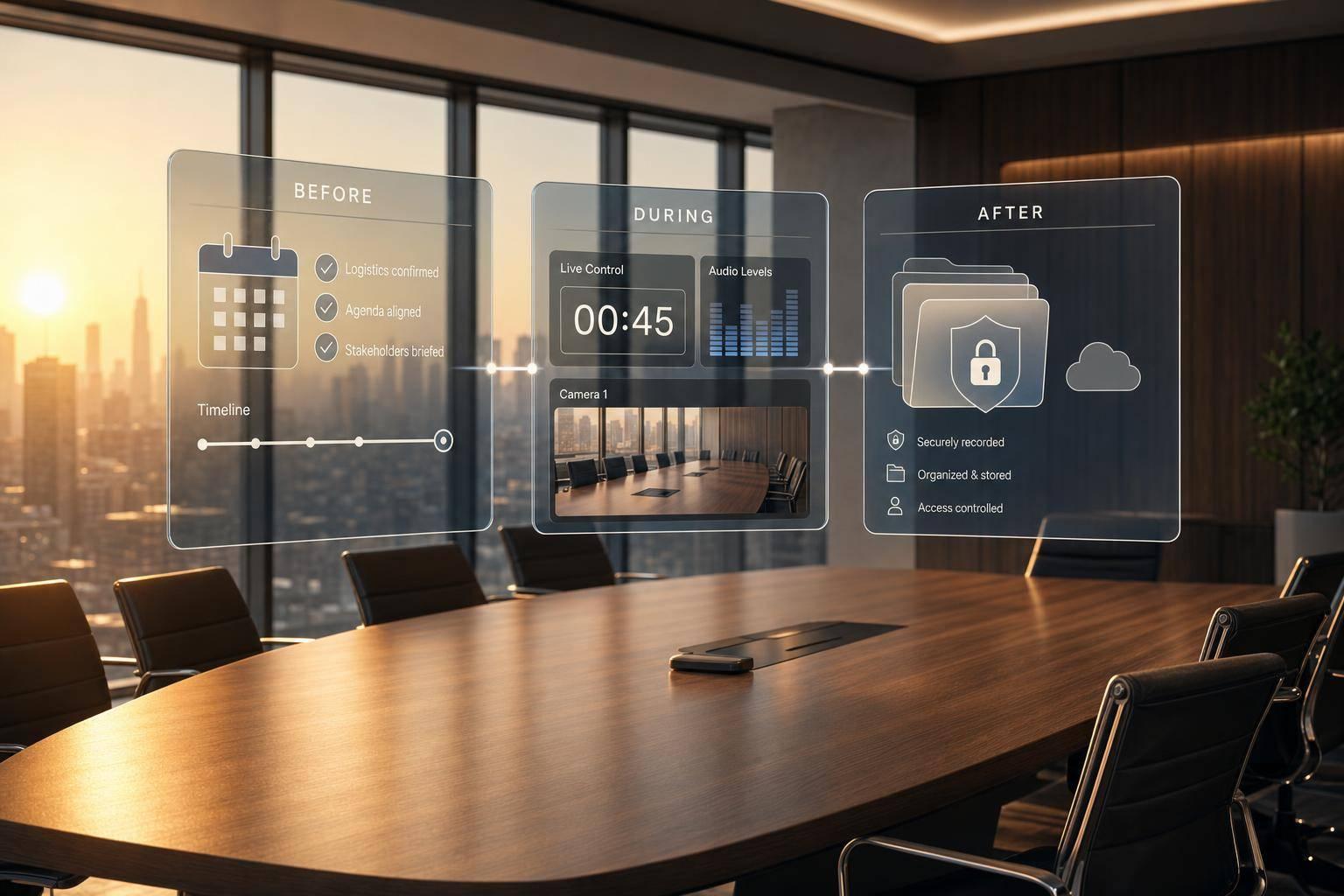
Board meeting production means one team runs the meeting before, during, and after it so slides, audio, video, remote access, and recordings stay under control. It goes far beyond setting up a mic and a screen. In high-stakes meetings, one wrong deck, a dropped audio feed, or a bad screen share can slow decisions and put private board material at risk.
Here’s the short version:
- Before the meeting: I see planning, room checks, file testing, version control, network checks, and rehearsal.
- During the meeting: I see live slide control, remote director support, webcast handling, source switching, and fast issue response.
- After the meeting: I see secure file handling, approved recording delivery, and an incident log for the next session.
Why do large companies bring in a partner for this? Because split ownership creates risk. If the executive assistant, IT, venue staff, and presenters each own one piece, no one owns the full meeting. A production partner puts one lead in charge of the whole flow.
A few numbers show why this matters: about 70% of hybrid meetings leave some attendees unable to see or hear well. And microphone problems affect 64% of small-room meetings and 76% of larger-room meetings. In a board session, that’s not a small glitch. It can interrupt a vote, delay a review, or expose private material.
| Area | Without a production partner | With a production partner |
|---|---|---|
| Ownership | Split across several people | One lead owns the meeting flow |
| Content control | Decks and edits handled in many places | One intake path and one master show file |
| Live support | Reactive troubleshooting | Dedicated live oversight and backup plans |
| Remote access | Mixed handling of logins and support | Managed participant access and backchannel support |
| Post-meeting | Manual follow-up | Controlled file transfer and recording delivery |
In short: board meeting production is about control, timing, privacy, and meeting continuity. That’s why many Fortune 500 companies don’t treat it like standard AV support.
What Board Meeting Production Covers Before, During, and After the Meeting
Board meeting production usually falls into three parts: prep work, live support, and what happens once the meeting ends. That means the job isn’t just “run the AV.” It covers the full workflow before, during, and after the session.
Before the Meeting: Planning, Room Design, and Presentation Control
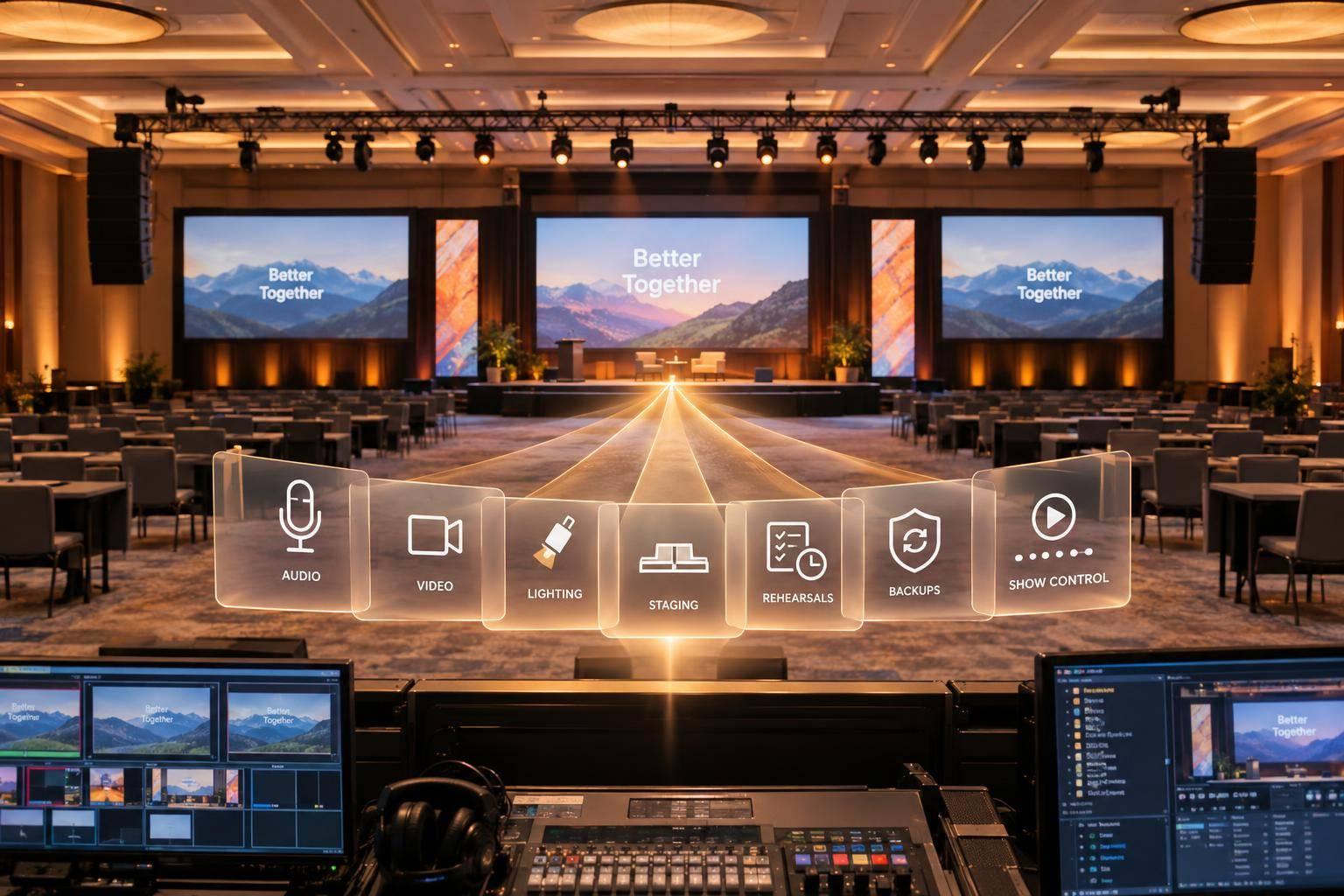
A production partner begins with a site survey. That includes camera sightlines, microphone pickup, display visibility, lighting, and dedicated network capacity. In hybrid meetings, the check also includes upload bandwidth plus any firewall or VPN limits.
Room design affects both how leaders come across in the room and how they appear to people joining remotely. Confidence monitors help preserve eye contact. Discreet microphones help deliver clean audio. Camera placement makes sure the active speaker is framed clearly.
The team also gathers approved slide decks and media ahead of the deadline, tests each file on the playback computer, locks version control, and rehearses the full workflow before directors walk in.
During the Meeting: Hybrid Support, Webcast Execution, and Live Troubleshooting
During the meeting, producers handle the moving parts in real time. They admit remote directors, verify identity, monitor return audio, switch sources and cameras, and maintain secure webcast access through a private technical backchannel.
For confidential sessions, the team keeps the room feed, program feed, recording feed, and presenter feed separate. That split matters because it keeps internal cues out of the webcast and the recording. If a director loses connection, the team moves to a pre-approved backup, such as a second device, dial-in audio, or another network path, without stopping the agenda.
After the Meeting: Recording Delivery and Production Follow-Through
After the meeting, the team secures the recording, confirms approved distribution, and transfers files only through controlled channels. Recording, distribution, and retention choices should be cleared with legal and governance stakeholders before any sensitive board content is stored or shared.
Post-meeting follow-through also includes a written incident log: what failed, when it happened, how it was fixed, and what should change before the next board session. That record is what separates a one-off effort from a process that gets tighter over time.
These steps protect audio quality, sightlines, content control, remote access, and recording integrity. If one part slips, the problem usually shows up live, where everyone can see it.
sbb-itb-ae35a94
The Risks of Running a High-Stakes Board Meeting Without a Production Partner
Most internal teams are capable. The problem usually starts with split ownership. When no one owns the live meeting from start to finish, small cracks can turn into public mistakes.
Where Internal Coordination Commonly Breaks Down
A presenter pulls up the wrong deck. A remote director loses screen access. The room audio cuts out at the worst possible moment.
Those aren’t minor hiccups. Wrong slides can misstate financials. Bad audio can stall a vote. Poor framing can make leadership seem unprepared.
The core issue isn’t one mistake on its own. It’s the fact that no one is overseeing all of it during the live meeting.
Why Split Ownership Creates Risk
In many internally managed board meetings, duties are spread across several people. The executive assistant handles agenda flow, IT handles connectivity, venue staff handle equipment, and presenters handle slides. But no one owns the full live meeting.
That’s the gap shared responsibility often leaves behind: no single person is watching the whole room, the full run of show, and every moving part at once.
If a presentation stops advancing in the middle of the session, things can unravel fast. The presenter turns to the executive assistant. The executive assistant reaches out to IT. Venue staff start checking the display. At the same time, the board chair is forced to fill the silence while directors wait.
A production partner fixes that by putting one accountable lead in charge of the live meeting.
How a Production Partner Reduces Risk and Improves Meeting Flow

Board Meeting Production: Self-Managed vs. Partner-Managed
A Clear Production Workflow from Discovery Through Post-Meeting Delivery
A production partner solves fragmented ownership by planning your corporate event with professional production support, putting one lead in charge of the full meeting from the very beginning. Instead of several teams handling separate pieces, one production lead owns the meeting flow end to end.
It starts with a discovery conversation that turns board requirements into specific, testable plans. That includes who will attend in person and who will join remotely, which parts of the meeting are confidential, whether the session will be recorded or webcast, what voting or Q&A tools are needed, and who can approve last-minute changes.
From there, the team runs a physical site survey and tests the room under actual conditions. The goal is simple: confirm the room’s technical needs and check backup paths before meeting day.
Once the setup is mapped out, presentation management becomes a controlled process of its own. Files come in through one approved channel and are locked into a master show file. Presenters don’t click through their own slides. A content operator handles that job, which keeps the pace steady and cuts down on avoidable mistakes.
The full agenda is then rehearsed, including handoffs, media playback, remote logins, voting, and recovery steps. By the time executives walk in, the main cues have already been tested.
What Fortune 500 Companies Gain from a Specialized Production Partner
That single ownership model changes the meeting itself. The main gain is simple: one lead coordinates the room, content, webcast, remote participants, recording, and crew. That person handles live cueing and manages transitions through one chain of command.
Presenters can stay focused on the board discussion instead of juggling slides, audio, or participant access. A dedicated technology moderator manages remote participant access separately from the chair running the meeting.
Security also follows documented procedures aligned with company policy. Access credentials move through controlled channels, waiting rooms verify participants, screen sharing is limited to designated presenters, and recording decisions follow documented retention policy.
After the meeting, approved recordings and files are packaged and transferred securely. That protects confidentiality and helps preserve board confidence in every session.
Self-Managed Production vs. Partner-Managed Production
The difference becomes clear when you look at who owns what.
| Responsibility | Self-Managed | Partner-Managed |
|---|---|---|
| Pre-meeting | Planning, content control, and rehearsal split across corporate secretary, IT, venue, and presenters | One production lead owns the integrated plan, single file intake process, master show file, and full agenda rehearsal covering presenters, cues, remote participants, media, and failure recovery |
| Live execution | Internal staff divide attention between governance duties and technical support | Show caller and technical team monitor content, webcast, recording, and participant access |
| Live control | Troubleshooting handled reactively; access, recording, and file handling managed inconsistently across teams | Escalation paths, spare equipment, redundant connections, and documented security procedures ready before the meeting starts |
| Post-meeting delivery | Recordings and files require separate coordination and manual follow-up | Approved recordings, files, and deliverables are packaged and transferred securely |
Self-managed production breaks down because ownership is split.
Conclusion: Why Board Meeting Production Matters for Mission-Critical Communications
Board meeting production isn't just a better AV setup. It's an end-to-end process that protects the three things that matter most in mission-critical communications: confidentiality, executive presence, and decision-making continuity.
And the risk isn't abstract. Reports show that about 70% of hybrid meetings leave some participants unable to see or hear well. On top of that, microphone failures affect 64% of small-room meetings and 76% of larger-room meetings. In a quarterly board review or a confidential shareholder update, even a few minutes of lost audio or one mishandled screen share can derail the discussion or expose restricted materials.
This is why reliability has to be built in before the meeting begins. A production partner checks systems again and again, confirms every presentation file, rehearses speaker handoffs, lines up backup connectivity and equipment, and assigns a dedicated technology moderator so executives can stay focused on the meeting itself.
And if recording is authorized, the job doesn't stop when the meeting ends. The partner still needs to verify the final file, organize approved materials, apply access controls, and deliver everything through secure, approved channels that match governance and records-retention requirements. That makes board meeting production a governance issue, not just a technical one.
FAQs
How is board meeting production different from standard AV support?
Board meeting production is more than a basic AV setup. It involves secure, end-to-end planning for high-stakes meetings, including executive staging, confidential content handling, and backup protocols.
Unlike standard AV support, it also covers real-time cueing, troubleshooting, and secure hybrid connectivity. The goal is simple: keep the meeting running smoothly, protect sensitive information, and avoid disruptions.
When should a company hire a board meeting production partner?
Hire a board meeting production partner when the meeting involves high-stakes communications - like quarterly board reviews, confidential shareholder updates, or leadership summits - where technical issues could interrupt decisions or hurt credibility.
It becomes even more useful when you need:
- risk reduction and live troubleshooting
- security and discretion for sensitive information
- support for hybrid or multi-location execution
- a single point of contact for coordination and presentation support
What security steps matter most in a hybrid board meeting?
The most important steps involve digital, physical, and procedural controls working together.
Limit access to the boardroom, virtual meeting, and any recordings to authorized participants and only the technical staff who need to be there. Use encrypted video, secure file sharing, dedicated network segments, and encrypted communications.
Confidentiality matters just as much on the process side. That means using NDAs, secure document handling, and tight control over who can access recordings. If you work with a production partner, they should also maintain security certifications such as ISO 27001 or SOC 2.
Related Blog Posts



Streamline your workflow, achieve more

Lorem ipsum dolor sit amet, consectetur adipiscing elit. Maecenas ac velit pellentesque, feugiat justo sed, aliquet felis.



Lorem ipsum dolor sit amet, consectetur adipiscing elit. Maecenas ac velit pellentesque, feugiat justo sed, aliquet felis.