Here Are The Best Conference Production Companies To Handle Content Playback And Media, Stage Management, And Executive Leadership Coordination.

Chief Executive Officer
If your event includes keynote videos, teleprompters, rehearsals, and C-suite speakers, the main issue is simple: can one team keep the show on time without errors?
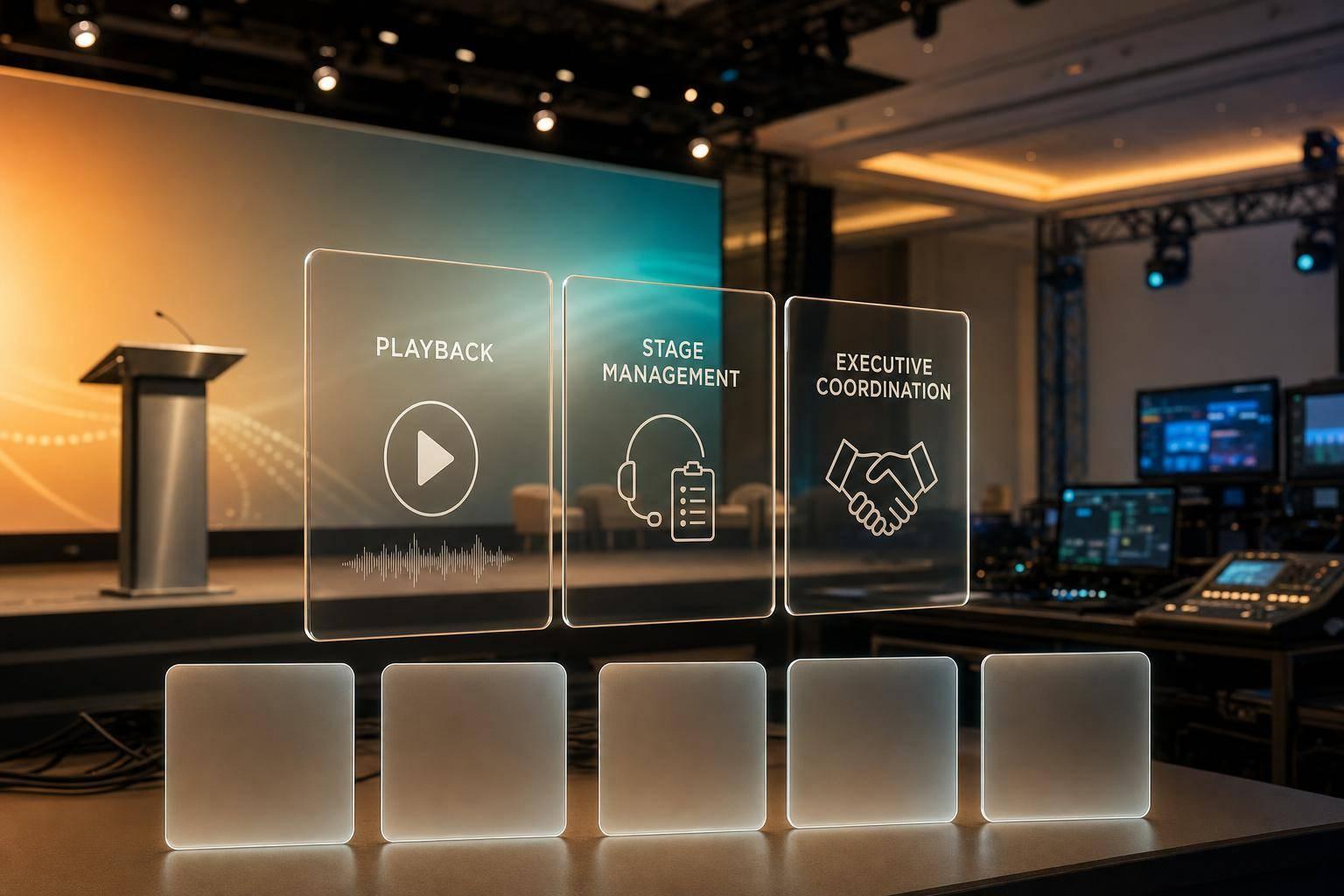
I’d narrow this list down by three checks:
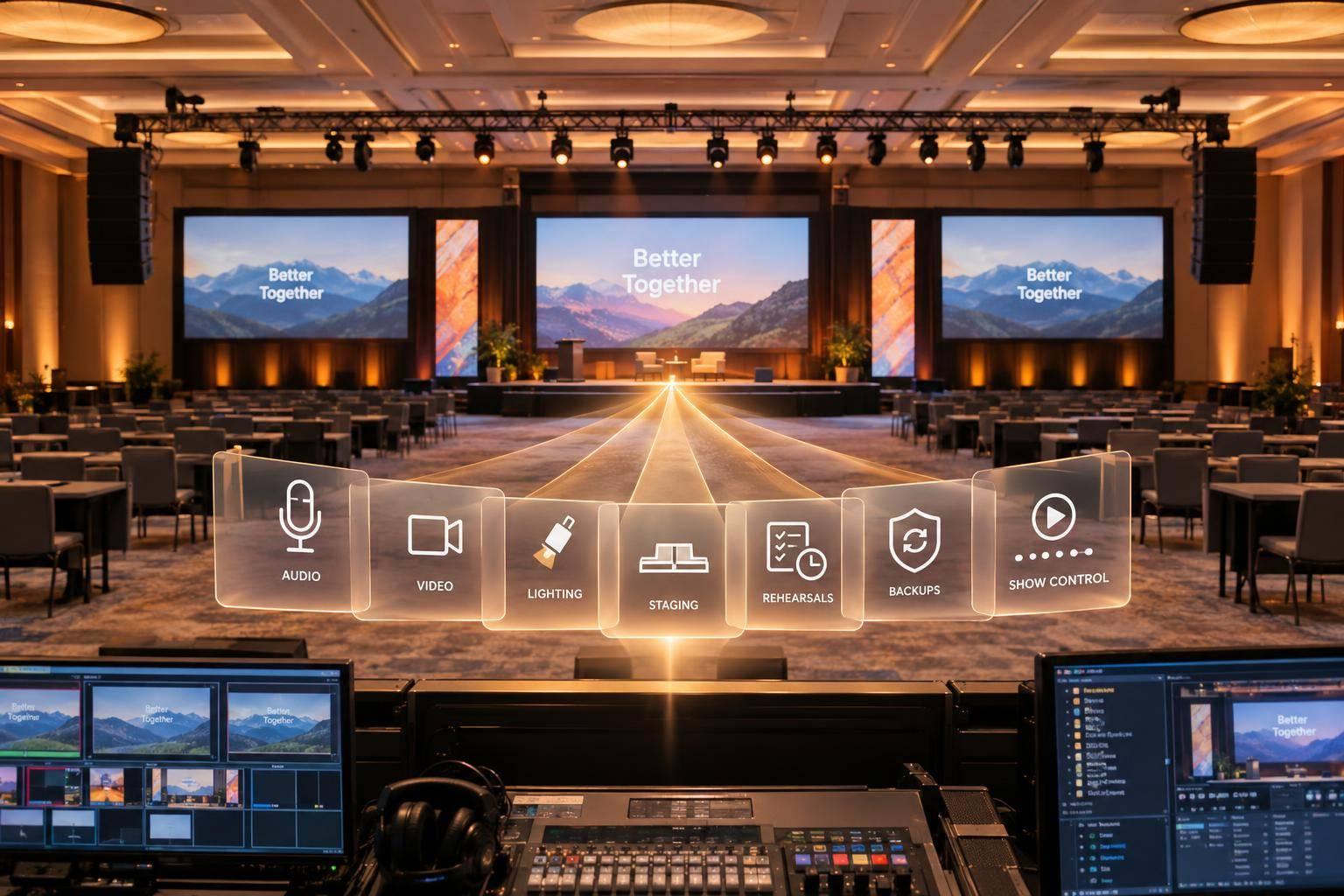
- Content playback and media: slides, video cues, LED screens, live feeds, and backup systems
- Stage management: run of show, speaker handoffs, backstage timing, and cue calling
- Executive coordination: rehearsals, teleprompter support, green rooms, and VIP movement
The article reviews five companies through those exact filters:
- Corporate Optics for executive-heavy meetings and tighter speaker support
- Encore Global for large hotel-based conferences and multi-room programs
- Freeman for convention-scale shows with many rooms and heavy schedule control
- George P. Johnson for major keynote programs and brand-led stage builds
- Jack Morton Worldwide for launch events and high-visibility executive presentations
A few numbers help frame the range here:
- Encore supports 400,000 events per year across 23 countries and 2,200 venues
- Freeman has handled shows like Money 20/20 with 11,000+ attendees
- GPJ supports programs at the scale of Dreamforce, with 170,000+ attendees
- Corporate Optics supports events up to 5,000 attendees
- Jack Morton has worked on programs tied to Google NEXT, Meta Connect, and Samsung Unpacked
Quick Comparison
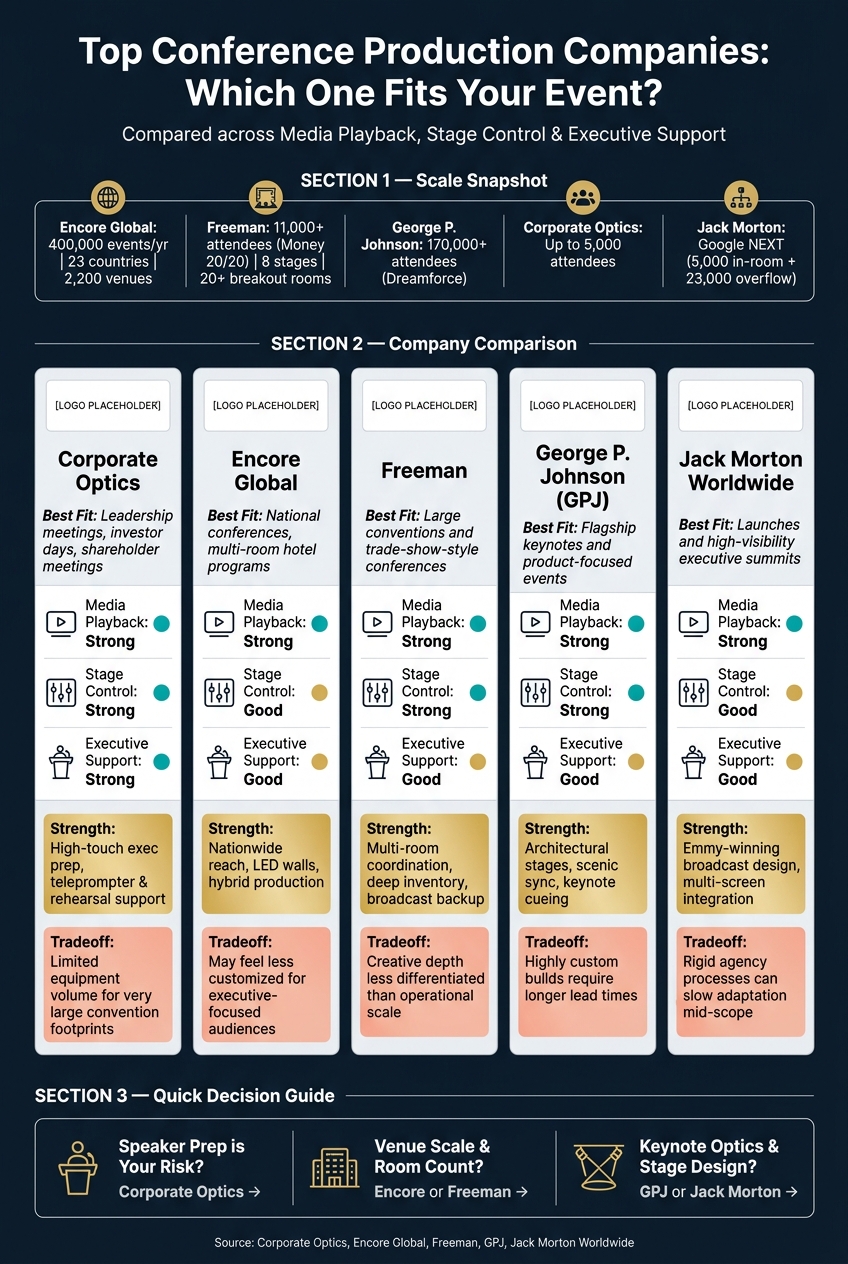
Top Conference Production Companies Compared: Scale, Strengths & Best Fit
| Company | Best Fit | Media Playback | Stage Control | Executive Support |
|---|---|---|---|---|
| Corporate Optics | Leadership meetings, investor days, shareholder meetings | Strong focus on cue-based keynote playback and teleprompter updates | Tight backstage control for speaker flow | High-touch support for executives |
| Encore Global | National conferences with general sessions, breakouts, and expo halls | Strong for LED walls, live switching, and hybrid production | Good fit for large multi-room timing | Good presenter prep and room flow support |
| Freeman | Large conventions and trade-show-style conferences | Strong file management and broadcast backup systems | Built for many rooms and packed schedules | Good VIP access and backstage controls |
| George P. Johnson | Flagship keynotes and product-focused events | Strong scenic sync and keynote cueing | Tight show timing across major programs | Good coaching and green room support |
| Jack Morton Worldwide | Launches and high-visibility executive summits | Strong for multi-screen shows and content trafficking | Good for large keynote moments with precise cues | Good speaker training and VIP travel support |
If I were picking fast, I’d use this rule: choose the team based on your biggest failure point. If the risk is speaker prep, look at Corporate Optics. If it’s venue scale and room count, look at Encore or Freeman. If it’s keynote optics and stage design, look at GPJ or Jack Morton.
1. Corporate Optics
Corporate Optics is a technical event production company built for high-stakes corporate conferences. Founded by Steven P. Simmons, the company has earned an Emmy Award, an MPI Global Paragon Award, and 2025 Inc. 5000 recognition. Its work covers investor days, executive town halls, shareholder meetings, and large corporate general sessions. At this level, the job is simple to describe and hard to pull off: keep media cues, stage flow, and executive support in sync when the room is live and there’s no room for drift.
Content Playback & Media
Corporate Optics handles keynote media execution across slide hosting, lower-thirds, confidence monitors, IMAG, branded visual elements, and LED-wall sync. It also uses visual renders to line up scenic builds with live presentation graphics, so what’s on stage matches what the audience sees on screen.
For hybrid events, the team uses redundant switching systems to keep in-room and remote audiences on the same page. It also supports AI-assisted teleprompter workflows with real-time script updates and eye-line prompting. That can make a big difference when a speaker changes wording minutes before walking on stage.
Stage Management & Show Calling
Corporate Optics uses a four-phase workflow: Discover, Design, Develop, and Deliver. The Develop phase is where technical rehearsals and backup planning happen well before show day.
On-site, the team manages speaker cues, transitions, and backstage handoffs. That matters when a general session includes several speakers and tight timing. One missed cue can throw the whole run of show off, so tight control backstage helps keep the program moving and makes executive movement smoother behind the scenes.
Executive/VIP Coordination
For executive support, the team provides teleprompter scripting, coaching, rehearsals, dedicated green rooms, and speaker-flow support for last-minute changes. A concierge team handles last-minute requests so leadership can stay focused on the program instead of the logistics around it.
Scale and Fit
Corporate Optics supports events with up to 5,000 attendees, from secure board meetings to large-scale conventions. The company brings production experts into venue selection early to flag technical requirements before contracts are finalized.
For planners, that leads to one practical question: can one team keep playback, stage timing, and leadership support synchronized from rehearsal through show day?
2. Encore Global
Encore works at a big scale: 400,000 events per year across 23 countries and 2,200 venues. That kind of reach matters when a single team needs to keep the general session, breakout rooms, and expo hall moving in sync.
Content Playback & Media
Encore manages live switching, content capture, and animated content built for large LED video walls and panoramic screens. That’s a big deal in conference settings, where one weak screen moment can throw off the feel of the whole room.
At Procore Groundbreak 2025 in Houston, Encore was the full-service production partner for a brand conference with more than 5,000 attendees. The team supported media playback, live production, and stage management across both the general session and the expo hall.
Stage Management & Show Calling
Playback is only part of the job. Encore also helps keep the show on time and on cue. Their teams put together detailed run-of-show documents and lead cue-to-cue rehearsals before the event starts.
Show Producer Laura Massas explains:
"Presenter support starts in pre-production. One of the most effective tools we use is a table read scheduled well before the event. This allows us to walk through rehearsal timing, stage entrances, introductions and how the room functions."
During the event, show callers and technical directors keep AV, lighting, staging, and rigging teams aligned in real time. They also plan for backup paths when issues come up, including wireless interference.
Executive/VIP Coordination
With executive speakers, the job shifts from timing cues to making sure the presenter feels ready. Confidence monitors help speakers stay focused on the audience instead of turning away or relying only on memory. Encore also handles speaker needs, technical needs, and speaker movement and timing so VIP presenters are set for live sessions.
Corporate Conference Scale
Encore fits best for companies running multi-room conferences that need the same production standard across a general session, breakout spaces, and an expo hall. For repeat conferences, standardized requirements can help keep the setup and show flow steady from one venue to the next.
3. Freeman
Freeman brings close to 100 years of live-event experience to corporate conferences where timing can't slip and stage cues have to land on the dot. That kind of scale shows up when an event has multiple rooms, tight run-of-show timing, and executive speakers who all need to stay in sync.
Content Playback & Media
Freeman's Speaker & Content Management system gives presenters a simple portal for advance file submission and last-minute updates. That's a big deal in fast-moving conference settings, where a speaker may swap slides an hour before going on stage.
Their team also includes Motion and Graphic Designers who build animations, brand visuals, and polished speaker support slides. For live broadcasts and press events, Freeman uses high-capacity power systems backed by generators and redundant systems. Freeman is also adding real-time captions, translation, and session summaries to its media workflow.
Stage Management & Show Calling
Freeman staffs full show management teams with producers, stage managers, and technical directors focused on multi-room control, backstage monitoring, and rapid buildouts. In plain English, they don't just run one stage well. They help keep the whole machine moving.
Technical directors manage live AV integration, while scriptwriters keep narrative and visual timing aligned. Backstage, control-room feeds let the team monitor stage activity and audience response in real time. At Money 20/20, Freeman produced creative and AV across eight stages and more than 20 breakout rooms for 11,000+ attendees, completing the on-site build in 36 hours.
Executive/VIP Coordination
For executive speakers and VIP presenters, Freeman handles secure access, credential checks, and private press briefing rooms. That extra layer matters when high-profile speakers need a smoother path from backstage to stage.
Executives can preview scenic renders and lighting plans before going live, which helps them get comfortable with the setup before showtime.
Corporate Conference Scale
Freeman fits best when the event is large, complex, and high-stakes. Large corporate programs may need 12–14 months of lead time, while standard corporate events usually need 4–6 months.
This makes Freeman a strong fit for programs that need one team to coordinate content, stage flow, and VIP logistics across a packed agenda.
sbb-itb-ae35a94
4. George P. Johnson
George P. Johnson (GPJ) is a strong fit for large corporate conferences where keynote media, stage flow, and executive logistics all need to move in lockstep. That kind of setup matters when the keynote team, backstage crew, and executive speakers all have to follow the same clock without drift.
Content Playback & Media
Onstage, that often comes down to keynote playback, scenic sync, and broadcast-ready cueing. GPJ handles keynote content production, scenic integration, and cue-based playback for complex mainstage programs. Its Live Production team also covers stage production, choreography, set sound, video, and lighting design.
At Genesys Xperience 2024 in Denver, GPJ managed three mainstage keynotes and more than 80 breakout sessions. The team carried the "Your Future Accelerated" theme through the stage and scenic design.
Stage Management & Show Calling
GPJ approaches showrunning like precision work. One missed cue can throw off the whole room. You can see that in its backstage flow, traffic planning, and live timing control across multi-session programs.
At Google Cloud Next, GPJ ran live and broadcast production for both the in-room audience and downstream distribution. The production also included backstage interviews and executive messaging.
Executive/VIP Coordination
When leadership presenters are involved, the job goes past timing. It also includes coaching, prep, and backstage readiness. GPJ supports executives with scriptwriting, coaching, and keynote preparation. It also manages speaker logistics and green room management.
"The optimal rehearsing, preparation and delivery of your speakers can turn the average keynote address into a commanding brand statement." - George P. Johnson
At IBM Think 2024 in Boston, GPJ managed a curated Meeting Center that facilitated more than 1,500 meetings between IBM leaders, account teams, and sponsors.
Corporate Conference Scale
GPJ is well matched to flagship programs that need scale and tight control. Its Dreamforce work supports the world's largest software conference, with more than 170,000 attendees, which gives a clear sense of the complexity the team can handle. GPJ fits flagship conferences with multiple stages, executive speakers, and heavy content demands.
5. Jack Morton Worldwide
Jack Morton Worldwide has spent more than 80 years in the conference and brand experience space. You can see that long track record in programs where keynote timing, stage tech, and executive delivery all need to hit without a hitch. In 2023, Adweek named Jack Morton its Experiential Agency of the Year. For planners, the main question is simple: does that depth on the idea side also show up in clean playback, tight stage flow, and polished speaker prep?
Content Playback & Media
Its Emmy-winning broadcast design team manages content trafficking and multi-screen integration, which is a good match for keynotes with frequent deck swaps and tight cue windows . If your show has lots of moving parts, that matters. A missed slide or late cue can throw off the whole room.
Stage Management & Show Calling
At Google NEXT 2018, Jack Morton redesigned the keynote stage with 360-degree rotating content containers and coordinated a live cross-city performance for 5,000 in-room attendees and 23,000 in overflow spaces. That's the kind of show where stage calling can't be loose. Every cue has to land at the right second.
Executive/VIP Coordination
Jack Morton supports C-suite summits with speaker training, speech writing, housing, travel, and guest services . For planners, that usually means cleaner speaker prep, tighter VIP movement, and fewer awkward moments once people step on stage.
Corporate Conference Scale
Jack Morton's conference work includes Samsung Unpacked, Meta Connect 2023, and Google NEXT . On the broadcast side, the team has also built environments for CBS Sports' Super Bowl LVIII and ESPN. That mix makes Jack Morton a strong pick for flagship launches and executive summits where visual impact and speaker control both matter. The next step is a practical one: check where this level of production fits the event, and where it may be more than the team needs.
Pros And Cons By Use Case
Use the table below to line up event size, production depth, and executive risk with the best fit. Each option is judged with the same three filters used across this article: playback reliability, stage control, and executive coordination. The table narrows each company down to one main use case, one clear strength, and one likely tradeoff.
| Company | Strongest Use Case | Pros | Cons |
|---|---|---|---|
| Corporate Optics | Executive-heavy leadership conferences | Hands-on executive show management and speaker prep | May not have the massive equipment volume needed for very large convention footprints |
| Encore Global | Large national general sessions and hotel-network events | Nationwide coverage and end-to-end logistics | Can default to standardized AV packages that feel less customized for executive audiences |
| Freeman | Exhibit-heavy trade shows and multi-room conventions | Deep inventory and multi-room coordination across major U.S. markets | Creative depth is less differentiated than its operational scale |
| George P. Johnson | Brand-led keynotes and product launches | Architectural stages and premium scenic design | Highly customized builds can require longer lead times |
| Jack Morton Worldwide | Long-lead brand launches and planning support | Strategic planning and high-end design | Rigid agency processes can slow adaptation when scope shifts quickly |
Large-scale providers tend to work best when an event stretches across multiple rooms. Smaller, high-touch teams often cut handoff risk when executive timing leaves no room for error.
After fit, the next issue is control. Who owns playback, stage calling, and executive support on site? For executive rehearsals and cue-sensitive shows, ask three plain questions:
- Who owns the gear?
- Who runs the crew?
- Who stays on site from load-in through strike?
That answer usually tells you more about execution risk than any capabilities deck.
Conclusion
Pick the partner that covers your biggest risk point: media playback, backstage flow, or executive confidence on stage. If backstage flow is where things tend to break down, find a team that handles both the gear and the crew from planning through strike. The right fit depends on the event’s risk profile and scale.
Then comes budget - but fit comes first. Enterprise conference production is custom-scoped, so the final price depends on the city, venue rules, streaming needs, scenic build, and rehearsal time. At this level, there aren’t flat rates. You should expect a detailed discovery or scoping phase before any number is locked in.
For executive-heavy programs, stage control still tends to be the deciding factor. If executive coordination is the highest-risk variable, Corporate Optics is built for that need, with end-to-end planning, speaker support, on-site staffing, and show-day continuity.
FAQs
How do I choose the right production partner for my event?
Look beyond gear rental. You want a partner that takes charge of your event’s technical plan from start to finish.
One of the biggest things to look for is one point of accountability. That usually means a dedicated project manager or production manager who owns the details, keeps teams aligned, and gives you one clear person to call when something needs attention.
It also helps to ask direct questions about risk management, technical planning, and work with executive speakers. Can they run structured rehearsals? Do they know how to set up confidence monitors? Can they handle live show calling without things going sideways? Those details matter more than people think.
If your event is hybrid, don’t treat that piece like a bolt-on service. Make sure hybrid production is a core part of what they do, not something they tack on at the last minute.
What should I ask before hiring a conference production team?
Look past the gear list and dig into how they run a show. Ask about backup plans and failover for playback, streaming, and presentation hardware. If something goes down mid-event, you need to know what kicks in next.
You should also ask about onsite staffing. Will senior leadership be there, or are they handing things off to a junior crew? And does the team have experience with cue-heavy corporate events, where timing, speaker handoffs, and show flow have to be tight?
For hybrid events, get clear on how they manage the virtual side. That includes the attendee experience online and their process for fixing issues in real time when something slips. In a hybrid setup, small problems can snowball fast if the team isn't ready.
How far in advance should I book conference production support?
Book your production partner well before load-in day. Most executive summits need 8 to 16 weeks to get ready, and large conferences often need 4 to 6 months.
That lead time matters. It gives your team room to handle technical planning, site surveys, a master technical rider, staging design, and executive rehearsals. And that extra runway can help you avoid expensive or messy problems once the event is live.
Related Blog Posts


Streamline your workflow, achieve more

Lorem ipsum dolor sit amet, consectetur adipiscing elit. Maecenas ac velit pellentesque, feugiat justo sed, aliquet felis.



Lorem ipsum dolor sit amet, consectetur adipiscing elit. Maecenas ac velit pellentesque, feugiat justo sed, aliquet felis.