2 Reasons To Use Corporate Optics For Conference Production In Las Vegas For Multi-Day Conferences.

Chief Executive Officer
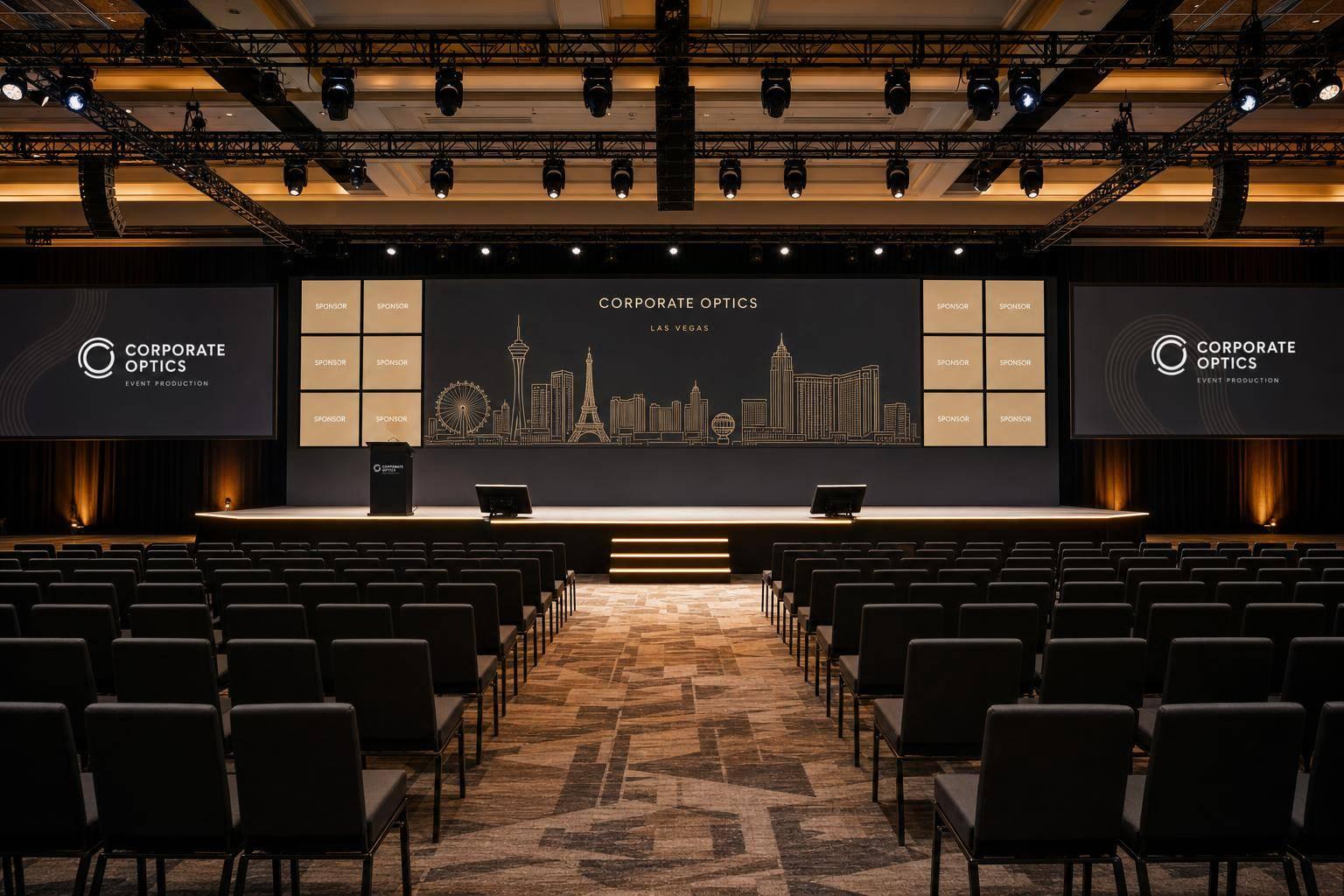
If your conference runs for 2+ days, the main goal is simple: keep every room working the same way from open to close. In Las Vegas, that usually comes down to 2 things: steady AV each day and enough on-site crew to cover general sessions, breakouts, and hybrid feeds without delays.
Here’s the short version:
- Reason 1: Corporate Optics focuses on steady audio, lighting, and playback across every conference day.
- Reason 2: Corporate Optics provides on-site crew coverage that fits multi-room, multi-day schedules.
Why this matters:
- A single AV issue can delay a full session block.
- Multi-room events often involve dozens of speaker changes in a day.
- Hybrid conferences add another layer, since in-room and remote viewers both need the same clean show.
- Even a 5- to 10-minute delay can disrupt published agendas, sponsor spots, and room turns.
Quick Comparison
| Reason | What it means for you | Main focus |
|---|---|---|
| Consistent AV quality | Fewer day-to-day tech issues | Audio, lighting, playback, cue control |
| Scaled on-site support | Better room coverage across the program | Stage management, room techs, streaming support |
My takeaway: if you’re planning a multi-day Las Vegas conference, you need a team that can keep the show steady on Day 1, Day 2, and the final session - not just during the opening keynote.
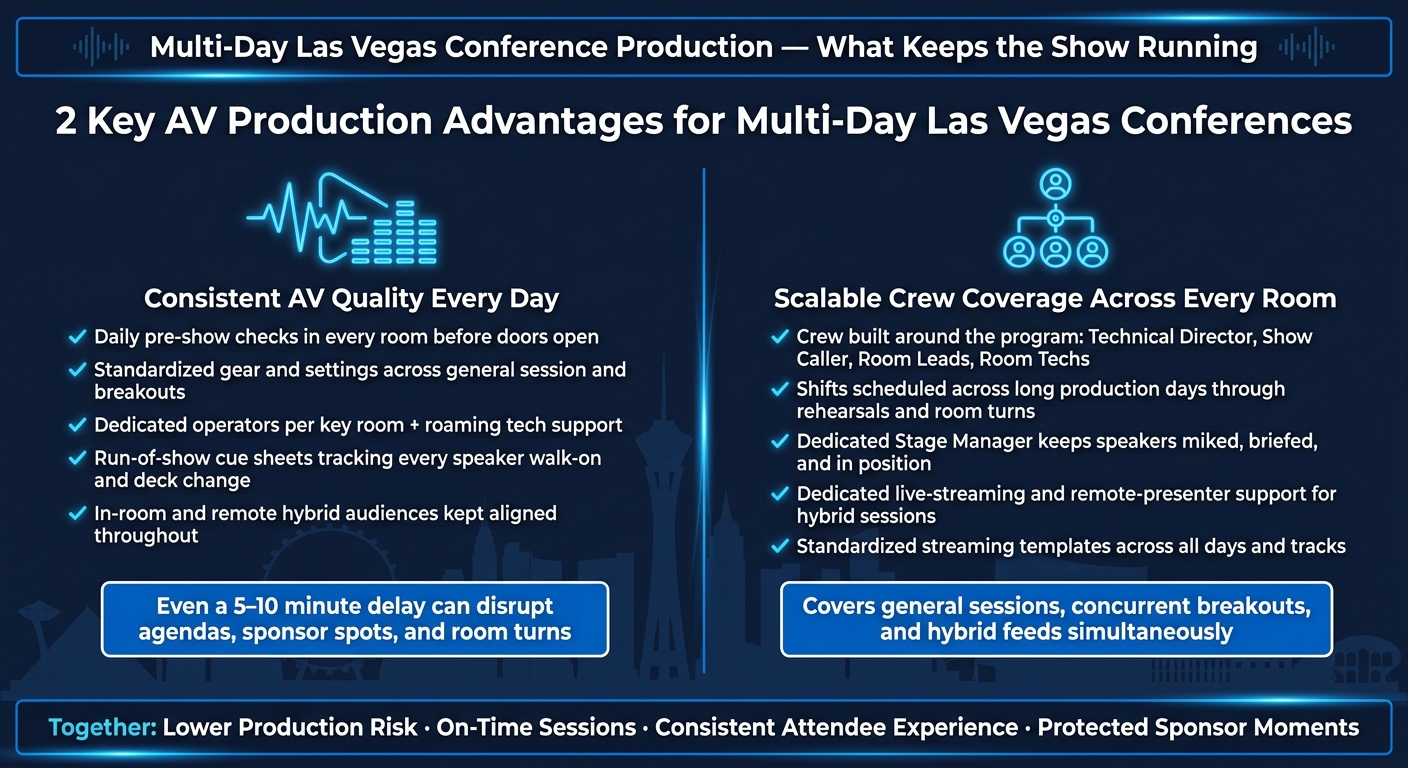
2 Key AV Production Advantages for Multi-Day Las Vegas Conferences
Event A/V Essentials Part 5: Creating Your Onsite Production Schedule - Logan Clements
Why Production Decisions Carry More Weight For Multi-Day Las Vegas Events
Multi-day conferences make every technical slip cost more, because the same show needs to work at the same level day after day. That’s why the two biggest production advantages are consistency and support that can scale with the event.
Large Las Vegas venues can make signal problems more likely, especially with long cable runs and overnight room turns. If a room gets reset and the crew comes back the next morning, every signal path and connection point needs to be in the exact same place it was the day before. When that day-to-day consistency slips, attendee trust usually slips with it.
Breakout rooms add even more pressure. Speaker swaps, slide updates, and confidence monitor changes need to happen fast in every room, every day. One slow reset can push back the full afternoon schedule, and that puts organizers in a tough spot with both speakers and attendees.
Sponsor moments, awards, and entertainment segments bring in more stakeholders and tighter timing. Each piece comes with a promise: stage time, a cue, a sequence. All of it needs to stay on track.
Hybrid sessions add one more layer. The in-room experience and the remote audience need to stay aligned across the full conference run. Managing both at once, over multiple days, leaves very little margin for execution gaps.
The first advantage is consistent audiovisual quality from the opening session to the final closing program.
1. Consistent Audiovisual Quality And Technical Control Across Every Conference Day
The hard part isn’t getting AV right once. It’s keeping it right from Day 1 to the final session.
That matters because the same show needs to come through cleanly in every room, every day. Corporate Optics handles this with a daily pre-show check in each room before doors open. Those checks cover audio, lighting, and playback, so if something shifted overnight, it gets fixed before it turns into a live issue.
They also use standardized gear and settings across the general session ballroom and each breakout room. That helps keep the experience steady and avoids the slow drift that can cause feedback, off-brand visuals, or missed cues.
The production side is mapped out in detail. Run-of-show documents and cue sheets track each speaker walk-on, deck change, and room reset. Presenter decks are preloaded with clear cues, which helps transitions move cleanly instead of stalling with awkward gaps or tech delays.
On-site, Corporate Optics assigns dedicated operators to key rooms, with roaming tech support covering the rest. So no session gets left on its own. A central team also monitors signals and communication, which helps spot problems before they hit the stage.
For hybrid sessions, the AV setup follows the same standard approach. In-room and remote audiences stay aligned as part of the full conference flow, not as some side system that gets handled separately. That keeps general sessions, breakouts, and hybrid feeds moving together without slowing the schedule.
The payoff is simple: fewer tech surprises and a steadier conference flow.
sbb-itb-ae35a94
2. Scalable On-Site Technical Support For General Sessions, Breakouts, And Hybrid Components
When a Las Vegas conference includes concurrent breakouts, a high-production general session, and hybrid elements over several days, the staffing model needs to match that level of complexity.
On-Site Technical Coverage
That kind of consistency only happens when the on-site crew scales with the schedule. Corporate Optics builds the crew around the program, assigning a technical director, show caller, room leads, and dedicated room techs where they’re needed most. The team is scheduled in shifts across long production days so coverage stays in place through rehearsals, live sessions, and room turns.
Session Transition Control
Once the crew is set, session flow becomes the next pressure point. A dedicated stage manager keeps speakers moving by making sure presenters are miked, briefed, and in position before each segment. A show caller runs the cue sheet and coordinates walk-in music, video rolls, lighting changes, and deck transitions in real time. That live coordination between the stage manager, show caller, and room techs keeps back-to-back sessions moving without delays or messy handoffs.
Hybrid And Breakout Scalability
For hybrid components, Corporate Optics provides dedicated live-streaming support for remote audiences, along with dedicated remote-presenter support. Remote presenters get tech checks and backup options before they go live. Streaming templates stay standardized across days and tracks, so the broadcast remains consistent and hybrid sessions stay aligned with the rest of the conference schedule.
How These Two Advantages Translate Into Organizer Value
Taken together, these two advantages create immediate value for organizers. That stability cuts day-to-day risk and helps keep the show on track. Instead of reworking the production plan every morning, organizers can keep building on something that is already running smoothly.
When rooms are pre-loaded, microphones are tested, and transitions follow rehearsed cues, sessions start on time and speaker handoffs stay clean. That matters. Attendees count on the published schedule, so on-time sessions help protect trust in the event.
The same steady execution also protects sponsor moments. Sponsors get keynote-level polish, which helps protect sponsor value and supports renewals.
It can also trim avoidable spending. Right-sized budgets help avoid overtime, emergency rentals, and last-minute fixes.
And when the event grows, the production model doesn’t need to be rebuilt from zero. A breakout track, a sponsor stage, or a hybrid stream can be added without starting over on the production plan.
Conclusion
Those two advantages matter because multi-day Las Vegas conferences don't leave much room for technical drift. Sessions run at the same time, schedules change, and attendees move from room to room expecting the same level of quality at every stop. That's exactly when production control matters most.
Corporate Optics delivers two things that matter for multi-day conferences: steady audiovisual quality across every conference day and on-site technical support that can scale across every room and format. Together, they help cut production risk in a demanding Las Vegas venue. For organizers, that means lower risk, smoother sessions, and a better attendee experience from the first program to the last.
FAQs
How early should AV planning start?
For large conferences, start AV planning 3 to 6 months ahead. For general multi-day conferences, 4 to 12 months is even better if you want to lock in resources and support a polished execution.
That extra lead time also gives you room for site checks and one shared production plan. The result is less risk and more consistent audiovisual quality across the event.
What rooms need dedicated techs?
For multi-day conferences in Las Vegas, dedicated on-site technicians are a must for the general session ballroom and every active breakout room.
Why? Because when several sessions are running at the same time, AV issues can snowball fast. A technician in the room helps keep audio and video quality steady, speaker handoffs smooth, and troubleshooting immediate.
That matters even more when hybrid elements are in play. In-person attendees expect a polished show. Remote attendees do too. Having dedicated tech support in each active space helps both groups get a smooth, professional experience.
How do hybrid backups work?
Hybrid backups use redundant signal feeds, broadcast-quality encoding, and redundant switching systems to create backup paths for critical data and video streams.
That setup helps keep the experience steady and uninterrupted for both in-person and remote audiences. It also gives the crew room to fix technical issues on the spot without throwing off the flow of the event.
Related Blog Posts


Streamline your workflow, achieve more

Lorem ipsum dolor sit amet, consectetur adipiscing elit. Maecenas ac velit pellentesque, feugiat justo sed, aliquet felis.



Lorem ipsum dolor sit amet, consectetur adipiscing elit. Maecenas ac velit pellentesque, feugiat justo sed, aliquet felis.