4 Companies Offering End-To-End All-Associates Meeting Solutions, And Why To Reach Out To Them Today.

Chief Executive Officer
If you’re planning an all-associates meeting in 2026, the short answer is this: pick a vendor that can handle planning, AV, streaming, audience interaction, backup coverage, and post-event edits under one roof.
When a meeting reaches hundreds or thousands of employees, small issues can hurt the message fast. The article points to four firms that cover most or all of that work: Corporate Optics, Broadcast Management Group, Multi Image Group (MIGstream), and Orlando Corporate Media.
Here’s the plain breakdown:
- Corporate Optics: best fit for high-visibility leadership meetings and large multi-site broadcasts
- Broadcast Management Group: fits distributed internal events and multi-location programs
- MIGstream: fits online-first town halls, sales meetings, and large virtual sessions
- Orlando Corporate Media: fits recurring hybrid or virtual updates, especially East Coast productions
The article also makes one budget point clear: many hybrid meetings start around $20,000, a 300-person hybrid event often falls between $35,000 and $50,000, and larger multi-day programs can run $80,000+.
Quick comparison
| Company | Best For | Main Strengths | Post-Event Output |
|---|---|---|---|
| Corporate Optics | Large leadership meetings | Run-of-show control, scenic build, streaming | Replay, reporting, archived recordings |
| Broadcast Management Group | Multi-site employee events | Multi-camera streaming, remote presenters, fiber support | Recaps, training edits, replay assets |
| MIGstream | Virtual-first town halls | Scripting, speaker prep, polling, chat | Recordings, analytics, edit-ready clips |
| Orlando Corporate Media | Recurring hybrid updates | Platform setup, speaker testing, live switching | Full recordings, highlight reels, captions |
What I’d look at first: your format, audience size, how visible your leadership team will be, and how much time you have before show day.
If you need one team to keep the meeting on track from kickoff through replay, these are the four names the article says to contact now.
sbb-itb-ae35a94
What End-To-End All-Associates Meeting Support Actually Includes
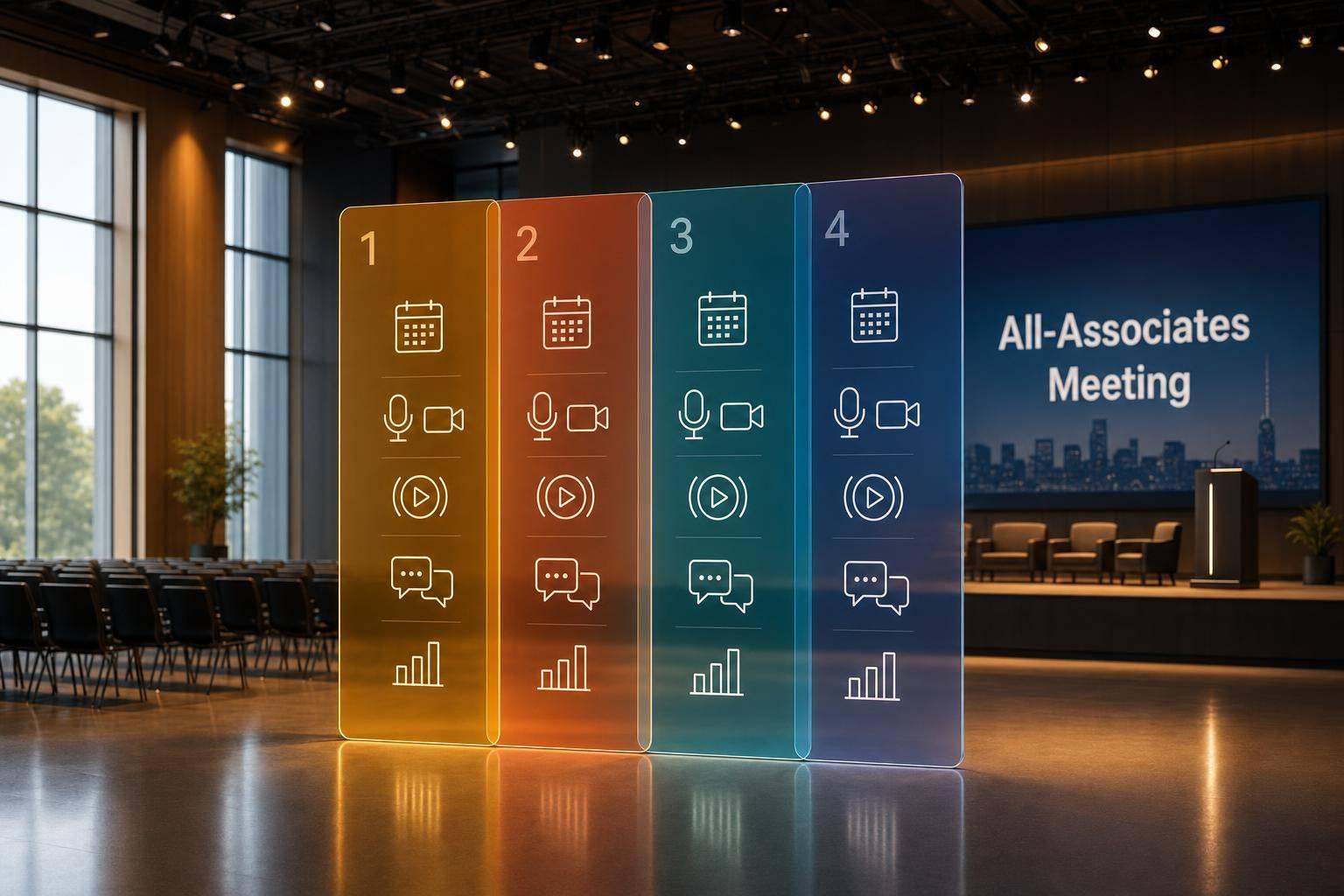
End-to-end support means one team handles the full meeting, from early planning to post-event follow-up. Your internal team isn’t stuck trying to piece together vendors, timelines, and production work on its own. In most cases, that support breaks into five phases.
It starts with planning. This is where the provider helps shape the message and build the run-of-show. Pre-production usually includes consultation, agenda design, program and resource planning, executive speaker support, and custom fabrication, such as stage design, trussing, scenic elements, and LED video walls.
Then comes live production. This covers enterprise-grade audio systems, custom lighting, rigging, and stage management, usually led by an on-site production manager who acts as the single point of contact for AV, lighting, and video. For hybrid events, that scope also includes live streaming, fiber transmission, and a virtual platform for breakout sessions and remote keynotes.
Once the program is in place, attention shifts to participation. Audience engagement should help both in-room and remote attendees stay involved. That often includes live polling, moderated chat, gamification, and one-on-one networking, so virtual attendees are taking part instead of just sitting on the sidelines.
Contingency planning matters just as much. Live events can go sideways fast if there’s no backup plan. Built-in redundancies, on-site managers, and 24/7 customer support help reduce the risk of technical issues during live broadcasts.
After the event, the work isn’t over. Post-event reporting should show what happened and turn the meeting into content you can keep using. That includes engagement metrics, post-event analysis, on-demand content, and edited recap clips or social cutdowns that help the meeting keep working after the room clears out.
| Service Phase | What's Included |
|---|---|
| Pre-Production | Consultation, agenda design, program and resource planning, custom fabrication |
| Live Production | AV, lighting, stage management, live streaming, remote speaker support |
| Audience Engagement | Live polls, moderated chat, networking portals, gamification |
| Redundancy and Support | On-site managers, built-in redundancies, fiber transmission, 24/7 support |
| Post-Production | Metrics and analytics, on-demand content, recap clips |
Use this checklist to compare each provider's scope below.
1. Corporate Optics
Corporate Optics, founded by Steven P. Simmons, handles technical event production for corporate and government meetings that need one team to run planning, show flow, and live delivery. That setup matters when in-house teams want a single owner for the agenda, technical execution, and post-event follow-up.
Planning and Run-of-Show Ownership
Corporate Optics takes charge of the run-of-show, coordinates vendors, manages budgets, staffs the venue, and supports speakers. Keeping all of that under one roof cuts down on vendor churn and helps keep the run-of-show lined up with leadership goals. It also keeps the agenda tight and the event on schedule.
AV, Staging, and Broadcast Production
Once the run-of-show is set, Corporate Optics brings the program into the room with stage, lighting, and broadcast production. It handles audiovisual design, stage design, scenic production, custom fabrication, show lighting, and live video production. That helps avoid production gaps during live leadership messaging.
Hybrid and Virtual Delivery and Audience Engagement
The same production team can also extend the meeting to remote employees without making it feel disconnected. Corporate Optics supports hybrid and virtual event production with live streaming for distributed teams and audience engagement tools. That helps remote associates follow the same message and timing as people in the room.
Post-Event Analytics, Recording, and Repurposing
When the live session wraps up, the meeting can still keep working as internal content. Corporate Optics provides on-demand replay, reporting, and recording archive. Those assets help teams share the meeting with absentees and reuse clips for internal communications or training.
2. Broadcast Management Group
Broadcast Management Group handles all-associates meetings from the first planning session to the live show itself.
Planning and Run-of-Show Ownership
The team takes care of the event from the initial consultation and creative direction through rehearsals and live production. Once the run-of-show is locked in, they shift into live delivery and manage the program as it happens.
AV, Staging, and Broadcast Production
It delivers stable live streaming with multi-camera switching and dedicated hardware encoders. That helps keep the signal steady and the picture clean for large internal audiences across the full program.
Hybrid and Virtual Delivery and Audience Engagement
It also supports remote keynote speakers and two-way interaction, so off-site presenters can speak to both in-room and virtual attendees without breaking the flow. Fiber transmission helps maintain stream quality across the full audience. That makes the meeting easier to follow for employees who couldn't attend in person.
Post-Event Analytics, Recording, and Repurposing
After the event, footage can be turned into replay cuts, executive recap clips, and internal training assets using multiple camera angles and professional audio.
3. Multi Image Group (MIGstream)
Multi Image Group, or MIG, uses a single-vendor production model, which means less back-and-forth across multiple partners. That tends to matter most for internal meetings, where one team needs to own both the message and the live production.
Planning and Run-of-Show Ownership
MIG handles pre-production, including theme development, scripting, and speaker prep, plus speaker coordination, schedule management, and venue and tech alignment. In plain terms, it helps keep executive speakers, content timing, and show cues lined up before show day.
AV, Staging, and Broadcast Production
MIG's technical team manages show transitions between live and virtual segments, so the program keeps moving without awkward handoff gaps.
Hybrid and Virtual Delivery and Audience Engagement
MIGstream supports broadcast-grade livestreaming with multi-camera switching, hardware encoders, and network redundancy, which helps deliver a steady broadcast for employees on the corporate intranet. It also includes audience engagement tools like live Q&A, polling, moderated chat, and remote speaker management, so both in-room and virtual attendees stay involved throughout the program. That setup helps keep remote employees on the same timeline as the in-room audience.
Post-Event Analytics, Recording, and Repurposing
After the meeting, MIG keeps recordings, analytics, and edit-ready clips in one workflow.
4. Orlando Corporate Media
Orlando Corporate Media, also known as Orlando Webcasts, supports all-associates meetings with 20+ years in corporate and broadcast video production and 14+ years in live streaming. For teams that want one partner to run the room, the stream, and the assets that come after, that setup makes a lot of sense.
Planning and Run-of-Show Ownership
Before the event starts, Orlando Corporate Media handles platform selection, presenter onboarding, network evaluation, and stream testing. That prep work helps keep speaker timing, platform setup, and live delivery on track instead of leaving things to chance.
AV, Staging, and Broadcast Production
On-site, they manage multi-camera live streaming, live switching, audio mixing, graphics, lighting, and recording for keynotes, breakout rooms, panels, and executive presentations. They also set up camera placement, audio capture, and 4K video for both the in-room audience and the broadcast feed.
That means the same event can support in-room projection, live streaming, and edited recordings at the same time, with files delivered in multiple formats. If you've ever seen an event look fine in the room but fall apart online, you know why that matters.
Hybrid and Virtual Delivery and Audience Engagement
They also support hybrid events with remote speaker testing, moderators, and technical coverage across Zoom, WebEx, YouTube, Facebook, and other business streaming platforms. Their virtual event producers and moderators can work engagement segments into the run-of-show, including:
- live Q&A with executives
- moderated chat
- timed polls
This helps camera cues, graphics, and speaker transitions line up with audience participation moments instead of feeling thrown together at the last minute.
Post-Event Analytics, Recording, and Repurposing
Deliverables include full recordings, highlight reels, topic clips, captions, and branded speaker graphics ready for internal distribution. Because the files are delivered in online-ready formats, communications teams can reuse the content fast without bringing in a separate editing vendor.
That can cut turnaround time and make internal distribution much easier, especially when teams need to turn one event into multiple follow-up assets.
Side-By-Side Look At What These Providers Cover
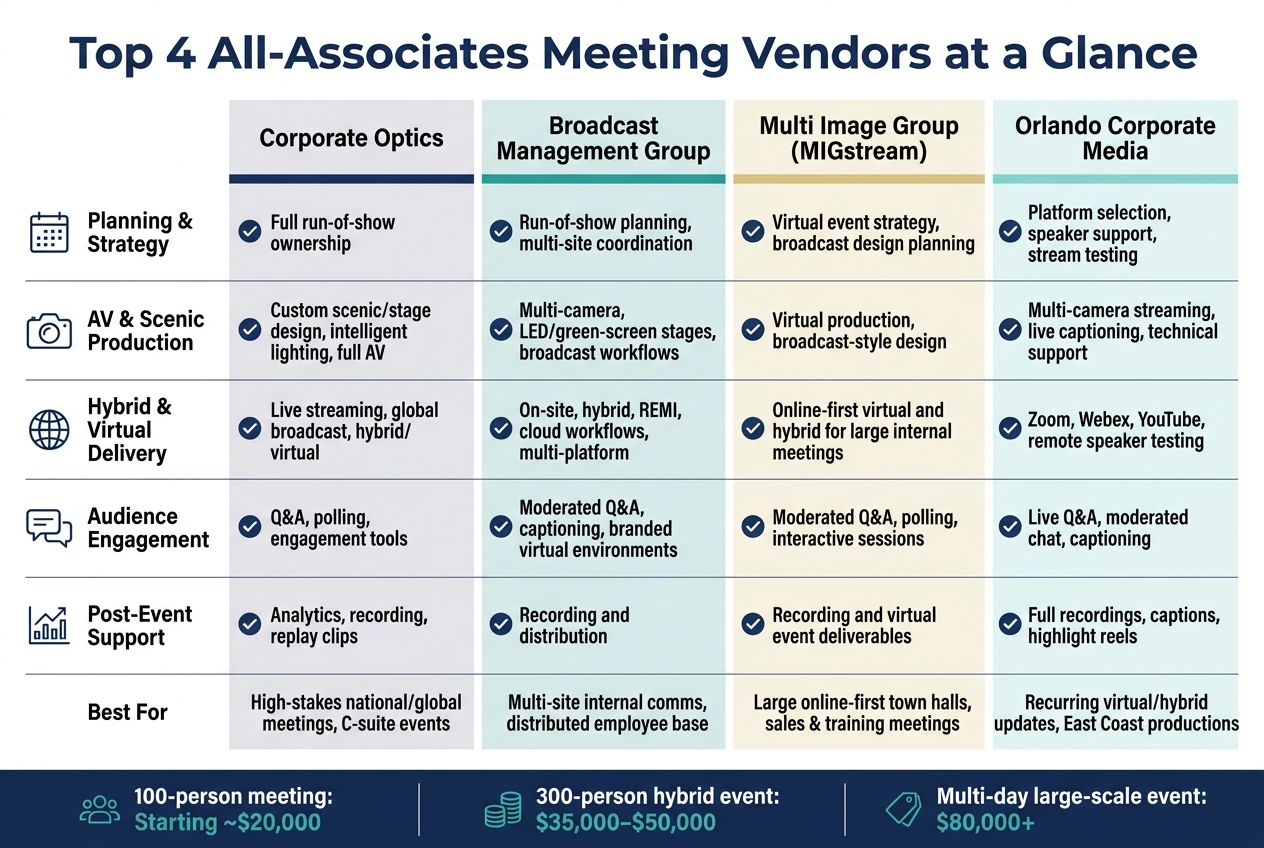
Top 4 All-Associates Meeting Vendors Compared: Features & Pricing
After the service-by-service breakdown, this table is the fastest way to line up each provider with your meeting format. Each one handles a different share of the work across planning, production, delivery, engagement, and post-event follow-up. If you want a quick scope check, start here.
| Company | Planning & Strategy | AV & Scenic Production | Hybrid & Virtual Delivery | Audience Engagement | Post-Event Support | Ideal Use Cases |
|---|---|---|---|---|---|---|
| Corporate Optics | Full run-of-show ownership | Custom scenic and stage design, intelligent lighting, full AV production | Live streaming, global broadcast, hybrid and virtual production | Q&A, polling, and engagement tools | Analytics, recording, and replay clips | High-stakes national or global meetings, C-suite events, multi-site broadcasts |
| Broadcast Management Group | Run-of-show planning, multi-site coordination | Multi-camera production, LED and green-screen stages, broadcast workflows | On-site, hybrid, and REMI production; cloud workflows; multi-platform distribution | Moderated Q&A, captioning, branded virtual environments | Recording and distribution | Multi-site internal communications, branded virtual town halls, distributed employee bases |
| Multi Image Group (MIGstream) | Virtual event strategy, broadcast design planning | Virtual production and broadcast-style design | Online-first virtual and hybrid delivery for large internal meetings | Moderated Q&A, polling, and interactive sessions | Recording and virtual event deliverables | Large online-first town halls, quarterly wrap-ups, sales and training meetings |
| Orlando Corporate Media | Platform selection, speaker support, network evaluation, stream testing | Multi-camera streaming and technical support, live captioning | Zoom, Webex, YouTube, and other streaming platforms; remote speaker testing | Live Q&A, moderated chat, captioning | Full recordings and captions | Recurring virtual or hybrid updates, regional events, U.S. East Coast–based productions |
Here’s the plain-English version. Corporate Optics is a strong match for high-stakes national or global meetings. Broadcast Management Group works well for multi-site internal communications. MIGstream fits online-first town halls. Orlando Corporate Media makes sense for recurring virtual or hybrid updates.
Once you’ve narrowed the fit, budget usually becomes the next filter. It helps to set that boundary early. A 300-person hybrid town hall often lands in the $35,000–$50,000 range, smaller 100-person meetings can start at about $20,000, and more involved multi-day events can climb to $80,000+.
How To Match A Provider To Your Internal Meeting Needs
The table helps narrow your options. But the final pick usually comes down to four things: format, audience size, executive visibility, and timeline. Get that match wrong, and fixing it mid-event can get expensive fast. These filters tie straight to planning, production, delivery, and what happens after the event.
Start with your format. In-room meetings put the focus on production at the venue. Online-first meetings shift that focus to the virtual platform and a broadcast setup that looks good on screen. Hybrid events have to do both at once. That means two-way communication tools, built-in backups, and on-site technicians who can keep things moving if something goes sideways. Once you’ve locked in the format, the next filter is leadership visibility.
Executive visibility changes the standard. If your CEO or senior leadership team is on stage, the production has to feel polished and steady. Dedicated support - like on-site production managers, speaker support, and custom scenic builds - can make a big difference for people in the room and those watching remotely. For high-visibility internal meetings, it helps to work with a provider that handles end-to-end planning, speaker support, live streaming, and post-event analytics.
Then look at scale and what you want to do with the content after the meeting. Audience size and post-event goals are practical filters. Large or global all-associates meetings need the setup to handle high attendance and keep in-room and remote participants in sync. If you want the footage to keep working after the event - for on-demand viewing, training, or internal communications - ask about recording, editing, analytics, and content repurposing before you sign anything.
Timeline is often what settles the decision. If the planning window is short, a turnkey provider that can own planning, AV, and virtual delivery is often the safer bet. Using one vendor cuts handoff risk when fabrication, AV, and virtual delivery all need to land on the same deadline. That’s where a turnkey team earns its keep.
Conclusion
Taken together, these providers show what full-service all-associates support should look like. The best partners cut down the moving parts and handle execution cleanly, so internal teams can stay focused on the message instead of chasing logistics.
Clear audio, polished visuals, and stable streaming make leadership communication easier to follow for both in-room and remote attendees. Just as important, they keep attention where it belongs: on the message. That only happens when the right team is in place early.
Reach out now to lock in the right crew, schedule rehearsals, and avoid rushed approvals later.
The four providers here all support all-associates meetings - Corporate Optics, Broadcast Management Group, Multi Image Group (MIGstream), and Orlando Corporate Media. Contact the partner that fits your format, timeline, and audience size before your planning window gets tighter.
FAQs
How far in advance should I book support for a 2026 all-associates meeting?
Start planning and booking early for your 2026 all-associates meeting. Bringing in your production partner well ahead of time makes it easier to line up goals, venue choice, and technical details for a dependable large-scale internal event.
Booking early can also help you secure your preferred team and key logistics, which sets up a smoother event experience.
What should I ask before hiring one team to run the entire meeting?
Ask for a proposal that clearly covers AV and technical production, logistics, and program management. You should also ask for examples of hybrid or virtual events they’ve handled, plus how they adjust their services to fit your event size, format, and goals.
It’s also smart to confirm their backup plans for common tech issues. For example:
- dropped presenter feeds
- slide failures
- audio echo
- stream outages
And ask for a clear cost breakdown, so you can see exactly what’s included and where the money goes.
How do I know if my meeting needs full end-to-end production support?
Consider full end-to-end production support when your event is high-stakes and you need one team running the whole show to cut risk. This setup is common for leadership conferences, shareholder meetings, and large hybrid events.
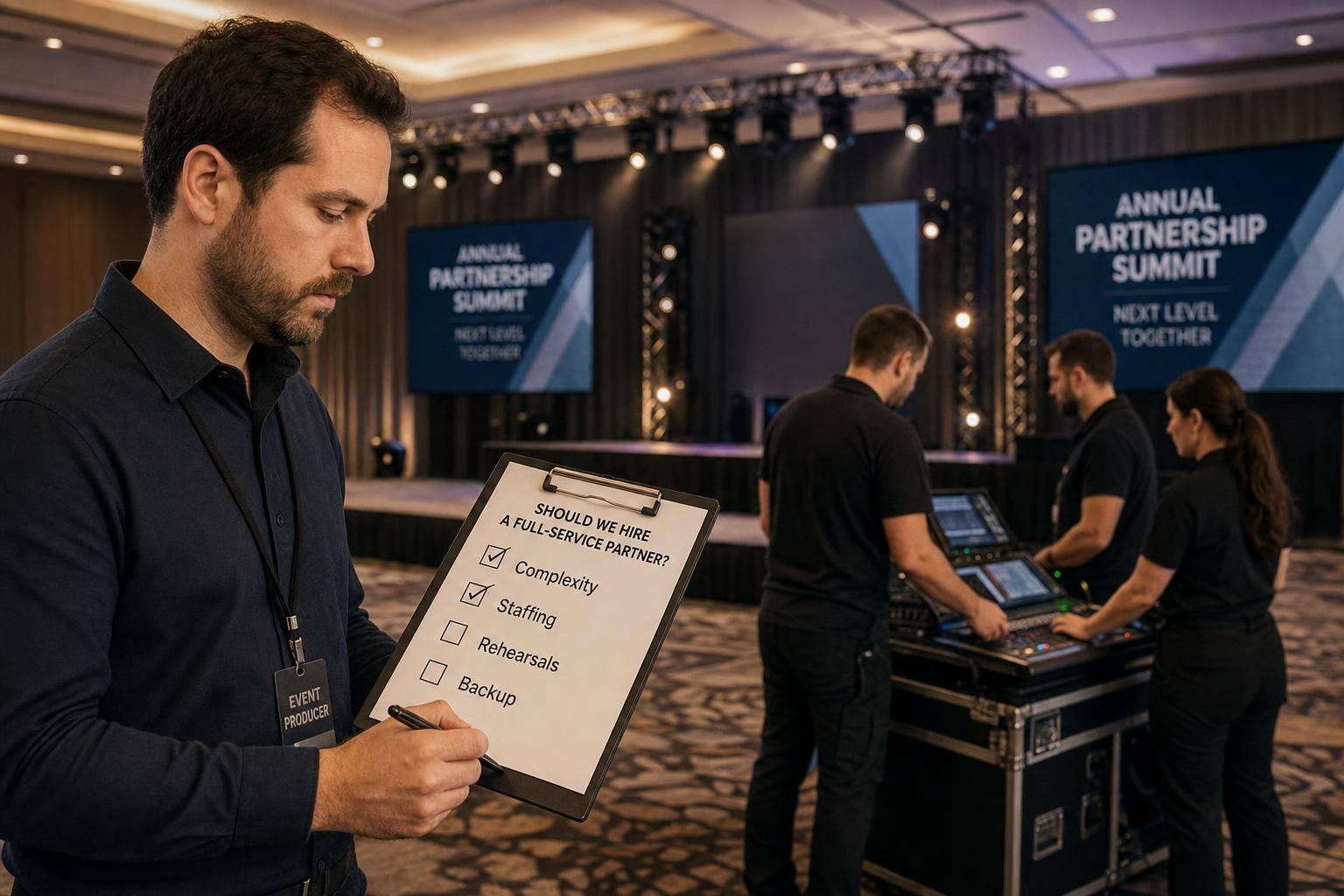
It’s usually the right fit if you need:
- integrated AV, lighting, and scenic design
- reliable hybrid or virtual delivery
- tight agenda, rehearsal, and backstage coordination
- simpler vendor management from planning through post-event analytics
Related Blog Posts
- 4 Meeting Production Companies That Excel At Seamless AV (audio/video), Lighting, and Stage Design for Corporate Conferences, and events
- All-Associates Meeting Production Companies With Program Management Expertise
- End-To-End Annual Meeting Production Companies For Your Next Company Conference
- Organizing A Company-Wide Sales Meeting And Need Help With AV? Get A Quote From These 3 Companies.


Streamline your workflow, achieve more

Lorem ipsum dolor sit amet, consectetur adipiscing elit. Maecenas ac velit pellentesque, feugiat justo sed, aliquet felis.



Lorem ipsum dolor sit amet, consectetur adipiscing elit. Maecenas ac velit pellentesque, feugiat justo sed, aliquet felis.