In-House Av Vs. A Corporate Event Production Company: When It's Time To Hire A Full-Service Partner.

Chief Executive Officer
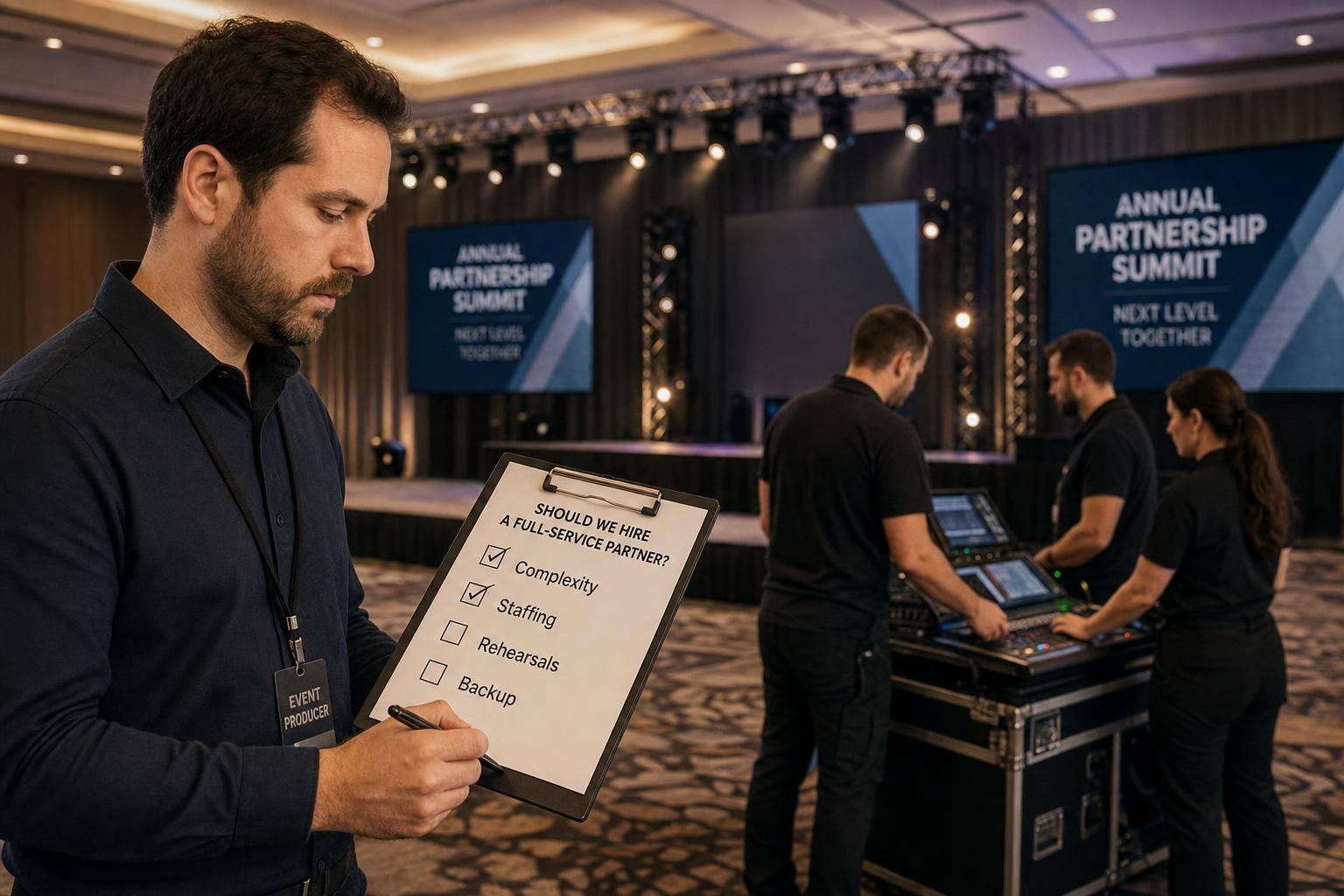
If your event has more than one room, a livestream, timed cues, or high-stakes speakers, in-house AV may not be enough. I’d make the call based on five things: complexity, staffing, room and network setup, show calling, and what happens if something fails.
Here’s the short version:
- I’d stick with in-house AV for a simple one-room meeting with slides, basic mics, and no stream.
- I’d bring in a full-service production partner when the event needs cameras, switching, remote speakers, custom lighting, backup systems, or cue-by-cue control.
- The main issue is not just gear. It’s whether one team can plan, staff, rehearse, run, and fix the event without things slipping.
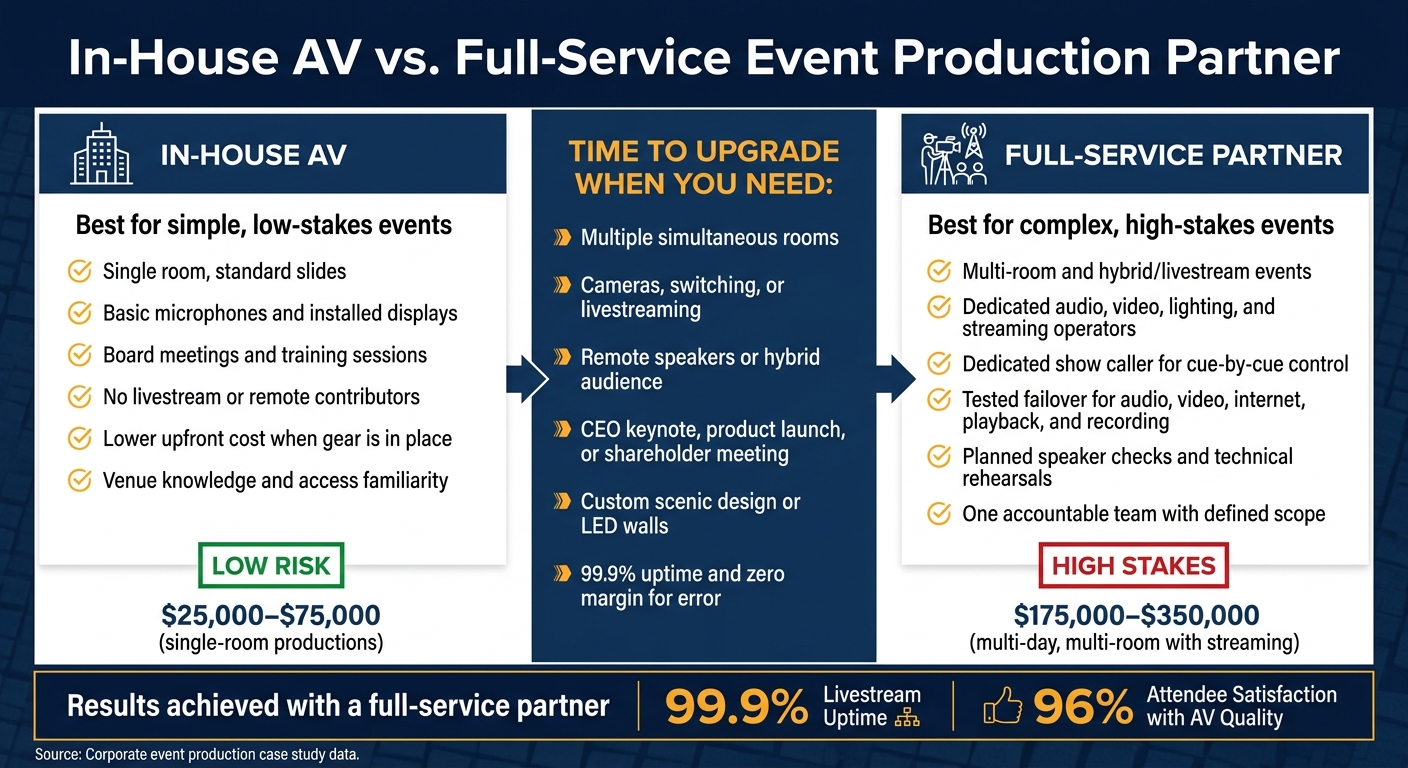
- Cost matters, but failure risk matters more. The article notes that single-room productions often fall in the $25,000 to $75,000 range, while multi-day, multi-room events with streaming can reach $175,000 to $350,000.
- In one example, a leadership summit with an LED wall, multi-camera stream, and custom graphics reported 99.9% livestream uptime and 96% attendee satisfaction with AV quality.
In-House AV vs. Full-Service Event Production: Which Do You Need?
The AV Playbook Part 5: The Corporate Event Production Timeline
sbb-itb-ae35a94
Quick Comparison
| Criteria | In-House AV | Full-Service Partner |
|---|---|---|
| Best fit | One room, simple agenda | Multi-room, hybrid, broadcast-style events |
| Staff coverage | Often limited to venue support | Dedicated team for audio, video, lighting, streaming, and show control |
| Show calling | Often limited or shared | Dedicated cue and timing control |
| Backup plans | Basic spares | Tested failover for audio, video, internet, playback, and recording |
| Rehearsals | Limited by staff time | Planned speaker checks and cue rehearsals |
| Risk level | Lower-stakes events | High-stakes events like keynotes, launches, and shareholder meetings |
| Accountability | Split across teams | One lead team with defined scope |
My takeaway is simple: if your team can’t run every room, every cue, and every backup path with confidence, it’s time to hire help. That’s the line this article draws, and it does it by focusing on risk, staffing, and execution - not just equipment.
What In-House AV Teams Usually Handle Well
In-house AV teams are usually built around the venue’s installed systems. They know the room, the signal paths, and the venue’s access rules. That includes things like which wireless frequencies clash in certain spaces, where the patch panels are, and what approvals need to happen before setup starts. That kind of venue knowledge matters.
Their main strength is venue-based execution: podium audio, PA, room displays, projectors, confidence monitors, wireless mics, playback, and basic lighting. If an event stays inside those lanes, an in-house team can deliver the technical support you need.
Events Where Internal AV Support Works
Internal AV is a good fit for simple, single-room programs with a standard slide deck, a few speakers, and installed displays. Board meetings and training sessions are the clearest examples. One presenter goes after another, and the technical load stays light.
In-house AV is enough when there’s no livestream, no remote contributors, no simultaneous rooms, and no custom scenic or lighting design. Once you add extra rooms, remote guests, or live switching, the support model starts to shift.
Where Internal Teams Start to Feel Stretched
Things can get tight fast when one technician is trying to handle audio, video, playback, presenter support, and troubleshooting across multiple spaces at the same time. Add multi-camera streaming, last-minute slide edits, or a panel with remote contributors, and the cracks start to show.
A few signs usually point to a team hitting its limit:
- No dedicated show caller to coordinate cues and transitions
- Limited spare equipment if a microphone or display path goes down
- No tested failover plan
If an event needs separate operators for audio, video, playback, cameras, and streaming, plus someone calling the show, that usually goes beyond what most in-house teams can cover. At that stage, staffing and show control stop being support tasks and become production needs.
Those gaps are what a full-service partner is built to close.
What a Full-Service Corporate Event Production Partner Provides
A full-service production partner does a lot more than drop off gear. When your in-house AV team hits its limit, this kind of partner steps in and covers the rest. That means planning, staffing, execution, and backup planning all sit with one team instead of being split across vendors or left to chance.
Core Services from Design Through Execution
The work starts well before setup day. A full-service partner looks at your event goals, audience size, venue, agenda, brand needs, and budget first. Then it builds a production plan around those details.
That plan usually includes audio, video, lighting, staging, and livestream support. If you're running a hybrid or livestreamed event, the scope often extends to remote presenter integration, virtual green rooms, redundant streaming paths, and post-event content delivery.
A documented leadership summit that used a large LED wall, multi-camera livestreaming, and custom motion graphics reported 99.9% livestream uptime and 96% attendee satisfaction with AV quality. Numbers like that don't come from equipment alone. They depend on people who can run the show in real time.
Operational Leadership That Equipment Alone Does Not Cover
This is where a full-service team earns its keep. You’re not just getting tech. You’re getting a technical director to make live calls, a show caller to manage cues and transitions, and onsite leadership to keep presenters and crew moving in sync.
Those roles stay in constant contact during the event, so a last-minute speaker swap or a tech issue doesn’t throw the whole program off track. Rehearsals, backup paths, spare gear, and clear escalation steps help keep things moving when something goes wrong. And something usually does, even in well-planned events. The difference is whether the audience notices.
How Corporate Optics Supports End-to-End Production
Corporate Optics serves as a full-service production partner for corporate, government, and organizational events. The team supports these events with one production plan that runs from early strategy through show day.
When complexity and risk go up, having one accountable team matters. At that point, the key question isn't whether extra coordination sounds nice. It's whether your event needs this level of support to stay on schedule and on brand.
When to Move from In-House AV to a Full-Service Partner
The earlier point about complexity and accountability leads to a simple test: headcount isn’t the main issue. What matters is whether your team can design the show, rehearse it, run it, and fix problems on the fly without dropping their other work. If that answer feels shaky, that’s the sign.
Decision Points Based on Event Complexity and Risk
Once you’re running multiple rooms at the same time, the workload changes fast. Each room needs its own audio, video, playback, and a person there to run it. Add a hybrid or livestream component, and the event starts to look a lot more like a broadcast. Now you’re dealing with cameras, switching, encoding, internet management, remote-speaker coordination, and a second audience that needs attention too.
Then the pressure keeps stacking up. Cue-heavy shows, design AV production including scenic design, advanced lighting, and complex content playback all add moving parts. And when the stakes are high, the margin for error gets small in a hurry. A CEO keynote, a product reveal, or a shareholder meeting can’t afford a failed livestream or a missing recording. When that happens, the cost isn’t just technical trouble - it’s lost credibility. That’s where a full-service partner starts to make a lot more sense, especially when several of these conditions show up at once.
Comparison Table: Event Requirements, Risk Level, and Recommended Support Model
| Event requirement | Risk level | Recommended support model |
|---|---|---|
| Single-room meeting, standard slides, basic microphones, one display | Low | In-house AV with a trained operator and backup laptop |
| Breakout-heavy conference with several rooms running concurrently | Moderate to high | Full-service partner or hybrid model with external room technicians and centralized production leadership |
| Hybrid town hall with remote viewers, cameras, streaming, and executive presenters | High | Full-service partner with dedicated broadcast, internet, recording, and remote-audience support |
| Product launch with scenic design, LED, advanced lighting, and timed content | High | Full-service partner from concept and design through show operation |
| Shareholder meeting requiring precise timing, reliable recording, and executive confidence | High | Full-service partner with rehearsals, show calling, redundancy, and documented accountability |
| Executive broadcast with scripted cues, remote speakers, graphics, and multiple presentation sources | High | Full-service broadcast-capable partner |
| Any event requiring backup paths for audio, video, playback, internet, or recording | High | Full-service partner, unless internal staff can run tested backup systems end to end |
Cost, Control, and Accountability Trade-Offs
On paper, in-house delivery can look cheaper - especially if the gear is already in place and you have staff on hand. But that number can be misleading. It often leaves out the hidden drain: separate equipment rentals, freelance operators, scattered vendor coordination, and the hours your internal team spends managing production instead of doing their normal jobs.
A full-service partner usually costs more upfront. Still, that price often covers labor, show management, and backup planning under one scope. That changes the math.
Just as important, the accountability looks very different. With in-house delivery, blame can end up split across internal teams, venue staff, and presenters. With a full-service partner, ownership is spelled out before show day in the production plan.
| Consideration | In-house delivery | Full-service production partner |
|---|---|---|
| Upfront cost | May be lower when equipment and staff already exist | Higher quoted cost, but often includes integrated labor and management |
| Staffing needs | Internal staff cover operation, coordination, and troubleshooting | Provides specialized operators, show leadership, and room coverage |
| Rental requirements | May require separate rentals for LED, lighting, cameras, staging, or streaming | Coordinates equipment packages and specialty rentals |
| Rehearsal support | Limited by staff availability and competing duties | Can schedule technical rehearsals, speaker checks, and cue-to-cue practice |
| Customization | Works well for standard presentations and repeatable formats | Better suited to scenic design, advanced lighting, broadcast graphics, and custom show control |
| Backup systems | May be limited to spare cables, microphones, or computers | Can design, test, staff, and operate redundant audio, video, playback, recording, and network paths |
| Responsibility for failures | Often dispersed across internal departments, venue staff, and presenters | Defined in the statement of work, production plan, and escalation structure |
| In-person and remote audiences | Usually optimized for the room | Can design separate experiences for the room, livestream, and remote participants |
Cost matters, but it should come after you’ve sized up the complexity and the risk. In the U.S., event budgets can shift a lot based on city, venue, scope, and labor rules. Single-room productions often land in the $25,000–$75,000 range, while multi-day, multi-room events with streaming and rehearsal support can reach $175,000–$350,000.
How Full-Service Event Production Works from Planning to Show Day
Discovery, Design, and Production Planning
Once you bring in a full-service partner, the job shifts from idea to execution. The first step is to map out the event goals, audience, room count, live elements, and success metrics.
From there, the team turns those inputs into a production plan. That usually includes room diagrams, signal flow, lighting, camera positions, equipment lists, and staffing. Accessibility is built into the plan from the start, not tacked on at the end. That means captioning, stage access, audio clarity, and accommodations for remote viewers are all tied directly to event performance and system reliability.
A shared production brief and schedule keeps everyone aligned. It spells out who owns each decision, when content is due, and how changes get approved. That kind of structure helps the production stay on course all the way to show day.
Run-of-Show Development, Rehearsals, and Onsite Execution
Next, that plan becomes the run of show. Think of it as the cue-by-cue script for the entire event. Each line notes the time, segment, speaker, microphone assignment, presentation file, video cue, lighting state, camera instruction, and the operator handling it. When a speaker steps onstage, the show caller isn't guessing. They're following a documented sequence that every team has already rehearsed.
Rehearsals put the whole chain under stress before the audience ever sees it. That includes microphones, playback, lighting transitions, camera framing, stream encoding, remote speaker feeds, and live captions. For hybrid events, a full technical rehearsal of the encoder, remote feeds, return audio, stream graphics, and backup workflow is a must. If a live connection drops, the fallback only helps if it has already been tested.
By show day, the goal is simple: no surprises. The partner handles load-in, system build, line checks, content checks, presenter prep, cue execution, and live troubleshooting under one production lead. So if something breaks, the response is fast and coordinated, not a scramble from whoever happens to be nearby.
Conclusion: The Clearest Signs It Is Time to Hire a Full-Service Partner
In-house AV can work well when the event is simple: one room, a steady agenda, standard presentation playback, basic microphones, and low stakes if a small issue pops up. In that kind of setup, using internal resources makes sense. For those simpler needs, a corporate event checklist can help keep the details organized.
Things change when scale, visibility, or technical complexity increases. Multiple rooms running at once, executive-facing presentations, livestreaming, detailed show calling, scenic design, remote contributors, or strict accessibility needs can push past what most internal teams can handle with confidence while still doing their day jobs. The real question isn't whether your team is skilled. It's whether they can design the show, staff every room, manage presenters, run tested backups, and fix problems in real time without anything slipping through the cracks. If the honest answer is "maybe", bringing in outside help may cost less than a failed event.
FAQs
How do I know if our event is too complex for in-house AV?
Your event has probably outgrown in-house AV once tech problems can damage your brand or make executives look unprepared. That usually happens when you're running a hybrid or virtual event, putting senior leaders on stage, managing a multi-room agenda, or hosting more than 50 attendees.
Bring in a full-service partner if you need:
- Integrated production
- Broadcast-grade execution
- Show-day control
- A single point of accountability
What should a full-service production partner handle that my internal team may not?
A full-service production partner should handle the end-to-end technical scope and show control that internal teams often can’t manage on their own.
That usually includes:
- technical design
- staging, scenic, lighting, audio, and video
- hybrid streaming, show calling, and presenter playback
- onsite troubleshooting, backup paths, and post-event debrief
Why does this matter? Because split ownership can turn into a mess fast. One team handles staging, another owns streaming, someone else manages playback, and suddenly the handoffs get shaky. A single production partner helps close those gaps and keeps the whole show running as one system.
Is hiring a full-service partner worth the extra cost for a high-stakes event?
Yes. For high-stakes events, a full-service partner is often worth the extra cost because they give you one point of accountability and help cut technical risk.
That matters when your event includes executive speakers, hybrid elements, multi-room agendas, or complex staging. It also helps you avoid a patchwork of vendors, which can lead to communication gaps, tech issues, and fuzzy ownership.
Related Blog Posts
- End-To-End Annual Meeting Production Companies For Your Next Company Conference
- Highly Recommended Full-Service Corporate Event Production Companies To Work With Today.
- Executing A Multi-Day Corporate Event Requires A Partner That Handles Everything From Large -Scale Audiovisual (AV) Production And Custom Scenic Design To Logistics. Here Are 2 Companies To Reach Out To Today.
- 3 Production Companies To Reach Out To Today Who Handle Av, Staging, Lighting, Show Calling, Technical Direction, Rehearsals, And Hybrid/Streaming.


Streamline your workflow, achieve more

Lorem ipsum dolor sit amet, consectetur adipiscing elit. Maecenas ac velit pellentesque, feugiat justo sed, aliquet felis.



Lorem ipsum dolor sit amet, consectetur adipiscing elit. Maecenas ac velit pellentesque, feugiat justo sed, aliquet felis.