Top-Rated Event Production Companies For Annual Shareholder Meetings, Live Broadcast, Staging, And Compliance-Heavy Events.

Chief Executive Officer
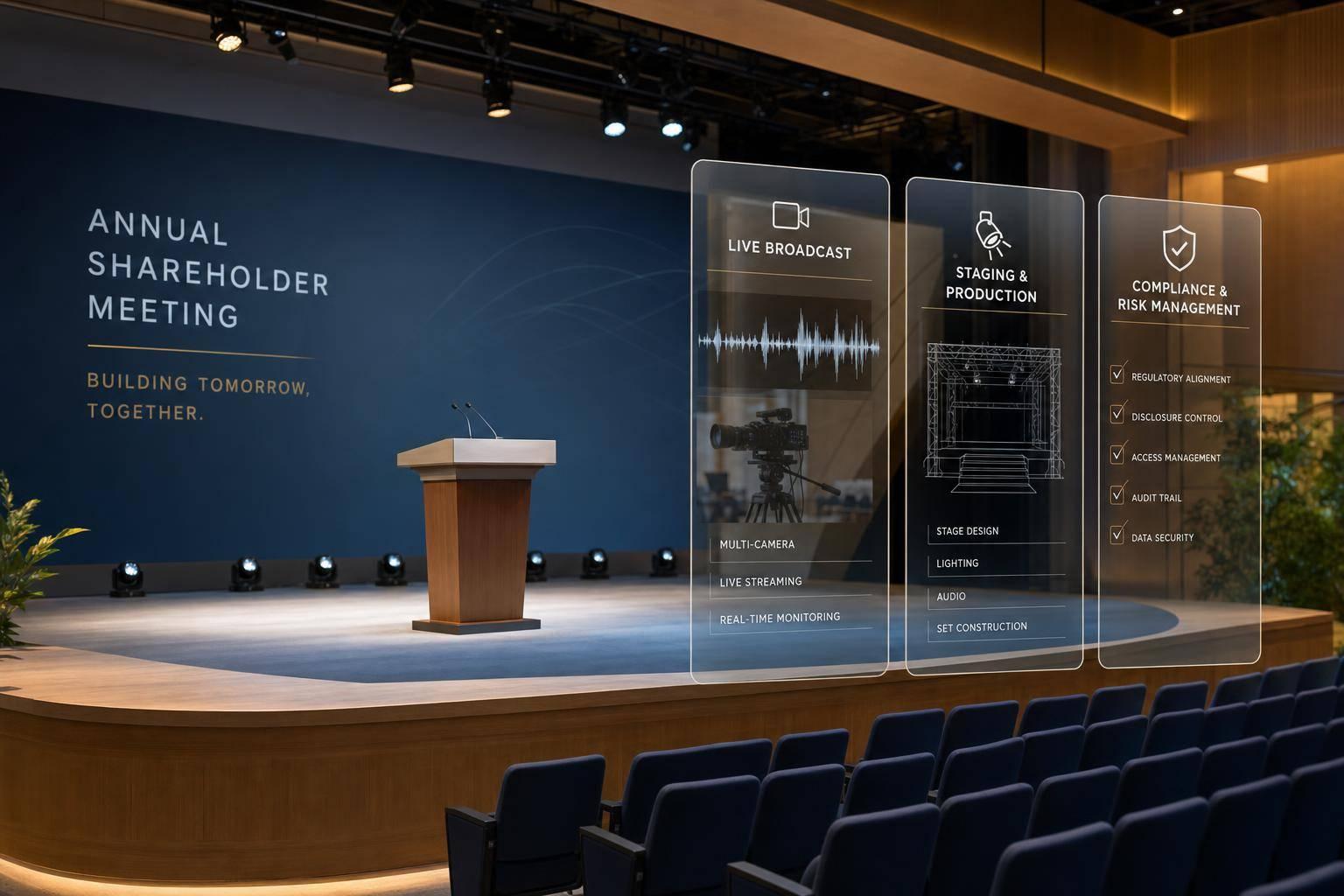
If you’re choosing a partner for an AGM, investor day, or earnings webcast, the main issue is simple: who lowers coordination risk the most? In these events, failure can affect voting, disclosure, stream uptime, records, and executive presentation all at once.
I’d break the market into six groups:
- Corporate Optics for one-team event leadership
- Capital markets event integrators for compliance workflows and failover
- Virtual AGM platforms for shareholder access, identity checks, and voting
- Broadcast webcasting firms for stream uptime and distribution
- Executive staging firms for on-camera stage control
- Archival video teams for post-event records and retention
A few data points stand out right away:
- Computershare handled 5,700+ meetings
- Broadridge has offered VSM tools since 2009
- Centric Events reports 99.9% uptime across 500+ events
- wtv.Financial reports 99.9% uptime and 2,000+ events per year
- Large productions can run $150,000+, while many hybrid programs land in the while many hybrid programs land in the $10,000 to $50,000+ range0,000 to $50,000+ range
My takeaway: if your team wants one point of contact, a full-service lead like Corporate Optics makes the most sense. If your team can coordinate several vendors, a mix of voting, webcast, staging, and archive specialists can fit better.
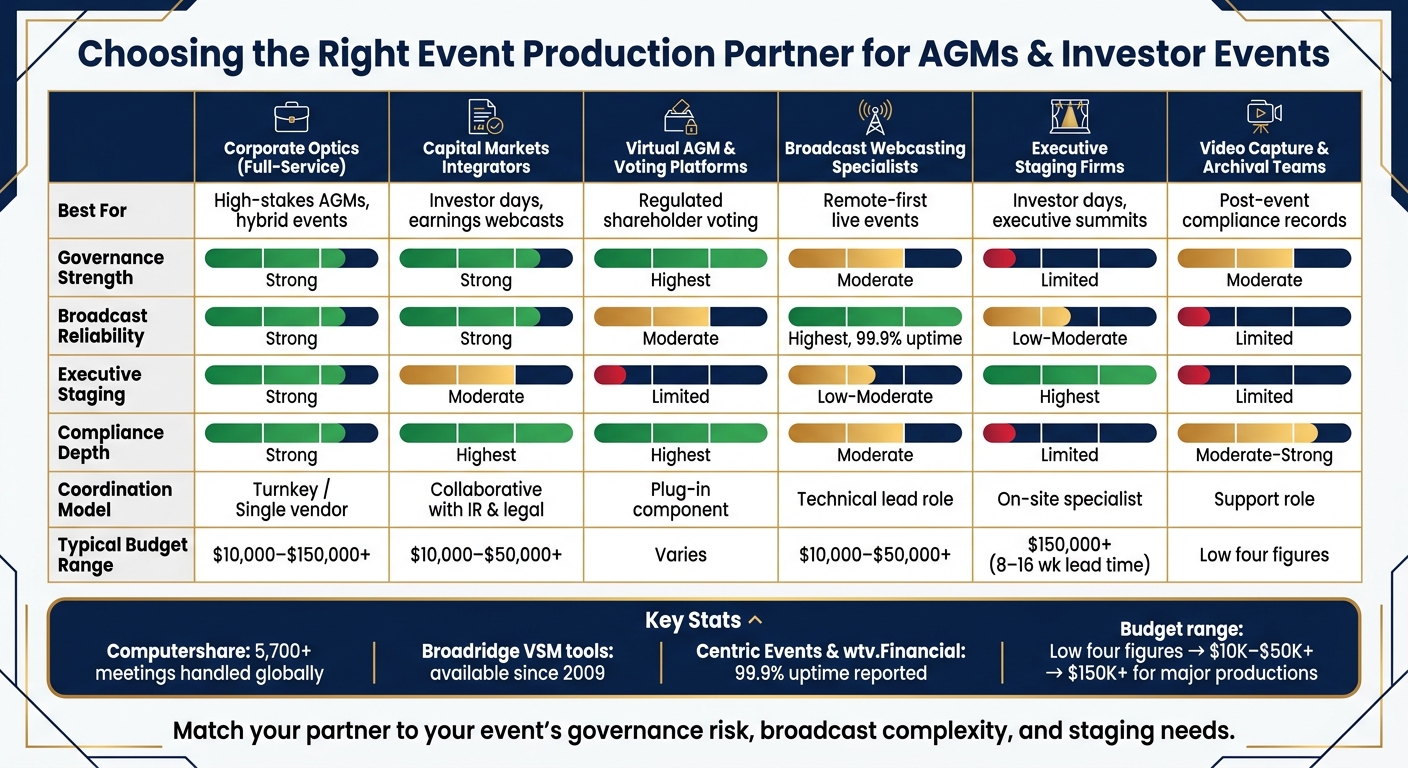
Event Production Company Types for AGMs & Investor Events: Quick Comparison Guide
Quick Comparison
| Option | Best For | Main Focus | Main Gap |
|---|---|---|---|
| Corporate Optics | High-stakes events with many moving parts | One-team planning, staging, AV, rehearsals, live delivery | Can be more than a small meeting needs |
| Capital Markets Event Integrators | IR events with legal and disclosure pressure | Compliance workflow, DR paths, audit logs, secure handling | May need outside help for venue and room setup |
| Virtual AGM Platforms | Formal shareholder meetings | Access control, voting, tabulation, attendance records | Limited physical production |
| Broadcast Webcasting Firms | Remote-first live events | Uptime, redundancy, distribution, monitoring | Limited stage and room support |
| Executive Staging Firms | Investor days and executive presentations | Lighting, scenic build, cue timing, teleprompters | Limited governance depth |
| Archival Video Teams | Post-event recordkeeping | Recordings, transcripts, logs, retention | Not built to run the full live event |
Bottom line: pick the setup that fits your event’s mix of governance, broadcast risk, staging, accessibility, and internal bandwidth.
sbb-itb-ae35a94
1. Corporate Optics
Corporate Optics is a full-service production firm for shareholder meetings, live broadcasts, hybrid leadership meetings, and compliance-sensitive corporate communications. It runs projects through a four-stage Project Life Cycle: Discover, Design, Develop, and Deliver.
That process starts with Discovery, where the team sets objectives and works through event constraints before design starts. In high-stakes programs, that kind of structure matters. When production control and broadcast execution carry the most risk, loose planning can cause problems fast.
The Develop phase includes technical rehearsals and contingency planning. On the executive staging side, Corporate Optics brings scenic design, lighting, audio, and visual elements into one production plan. It also manages speaker needs and venue logistics with leadership teams, which helps keep presentation quality high and timing tight for AGMs and other public-facing programs.
Its best fit is for programs that put a premium on rehearsal discipline, contingency planning, and coordinated live execution.
The table below shows how Corporate Optics lines up its services with the event types that matter most for shareholder and compliance-heavy programs:
| Event Type | Core Deliverables | Technical Stack Elements | Governance Benefits |
|---|---|---|---|
| AGM Production | Strategic program management; Run of Show detailing; public event coordination | Scenic design, broadcast-grade audio, lighting | Run-of-show control; risk mitigation via contingency planning |
| Live Broadcast Events | Real-time execution; vendor coordination | Visual systems, technical rehearsals, live stream management | Live broadcast execution through built-in contingency planning |
| Hybrid Leadership Meetings | Speaker requirement management; venue logistics | Integrated AV coordination, remote participant interfaces | Consistent speaker presentation and timing control |
| Internal Compliance Communications | Governance briefings, compliance sessions, and internal leadership communications | Secure AV capture, captioning, and archival recording | Structured delivery with secure capture and message control |
Corporate Optics can work alongside an in-house AV team or take the lead from start to finish. Its background in government and corporate events makes it a strong match for programs that need disciplined planning and steady live execution. For high-stakes corporate events, the main draw is centralized control across planning, staging, and live delivery.
2. Capital Markets Event Integrators
This category covers the compliance and audit layer that regulated investor events need. Capital markets event integrators are built for one simple reason: financial communications can move markets. So when something breaks during an earnings call, AGM, or investor webcast, the problem isn’t just a bad viewer experience. It can create disclosure risk.
That’s where these firms differ from standard production vendors. A general production team can record and stream an event. An integrator adds SEC/FINRA-aligned workflows, audit trails, as-run logs, and recording retention policies built for disclosure rules. They also manage Material Non-Public Information (MNPI) through restricted-access workflows and secured signal paths, so content stays protected before public release. In regulated investor communications, that’s just part of the job.
Reliability is another big dividing line. Leading integrators run 24/7 Network Operations Centers (NOC), with redundant encoding paths and Disaster Recovery (DR) shadow paths. Broadcast Management Group (BMG), for example, runs a 24/7 corporate broadcast network using IP workflows and real-time NOC monitoring with full DR failover capability. That setup is what separates a mission-critical investor broadcast from a standard corporate livestream.
"The AGM is your most regulated event of the year. A dedicated production team, a tested technical setup and integrated registration remove the operational burden." - Euronext Corporate Solutions
The gap becomes most obvious in four areas: security, compliance, voting, and failover. For public companies reviewing integrators, these are the features that matter most:
| Capability | What to Look For |
|---|---|
| Broadcast Reliability | 24/7 NOC monitoring, redundant encoding paths, DR shadow paths |
| Security | ISO 27001 certification, MNPI protocols, encrypted delivery, role-based access controls |
| Compliance | SEC/FINRA/SOX-aligned audit logs, timestamped recordings, WCAG-compliant captions, transcripts with speaker identification |
| Voting & Authentication | Secure shareholder identity verification, live voting with real-time tallying |
| Executive Staging | Professional teleprompter support, confidence monitors, speaker briefings, secure rehearsal environments |
| Contingency Response | Documented DR failover protocols, quarterly live DR tests, incident escalation procedures |
One area IR teams often miss is executive staging. It sounds small until the event goes live. High-end integrators usually include dedicated support like teleprompter systems, confidence monitors, and secure rehearsal environments, which help leadership stay composed and deliver clearly under live broadcast pressure.
3. Virtual AGM And Secure Voting Platform Providers
Virtual AGM platforms bring shareholder authentication, voting, and webcast delivery into one governance layer. If voting breaks or shareholders can’t get in during a live AGM, that’s not just a tech issue. It’s a governance problem. And while some capital markets firms run the full event, these providers usually own the shareholder portal and the voting layer.
They handle the parts that matter most for formal shareholder meetings: authentication, vote tabulation, participation logs, and post-meeting reporting. That’s why they matter more than a standard livestream vendor when voting integrity is the main concern. Computershare managed more than 5,700 meetings globally in its last fiscal year, with over 848,000 votes cast annually in U.S. AGMs alone. That points to deep ties with transfer agent services, proxy solicitation, and inspector of elections work. Broadridge has been providing Virtual Shareholder Meeting (VSM) technology since 2009.
Authentication is where these platforms start to separate from each other. BeaconLive uses biometric authentication along with unique PINs. Computershare verifies multiple shareholder groups and beneficial holders through unique control numbers. TSX Trust also uses unique control numbers, with live tabulation and back-end reporting, and it supports both English and French. For companies with shareholders across many regions, ReadyComm adds closed captioning in more than 100 languages and uses Akamai's global CDN to help keep delivery stable.
Audit readiness after the meeting matters just as much as access during it. Euronext Corporate Solutions (EngageStream) automatically creates attendance reports, engagement analytics, and a full compliance trail with auditable participation logs. wtv.Financial hosts data on Swiss-based servers, holds ISO 27001 certification, and delivers more than 2,000 live, virtual, and hybrid events each year with a reported 99.9% uptime.
The table below highlights the differences that tend to matter most.
| Provider | Authentication Method | Compliance/Governance Focus | Notable Capability |
|---|---|---|---|
| Computershare | Unique control numbers | Tabulation and inspector of elections | 5,700+ meetings globally; 848,000+ U.S. AGM votes annually |
| BeaconLive | Biometric authentication + unique PINs | Verified identity for voting integrity | API integration for registration |
| Euronext (EngageStream) | Integrated shareholder authentication | Full compliance trail and auditable logs | Attendance and engagement reports |
| TSX Trust | Unique control numbers | Bilingual support and voting reporting | Live tabulation and back-end reporting |
| wtv.Financial | ISO 27001 / Swiss hosting | GDPR and FADP-aligned security | 99.9% uptime; 2,000+ events/year |
| ReadyComm | SSO, PIN, password | Secure archiving and access control | 100+ language captioning; Akamai CDN |
| GetQuorum | Secure electronic proxy | Quorum and advance voting workflows | 300%+ boost in advance voting participation |
When the main need moves away from governance controls and toward stream performance, production depth, and viewer experience, broadcast specialists usually make more sense.
4. Broadcast Webcasting Production Specialists
Once voting and governance are locked in, the next issue is simple: will the stream hold up, and will the production look clean on air? This is the layer that turns a compliant event into a broadcast people can actually rely on.
The gap usually comes down to infrastructure.
Centric Events uses dedicated hardware encoders instead of software-based setups. It also pairs bonded cellular with hardwired internet for backup and stability. Centric Events reports 99.9% stream uptime across more than 500 produced events.
BMG takes a different route. It runs a 24/7 Cloud NOC, uses real-time monitoring, and supports parallel delivery to IR platforms, corporate websites, and call lines. BMG has delivered investor communications to more than 5,900 brokers globally for institutions like UBS.
For regulated events, production isn't just about keeping the video live. It also needs to produce records that are ready for review later. That means the output matters just as much as the stream itself.
| Provider | Redundancy Model | Primary Strength |
|---|---|---|
| Broadcast Management Group | 24/7 Cloud NOC, redundant transmission paths | Parallel delivery to IR platforms, websites, and call lines |
| Centric Events | Bonded cellular + hardwired internet, hardware encoders | 99.9% uptime across 500+ events |
| wtv.Financial | Swiss-hosted servers, ISO 27001 certified | 99.9% uptime; 2,000+ events annually |
Leading broadcast specialists also support WCAG captions, sign language, and multilingual audio translation. For IR teams dealing with disclosure rules, these firms can provide speaker-identified transcripts, as-run logs, and tamper-evident archives. Those outputs help support SEC, SOX, and audit review.
Once delivery is stable, presentation and scenic control become the next differentiator.
5. Executive Staging And Scenic AV Firms
Once the webcast is covered, attention shifts to the stage itself. For shareholder meetings and investor days, stage execution has a direct effect on credibility. A bad camera frame, a missed cue, or the wrong slide at the wrong moment can undercut the whole presentation. That risk tends to show up in a few places: redundancy, cue timing, slide control, and hybrid set design. Following hybrid meeting planning best practices ensures these technical elements align with the overall event strategy.
These firms approach staging as execution control, not set dressing.
CitiView Audio Visual works in the NYC financial district and supports institutional investor events with redundant systems and discreet presentation management.
Axios Pro Solutions leans into the people side of production. Their show callers handle exact cue timing for large-format LED stages built for Fortune 500 general sessions.
Cardboard Spaceship puts a lot of focus on pre-event prep. Their process includes slide version control and media testing to stop failures during live transitions. They also offer virtual prompter support and advise remote rehearsals at least one week before the event. Their cue-based run-of-show helps protect pacing and handoffs.
Broadcast Management Group (BMG) uses Unreal Engine and Brainstorm to build virtual sets that mix in-room speakers with remote presenters. BMG has produced virtual shareholder meetings with remote presenters, greenscreen studios, and REMI workflows for confidential content.
| Firm | Primary Staging Strength | Executive Support Focus |
|---|---|---|
| CitiView AV | Physical LED & lighting | Discreet support & redundancy |
| Axios Pro | Large-format LED walls | Show calling & cue precision |
| BMG | Virtual/Unreal Engine sets | On-air coaching & stage blocking |
| Cardboard Spaceship | Branded environments | Slide version control & pacing |
For major shareholder events and investor days, lead time is usually 6 to 10 weeks, with a full speaker rehearsal at least one day before the event. After the stage is locked, the next issue is keeping the event captured cleanly for compliance and later use.
6. Corporate Video Capture And Archival Production Teams
Once the webcast ends, the recording becomes the record that lasts. In shareholder meetings, that matters a lot. A clean capture isn't just something you hand off at the end. It's documentation.
These providers are built around record integrity, not live show execution. The main goal is a defensible archive.
Broadcast Management Group (BMG) keeps recordings, as-run logs, captions, transcripts, and secure media archives to support post-event audit and legal review. Their workflow follows a compliance-grade model built around searchable metadata, version control, and tamper-evident storage. That changes the priority from keeping the production moving to protecting the record itself.
AVP.Live looks at capture through a broadcast engineering lens. They use redundant encoding paths and on-site backup hardware to protect recording integrity during shareholder and investor events.
VIXY Live brings more than 25 years of experience in live financial communication and holds ISO 27001 certification. As the company puts it, "Listed companies follow a highly standardized IR communication model... Reliability, compliance, and reproducibility are crucial."
For planners comparing providers, the areas below help show the gap between compliance-grade archival teams and standard post-event recording services:
| Control Area | What to Look For | Why It Matters |
|---|---|---|
| Redundancy | Dual-path encoding, on-site backup hardware, 24/7 NOC monitoring | Protects capture if primary systems fail |
| Governance | As-run logs, timestamped recordings, audit trails | Supports post-event regulatory review |
| Archival Security | ISO 27001, tamper-evident storage, version control | Protects sensitive event records |
| Accessibility | WCAG-compliant captions, transcripts, multilingual support | Improves access for global investors |
| Retention | Defined retention policies, long-term archive options | Enables audit and legal handoff |
ReadyComm includes one-year archiving by default, with extension options. These differences stand out more when you compare capture, governance, and retention side by side.
How These Provider Types Differ On The Criteria That Matter Most
The profiles above show what each provider type does. This framework shows how they stack up on the criteria that usually decide the choice.
Not every provider is built for the same job. A firm that shines in scenic design can still miss the mark on voting compliance. A platform with tight governance may offer almost nothing for executive staging. The key is knowing where each provider type performs well, and where the gaps start to show. That makes it much easier to match the right partner to the right kind of risk.
Governance Readiness
Governance readiness comes down to one thing: a defensible record. That includes authentication, voting, attendance logs, and reporting that legal counsel can actually use. Virtual AGM and secure voting platform providers lead this category because they offer integrated shareholder authentication, live voting, and compliance trails built for SEC and SOX requirements.
Capital markets event integrators come next. Many hold ISO 27001 certification and work directly with legal and IR teams across markets. Broadcast specialists and staging firms play a smaller part here, mainly through IR-ready replay assets and secure content handling. The point that matters most is simple: can the provider produce a record that holds up under legal review, not just a record that proves the event happened?
| Provider Type | Governance Strength | Primary Compliance Control |
|---|---|---|
| Virtual AGM Platforms | Highest | Secure authentication, live voting, automated attendance logs |
| Capital Markets Integrators | High | ISO 27001, multi-market regulatory alignment |
| Broadcast Webcasting Specialists | High | Audit-ready logs and IR-ready replay assets |
| Executive Staging Firms | Low–Moderate | NDA-protected workflows, secure content handling |
| Video Capture Teams | Moderate | Multi-camera archival for regulatory records |
Broadcast Reliability
A dropped feed during a live shareholder meeting or earnings call does more than hurt stream quality. It can shake market confidence.
This is where broadcast webcasting specialists stand out. They run 24/7 NOC support and conduct quarterly live disaster recovery tests to check failover plans during market hours. Capital markets integrators also perform well here, especially because they treat presentation management and slide version control as mission-critical assets.
Executive staging firms can bring strong on-site hardware backup. But that strength tends to narrow once remote or hybrid delivery enters the picture. In practice, the deciding question is whether the provider can keep the stream live when the main systems start to strain.
Executive Staging
Once governance and reliability are in place, the physical presentation layer becomes the next separator.
When the room itself matters, think LED video walls, stage lighting, teleprompter systems, and confidence monitors, executive staging and scenic AV firms lead the field. They build stage setups that read well both in person and on camera. That has a direct effect on speaker delivery, camera framing, and how controlled the event feels to viewers.
Broadcast specialists also perform well here. They create on-brand studio setups tuned for multi-camera switching and polished on-camera delivery. Virtual AGM platforms sit at the other end of the range. Their “stage” is digital: branded layouts, secure Q&A, and a clean player design, but no physical production setting.
| Provider Type | Scenic Design | Teleprompter/Coaching | On-Camera Quality |
|---|---|---|---|
| Executive Staging Firms | Highest | High | Polished physical stage |
| Capital Markets Integrators | High | Highest (full AV rehearsals) | Professional, polished on-camera presentation |
| Broadcast Specialists | Medium | High | Broadcast-quality switching |
| Virtual AGM Platforms | Low | Medium | Clean, branded digital interface |
Risk And Redundancy
For shareholder events, reliability and recovery planning go hand in hand. Redundancy is no longer optional. It's the baseline.
The strongest providers build backup into every layer: dual encoding paths, backup internet connections, and real-time monitoring that spots issues before they hit the live stream. Broadcast specialists focus on shadow paths and NOC-led incident response. Virtual AGM platforms protect against governance failures with encrypted voting pipelines and ISO 27001-certified security. Executive staging firms handle physical backup well, though their risk scope is usually limited to what is happening in the room.
Put together, these controls act as the last line of defense when governance and production are already in motion. They help protect the event record at the moment it matters most.
Pros And Cons By Provider Type
The table below compares each provider type by the tradeoff that matters most in practice: accountability, compliance depth, and coordination load. Put simply, this turns the earlier provider profiles into a decision matrix.
| Provider/Category | Main Advantages | Main Limitations | Best Use Case | Typical Integration Model |
|---|---|---|---|---|
| Corporate Optics (Full-Service) | Single point of accountability; unified staging, AV, and compliance workflow | Higher overall cost for turnkey scope | AGMs, high-stakes investor days, hybrid shareholder events | Turnkey; manages all sub-vendors and venue logistics |
| Capital Markets Event Integrators | Strategic IR alignment; broadcast-first technical focus; strong presentation version control | May not handle physical logistics like catering or venue sourcing | Investor days; earnings webcasts | Collaborative partner with IR and legal teams |
| Virtual AGM & Secure Voting Platforms | Secure voting layer; needs separate broadcast production | Lacks show production value; requires a separate partner for visual broadcast execution | Regulated shareholder voting; proxy events | Plug-in component within a broader production workflow |
| Executive Staging & Scenic AV Firms | Architectural stage design; custom fabrication; cinematic lighting | Lead times of 8–16 weeks; higher fabrication costs; limited compliance depth | High-visibility executive summits; executive brand events | On-site specialist; works under a lead producer |
| Broadcast Webcasting Specialists | Live stream reliability and broadcast control | Requires a separate partner for physical staging or catering | Earnings calls; town halls; press announcements | Technical lead; coordinates with venue internet and AV |
| Corporate Video Capture & Archival Teams | High-quality post-event assets; multi-camera recordings and session breakouts for IR sites and internal distribution | Limited live broadcast capability when used alone | IR site archives; internal compliance records | Support role; integrated into the broader broadcast workflow |
What does this table tell you? The real decision isn’t about who has the longest feature list. It’s about whether you want best vendors for meeting planning to manage or deeper specialization across separate providers.
Across governance, reliability, and staging, the big tradeoff is simple: single-vendor accountability versus multi-provider coordination. If IR and legal need to stay locked in on messaging, a full-service partner takes vendor wrangling off their plate. That can make a big difference when the stakes are high and timing is tight.
A specialist mix can still be the right call. It tends to fit programs that need separate experts for voting, staging, and broadcast. But that setup asks more from your internal team. Someone has to connect the dots, keep handoffs clean, and make sure nothing slips between vendors.
For U.S. corporate planners running AGMs, investor days, earnings webcasts, or regulated internal communications, the key question is coordination capacity, not feature count. Which setup cuts event risk most for this specific program?
Choose a full-service partner when internal bandwidth is limited and coordination risk is unacceptable. Use a specialist mix only when your team can handle the integration load.
Conclusion
Choosing the right production partner comes down to one plain question: how much coordination risk can your team take on?
The answer depends on the event’s mix of governance risk, broadcast complexity, and stage needs. Governance-heavy AGMs need secure voting and compliance workflows. Webcast-heavy programs need backup systems for the broadcast. Presentation-led events need strong staging. And when one event pulls together staging, AV, live streaming, accessibility, and compliance control, it helps to have one team running the whole thing. In that case, Corporate Optics is the lead production integrator, managing the full ecosystem under one accountable team.
Pick the partner that fits the event’s risk level, audience size, disclosure sensitivity, accessibility needs, and budget. Budget should follow event risk: low four figures for small meetings, $10,000–$50,000+ for multi-day hybrid events, and $150,000+ for major productions.
| Provider Type | Best For | Key Strength | Primary Limitation |
|---|---|---|---|
| Corporate Optics (Lead Integrator) | End-to-end compliance-sensitive events | Full integration of staging, AV, live streaming, and contingency planning | May exceed requirements for simple, low-risk meetings |
| Capital Markets Event Integrators | Investor days and IR-specific messaging | Strategic run-of-show planning and presentation version control | May require third-party vendors for heavy physical staging |
| Virtual AGM & Secure Voting Platform Providers | Governance-critical shareholder meetings | Secure voting and regulatory compliance | Often lacks high-end physical scenic design |
| Broadcast Webcasting Production Specialists | Pure webcast infrastructure and remote-first broadcasts | Hardware redundancy and 99.9% stream uptime | Less focus on the in-room attendee experience |
| Executive Staging & Scenic AV Firms | High-end physical environments and executive brand events | Architectural design, custom scenic fabrication, and cinematic lighting | Longer lead times; limited compliance depth |
| Corporate Video Capture & Archival Production Teams | Post-event archives and compliance records | Multi-camera recordings and clean audio mixes within 24–48 hours | Less suited to full live broadcast production on its own |
For AGMs, investor days, earnings webcasts, and compliance-heavy corporate events, coordination is the deciding factor.
FAQs
How early should we start planning an AGM or investor webcast?
For an Annual General Meeting, start planning 9 to 12 months ahead. That gives your legal and investor relations teams enough time to get on the same page, book the venue, and lock in technical partners.
A clear timeline matters for these high-stakes events. Formal shareholder notices are usually sent 3 to 5 months before the meeting, so there’s not much room for delay. Smaller investor events can often come together on a shorter schedule, but AGMs usually need more runway.
What should we prioritize first: voting, streaming, or staging?
Don’t treat these as separate tracks. For high-stakes corporate events, staging, streaming, and voting need to run from one integrated technical plan.
Staging helps speakers come across clearly and keeps the room engaged. Streaming gives remote attendees a smooth experience. Voting and Q&A make secure, real-time participation possible.
When you treat all three as one system, it’s much easier to support compliance, backup coverage, and day-of reliability.
How do we know if we need one production lead or multiple specialists?
It depends on your event’s size and complexity. For high-stakes events like annual shareholder meetings, one production lead is usually the safer choice.
Too many vendors can slow down troubleshooting and add risk. One production partner keeps video, audio, streaming, and display systems working together. It also makes backup planning easier and helps keep the run of show aligned.
Related Blog Posts


Streamline your workflow, achieve more

Lorem ipsum dolor sit amet, consectetur adipiscing elit. Maecenas ac velit pellentesque, feugiat justo sed, aliquet felis.



Lorem ipsum dolor sit amet, consectetur adipiscing elit. Maecenas ac velit pellentesque, feugiat justo sed, aliquet felis.