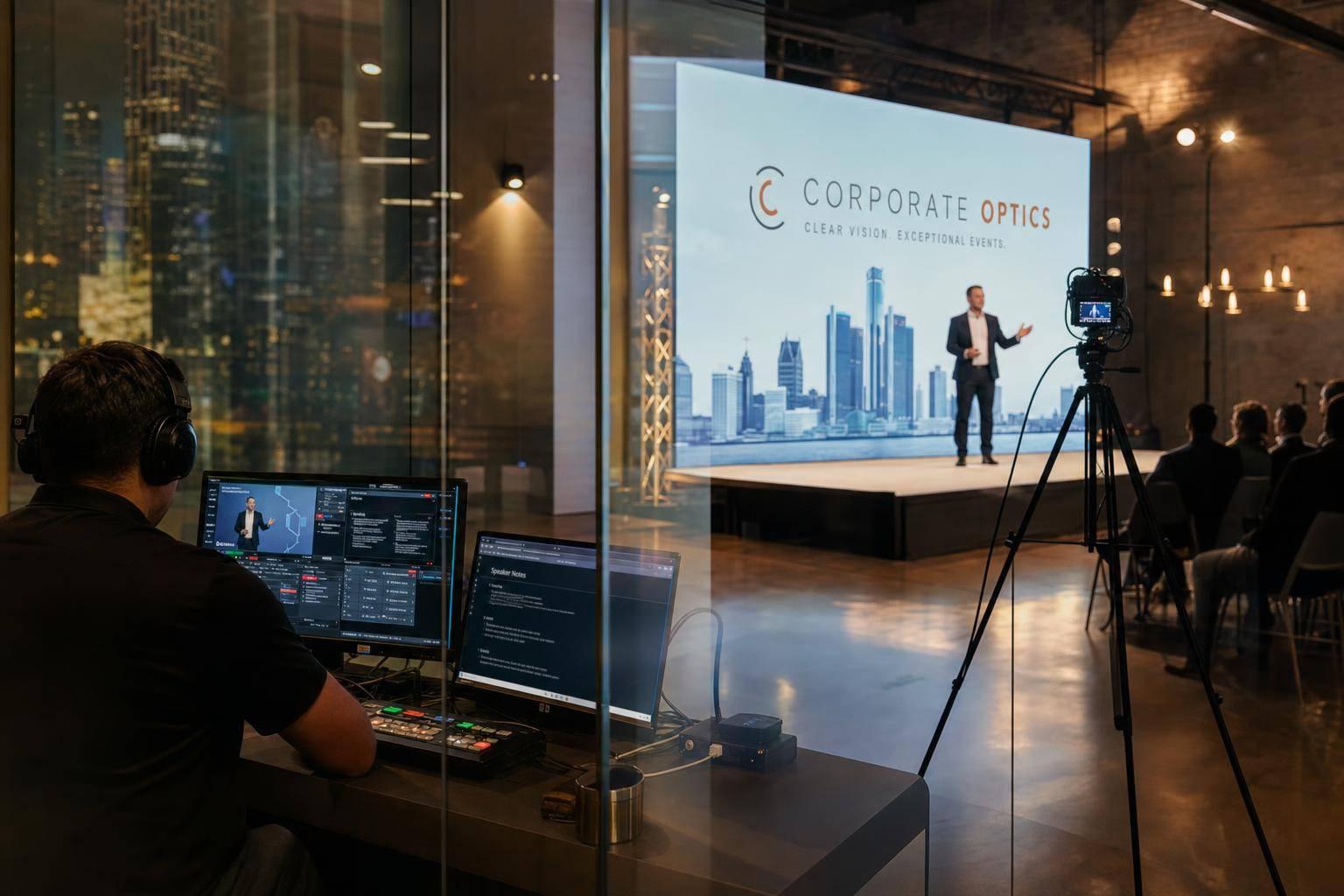
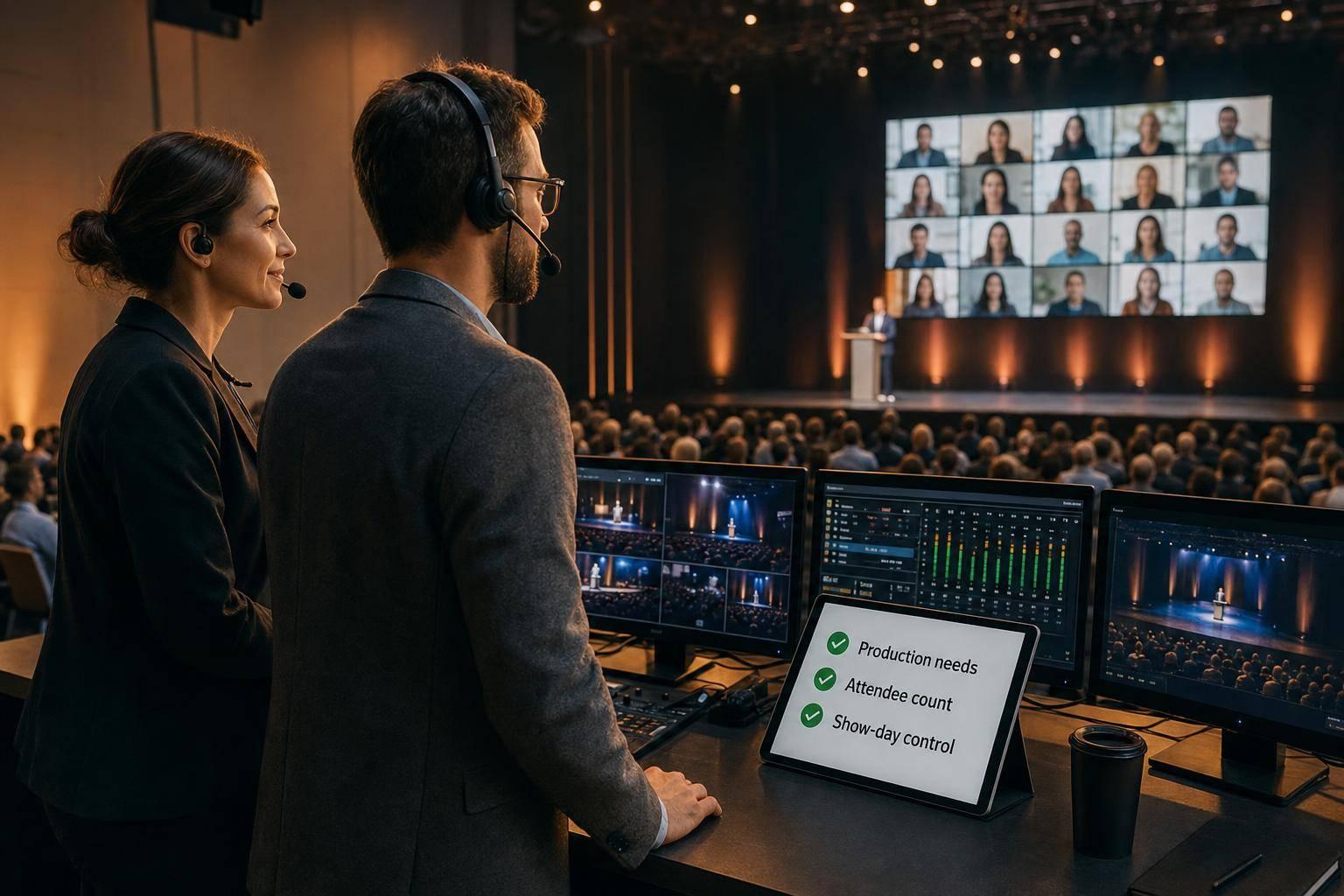
5 Event Production Partners For Corporate Event Production Who Handle End‑To‑End Strategy, Creative, Technical Production, And On‑Site Execution.

Chief Executive Officer
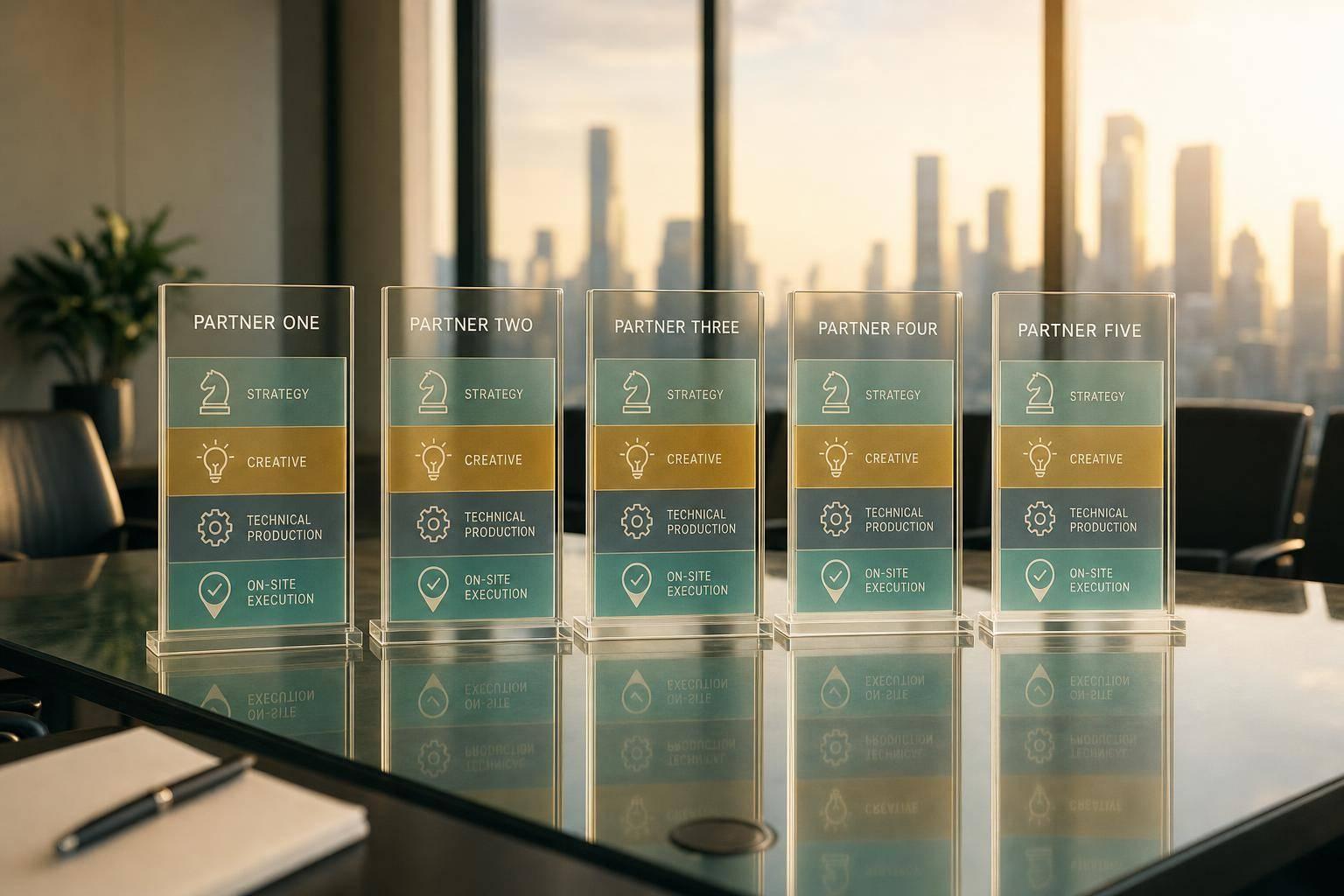
Need one team to plan, build, run, and support your corporate event? I’d narrow this list by one thing first: where the pressure is highest - the room, the stream, the venue load, or the brand experience.
Here’s the short version:
- Corporate Optics fits executive meetings, investor events, and sales meetings where show flow, AV, livestreaming, and speaker support need to stay tightly aligned.
- Encore fits large hotel-based conferences and multi-room meetings, with reach across 23+ countries and 85+ years in the field.
- Freeman fits convention-scale programs, trade shows, and large enterprise conferences that need staging, freight, labor, and venue coordination.
- We & Goliath fits hybrid and virtual-first events, especially global programs with remote speakers, livestreaming, interpretation, and audience tools.
- MKG fits product launches, activations, and brand-led company events where the look, feel, and audience moment matter as much as the agenda.
One stat stands out: 66% of event planners outsource at least part of event management. Using a corporate event checklist can help you identify which tasks to keep in-house versus outsource. So if your team is short on time, picking the right partner can cut down on vendor handoffs, show-day issues, and last-minute fixes.
Quick Comparison
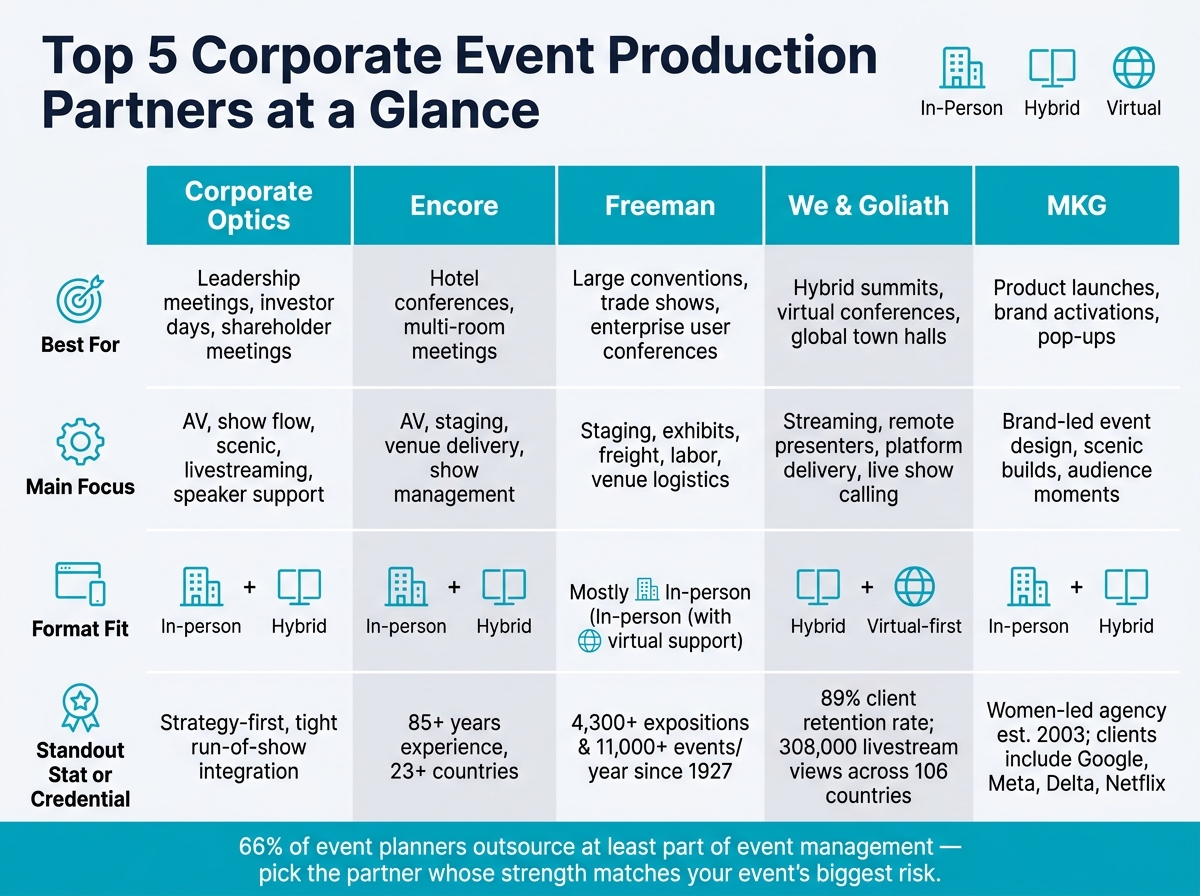
Top 5 Corporate Event Production Partners: Side-by-Side Comparison
| Partner | Best For | Main Focus | Format Fit |
|---|---|---|---|
| Corporate Optics | Leadership meetings, shareholder meetings, sales meetings | AV, show flow, scenic, livestreaming, speaker support | In-person + hybrid |
| Encore | Hotel conferences, multi-room meetings | AV, staging, venue delivery, and conference event production management | In-person + hybrid |
| Freeman | Large conventions, user conferences, trade shows | Staging, exhibits, freight, labor, venue logistics | Mostly in-person, with virtual support |
| We & Goliath | Global town halls, virtual summits, hybrid conferences | Streaming, remote presenters, platform delivery, live show calling | Hybrid + virtual-first |
| MKG | Product launches, pop-ups, brand events | Brand-led event design, scenic builds, audience moments | In-person + hybrid |
If I were choosing, I’d keep it simple: pick the partner whose main strength matches your event’s biggest risk.
sbb-itb-ae35a94
1. Corporate Optics
Corporate Optics is a technical event production company founded by Steven P. Simmons. The company supports corporate, government, sporting, and lifestyle events, with a strong focus on leadership conferences, shareholder meetings, sales meetings, award ceremonies, and broadcast productions.
At a high level, its services span four main areas: strategy, creative work, technical production, and show-day execution. That matters because events rarely succeed on one piece alone. A sharp stage means less if the agenda drifts. Great speakers can still fall flat if the audio cuts out. Corporate Optics is set up to connect those moving parts from the start.
Strategy & Planning
Corporate Optics often joins projects early in the process. That includes agenda development, venue sourcing, budget planning, vendor coordination, contingency planning, sponsor management, and registration management.
Getting involved at this stage helps keep the event on track before the big decisions start piling up. It also helps line up the creative, technical, and logistical sides of the program so one choice doesn’t throw off the rest.
Creative & Content
On the creative side, Corporate Optics handles stage design, scenic production, and custom fabrication. The team also supports speakers and provides event furniture and décor.
In plain terms, this is the part that shapes how the event looks and feels in the room. From the stage setup to the visual details around it, these choices help frame the program for both live attendees and viewers watching from somewhere else.
Technical Production
Technical production is a main part of what Corporate Optics does. The company manages audiovisual design, intelligent lighting, sound coordination, live streaming, hybrid event production, and global broadcast services.
That mix works well for events that need to serve both in-room and remote audiences. A leadership summit, for example, might need clean audio for the ballroom, polished lighting for the stage, and a stream that feels smooth for viewers tuning in from other cities or countries.
On-Site Execution
On site, Corporate Optics provides staffing, manages the run of show, and supports live event operations through show day. The team also offers audience engagement tools.
Pricing is custom and based on the scope of the event, with details shaped through consultation. That makes sense for this kind of work since a single-day shareholder meeting and a multi-part broadcast production can look very different in staff needs, tech setup, and delivery.
2. Encore
Encore is a global event production partner with more than 85 years in the industry and operations across 23 countries. The company presents itself as a single partner for strategy, creative, technical production, and on-site execution. In plain terms, that means one team can help shape the event, build the experience, run the tech, and manage the room once the show starts.
Strategy & Planning
Encore's planning support can cover the full pre-event setup: defining the event goal, mapping the attendee journey, building the program flow, setting production needs, planning room layouts, identifying speaker requirements, and working with the venue. This is especially useful for hybrid events or programs spread across more than one space, where timing, room use, and tech all need to line up.
Creative & Content
Encore also supports thematic storytelling, branded staging, motion graphics, and presentation design. That helps keep a multi-day program aligned from session to session, instead of feeling pieced together. The same creative direction then carries into the technical setup for the show.
Technical Production
On the production side, Encore manages audio, video, lighting, scenic integration, power, connectivity, and digital platforms for live events. They also specialize in multi-camera streaming to bridge the gap between in-person and virtual audiences. For Forbes Travel Guide's The Summit, Encore delivered an integrated solution that included stage and scenic design, audio, lighting, video, LED systems, AI-powered session summaries, and project management. That's the kind of scope that fits large general sessions and multi-day conferences where the tech stack has to work together without gaps.
On-Site Execution
On event day, Encore provides show management, stage management, show calling, and on-site staffing. For Tealium: Digital Velocity 2025, Encore handled full event management, end-to-end technical production, sponsor activations, registration services, staffing, and live photo and video coverage. A dedicated crew helps keep the program on schedule and deals with live issues as they come up, so the client team doesn't have to get pulled into backstage calls.
3. Freeman
Freeman is built for big corporate programs where scale, venue logistics, and show control matter just as much as the idea behind the event. The company has been operating since 1927 and supports more than 4,300 expositions and 11,000 other events around the world each year, which makes it a strong fit for corporate programs in convention centers and other hard-to-run venues. You can see that scale across four main areas: planning, creative, technical production, and on-site execution.
Strategy & Planning
Freeman's Strategy & Insights team begins with discovery focused on business goals and audience needs, then turns that work into a program structure with content tracks and engagement points. Its Strategy & Show Planning services cover overall show design, sponsorship strategy, marketing, registration, analytics, and AV and event tech integration.
For annual meetings, sales kickoffs, product launches, and roadshows, Freeman sets goals, KPIs, program frameworks, and measurement plans and engagement scorecards. The team also builds master schedules, run sheets, cue scripts, and speaker rehearsal plans.
Creative & Content
Freeman offers experiential design, creative direction, content production, scenic design, and digital content and displays. In practice, that can include keynote storylines, executive presentations, motion graphics, stage environments, signage, sponsor messaging, digital displays, LED and lighting designs, projection mapping, and post-event content capture.
Technical Production
Freeman handles AV production, event technology, staging, rigging, electrical, lighting, video, and digital services for large-scale programs. Studio Blue supports general sessions, sales meetings, and large employee events with broadcast-quality live streaming and tight stage direction. Freeman also uses real-time attendance and engagement tracking, which gives organizers a live view of how sessions are performing while the event is in progress.
On-Site Execution
Freeman manages setup, shipping, material handling, rigging, electrical, crew management, power distribution, trucking, and teardown, while also coordinating with venues, suppliers, and contractors. Production and technical managers oversee union labor coordination, handle issues as they come up, and run show management during general sessions.
4. We & Goliath
We & Goliath is an event production partner with a strong focus on creative and hybrid delivery. The team brings 20+ years of experience across virtual and hybrid summits, conferences, workshops, tours, rallies, and retreats. Their work is centered on corporate clients that run virtual and hybrid events. What sets them apart is a strategy-first process built for virtual and hybrid delivery from day one. That makes them a solid choice for corporate programs where hybrid isn't an add-on. It's the core format.
Strategy & Planning
We & Goliath uses its SMART Event Method™ to connect event design with business goals at the start. Planning can cover discovery, goal alignment, audience definition, format recommendations, timelines, budgets, and ROI measurement from your production company. Some of their virtual and hybrid programs have also led to measurable lifts in attendance and revenue for clients.
Once the plan is locked in, the team turns that direction into a clear visual story and content plan.
Creative & Content
We & Goliath develops event concepts, thematic storytelling, visual direction, motion graphics, stage content, presentation design, and speaker support. For corporate teams, that means the production side and the promotional side can move in the same direction instead of pulling apart.
Those choices then shape the AV, streaming, and staging setup.
Technical Production
The team handles scenic fabrication, stage management, projection and LED support, camera and streaming coordination, playback, and technical rehearsals. Their production work has supported events with attendees in up to 125 countries, along with 6 languages of simultaneous interpretation and captioning. In one virtual program, they helped generate 308,000 livestream views across partners in 106 countries.
For corporate buyers, that kind of reach matters. If an internal meeting or customer event needs to land the same way across regions, the technical setup can't be shaky.
On-Site Execution
When event day arrives, all of that prep turns into live coordination across speakers, crew, and show control. We & Goliath manages rehearsal management, run-of-show execution, show calling, speaker management, registration support, floor management, live issue resolution, load-in, strike, and contingency planning. Their 89% conference client retention rate for virtual and hybrid work suggests they deliver steady execution for repeat corporate programs.
5. MKG
MKG is a women-led experiential agency founded in 2003, with offices in New York and Los Angeles. It focuses on brand-led corporate events. Its client list includes major enterprise and consumer brands like Delta Air Lines, Google, Meta, Target, Netflix, Bank of America, lululemon, and Unilever.
Strategy & Planning
MKG builds its work around brand-led event strategy. The goal is simple: connect live, digital, and hybrid experiences to bigger marketing and communication goals.
That usually means handling audience goals, brand positioning, format choices, timeline planning, stakeholder coordination, budget planning, vendor management, and milestone tracking. So if you need an event to do more than just look good, MKG makes sense. It's well suited for product launches, sponsorship activations, executive meetings, conferences, incentive programs, and employee engagement events tied to a broader business result.
Creative & Content
Creative is one of MKG's strongest areas. The agency develops event themes, visual identity, key live moments, presentation design, scripts, speaker support, motion graphics, and branded environments built around one central idea.
That matters because good event creative can't live only on a mood board. It has to work on stage, on screen, and in the room. MKG's background in large brand activations and conference programs gives teams a solid base when they want strong direction tied to production-ready assets.
Technical Production
MKG also brings deep production experience. It supports execution across audiovisual design, lighting, staging, scenic fabrication, video production, projection or LED walls, show programming, content playback, and rehearsal support.
The team also handles technical drawings and equipment sourcing. MKG has worked on virtual and hybrid formats too, including digital sponsorship work for Google and Bank of America at the Grace Hopper Celebration. That shows it can shape technical production for distributed audiences, not just in-room events.
On-Site Execution
On event day, MKG manages live operations across run-of-show execution, crew coordination, cue calling, speaker support, attendee flow, signage placement, registration, and live troubleshooting.
It can also provide event staffing, backstage support, and contingency handling when timing shifts or technical issues pop up. Depending on the engagement, MKG may also deliver post-event wrap-up materials such as performance summaries, attendee feedback analysis, and reports to measure conference ROI. The comparison below shows how that approach differs from the other partners' production models.
Side-by-Side Comparison: Capabilities, Deliverables, and Fit
These five partners all cover end-to-end event work. The difference is where each one fits best.
The table below helps match event size, audience mix, and production demands to the right model.
| Partner | Core Strength | Best-Fit Event Types | Key Deliverables | Typical Fit |
|---|---|---|---|---|
| Corporate Optics | Technical production + executive program design | Leadership summits, investor days, shareholder meetings, sales meetings | Run-of-show, AV, scenic, livestreaming, speaker support | Mid-to-large corporate meetings; in-person and hybrid |
| Encore | In-venue AV + integrated event technology at scale | Hotel conferences, multi-room meetings, hybrid corporate events | Event strategy, staging, AV, hybrid streaming, program management | Large in-venue programs across multiple rooms or venues |
| Freeman | Large-scale staging + exhibit environments | Enterprise user conferences, trade shows, national conventions | Scenic design, general session staging, exhibit services, content, logistics | Large conventions and multi-day enterprise programs |
| We & Goliath | Virtual-first strategy + broadcast-quality streaming | Hybrid summits, virtual conferences, global town halls | Platform setup, livestreaming, remote speaker management, post-event analytics | Virtual and hybrid programs with distributed global audiences |
| MKG | Experiential creative + brand-led production | Product launches, pop-ups, brand experiences | Creative direction, scenic design, custom fabrication, interactive installations | Mid-to-large experiential brand activations and conference programs |
The biggest split comes down to venue and logistics demands versus remote audience demands.
Encore and Freeman are built for large venues, multiple rooms running at once, and the crew coordination that comes with that. If your event lives inside a hotel, convention center, or a big multi-day setup, those strengths matter a lot.
We & Goliath fits best when the remote audience matters just as much as the people in the room - or more. That usually means hybrid summits, virtual conferences, and global all-hands programs where streaming quality, remote speaker handling, and platform flow can make or break the experience.
Corporate Optics stands out when message control and show control need to work hand in hand. Think executive-facing programs where timing is tight, cues need to land cleanly, and speaker coaching can't be an afterthought.
MKG fits a different kind of brief. If the event has to shape brand perception - not just deliver information to an internal group - MKG makes more sense. Product launches, pop-ups, and immersive brand moments fall into that lane.
A simple way to think about it:
- For executive content programs, put more weight on run-of-show design and speaker support
- For multi-room conferences, focus more on freight, labor, and venue coordination
The next section turns those fit differences into practical tradeoffs.
Pros and Cons
Each partner brings a different mix of strengths and tradeoffs. The table below sums up the day-to-day differences that tend to matter most when you're choosing a fit.
| Partner | Pros | Cons | Best For |
|---|---|---|---|
| Corporate Optics | Strategy-first approach; tight integration of run-of-show with creative and AV; direct access to senior strategists; fast iteration | Less suited to large multi-city programs; larger builds may need local AV support. | Executive summits, leadership meetings, investor days |
| Encore | Broad in-venue AV coverage across 23 countries. | Stronger in execution than early-stage strategy; can feel less tailored for highly custom concepts; hotel contracts can limit pricing flexibility. | Large in-hotel conferences, multi-room national meetings, hybrid webcasts from ballrooms |
| Freeman | Integrated exhibit, staging, logistics, creative, and AV production for large trade shows. | Less flexible for small or late-stage changes; costly for narrow-scope projects. | Large conventions, enterprise user conferences, trade shows with exhibit halls |
| We & Goliath | 89% conference client retention rate; TV-quality multi-camera streaming; strong hybrid format design; engagement tools for remote audiences | Heavy scenic and rigging work often needs local partners; in-room scenic depth is secondary to broadcast depth. | Hybrid global town halls, virtual summits, association meetings with distributed audiences |
| MKG | Strong experiential creative; strong brand storytelling; immersive environments and custom fabrication | Creative-heavy work can raise costs for routine programs; complex broadcast needs may require outside technical vendors. | Product launches, brand activations, pop-ups, culture-driven internal events |
In plain terms, the choice usually comes down to three things: event scale, audience mix, and where most of the production weight sits. Is the main job happening inside the room, or on the stream?
That lens makes the differences easier to read. Some partners are better for executive rooms and tighter strategy work. Others shine when the job is a huge ballroom show, an exhibit-heavy conference, or a hybrid event built for both live and remote audiences. The next section turns those tradeoffs into selection criteria.
How to Choose the Right Partner for Your Event
Pick the partner whose main strength lines up with the biggest pressure point in your event: strategy, creative, technical production, or on-site execution.
Use the comparison above to connect your event’s toughest constraint with the right operating model.
| Event Scenario | Best-Fit Partner | Why |
|---|---|---|
| Leadership conferences and executive meetings | Corporate Optics | Run-of-show integration and speaker support |
| Large general sessions and enterprise meetings | Encore | Scalable technical production across staging, audio, video, and live show control |
| Complex in-person programs | Freeman | Single operational coordinator for vendors, timelines, and approvals |
| Hybrid or virtual-first events | We & Goliath | Broadcast-grade production, streaming reliability, and remote presenter coordination |
| Product launches and activations | MKG | Experiential creative, motion graphics, and immersive show environments |
After event type, look at your internal bandwidth. A 2026 corporate events trend report found that 66% of event planners outsource at least part of event management, with AV production, event technology, sustainability, and on-site execution leading the list. If your team is lean, go with a partner that can provide comprehensive conference production services from start to finish.
For complex programs, focus on the partner that can handle approvals, crew coordination, issue resolution, and show control. More moving parts usually mean more chances for things to slip. That’s why show-day command matters so much. Success often depends on how you design AV production to handle these high-pressure moments.
FAQs
How far in advance should I hire an event production partner?
Hire an event production partner as early as possible. That gives you time to lock in technical needs, secure logistics, and avoid last-minute problems.
Typical timelines vary by event type:
- 12+ months for large-scale events
- 4–6 months for large conferences or multi-city programs
- 8–16 weeks for executive summits or custom scenic work
- 4–8 weeks for smaller single-day events
Starting early also makes room for site surveys, CAD planning, and technical validation.
What should I ask before signing with an event production partner?
Before signing, confirm who owns the program, project management, and technical execution. You should also ask if you’ll work with one dedicated production manager from start to finish, or if that person changes as the project moves from one phase to the next.
It also helps to ask about their staffing model, how they handle quality control across venues, and what backup plans they have in place for redundancy, hybrid streaming, multi-room coordination, and high-traffic situations.
How do I know if I need full-service event production?
Consider full-service event production for high-stakes or complex events when you need one team to run the whole show and keep risk in check.
It works well for events that need integrated AV, lighting, scenic design, hybrid or virtual delivery, and tight coordination across agendas, rehearsals, backstage operations, and vendor management from planning through post-event analytics.
Related Blog Posts


Streamline your workflow, achieve more
Lorem ipsum dolor sit amet, consectetur adipiscing elit. Maecenas ac velit pellentesque, feugiat justo sed, aliquet felis.


Lorem ipsum dolor sit amet, consectetur adipiscing elit. Maecenas ac velit pellentesque, feugiat justo sed, aliquet felis.