Leading Corporate Conference AV Companies To Reach Out To Today.

Chief Executive Officer
If your conference has remote viewers, multiple rooms, or executive speakers, AV issues can turn into public problems fast. I’d narrow this list by three things first: event size, hybrid/streaming needs, and budget.
Here’s the short version:
- I’d look at Corporate Optics for executive meetings, shareholder events, and hybrid shows that need backup internet and tight show control.
- I’d consider Encore Global or Freeman for large conferences with many sessions, venue ties, and big gear needs.
- I’d put Tallen on the list for speaker-heavy programs, especially when remote presenters need support.
- I’d check We & Goliath and Plum Media when the stream matters as much as the room.
- I’d review RaffertyWeiss for polished screen content, motion graphics, and executive-stage visuals.
- I’d verify CSP Worldwide directly, because the article does not give enough checked detail to score it the same way.
The cost ranges in the article are clear:
- Small hybrid meetings: $10,000–$30,000
- Mid-size conferences: $40,000–$90,000
- Enterprise multi-day productions: $100,000+
The main buying test is simple: room-first AV is not the same as broadcast-first production. If you have a CEO keynote, live stream, or remote Q&A, I’d ask about mix-minus audio, backup connectivity, show calling, rehearsals, and backup gear before I ask about anything else.
How to Source an A/V Vendor for Your Next Event - Part #1: Why & When - Logan Clements
Quick Comparison
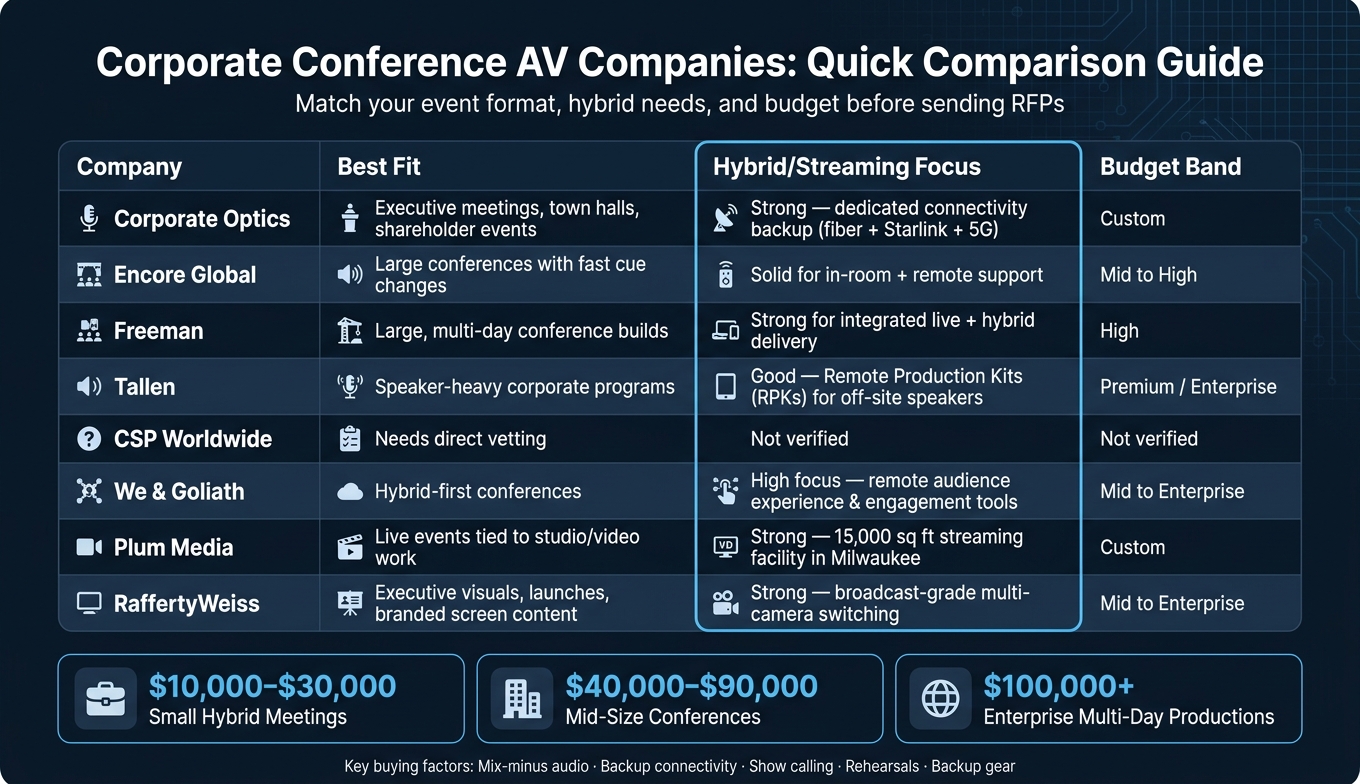
Corporate Conference AV Companies Compared: Fit, Hybrid Support & Budget
| Company | Best fit | Hybrid/streaming focus | Likely budget fit |
|---|---|---|---|
| Corporate Optics | Executive meetings, town halls, shareholder events | Strong; includes dedicated connectivity backup | Custom |
| Encore Global | Large conferences with fast cue changes | Solid for in-room + remote support | Mid to high, based on scope |
| Freeman | Large, multi-day conference builds | Strong for integrated live + hybrid delivery | High |
| Tallen | Speaker-heavy corporate programs | Good, with remote presenter kits | Premium |
| CSP Worldwide | Needs direct vetting | Not clear from article | Not clear |
| We & Goliath | Hybrid-first conferences | High focus on remote audience experience | Mid to enterprise |
| Plum Media | Live events tied to studio/video work | Strong for streaming + post-event video | Custom |
| RaffertyWeiss | Executive visuals, launches, branded screen content | Strong for polished live stream output | Mid to enterprise |
A few numbers stand out to me. The article covers 8 companies, 3 main buying factors that matter most, and 3 budget bands that can help you sort vendors fast. That makes this less about “best company” and more about best fit.
If I were sending RFPs today, I’d contact 2 to 3 vendors that match my format, send the same scope to each, and compare line by line.
1. Corporate Optics
Service Scope
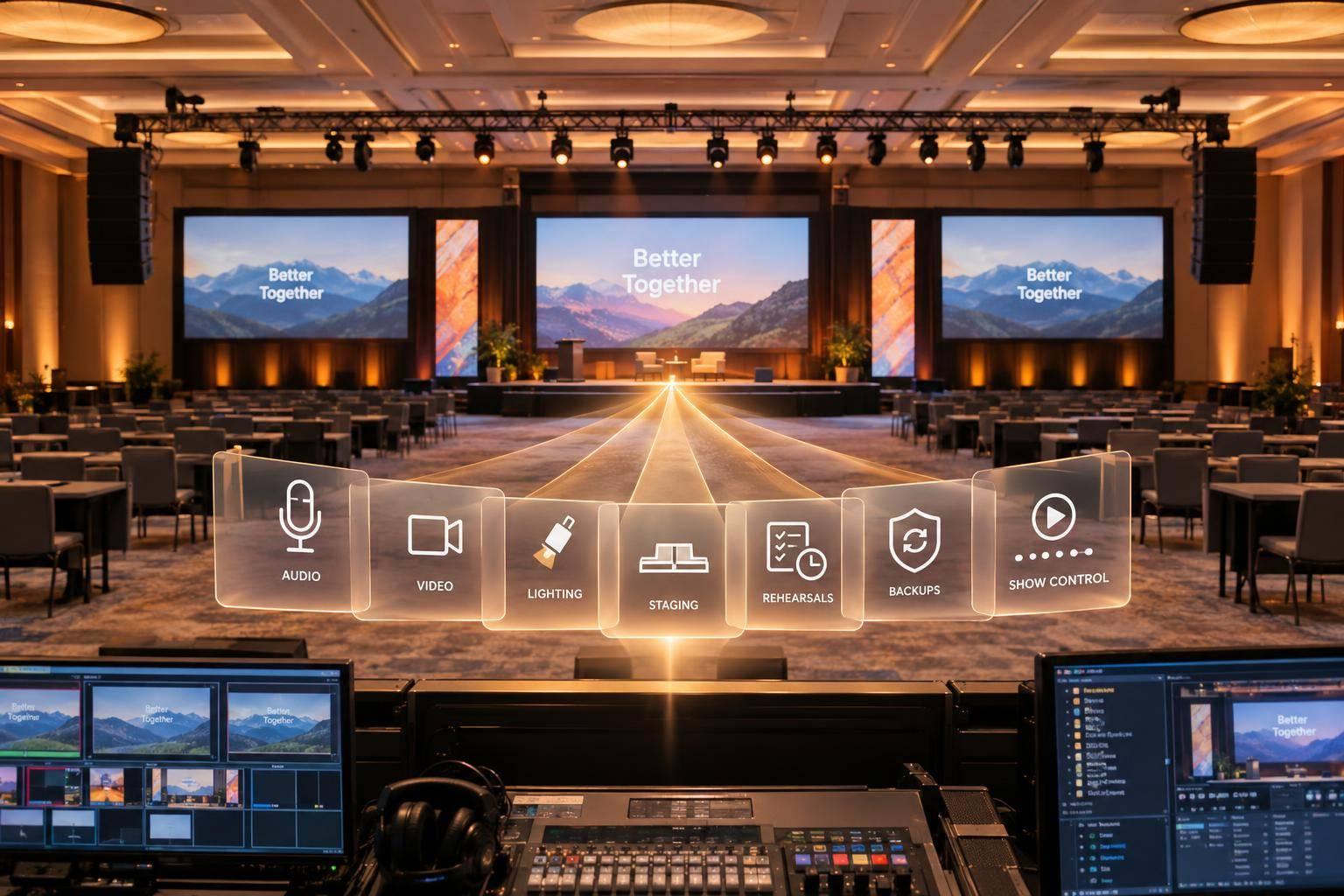
Corporate Optics handles audio, lighting, staging, LED walls, and on-site staffing. It also folds branded podiums, stage skirting, printed vinyl, and scenic backdrops into the show design. Those pieces help keep the stage on-brand and ready for presenters.
That same production setup works for both in-room and remote audiences without disrupting the flow of the event.
Hybrid and Streaming Depth
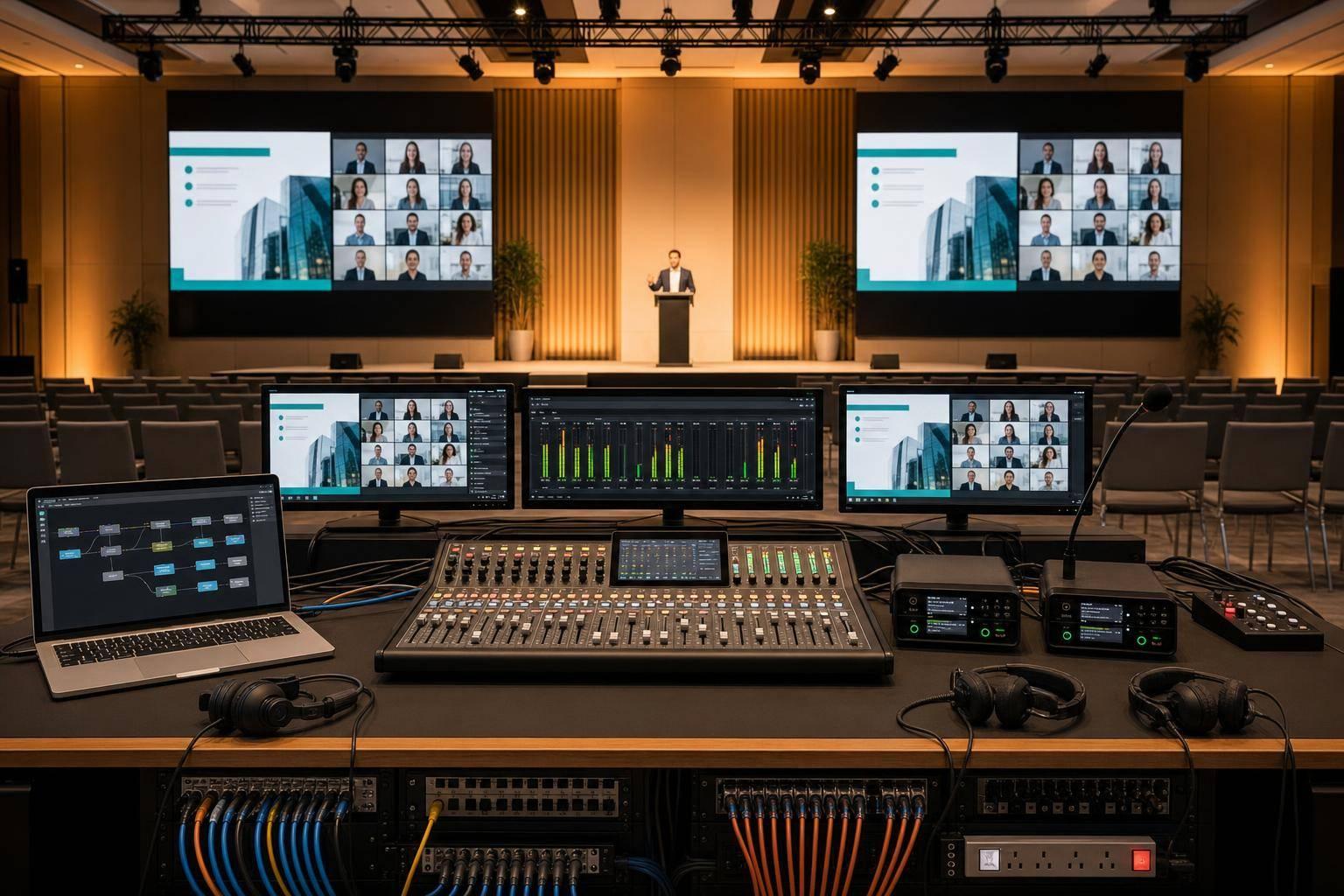
For hybrid events, Corporate Optics uses mix-minus audio routing, dedicated camera coverage, and live Q&A workflows for remote attendees. The idea is simple: remote guests should stay in sync with the room, not sit on the sidelines as passive viewers.
For virtual programs, the team uses multi-camera switching, clean slide transitions, and stable encoding to cut down on buffering and sync problems.
Connectivity is managed outside the venue's system. Corporate Optics brings its own fiber optic backbone, backed by Starlink and 5G providers for redundancy, which reduces reliance on venue Wi‑Fi.
Best-Fit Event Scale
It works well for executive town halls, shareholder meetings, sales meetings, and leadership conferences, from 12-person board sessions to multi-day programs with breakout rooms. A dedicated production manager oversees load-in, rehearsals, and live show-calling from a minute-by-minute show script.
Final scope depends on room count, crew size, and streaming needs.
Budget Alignment
Pricing is custom and scoped per event. The company serves the Washington, DC metro region, including National Harbor, Bethesda, and Arlington.
2. Encore Global
Service Scope
Encore Global handles the core parts of event production: audio, lighting, video, staging, and scenic design. The team also supports on-site technical management and show-calling for agendas, transitions, and speaker cues. On top of that, they offer speaker rehearsals and slide management tools.
That setup matters once the event goes live. When speakers are rotating in and out, sessions are packed tight, and cues need to land at the right second, strong production control makes a big difference.
Hybrid and Streaming Depth
For hybrid events, Encore Global focuses on live show control, video production, and presentation management for both in-room and remote audiences.
In plain terms, they help keep the experience steady on both sides of the screen. That includes managing what attendees in the venue see and what remote viewers get at the same time.
Best-Fit Event Scale
Encore Global is a strong match for conferences with complex run-of-show needs, frequent speaker changes, and tight cue timing.
If your agenda moves fast and every handoff has to be smooth, this is the kind of support that can keep things from going sideways.
Budget Alignment
Pricing scales based on the scope of staging, lighting, video, and crew. Bigger production builds need scope defined early.
That early planning helps keep production choices lined up with the budget, instead of letting costs drift as the event takes shape.
3. Freeman
Freeman is often considered for large, complex conference productions. The company handles audio, video, lighting, staging, and scenic design for corporate events. That includes support for general sessions, breakout rooms, and multi-day conference setups.
Freeman also supports both hybrid and in-person audiences through integrated production workflows. In plain terms, they can manage the live show and help with presentation delivery without splitting those tasks across a bunch of vendors.
Their scale and infrastructure make them a solid fit for organizations running high-attendance conferences with detailed run-of-show needs.
4. Tallen
Service Scope
Tallen is a strong pick for conferences that need tight show control and solid speaker support. It’s a full-service AV production company, and it assigns dedicated project managers to complex corporate conferences. The main draw is disciplined execution, especially for speaker-heavy programs where every handoff, timing cue, and stage transition needs to hit right on schedule.
Hybrid and Streaming Depth
Tallen offers Remote Production Kits (RPKs) for off-site speakers, which helps remote presentations stay in sync with the live show. That makes a big difference when virtual presenters can’t feel like an afterthought. Instead, they’re woven into the program in a way that feels smooth for both the audience and the speakers. It’s a strong option for pharmaceutical, financial, and legal events, where presenter quality and consistency can’t slip.
Best-Fit Event Scale
Tallen works well for regional and national corporate programs where steady execution across multiple sessions matters. It tends to make more sense for higher-stakes conferences than for smaller, simpler offsites.
Budget Alignment
Premium-priced and best matched to enterprise budgets that want hands-on production support.
5. CSP Worldwide
For planners weighing their options, proven production depth matters just as much as name recognition.
Right now, the available research doesn't offer enough verified detail to map CSP Worldwide's service scope, hybrid support, scale, or pricing. So before you reach out, it's smart to confirm the basics directly with the vendor: stage production, streaming, staffing, and budget fit.
That direct check matters if you're thinking about adding CSP Worldwide to a conference shortlist.
sbb-itb-ae35a94
6. We & Goliath
We & Goliath focuses on virtual and hybrid event production. It stands out most when a conference needs to work just as well for people in the room as it does for people watching online.
Service Scope
We & Goliath handles event strategy, platform selection, speaker training, marketing, and technical direction for both in-person and virtual stages. It also produces pre-recorded video segments that support live programming.
In plain English: the team is set up to support both the room and the stream at the same time.
Hybrid and Streaming Depth
This is where We & Goliath stands apart. The company puts a lot of attention on high-quality live streams and interactive remote experiences, not just a basic video feed. Its proprietary Engagement Formula uses gamification, polls, and networking tools to keep remote attendees involved instead of letting them drift into the background.
Best-Fit Event Scale
We & Goliath is a hybrid-first option, not a general AV vendor. It's best for hybrid programs where the remote audience is part of the main show design, not an afterthought. That makes it a strong fit for mid- to enterprise-budget hybrid conferences where streaming quality and remote engagement matter.
7. Plum Media
Plum Media is a strong fit for conferences that need live production and in-house video content from the same team. Its setup is a bit different from firms that focus only on event logistics. Plum Media blends live event production with creative strategy, scriptwriting, custom video, and post-production. That mix makes it a smart pick for polished executive presentations backed by custom video.
Service Scope
Plum Media supports conferences with:
- creative strategy
- video production
- live event execution
- post-event deliverables
Hybrid and Streaming Depth
One of Plum Media’s biggest strengths is how it connects live events with studio-based content work. The company has a 15,000-square-foot facility in Milwaukee built for live streaming and studio production. That setup feeds directly into hybrid conference delivery.
Best-Fit Event Scale
Best for conferences that want one partner for live production, streaming, and post-event video.
Budget Alignment
Custom pricing. Best for planners who want bundled creative and production services.
8. RaffertyWeiss
For conferences where the screen matters just as much as the stage, RaffertyWeiss is a strong pick. RaffertyWeiss Media focuses on corporate video for conferences, with polished on-screen branding, motion graphics, and live event video built for LED walls and projection systems. The goal is simple: keep the brand look consistent across the whole event.
Service Scope
RaffertyWeiss produces corporate video, motion graphics, and live event content for LED walls, projection, and branded displays.
Hybrid and Streaming Depth
Its live streaming work includes multi-camera switching, professional lighting, and broadcast-grade audio.
Best-Fit Event Scale
This team fits best with conferences where on-screen polish matters most, especially executive meetings, product launches, and brand-heavy programs. Custom pricing makes the fit stronger for mid-size to enterprise budgets. It also works well for planners who need conference visuals to feel broadcast-clean and stay consistent with the brand across live playback and on-site screens.
How These Providers Compare On Production Depth, Hybrid Support, Scale, And Cost
Here’s the fastest way to line these providers up with event size, hybrid needs, and budget.
The biggest differences usually come down to production depth, hybrid support, scale, and cost. Full-service teams can take on staging, LED walls, fabrication, and show-calling. Venue-based AV teams tend to be simpler and more package-led. Broadcast-focused teams put the stream first.
That split matters once you map it to the job at hand.
Executive presentations and scenic staging often need a full-service partner with dedicated on-site staff for cueing and troubleshooting. Remote presenter setup and high-stakes live streaming usually fit a boutique broadcast specialist, especially one using redundant signal routing. Multi-room audio for concurrent breakout sessions is often a better fit for full-service providers that can run multiple tracks at the same time. That matters even more when remote attendees are relying on the live show’s technical backbone.
Hybrid events live or die on a few basics: clean in-room audio, dedicated camera coverage, and stable remote connectivity. Teams that bring their own mix-minus audio and redundant connectivity are more likely to keep the stream steady when pressure is high. For planners, this is often the line between room-first support and broadcast-first support.
Budget is another clear divider:
- Small hybrid meetings usually run $10,000–$30,000
- Mid-sized conferences often land at $40,000–$90,000
- Multi-day enterprise productions commonly reach $100,000+
Use the chart below for a quick fit check.
| Event Need | Best Provider Type | Example Companies | Typical Budget Band (USD) |
|---|---|---|---|
| Small hybrid meeting (single room, basic stream) | Venue-based AV team or boutique | Encore Global, Tallen | $10,000–$30,000 |
| Scenic staging & LED walls | Full-service production partner | Corporate Optics, Freeman | $40,000–$90,000 |
| Remote presenter & streaming | Boutique broadcast producer | We & Goliath, Plum Media | $10,000–$40,000 |
| Multi-room audio & breakouts | Full-service production partner | Tallen | $40,000–$90,000 |
| Large-scale conferences | Large-scale production partner | Freeman, Encore Global | $100,000+ |
| Executive keynotes | Boutique broadcast producer | RaffertyWeiss | $40,000–$90,000 |
Pros And Cons By Provider Type
The profiles above show what each company does. This section turns that into a simpler choice across three provider types.
No single provider type is the best pick in every case. The right fit comes down to what you need to pull off, how much time you have, what you can spend, and how deep the production needs to go.
Full-service production partners focus on customization. They usually assign a dedicated production manager and take care of custom staging and branding. The tradeoff is lead time. Custom scenic pieces and LED walls take planning, and travel costs can stack up if the team isn't local.
Large national and global AV firms bring scale and venue familiarity. They're often the in-house choice at hotels and major venues, which can make logistics easier. The downside is higher venue markups and less room for customization.
Boutique hybrid and broadcast-focused teams treat the room like a broadcast set. They focus on multi-camera coverage, clean switching, synced audio, and redundancy. That's a strong match for executive broadcasts and global livestreams, but it can be more specialized than a simple in-room meeting needs.
Use this table to line up event format, staffing model, and budget at a glance.
| Provider Model | Pros | Cons | Best Use Case |
|---|---|---|---|
| Full-Service Production Partner | High customization; dedicated production manager; in-house branding and fabrication; pricing flexibility | Higher lead times for custom builds; travel costs if not local | Annual conferences and leadership summits |
| Large National / Global AV Firm | Large equipment inventory; presence in major venues; easy to bundle with venue contracts | Higher marked-up pricing; the result may feel more standardized than custom | Large trade shows and multi-city roadshows |
| Boutique Hybrid / Broadcast Team | Broadcast-quality video and audio; strong remote engagement; redundant fail-safe systems | Limited physical infrastructure for large in-person crowds; highly specialized focus | Executive keynotes and hybrid town halls |
Match the provider type to the event's technical risk, audience mix, and budget before you ask for proposals.
Conclusion
After looking at the providers above, the right pick comes down to scale, technical risk, hybrid needs, and budget. A small regional sales meeting needs one kind of partner. A large leadership summit with a live global stream needs another.
For high-stakes keynotes and executive presentations, put broadcast-grade switching, dedicated fiber, and dedicated technical leads at the top of your list. Ask for a run of show, an itemized quote, and a contingency plan. That way, speakers stay on schedule and the audience doesn't end up watching a failure play out live.
When you compare proposals, make sure the quote includes setup, strike, rehearsals, and backup equipment. Those are common add-ons, and they can push the final invoice higher than expected. Also check whether the venue lets you bring in an outside AV team. That one detail can give you more control, more flexibility, and lower costs. Always review venue policy before saying yes to an in-house AV package.
If your event includes remote attendees, focus on teams that handle hybrid workflows well. For hybrid events, require mix-minus audio and redundant connectivity: fiber as the primary line, with Starlink or 5G as backup.
Start with two or three providers that fit your event format, send one standardized RFP, and compare like-for-like case studies. Then pick the team that has done this before with your type of event and your audience size.
FAQs
How early should I book conference AV support?
Book your AV production partner as early as you can. That gives your team enough time for site surveys, CAD drawings, and show-flow planning. It also cuts down on last-minute logistics problems and lowers technical risk.
A simple rule of thumb:
- Executive summits with custom scenic builds: 8 to 16 weeks ahead
- Large-scale conferences with complex logistics or broadcast production: 4 to 6 months ahead
- Large-scale event series: 12 months or more
What should I include in an AV RFP?
Ask for single-source accountability. You want one team to own the full scope, not a chain of vendors pointing fingers when something goes sideways.
Request a detailed, itemized proposal that breaks out:
- Labor
- Equipment
- Logistics
That level of detail makes it much easier to see where the money is going and where gaps may be hiding.
You should also require a named project manager. Not a general contact. Not a sales rep. One person who is in charge and can answer for the whole job. Along with that, ask for dedicated breakout-room techs, a central control desk, and a separate show caller. Those roles matter. If one person is trying to do all of it, things can get messy fast.
On the planning side, ask for pre-event engineering documents. Request a documented backup plan that includes redundant systems and spare gear. If audio, video, or networking fails, there should already be a clear response in place.
It also helps to ask for proof of technical rehearsals. A good crew doesn't just show up and wing it. They test cues, timing, routing, and handoffs before the event starts.
Get clear on staffing too. Ask which crew members are in-house and which are freelance. That doesn't automatically make one better than the other, but you do want to know who is working your event and how the team is built.
And finally, request 3D stage renderings. They can save a lot of back-and-forth because you can spot layout issues, sightline problems, or staging mismatches before load-in day.
When do I need broadcast-first AV?
You need broadcast-first AV when your event has to reach people beyond the room, like investor webcasts, leadership conferences, or executive town halls. It helps make sure both the in-person crowd and remote viewers get a polished, high-quality experience.
The key is to plan for it from day one. Broadcast-first AV needs dedicated broadcast-grade elements, including multi-camera switching, remote presenter feeds, and redundant streaming.
Related Blog Posts


Streamline your workflow, achieve more
Lorem ipsum dolor sit amet, consectetur adipiscing elit. Maecenas ac velit pellentesque, feugiat justo sed, aliquet felis.



Lorem ipsum dolor sit amet, consectetur adipiscing elit. Maecenas ac velit pellentesque, feugiat justo sed, aliquet felis.