Top Event‑Production Partners For Corporate Roadshows.

Chief Executive Officer
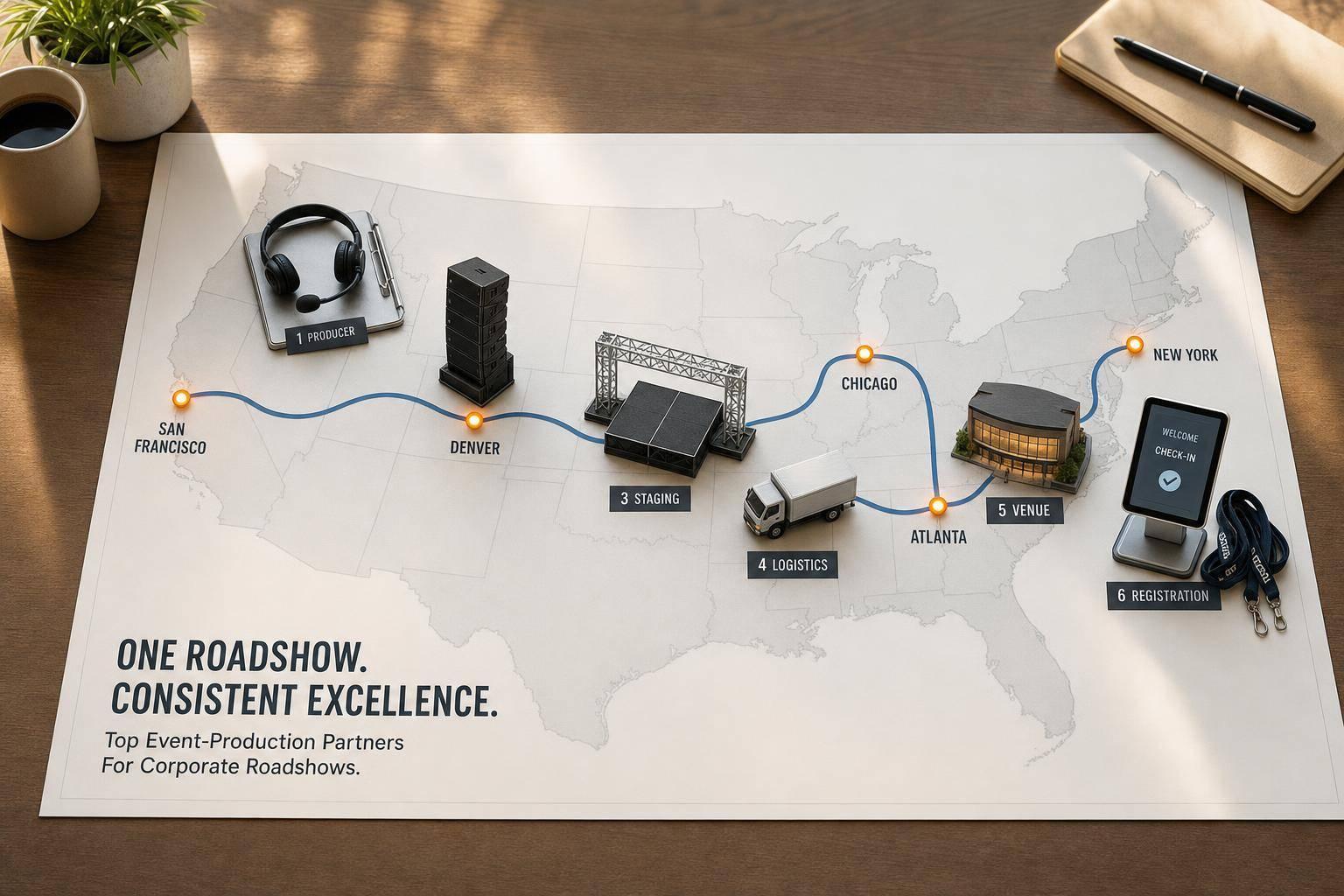
If you want the same show in every city, one lead partner usually works best. In a multi-city roadshow, the main issue is not just AV, staging, freight, or registration on their own. It’s keeping all of them lined up from the first stop to the last.
Here’s the short version:
- Corporate Optics fits teams that want one partner to run AV, staging, livestreaming, speaker support, and audience tools.
- AV production companies focus on audio, screens, playback, cueing, and show delivery.
- Scenic and staging vendors handle the physical setup, like stages, branded walls, and room layout.
- Logistics and freight coordinators move gear city to city and keep shipments on schedule.
- Venue sourcing and on-site teams match the show to each venue and handle access, labor, and show-day flow.
- Registration, engagement, and hybrid specialists run check-in, badge printing, livestream access, polling, and reporting.
The article’s main point is simple: the more stops you have, the more your roadshow depends on one clear system, one touring lead, and fixed standards for gear, crews, and show files. Without that, quality can slip fast.
A few facts stand out:
- A roadshow is not one event. It’s the same program repeated across cities, venues, and time zones.
- Even one major display element, like a 40-foot LED wall, needs to perform the same way in every market.
- The article compares partner types across 4 core needs: consistency, technical scope, multi-city logistics, and data.
Quick Comparison
| Partner Type | Main Role | Best For | Main Limit |
|---|---|---|---|
| Corporate Optics | Full-service touring production and AV | Teams that want one lead across the tour | Higher upfront cost |
| AV Production Companies | Show tech and execution | Programs centered on AV control | Limited data/reporting scope |
| Scenic and Staging Vendors | Physical build and branded setup | Tours with custom stage needs | Less control over freight and full-tour flow |
| Logistics and Freight Coordinators | Gear movement and shipping control | Tours with heavy freight needs | No ownership of show delivery |
| Venue Sourcing and On-Site Teams | Venue fit, access, labor, and show-day support | Teams that need local venue control | More stop-to-stop variation |
| Registration & Hybrid Specialists | Attendee flow, livestream access, and reporting | Programs focused on leads and audience metrics | Limited room-production scope |
Bottom line: if I were planning a U.S. corporate roadshow with 5, 10, or 20 stops, I’d look first at who can keep one standard across every market, not just who can offer the lowest bid in one city.
Unboxing Success by Creating Memorable Roadshow Experiences with Evan Babins
sbb-itb-ae35a94
1. Corporate Optics
Corporate Optics is a full-service technical event production and AV partner. The team supports AV design, scenic production, livestreaming, speaker support, analytics, and audience engagement tools.
Roadshow Consistency and Technical Scope
Their core model is simple: build one documented design system, then recreate it to the same standard in every city.
That matters more than it may seem at first glance. When each stop follows the same setup, presenters know what to expect, venues face fewer surprises, and field teams can work from a familiar playbook. The whole roadshow tends to run with less friction.
That kind of consistency comes from fixed technical standards. Corporate Optics standardizes the tech across stops, including screens, audio, and wireless systems. LED pixel pitches, console types, and managed wireless frequency planning are defined upfront and then carried across every venue. They also travel with redundancy, including backup equipment, to keep show delivery steady throughout the tour.
Multi-City Logistics
Even with standardized gear, a multi-city roadshow can go sideways without tight tour management.
Corporate Optics uses one point of contact and a traveling core crew to manage the tour. That crew carries show-specific knowledge from one city to the next, which helps keep execution aligned across the run. They also work with vetted local labor, giving teams a way to support both quality and cost control.
Data and Audience Reach
Corporate Optics also supports post-event analytics and audience engagement tools to measure conference ROI. Those tools help teams compare engagement from city to city and adjust future stops based on what happened in the room.
When a company doesn’t need full technical ownership, the next type of partner steps in to handle execution layers like AV build, staffing, and show delivery.
2. AV Production Companies
In a roadshow, AV is what keeps the program steady from one market to the next. AV production companies handle the technical side of the show: audio specs, screen formats, content playback, version control, and show calling. Their work starts with technical design and runs through teardown and the handoff to the next city.
Put simply, AV is the execution layer. It takes the roadshow plan and turns it into a show that can run the same way again and again.
Roadshow Consistency
The biggest risk in a multi-city program is drift. A show that feels sharp in one city can look or sound off in the next. And that’s a problem.
The goal isn’t to make one stop look great. The goal is to make every stop feel the same. For AV-only partners, that means keeping screen formats, audio specs, cue sheets, and playback files locked across the tour. Small markets and large markets should get the same standard, not two different versions of the show.
Technical Scope
National AV companies set the full technical package at the start and keep it fixed across the tour. They also plan backup coverage, such as spare equipment and managed wireless frequency plans. That helps the show stay on track when a venue throws a curveball.
Once that technical package is locked, scenic and staging shape how the audience experiences it.
The main difference comes down to accountability. A broker books different local crews in each city and manages bids. A real partner keeps the same lead producer and the same show files with the tour, then adds vetted local labor where needed to control costs.
Multi-City Logistics
Ask a simple question: does the lead producer travel with the show?
If the answer is no, you’re probably looking at a city-by-city booking setup, not a touring partner. That may seem cheaper on paper, but the time lost to rebriefing and rework from stop to stop can eat up those savings fast.
Data and Audience Reach
Analytics usually fall outside the AV-only lane. Their job ends at teardown and handoff. From there, the next partner type takes over the physical environment that carries the show.
3. Scenic and Staging Vendors
Scenic and staging shape the physical shell of a roadshow: the stage, set pieces, branded surfaces, and the way the room is laid out. The goal is simple. Create one build spec, then rebuild it the same way in every city. That spec gives AV a fixed frame to work within.
Roadshow Consistency
Loose build instructions almost always lead to uneven results. If the documentation isn’t detailed, stage width, signage placement, and branding can drift from one stop to the next.
Build Scope
Scenic and staging vendors handle the physical specs that set the show environment. That includes stage dimensions, rigging points, scenic finishes, backdrops, and branded placements.
Lock those standards early, and sponsor placements and brand assets stay in the same spot across the full tour. If you skip that step, each city can start to feel like a slightly different event. Once the build is locked, the next issue is making sure it moves from market to market without changes.
Multi-City Logistics
You need to decide what travels with the show and what gets sourced locally. The best touring partners use a traveling core crew and pair them with vetted local labor to keep continuity in place while managing cost.
It also helps to have one point of contact overseeing the full tour. Otherwise, the show gets re-briefed at every stop, and that’s where small mistakes start to stack up. Scenic choices also affect load-in speed, venue fit, and brand consistency across markets.
Data and Audience Reach
Standardized staging and redundancy also help create camera-friendly rooms. From there, freight and tour coordination decide whether the build shows up intact.
4. Logistics and Freight Coordinators
Once the build is defined, logistics determines whether that design makes it to each city intact.
After scenic specs are locked, logistics and freight coordinators move the build from city to city on time and in one piece, ready for the next load-in. This is the part people don't always see, but it can make or break the show.
Roadshow Consistency
If freight timing slips, even the same build can show up late, incomplete, or in the wrong order. Logistics coordinators protect the production standard set by the scenic and AV teams by managing the tour as one connected program, not a string of separate stops. The target is simple: the same show in every city.
Technical Scope
Logistics coordinators handle freight routing, load order, dock times, venue access windows, and shipment tracking. They also verify gear counts, ship spares, and track what travels with the tour versus what gets sourced locally.
This planning needs to happen before the tour starts. If the team waits until load-in to figure out what a local vendor can provide, they're already playing catch-up. At that point, the setup starts with improvisation instead of control.
Multi-City Logistics
The most practical model pairs one touring lead with vetted local labor. The core crew understands the build order, room flow, and setup details. One tour lead can then keep freight timing, venue access, and load order lined up across every stop.
Data and Audience Reach
On-time freight and clean load-ins help keep the audience experience consistent. When the build arrives intact and on schedule, people in a secondary market get the same impression as the audience at the first stop. Once freight is locked, venue access and load-in control become the next main risk point.
5. Venue Sourcing and On-Site Operations Teams
Once freight is set, venue sourcing and on-site operations determine whether the build actually fits the space and gets loaded in on time. These teams line up the approved production with the right rooms, handle access and labor, and manage show-day execution and teardown.
Roadshow Consistency
The main job here is stopping quality drift. A strong operations partner documents site standards once, then applies the same build standard in every city. That keeps the stage, screens, and brand experience consistent across the tour.
Without that documentation, booking city by city creates a mess. Each new crew has to learn the program from scratch, which adds friction fast.
From there, the on-site team turns venue access into a repeatable load-in plan.
Technical Scope
These teams map out venue-specific needs before the tour starts, including room dimensions, rigging limits, power availability, dock access, and load-in windows. Lock those limits in early, and you cut down on the kind of surprises that delay setup or force last-minute swaps on show day.
Multi-City Logistics
The best setup pairs one on-site lead, who owns the venue plan at every stop, with vetted local labor in each market. That gives the program one clear point of control from city to city.
If a different contact runs each city on its own, that’s a brokered staffing model, not a true operations partner.
That control carries straight into the last audience-facing layer: registration and engagement.
Data and Audience Reach
The right venue plan protects sightlines, acoustics, and attendee flow in every market.
6. Registration, Audience-Engagement, and Hybrid Event Specialists
These specialists handle the attendee side of the roadshow. Venue teams deal with the physical setup. Registration and engagement partners handle the systems people actually touch: check-in, badge printing, livestream access, and audience tools. Once the room is ready, that attendee flow needs to work the same way every time.
Roadshow Consistency
Consistency comes from one documented system for registration, engagement, and hybrid delivery. If every stop does things a little differently, those small gaps stack up fast. And when that happens, the brand experience starts to feel uneven.
Technical Scope
A strong specialist sets the system before the first city. That usually includes check-in, badge printing, session scanning, livestream access, audience polling, and platform setup. Backup equipment should travel with the tour so the experience stays steady for both in-room and remote audiences.
Multi-City Logistics
One traveling lead should carry the run-of-show, platform settings, and attendee workflow from city to city. Local crews can support the execution, but the system should stay in the hands of someone who knows it cold.
Data and Audience Reach
When workflows are documented, it's much easier to compare lead capture, engagement metrics, CRM sync, and ROI reporting across each stop. That's where consistency starts to pay off. A roadshow stops being a string of separate events and becomes a program you can measure. From there, the next comparison gets sharper: which partner type gives you the most control over consistency and reporting?
How Each Partner Type Performs Across Core Roadshow Needs
Corporate Roadshow Partner Types: Comparison Guide
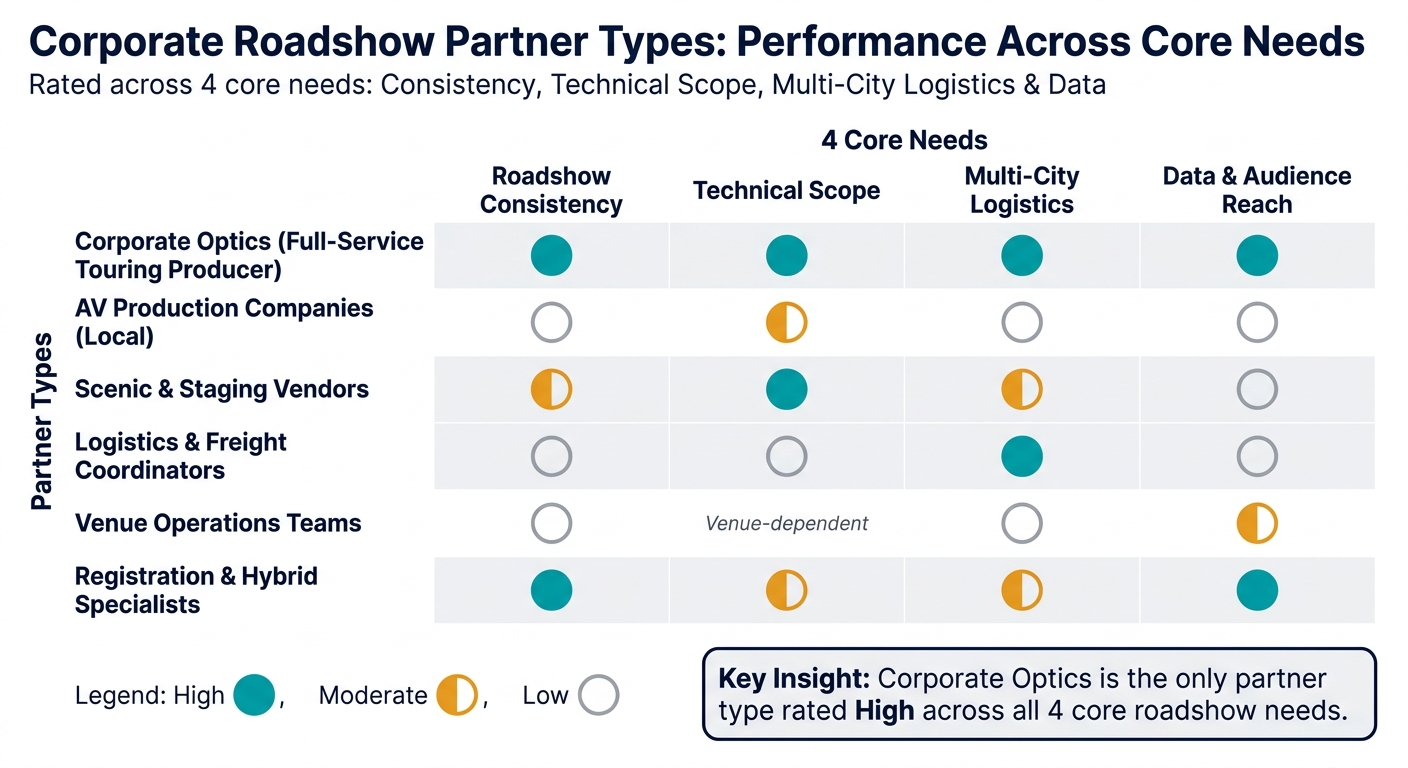
Now that each partner type is on the table, it helps to compare them against the four things that shape roadshow results: consistency, technical scope, multi-city logistics, and data.
Roadshow Consistency
When standards are set from one place, you get less variation from city to city. Corporate Optics documents one design system and rebuilds it to the same standard in every market. Scenic and staging vendors can hold physical standards well, but there’s still some risk of local differences. Registration and hybrid specialists tend to score high here too, since their digital platforms stay the same across every stop.
Technical Scope
With Corporate Optics, the technical setup stays fixed across the tour, including screens, audio, content workflows, and backup equipment. AV production companies and scenic vendors bring deep technical skill. Venue operations teams, on the other hand, are limited by whatever house gear is available locally.
There’s a catch: technical control only works when the same crew and freight plan move with the show.
Multi-City Logistics
Freight coordinators are strongest in this area. But moving gear is only part of the job. The harder part is keeping show knowledge with the touring crew from one stop to the next. Corporate Optics uses a blended labor model - a traveling core crew paired with vetted local labor to keep costs manageable. Venue operations teams are more limited because they work market by market.
Data and Audience Reach
Registration and hybrid specialists lead on data capture, engagement, and reporting. Corporate Optics brings that data together across the full tour, giving clients one view of engagement metrics and ROI reporting from the first stop to the last.
That’s the sharpest line in this comparison: digital specialists own audience data, while production-only partners usually don’t.
Use the table below for the quick snapshot. The notes above spell out the tradeoffs.
| Partner Type | Roadshow Consistency | Technical Scope | Multi-City Logistics | Data & Audience Reach |
|---|---|---|---|---|
| Corporate Optics (Touring Producer) | High | High | High | High |
| AV Production Companies (Local) | Low | Moderate | Low | Low |
| Scenic and Staging Vendors | Moderate | High | Moderate | Low |
| Logistics and Freight Coordinators | Low | Low | High | Low |
| Venue Operations Teams | Low | Venue-dependent | Low | Moderate |
| Registration & Hybrid Specialists | High | Moderate | Moderate | High |
Pros and Cons of Each Partner Type
Roadshow buyers usually make a simple trade: lower cost or tighter control.
National partners tend to bring more consistency from city to city. Local vendors, hired market by market, can lower the bid. But that lower number often comes with more variation once the tour is in motion.
The table below breaks that choice down in a practical way.
| Partner Type | Key Advantages | Common Drawbacks | Best-Fit Scenario |
|---|---|---|---|
| Corporate Optics (Full-Service Touring Producer) | End-to-end accountability across AV, scenic, logistics, and engagement; one lead contact; consistent show knowledge from first stop to last | Higher upfront cost; requires detailed documentation before the tour starts | Multi-city roadshows where repeatable execution and single-vendor accountability matter most |
| AV Production Companies (National) | Standardized execution, one accountable lead, and consistent show knowledge across stops | Higher upfront cost; requires early technical lockdown | Programs where AV consistency is the primary risk and other partner types handle the rest |
| AV Vendors (Local, City-by-City) | Lower bids for specific markets; local venue familiarity | Show drift between stops; each city forces a new crew ramp-up | Single-city events or one-off activations with limited budgets |
| Scenic and Staging Vendors | Deep fabrication expertise; strong control over physical build standards | Risk of local variation if documentation is loose; limited logistics ownership | Programs with complex or branded set builds that travel across markets |
| Logistics and Freight Coordinators | Strongest multi-city freight control; protects production standards in transit | No show knowledge; dependent on other partners for technical and creative continuity | Tours where freight complexity or gear volume is the primary operational risk |
| Venue Sourcing and On-Site Operations Teams | Local market access; venue-specific knowledge and labor management | Quality depends on house gear and local crew; limited cross-city continuity | Programs that need structured venue procurement and load-in management across markets |
| Registration, Audience-Engagement, and Hybrid Specialists | Consistent digital attendee experience; strong data capture and ROI reporting across stops | Limited physical production scope; dependent on other partners for room setup | Roadshows where attendee data, lead capture, and hybrid reach are primary program goals |
At first glance, local sourcing can look like the cheaper path. In practice, those savings often get eaten up by re-briefing, corrections, and the extra work of managing multiple vendors across multiple stops.
That’s the heart of the decision. The partner mix you choose shapes how much stop-to-stop consistency the roadshow can hold onto.
Conclusion
One thing is clear from the comparison above: the more cities your roadshow hits, the more tightly it needs to be managed.
The right partner mix for a corporate roadshow comes down to one core question: how much consistency does your program need? That’s why the lead partner carries the most weight. For most multi-city roadshows, it makes sense to put one full-service technical producer in charge. That keeps show knowledge in one place, cuts down on rebriefing, and gives your team one accountable point of contact at every stop.
Corporate Optics fits the lead role for programs that need repeatable live delivery from city to city. Its model relies on a traveling core crew, vetted local labor, and standardized screen, audio, and content workflows to keep each stop in line with the last one.
Then bring in specialty partners only where they fill a clear need. Scenic and staging teams can help with custom environments. Freight support can handle more involved moves. Hybrid meeting planning or engagement partners can support both in-room and digital audience interaction.
When your goal is to deliver the same show in every city, a strong central partner gives your team the control to make that happen.
FAQs
How many stops justify one lead partner?
Any program with multiple stops can justify a single lead partner for consistency and day-to-day efficiency.
Instead of treating each venue like a full reset, one lead partner keeps the same design system, the same main point of contact, and the same equipment standards across the tour. That makes planning smoother, cuts down on repeat briefings and split communication, and helps deliver one unified brand experience with fewer technical errors.
What should travel with a corporate roadshow?
A corporate roadshow should travel with a dedicated core team so each stop feels the same from city to city. In most cases, that means bringing a project manager, a lead audio engineer, and a lighting or video technician.
The production partner should also handle the traveling technical systems, including projection equipment, cameras, staging, and trussing. That keeps brand standards, stage design, and technical workflows consistent across the entire tour.
How do you keep roadshow quality consistent?
Run the same show at every stop. That means one design system, one set of documented stage, AV, and branding specs, and one team that owns delivery from city to city. If you can, use a traveling core crew so the standard doesn’t change every time the venue does.
Reliability has to be built in from the start, not patched together at the last minute. Set up backup streaming and network paths, keep backup encoders ready, coordinate show-calling closely, and make time for speaker rehearsals. On top of that, lock down pre-production details early and spell out contingency plans so the team knows exactly what to do if something goes sideways.
Related Blog Posts
- Leading Event Marketing & Production Companies
- 4 Meeting Production Companies That Excel At Seamless AV (audio/video), Lighting, and Stage Design for Corporate Conferences, and events
- Leading Event Production Partners For Corporate Roadshows
- Executing A Multi-Day Corporate Event Requires A Partner That Handles Everything From Large -Scale Audiovisual (AV) Production And Custom Scenic Design To Logistics. Here Are 2 Companies To Reach Out To Today.


Streamline your workflow, achieve more

Lorem ipsum dolor sit amet, consectetur adipiscing elit. Maecenas ac velit pellentesque, feugiat justo sed, aliquet felis.



Lorem ipsum dolor sit amet, consectetur adipiscing elit. Maecenas ac velit pellentesque, feugiat justo sed, aliquet felis.