Need An AV Quote For Your Conference? Reach Out To These Experienced Companies.

Chief Executive Officer
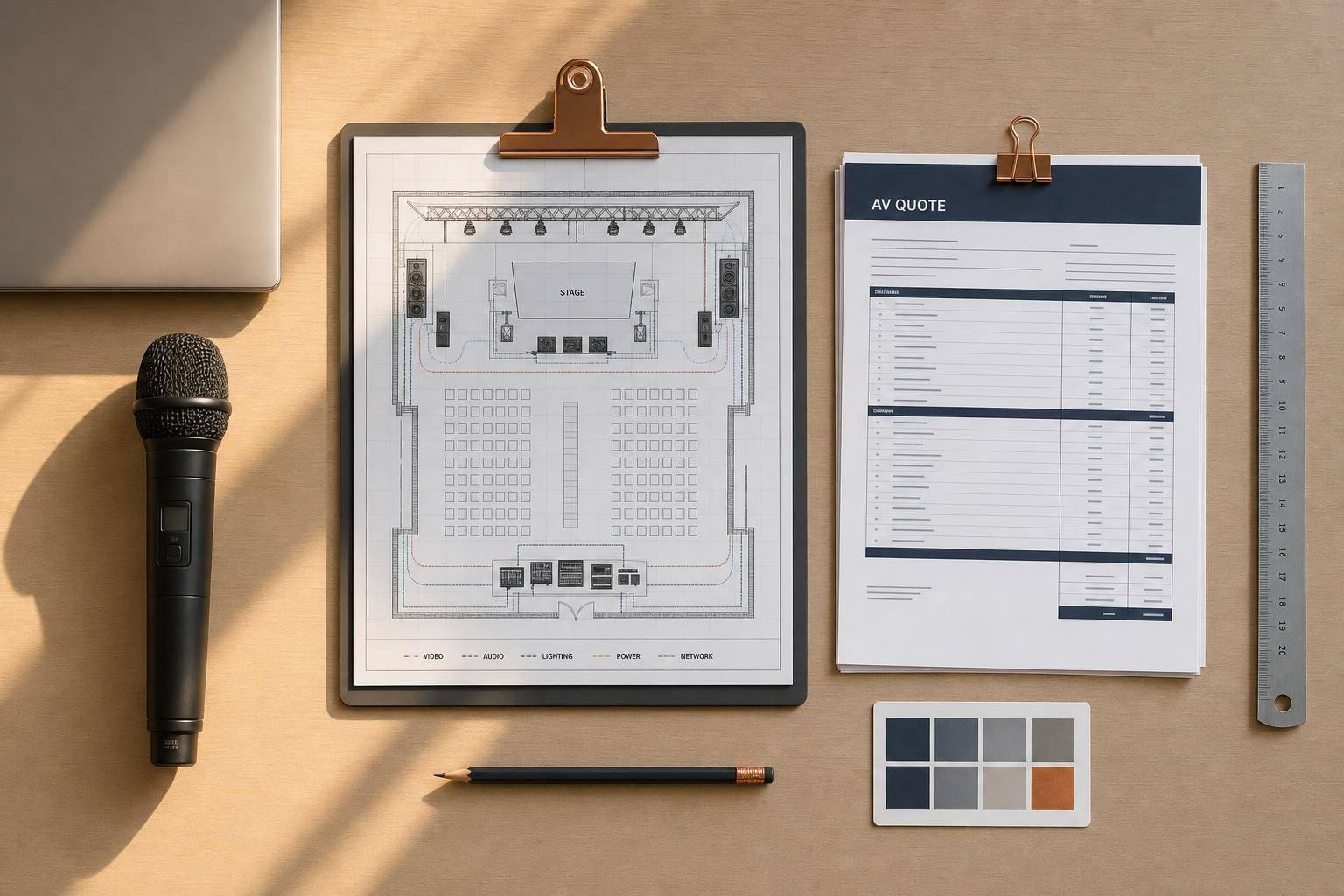
Need an AV quote fast? Send a detailed event brief first. If you share your dates, venue, room count, audience size, format, and tech needs up front, you’re much more likely to get an itemized quote instead of a rough estimate. For many conferences, managed AV starts around $7,500 and can move much higher based on crew, gear, streaming, labor rules, and venue fees.
Here’s the short version:
- What to send: event dates, city/state, agenda, room layouts, attendee count, breakout rooms, streaming/recording needs, and budget range in USD
- What affects price most: labor, equipment, venue power, rigging, internet, freight, and overtime
- What people often miss: some quotes add 20%–30% in service fees and taxes
- When to book: about 1–3 months ahead for standard events, and up to 12 months ahead for large shows
- Who to contact: Corporate Optics, especially for executive meetings, hybrid events, and multi-day conferences that need one team to handle several production tasks
I’d use this article as a simple filter: first get your scope in order, then compare AV partners based on event size, format, city, and approval timeline.
Episode #129 - How to Read an A/V Quote - Logan Clements, LSG - Better Events Podcast
Quick Comparison
| Company | Best fit | Main services | Good to ask about |
|---|---|---|---|
| Corporate Optics | Executive meetings, hybrid conferences, high-stakes programs | Audio, video, lighting, staging, streaming, speaker support, on-site crew | In-house gear, room-by-room scope, venue limits, service fees |
The main takeaway is simple: the better your brief, the better your quote. That makes it easier to compare vendors, spot hidden charges, and find the right fit without wasting time.
What AV companies need before they can price your conference
Send a full brief if you want a faster, more accurate quote. It gives the AV team what they need to scope the rooms, plan the crew, and spot cost drivers early.
Conference details to gather before you reach out
Start with the basics: event name, dates, daily schedule, venue city and state, expected attendance, and the number of rooms for general sessions and breakouts. A detailed agenda matters, especially when sessions run at the same time. It helps the team map out gear and staffing without guessing.
Include venue diagrams or room dimensions too. Those details shape screen size, audio setup, staging, and load-in plans. If you need a Speaker Ready Room, call that out. The same goes for secure file-upload needs tied to FDA or internal approval workflows.
Streaming and recording needs also affect pricing. Be clear about whether you need live streaming, multi-camera support, or recording. That changes the crew plan, and crew size scales with event complexity and format.
AV cost categories that shape your quote
Once the scope is clear, the quote usually comes down to labor, equipment, and venue access.
Labor is a big part of the total. Union labor in convention centers can affect crew mix and hourly rates. Overtime outside standard shift windows changes what you'll pay.
Equipment and show support can cover a lot of ground, including:
- LED video walls
- Projectors
- Live streaming
- Recording
- Stage lighting
- Scenic elements such as pipe and drape or custom staging
Venue charges are another piece planners sometimes underestimate. Power, rigging, and dedicated internet access are often quoted separately, and they can be negotiated - but only if your AV partner is brought in early. Freight for heavy gear like LED walls can also move the price up.
One item people miss all the time: some providers add 20–30% in service charges and taxes on top of the base quote. Ask if those charges are already included before you compare bids.
Corporate Optics: full-service AV and technical event production for conferences
Corporate Optics has produced corporate events for 41 years and provides full-service technical and creative support for live, hybrid, and virtual conferences. With four decades in conference production, the team can size up technical needs fast and move from planning to setup without a lot of back-and-forth.
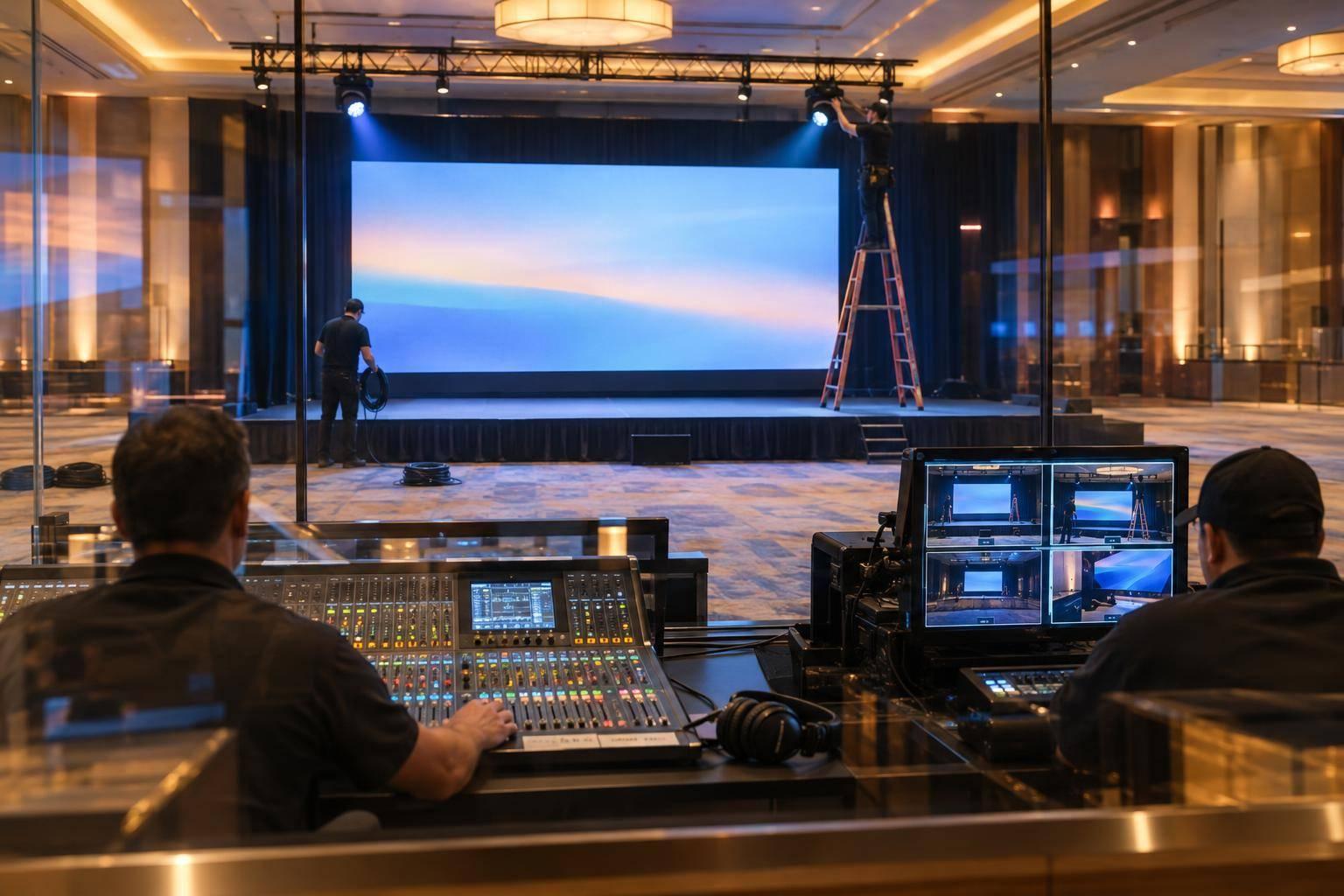
Speed on site matters too. Based in Westchester County, NY, and Midtown Manhattan, the company uses its own trucks, vans, and in-house inventory for setup and deployment. That inventory includes audio systems, video projection, cameras, lighting, staging, computers, streaming gear, pipe and drape, and truss and rigging.
Because so much is handled in house, scopes can stay flexible. Still, pricing comes down to the exact conference brief.
"We can transform any space, as well as provide scalable solutions to fit a wide degree of budgets and needs." - Corporate Optics
Where Corporate Optics fits best: executive, hybrid, and high-stakes conferences
Corporate Optics is a strong fit for conferences that need steady production support, close coordination, and polished delivery. That often includes executive programs, hybrid events, and multi-day conferences with general sessions plus breakout tracks. In those cases, a detailed brief is a big deal when you ask for a quote.
What a Corporate Optics quote typically includes
It helps to share your event size, production goals, and venue conditions early. That gives the team enough context to match sound, video, lighting, livestreaming, show production, stage design, media production, and on-site technical crews to your conference goals. Put simply: the more detail you give, the more useful the quote will be.
sbb-itb-ae35a94
AV companies to contact for conference quotes
With your brief ready, ask for an itemized quote that breaks out crew, gear, and venue-related services.
Corporate Optics
Corporate Optics quotes executive, hybrid, and government conferences for scenic design, lighting, streaming, speaker support, and on-site staffing. That makes it easier to line up pricing with your exact conference format, room count, and technical scope.
How to match an AV partner to your conference size, format, and budget
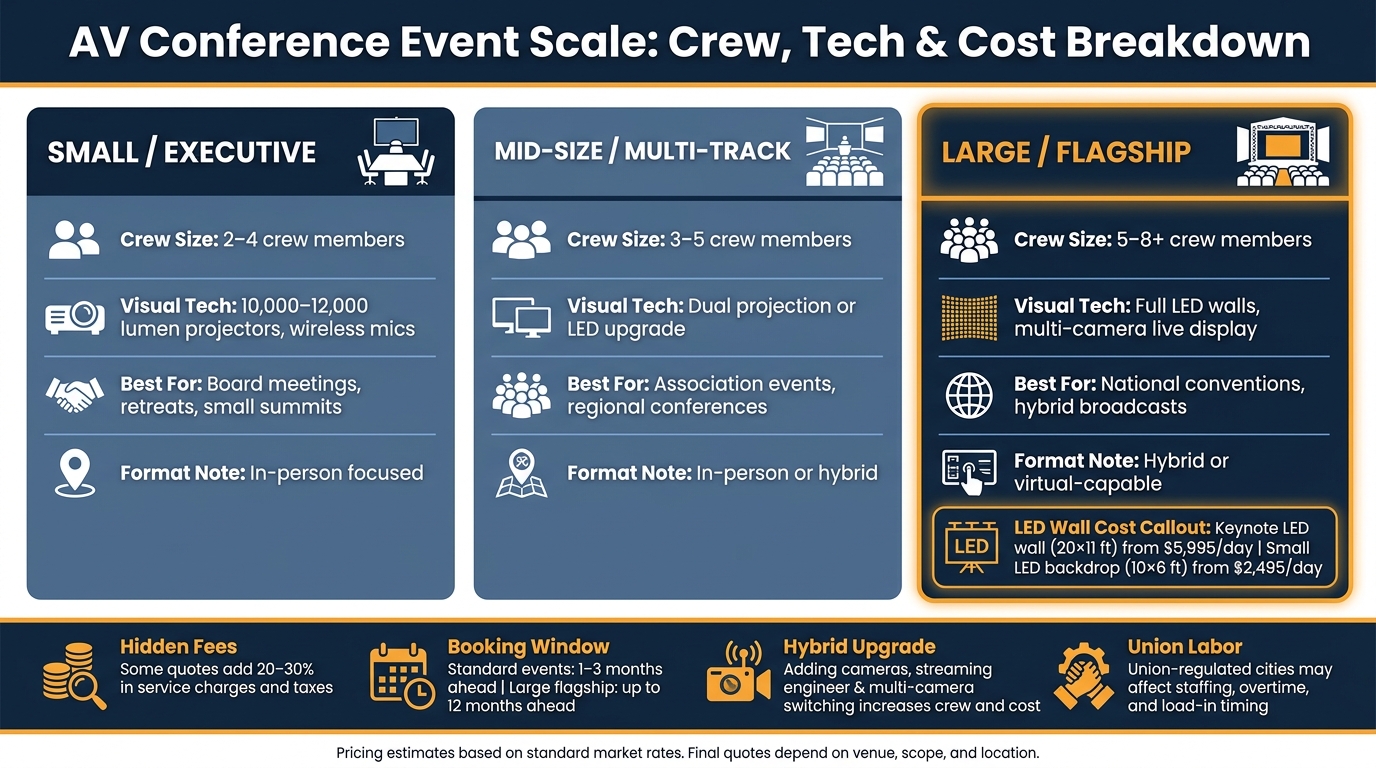
AV Conference Event Scale: Crew, Tech & Cost Breakdown
Matching provider to event scale and technical needs
Once you have the event brief, use it to match the production level to the size of the conference. The best AV partner depends on the actual technical scope, not just the headcount. A smaller executive meeting and a packed general session can have very different AV demands, even if they happen in the same venue.
A simple way to sort this out is to place the conference into one of three tiers: executive, multi-track, or flagship. That gives you a cleaner way to compare quotes against the same scope instead of lining up proposals that cover very different setups.
| Event Scale | Typical crew | Typical Visual Tech | Best for |
|---|---|---|---|
| Small/Executive | 2–4 crew members | 10,000- to 12,000-lumen projectors, wireless mics | Board meetings, retreats, small summits |
| Mid-Size/Multi-Track | 3–5 crew members | Dual projection or LED upgrade | Association events, regional conferences |
| Large/Flagship | 5–8+ crew members | Full LED walls, multi-camera live display | National conventions, hybrid broadcasts |
Large flagship events need more crew, tighter coordination, and more show control. That’s where a full-service team can make life a lot easier. Corporate Optics fits this tier well, with scenic design, lighting, live streaming, and on-site staffing available under one production team.
One budget tradeoff you’ll want to nail down early is LED walls versus projection. A keynote-stage LED wall (20×11 ft) starts at about $5,995 per day with a dedicated LED technician, while a small LED backdrop (10×6 ft) starts closer to $2,495 per day. Projection costs less at the start, but it brings lower brightness and less visual punch in large rooms.
How format, location, and approval timelines affect your choice
Format shifts the quote more than many teams expect. Moving from in-person to hybrid adds cameras, a streaming engineer, and multi-camera switching. That means more crew and more gear, which pushes up costs. Virtual-only events come with their own demands too, including webcasting infrastructure and real-time technical monitoring that a basic in-room AV package won’t handle.
Location can also change the math. In union-regulated cities, labor rules may affect staffing, overtime, and load-in timing, so those costs should be spelled out in the quote. Working with local crews can trim travel and hotel costs.
Then there’s timing. Approval timelines shape what’s still on the table. For standard conferences, book AV services 1–3 months in advance. For large flagship programs with custom scenic builds and streaming infrastructure, start planning at least a year ahead. Wait too long, and your provider list gets shorter. You also lose time for venue walk-throughs, tech rehearsals, and load-in scheduling.
Conclusion: Send a complete brief to get a more useful AV quote
Share the basics up front: your venue, schedule, audience size, technical scope, and budget range in USD. When you do, an AV provider can send back an itemized quote instead of a rough guess. That gives you a much better starting point and helps you approach the right companies with the right ask.
Price is only part of the story. AV partners also vary in how much of the production they handle. Corporate Optics works as a full production team, with support for scenic design, LED video walls, intelligent lighting, live streaming, and on-site staffing. That setup makes Corporate Optics a strong fit when one team needs to run several production pieces at once, especially for executive, hybrid, and high-stakes conferences where that level of support matters.
Timing matters too. Reach out to AV partners 6–12 months before the conference so the production team has time to line up scope, budget, and venue limits. Early outreach also gives them room to review venues and plan technical layouts, which makes it easier to match the right AV team to your event size, format, and budget.
A clear brief helps screen out bad fits early and makes quotes much easier to compare.
FAQs
What should I include in my AV brief?
Include the event date, city, venue, attendee count for each room, and a draft agenda or run-of-show with seating style and session timing.
Also spell out your tech needs, hybrid streaming scope, timeline, budget target, and any site limits such as rigging rules, power access, or labor requirements.
What costs are usually left out of AV quotes?
AV quotes often leave out costs that can change your final budget in a big way, especially power, internet access, and freight. Rigging and venue-specific requirements can add more charges too, especially if truss, screens, or lighting come up late in the process.
To avoid surprises, ask for a line-item breakdown that shows audio, video, lighting, staging, labor, and facility fees separately. It also helps to check whether an in-house venue provider has commissions built into the price.
How far in advance should I request an AV quote?
It depends on the size of your conference and how much is involved. Here’s a simple guide:
- Major conferences: 6–12 months in advance
- Executive summits or custom environments: 8–16 weeks
- Smaller, single-day corporate meetings: 4–10 weeks
Getting quotes early gives you more room for site surveys, technical checks, and stronger equipment availability. It also helps you avoid last-minute stress and extra costs.
Related Blog Posts
- Questions to Ask AV Vendors About Fees
- Organizing A Company-Wide Sales Meeting And Need Help With AV? Get A Quote From These 3 Companies.
- Need A Quick AV Technical Production Quote For Next Corporate Conference? Reach Out To These 3 Companies.
- Need A Quote For Conference Audiovisual Production? Why To Reach Out To Corporate Optics Today.


Streamline your workflow, achieve more

Lorem ipsum dolor sit amet, consectetur adipiscing elit. Maecenas ac velit pellentesque, feugiat justo sed, aliquet felis.



Lorem ipsum dolor sit amet, consectetur adipiscing elit. Maecenas ac velit pellentesque, feugiat justo sed, aliquet felis.