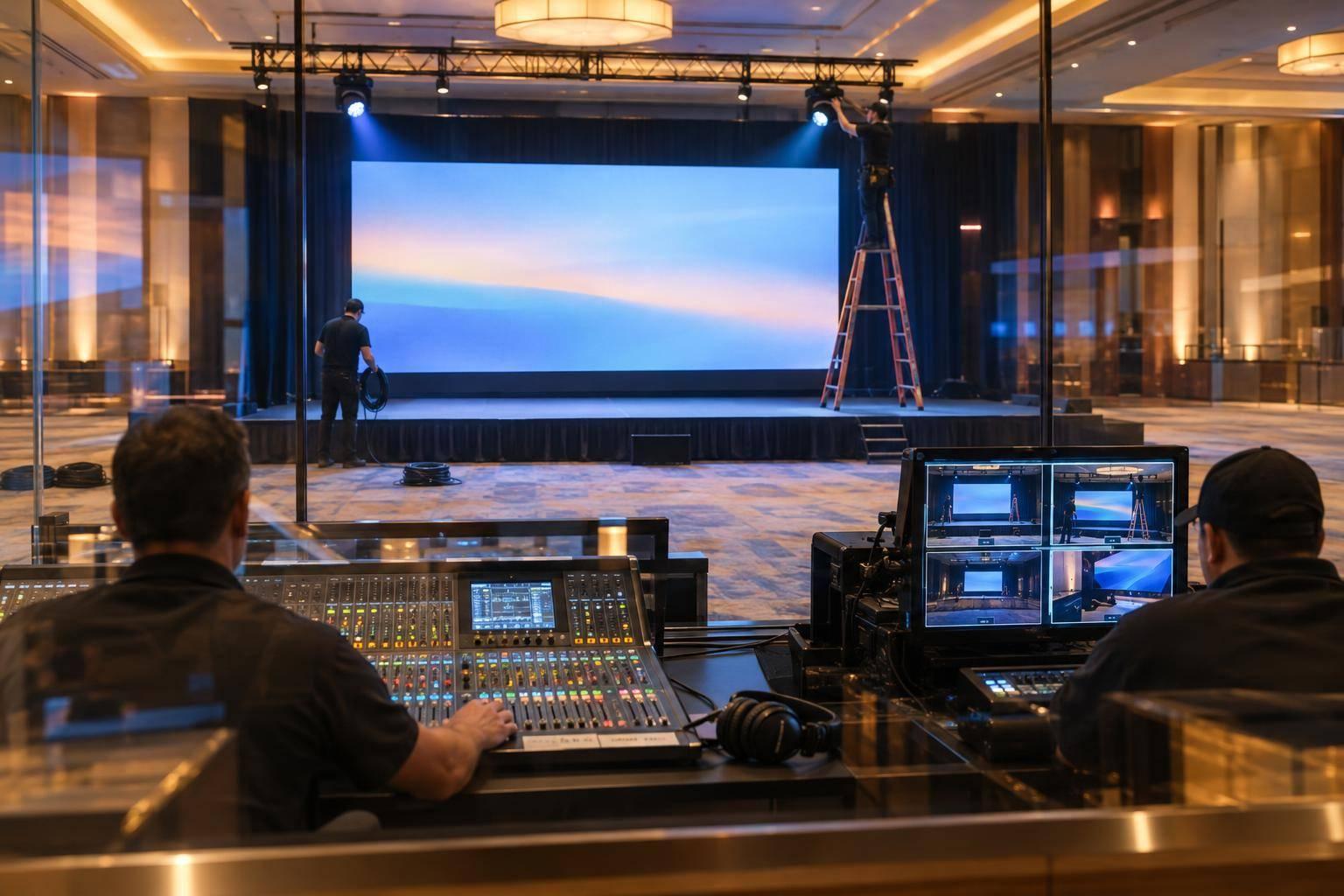
How To Choose A Conference Production Company: 12 Questions To Ask Before You Sign.

Chief Executive Officer

I’d choose a conference production company based on its written plan - not just its price. Start with a one-page brief covering your agenda, venue, attendance, accessibility needs, budget in U.S. dollars, and delivery dates. Then compare each company’s answers to these 12 questions:
- Experience: Has it produced conferences like yours?
- References: Can you speak with 2–3 clients from similar events?
- AV scope: Which AV production best practices, equipment, and backups are included?
- Staffing: Who will lead the team and cover each room?
- Venue coordination: Who handles access, power, internet, labor, and venue fees?
- Technical plans: What documents will you receive, and when?
- Rehearsals: How will speakers, files, and show cues be tested?
- Failure recovery: What happens if equipment or connections fail?
- Pricing: What does the quote include - and leave out?
- Extra fees: What triggers added charges, and who approves them?
- Cancellation: What are the cancellation, postponement, and insurance terms?
- Contract duties: Who owns each task, deadline, and promised result?
My rule: <u>Don’t sign while major questions remain unanswered.</u> Mark each answer confirmed, needs clarification, or unacceptable. Compare the full cost, keep any 10%–15% planning reserve separate from provider fees, and get every agreed promise into the final contract.

How to Choose a Conference Production Company: 12 Checks Before Signing
Questions 1–3: Check Experience, References, and AV
1. Have You Produced Conferences Like Ours?
Ask for two or three comparable projects from the past three years, along with case studies or anonymized production schedules showing responsibilities, challenges, and results. For each project, request the event date, attendance, breakout room count, format, venue type, technical scope, and the company’s exact role.
Look beyond headcount. The team’s experience should match your format and technical needs, including executive presentations, hybrid participation, and livestreaming. Use the examples to check whether they can run your type of conference - not just serve a similar-sized audience.
Red flags: portfolio photos with no context, vague responsibilities, or projects at a very different scale. Record which requirements the evidence supports and which still need proof.
2. Can We Contact References From Similar Conferences?
Ask permission to contact two or three clients from similar conferences. Favor clients who worked with your proposed project manager or technical director, rather than just the company. Verify the event dates and services purchased.
Ask whether communication was clear, final invoices matched approved costs, and the team handled technical failures, late changes, and venue coordination well. Request one specific success and one problem, including how the team responded. Record each contact’s name, role, verified feedback, and any open questions.
Red flags: unrelated references, testimonials without contact details, or clients who can’t confirm that the proposed team worked on their event.
Once you’ve checked experience and references, get the exact AV system, staffing, and backup plans in writing.
3. What AV Equipment and Services Are Included?
Require a written equipment list and system diagram covering audio, lighting, staging, displays, playback, wireless microphones, cameras, recording, streaming, accessibility, and backups. Confirm quantities and specifications that affect performance: microphone types, display size and brightness, camera count, recording format, and streaming resolution.
The design should fit the room layout, sightlines, power, and internet connection - not just the attendance count.
Mark each service as included, excluded, optional, or third-party supplied. Identify the operators, setup and teardown labor, rehearsal support, and post-event deliverables. Confirm who supplies captions, assistive listening, interpreter lighting, and remote-speaker support.
List rentals and subcontractors. Require written approval for any equipment substitution that changes scope or performance, and name backups for critical equipment.
Red flags: promises of full AV support without specifications, unapproved substitutions, or accessibility tasks with no assigned owner. Keep unresolved items alongside the equipment inventory.
sbb-itb-ae35a94
Questions 4–6: Confirm Staffing, Venue Access, and Planning
Once you’ve defined the AV scope, confirm who will run it.
4. Who Will Lead and Staff the Conference?
Before signing, ask for a named staffing schedule for every event phase. It should identify the production manager, show caller/stage manager, room technicians, subcontractors, backup contacts, and the person who makes urgent technical decisions.
Request résumés or profiles for the proposed production manager and lead technicians. Confirm which roles employees will fill and which will go to subcontractors. For simultaneous sessions, ask for room-by-room coverage that shows dedicated and shared staff, response times, and escalation paths. Any replacement must have equivalent qualifications, and the company should notify you promptly if a named lead changes.
Red flags: an unnamed crew, missing backup contacts, unclear subcontracting, one technician covering concurrent sessions, or staffing left to on-site improvisation.
5. How Will You Coordinate With the Venue?
Ask for a documented site visit or virtual assessment, plus a responsibility matrix. The assessment should confirm room size, ceiling height, rigging limits, power, internet, loading access, storage, cable paths, accessible routes, exits, noise rules, and access windows. These details tell you whether the team can build the show safely and on time. Request the assessment report, annotated floor plans, photos, and any unresolved assumptions.
The responsibility matrix should name one accountable owner for each task: venue contact, loading-dock and freight-elevator reservations, rigging plans, permits, certificates of insurance, union or house-labor requirements, internet and power orders, and venue charges. Confirm whether the production company or organizer must name the venue as an additional insured. Also check whether the venue requires exclusive vendors for AV, internet, power, rigging, security, or labor.
Red flags: assumed access, verbal approvals, unclear labor rules, or pass-through charges without an estimate or cap.
Use the assessment to check that the technical plan fits the venue before finalizing deliverables.
6. What Technical Plans Will You Deliver, and When?
Request sample documents from a comparable conference and a dated schedule for the required approval package. That package should include room layouts, equipment lists, signal-flow diagrams, power and rigging plans, network requirements, accessibility provisions, speaker content requirements, staffing plans, run of show, rehearsal schedule, and contingency procedures. Ask which file formats the team will use, how they’ll track versions, and who receives each document.
Each deliverable should name an owner and reviewer, along with an approval date and revision limit. The run of show should detail every segment and cue: speaker changes, microphone actions, presentation playback, lighting and audio cues, video rolls, transitions, and contingency actions. Include the start time, duration, responsible person, and technical action for each.
Work backward from the event date to allow time for venue deadlines, speaker content deadlines, and final testing. Require written change orders for approved changes that affect labor, equipment, fees, or rehearsal time. Attach the deliverables schedule and approval process to the contract.
Red flags: planning that begins at load-in, missing due dates, unlimited informal revisions, or unclear approval duties.
Use that schedule to set rehearsal dates and plan backups.
Questions 7–9: Review Rehearsals, Backups, and Pricing
7. How Will You Prepare Speakers and Run Rehearsals?
Once the plan is approved, put it to the test in rehearsals before show day.
Ask for a written rehearsal agenda tied to the approved run of show. It should name participants and test owners, state the included hours, and list the hourly rate for extra time. Confirm that it covers speaker briefings, microphone and stage checks, slide and video playback, lighting cues, transitions, audience interaction, remote connections, streaming, and recording.
Use the actual equipment and stage layout for rehearsals before critical sessions begin. Schedule a venue technical check the day before and presenter rehearsals before doors open.
Ask who receives late slides or videos, tests them, and updates the backup files. Speaker briefings should cover accepted file formats, high-contrast design, readable fonts, content deadlines, and where to submit final files.
Red flags: the first technical check happens just before a speaker goes onstage, no one leads rehearsals, or the plan leaves out executives or remote participants.
8. What Is the Backup Plan for System Failures?
Ask for written recovery procedures, not just a promise that spare equipment will be available. These procedures should cover audio, playback, displays, power, internet, streaming, recording, cameras, and crew communications.
Each procedure should state what triggers it, the immediate action, the fallback equipment or workflow, the decision-maker, the person handling recovery, the target recovery time, and who sends status updates. Include these recovery actions:
- Lost presentation laptop: switch to a tested backup laptop containing the latest files.
- Failed remote connection: switch to a prepared prerecorded segment or an in-room substitute.
Check backup quantities and locations against the equipment inventory. Identify any remaining single points of failure, such as one internet circuit or one streaming encoder.
Red flags: claims that equipment never fails, backups that haven't been tested, or reliance on venue staff who haven't been assigned recovery duties.
9. What Does the Quoted Price Include?
Ask for quantities, rates, labor hours, assumptions, exclusions, and approval rules for added work - not just a total. Check that the quote includes the rehearsal hours and backup equipment you've already agreed on.
For recording, confirm the capture method, editing, captions, storage, file formats, and delivery deadline. Red flags: unexplained totals, missing setup or teardown labor, and required items marked “to be determined.” Anything left open here could become an extra fee in the next section.
Before comparing totals, price the agreed rehearsal time, backups, and recovery steps as separate line items. Use the same worksheet for every proposal. Enter amounts in USD and leave unresolved costs blank, not $0. Label any 10%–15% contingency as a planning reserve, not a fee.
| Cost category | Common scope | Quoted amount (USD) | Exclusions | Clarification status |
|---|---|---|---|---|
| Technical planning and site visit | Production meetings, venue walkthrough, signal and power plan | $_____ | _____ | Open / confirmed |
| Equipment | Audio, video, lighting, staging, playback, confidence monitors | $_____ | _____ | Open / confirmed |
| Labor | Load-in, setup, testing, rehearsal, show operation, teardown | $_____ | _____ | Open / confirmed |
| Speaker and presentation support | Speaker checks, slide management, graphics, cueing | $_____ | _____ | Open / confirmed |
| Streaming and internet | Encoding, platform setup, stream test, backup connection | $_____ | _____ | Open / confirmed |
| Recording and file delivery | Cameras, recording, editing, captions, storage, delivery format | $_____ | _____ | Open / confirmed |
| Travel and logistics | Transportation, lodging, meals, shipping, parking | $_____ | _____ | Open / confirmed |
| Venue charges | Internet, power, rigging, house labor, exclusive-provider fees | $_____ | _____ | Open / confirmed |
| Taxes and service charges | Applicable sales tax and mandatory fees | $_____ | _____ | Open / confirmed |
| Contingency allowance | Approved reserve for defined scope changes | $_____ | _____ | Open / confirmed |
| Estimated complete cost | All required categories combined | $_____ | Remaining risks: _____ | Ready / revise |
Questions 10–12: Clarify Extra Fees and Contract Terms
10. What Could Trigger Additional Fees?
Once you’ve agreed on the base quote, spell out what costs extra. Request a fee schedule covering overtime, added rehearsals, extra rooms or technicians, rush revisions, travel changes, equipment substitutions, venue-mandated labor, storage, damage or loss, livestream expansion, and post-event editing. For each charge, list the trigger, rate, billing unit, minimum charge, taxes, and direct pass-through costs.
Define how overtime works, including per-person and after-hours rates, plus when the clock starts for setup and strike. Require invoices for direct pass-through costs and advance approval for markups.
Every change order should document the scope, labor and equipment impacts, schedule effects, taxes, and revised total. Set a written approval threshold for any unbudgeted charge. Keep change-order fees separate from cancellation charges, and request a realistic maximum cost estimate with the assumptions behind it.
Red flags: vague miscellaneous expenses, automatic overtime without notice, work starting before approval, or undocumented promises.
11. What Are the Cancellation and Postponement Terms?
Request a cancellation schedule with spelled-out dates. It should list the deposit, cancellation percentages or fixed charges, committed nonrecoverable costs, payment deadlines, and how refunds work. Ask whether recovered supplier payments reduce your bill and whether unused deposits become credits instead of being forfeited.
Give postponement its own contract section. Cover the rebooking window, transferable credits, rate changes, partial scope reductions, and what happens if the provider can’t accommodate the new date. Red flags: unexplained nonrefundable amounts or postponement automatically treated as cancellation.
Check the force majeure clause for covered disruptions, notice deadlines, mitigation duties, and rights to refunds, credits, or termination. You need to know the financial impact if the conference can’t proceed. Red flags: wording too narrow to cover weather, government restrictions, public-health disruptions, or venue closure - or relief offered to only one party.
Confirm the insurance types, coverage limits, and who pays deductibles. Coverage should include commercial general liability, workers’ compensation, automobile liability, equipment, and cyber or media liability where relevant.
With pricing and penalties clear, assign responsibility for each contract term.
12. Who Is Responsible for Each Contract Commitment?
Request a responsibility matrix attached to the contract that covers:
- Production operations: staffing, AV equipment, venue access and coordination, safety, internet, and power.
- Content and delivery: speaker files, approvals, recordings, and accessibility.
- Rights and data protection.
- Compliance and administration: insurance, permits, invoices, and incident reporting.
For every responsibility, name the party, deliverable, deadline, acceptance standard, and remedy if the commitment is missed.
Reconcile the proposal, statement of work, fee schedule, production schedule, and contract. Specify that the most specific approved document controls when terms conflict. Before signing, have counsel review force majeure, insurance, indemnification, liability limits, intellectual property, data, and dispute provisions.
Red flags: verbal-only promises, conflicting assignments, unclear insurance responsibilities, or liability terms that leave one party fully exposed.
Use a decision matrix based on documented evidence. Record each provider’s evidence, included scope, unresolved risks, contract exceptions, estimated total cost, and decision status. Mark the provider as approved, pending clarification, pending legal review, or rejected. Don’t approve a provider until all material exceptions and verbal promises are resolved in the final agreement.
| Provider | Evidence supplied | Included scope | Unresolved risks | Contract exceptions | Estimated total cost | Decision status |
|---|---|---|---|---|---|---|
| _____ | _____ | _____ | _____ | _____ | $___ | _____ |
Conclusion: Finish the Checklist Before You Sign
Use the 12 answers for your final risk check. Mark each one confirmed, needs clarification, or unacceptable. Only confirm answers backed by written documentation. Record every open issue as a written action item with an owner and deadline. Do not sign until every material issue is resolved in writing.
Your final agreement package should include the event brief, production and technical plans, staffing and venue requirements, rehearsal and backup procedures, streaming or recording specs, pricing and payment schedules, cancellation terms, insurance requirements, and responsibility matrix. Check that scope, responsibilities, and deadlines match across all documents.
Send any open item back to the provider for a written correction before approval.
Submit your conference brief - including your agenda, venue details, attendance, budget range, and deliverables - to Corporate Optics for a custom scope and proposal.
Related Blog Posts



Streamline your workflow, achieve more

Lorem ipsum dolor sit amet, consectetur adipiscing elit. Maecenas ac velit pellentesque, feugiat justo sed, aliquet felis.



Lorem ipsum dolor sit amet, consectetur adipiscing elit. Maecenas ac velit pellentesque, feugiat justo sed, aliquet felis.