Why Corporate Optics Is A Great Event Production Company To Work With In San Antonio, Texas.

Chief Executive Officer
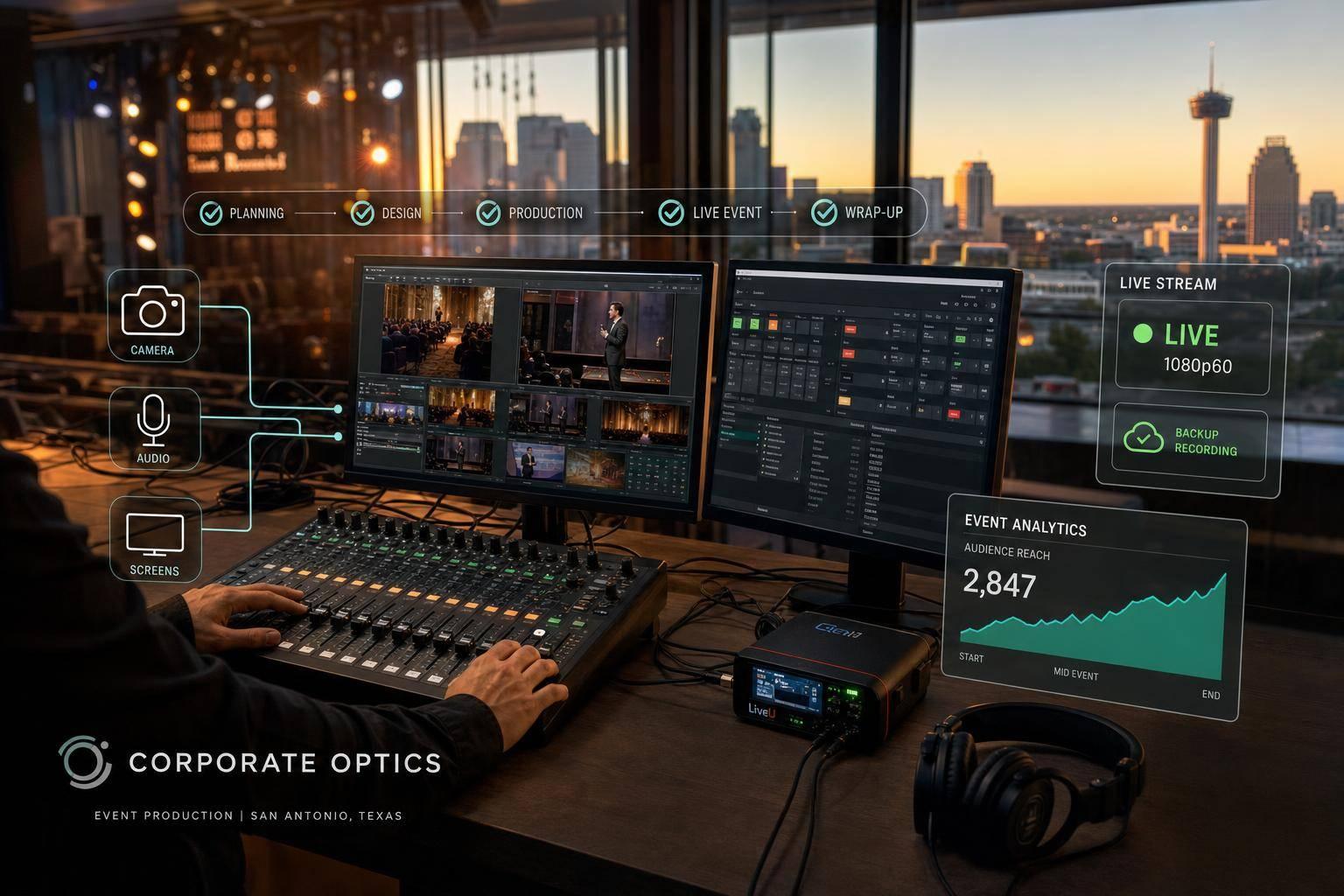
If you’re planning a corporate event in San Antonio, the main issue is simple: one AV miss can throw off the whole program. I’d sum up Corporate Optics this way: they help reduce that risk by handling planning, staging, AV, streaming, staffing, and post-event reporting through one team.
Here’s the short version of what stands out:
- 30+ years of experience in visual communication and event production
- Support for in-room, hybrid, and streamed events
- One workflow for venue coordination, show flow, crew, and tech
- Backup plans for mics, playback, and stream paths
- Post-event reports with attendance, dwell time, polls, and Q&A data
For planners, that means fewer handoff problems, fewer day-of surprises, and a clearer way to track what happened after the event. In a city where venue rules, room layouts, and internet limits can affect show quality, that kind of prep matters.
What I take from the article is straightforward: Corporate Optics is a good fit for San Antonio events because it focuses on prep, control, backup systems, and measurable results - not just gear.
Event A/V Essentials Part 5: Creating Your Onsite Production Schedule - Logan Clements
sbb-itb-ae35a94
Common Corporate Event Production Problems In San Antonio
San Antonio venues bring the same production trouble spots up again and again. For planners, the issues usually land in three buckets: AV and staging, hybrid delivery, and run-of-show control.
AV And Staging Issues That Disrupt Executive Presentations
Most AV failures aren't flashy. They're the kind that build slowly and make the whole program feel off.
Front-row guests get blasted with sound while people in the back of the ballroom can barely follow along. Projectors look faded when room lighting isn't managed. Screens end up partly blocked by columns or chandeliers. Standard hotel risers often don't give an executive panel enough space, and loose cables on stage turn into trip hazards. Lighting causes problems too. If a team relies on standard overhead fixtures instead of dedicated key and fill lighting, speakers can look shadowed or washed out. That's not the look most companies want for senior leadership.
The bigger money problem usually starts with a bad assumption: that a venue's base AV package can handle a full corporate program.
A venue may quote a screen, projector, podium mic, and a basic mixer. That might work for a simple meeting. But a multi-speaker leadership summit with video playback and hybrid streaming needs more than that, including:
- Extra wireless mic channels
- Confidence monitors
- Recording capability
When those pieces are missing, planners end up paying for rush rentals and last-minute crew time. And once the AV basics start slipping, hybrid issues and show-flow problems usually aren't far behind.
Hybrid Events That Leave Remote Audiences Behind
Hybrid events add a whole second layer of risk, and many in-room teams aren't set up to manage it well.
Internet is a common weak point. Venue bandwidth is often underpowered, especially when hundreds of attendees are using the same network at once. Camera coverage can fall flat too. One static camera aimed at the full stage gives remote viewers a distant, impersonal feed. They miss facial expressions, screen content, and any feeling of being part of the event.
Audio is another frequent pain point. Remote attendees may hear room microphones but miss video playback audio completely. Or they get echo because far-end audio is picked up again by open mics in the room. Then there's the ownership problem: if no one person is in charge of the virtual audience, stream quality, chat support, and remote speaker troubleshooting get split among an IT staffer, a platform admin, and a moderator. In plain English, everyone has part of the job, but no one owns the outcome.
That leaves remote attendees with an experience that feels disconnected from what's happening in the room. The ballroom may look polished in person, yet the stream can still feel like a separate production problem.
Run-Of-Show Gaps And No Post-Event Data
A run-of-show can look fine on paper and still cause chaos on site.
If it only lists session titles and start times, but leaves out cue-level detail, the crew has to make calls on the fly. That's when things start to wobble. Stingers get missed. Slide changes come late. Walk-on music fires at the wrong time - or doesn't fire at all. Speaker transitions turn awkward because no one decided who passes the mic or who walks executives to the stage.
Those misses pile up across the day. One session runs long, then Q&A gets squeezed, and before long the agenda is compressed at the exact moment the main content needs room to breathe.
Post-event data is another weak spot. Without session-level attendance and engagement numbers, planners can't measure conference ROI or make the next program better. That's why end-to-end production support matters so much. It's about tighter planning, clearer ownership, and on-site technical control that cuts down these risks before they snowball.
How Corporate Optics Solves AV, Staging, And Production Risks
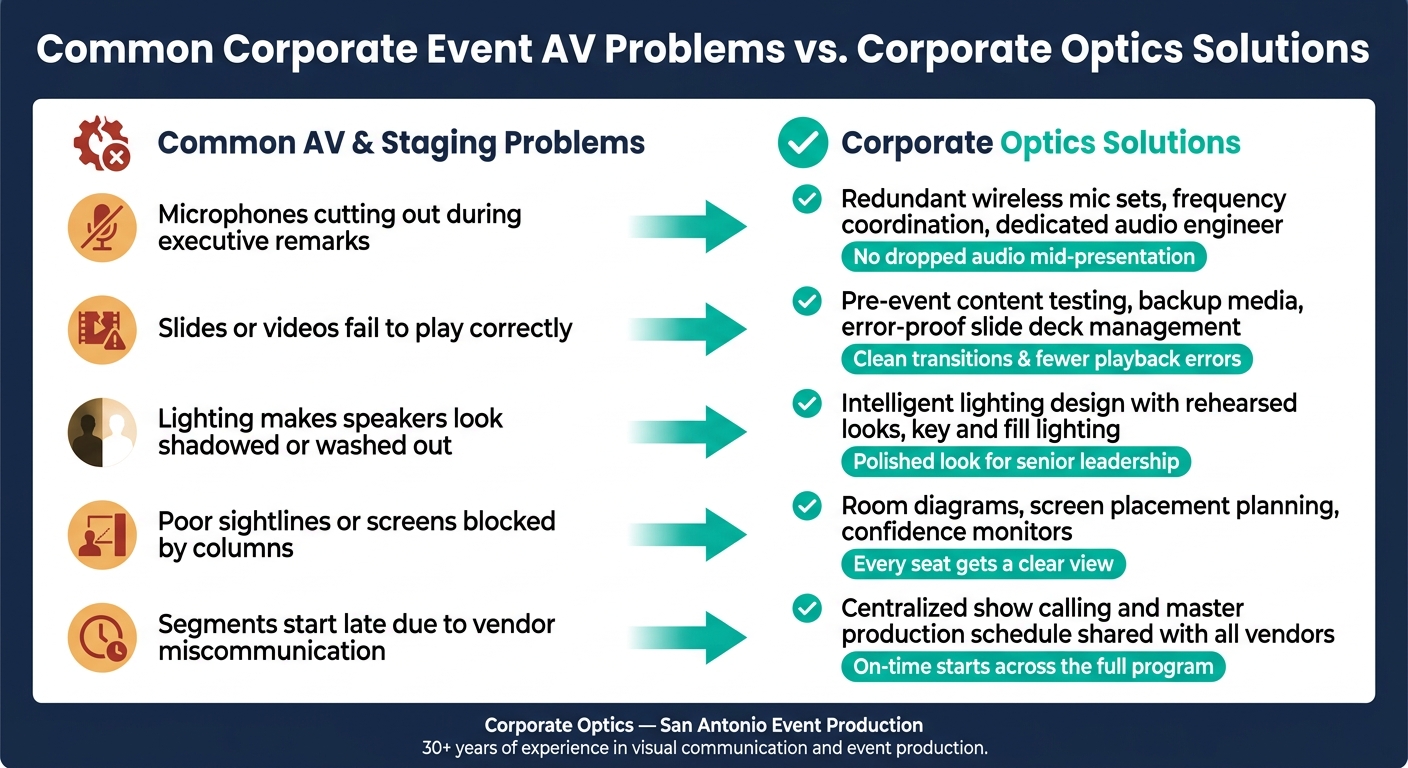
Common Corporate Event AV Problems vs. Corporate Optics Solutions
Corporate Optics deals with those risks through one coordinated production workflow.
End-To-End Technical Event Planning
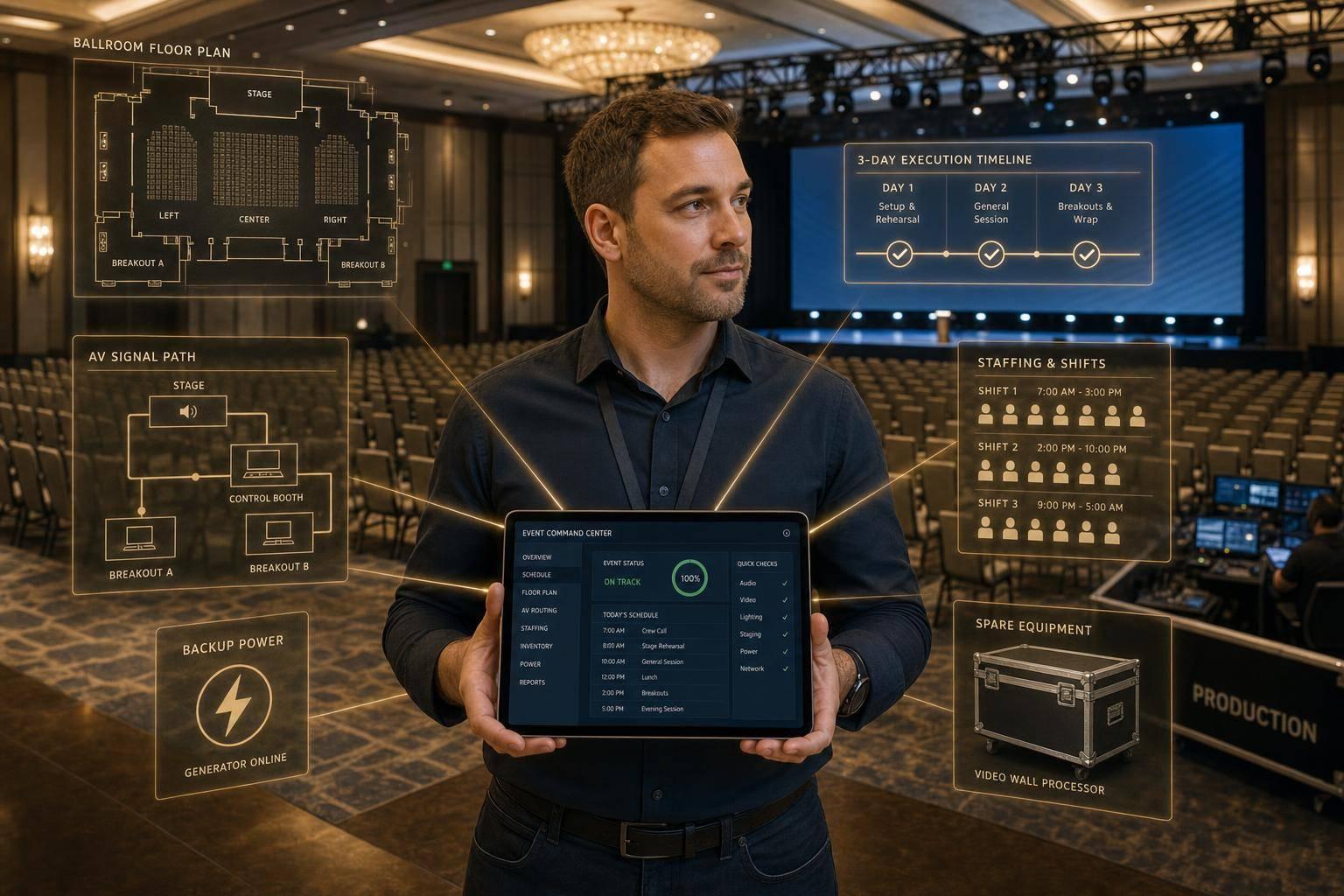
Corporate Optics serves as the central technical hub for the event. The team handles venue logistics, equipment planning, vendor coordination, and agenda development in one place.
The process starts with a discovery meeting to line up event goals. From there, the team builds a production script that ties each program segment to specific production needs, including mic counts, playback cues, lighting looks, and crew assignments. Corporate Optics then manages the master timeline and keeps communication moving between house AV teams, rental providers, and streaming platforms.
On show day, one team runs the event from a single production script. That matters because clean handoffs can be the difference between a smooth keynote and a messy scramble backstage.
That same plan carries straight into AV, scenic, and lighting execution on site.
AV, Scenic, And Lighting Support For Corporate Meetings
Corporate Optics handles San Antonio venue constraints with careful system design.
Audio planning includes speaker placement for even room coverage, digital consoles with scene recall, and wireless microphone management, including frequency coordination to stop interference in busy hotel ballrooms. Projection and display support matches projector output to room size and ambient light, places screens for clear sightlines, and adds confidence monitors so presenters don't have to turn their backs to the audience.
Scenic elements, such as custom stage sets and branded backdrops, are sized around local ceiling heights and rigging limits. Lighting rounds out the setup with programmable scenes for walk-ins, keynotes, and awards, all color-matched to corporate branding.
The table below shows the most common AV and staging problems and how Corporate Optics handles them:
| Common AV/Staging Problem | Corporate Optics Solution | Practical Impact |
|---|---|---|
| Microphones cutting out during executive remarks | Redundant wireless mic sets, frequency coordination, dedicated audio engineer | No dropped audio mid-presentation |
| Slides or videos fail to play correctly | Pre-event content testing, backup media, error-proof slide deck management | Clean transitions and fewer playback errors |
| Lighting makes speakers look shadowed or washed out | Intelligent lighting design with rehearsed looks, key and fill lighting | Polished, professional look for senior leadership |
| Poor sightlines or screens blocked by columns | Room diagrams, screen placement planning, confidence monitors | Every seat gets a clear view |
| Segments start late due to vendor miscommunication | Centralized show calling and a master production schedule shared with all vendors | On-time starts across the full program |
Those system decisions are supported by on-site staffing and contingency planning.
On-Site Staffing And Contingency Planning That Cut Event-Day Risk
Show-day execution is where the planning has to hold up. A plan can look great on paper, but event-day changes are where things usually get tense. Corporate Optics builds backup into the way the show runs.
A structured on-site team, usually made up of a technical director, audio engineer, lighting operator, video/graphics operator, and show caller, works from defined roles with clear backup procedures. Everyone knows their lane. Just as important, everyone knows what happens if something changes.
Contingency planning is built into the production script instead of being made up in the moment. Critical systems include redundancy, such as backup laptops with mirrored content, extra wireless microphone channels, and backup audio paths for streaming. If a presenter's content changes on the morning of the event, the graphics operator updates the file and confirms playback before doors open. If a segment runs long, the show caller relays that change to every department by headset so the lighting, audio, and content teams adjust together.
Live Streaming, Hybrid Production, And Measurable Event Outcomes
Those same production controls need to reach the remote audience too. A hybrid production should give online viewers the same level of control and consistency people get in the room.
Live Streaming And Hybrid Event Workflows For Corporate Audiences
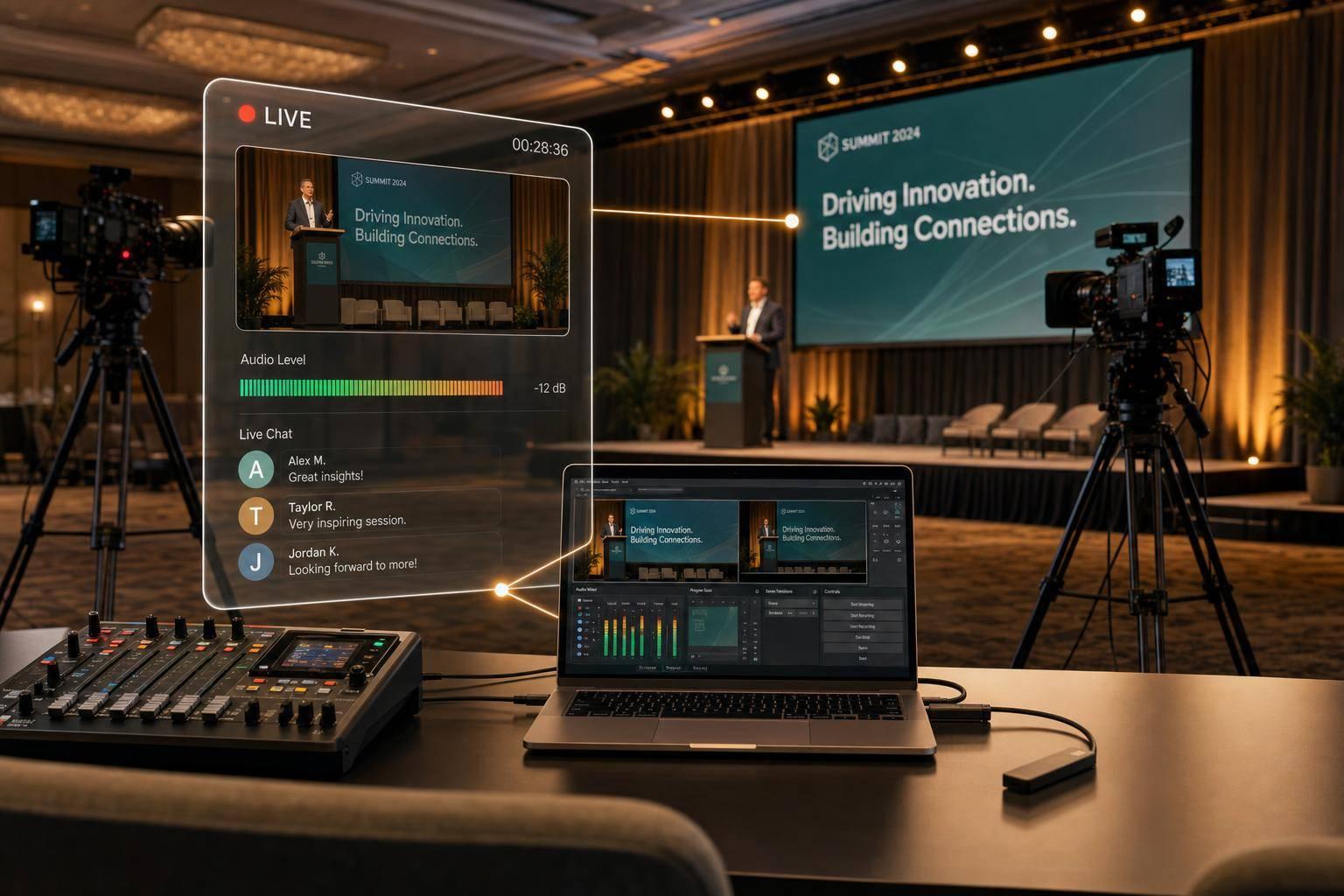
Corporate Optics manages hybrid events from planning through archive. In San Antonio venues, bandwidth limits, room layouts, and load-in rules turn hybrid planning into a technical job, not just a platform choice. Their streaming setup uses professional switching systems, streaming platforms, and redundant signal feeds to help keep the program stable from start to finish.
That work starts before the show goes live. Presenters are prepared ahead of time, not just managed during the broadcast. Remote speakers get support with run-of-show scripting, teleprompter services, and rehearsals so they are technically ready before they go live.
On the audience side, the goal is simple: keep people connected to the program instead of letting them drift. Live Q&A, real-time polls, and custom-branded virtual environments help keep participants aligned with what’s happening on screen.
Program Support And AI-Enabled Efficiencies
innovative AI tools can speed planning, improve content prep, and tighten cost control.
Post-Event Analytics That Help Teams Measure Results
The same production workflow should also lead to usable results after the event. After the event, Corporate Optics provides recording archives and analytics, including attendance, dwell time, poll results, and Q&A activity, to show what worked and guide the next program.
Why Corporate Optics Works For Corporate Events In San Antonio, Texas
San Antonio is a busy meetings market. That means corporate planners need production support that can deal with complex venues and tight schedules without things slipping through the cracks.
That’s where the setup matters. Instead of splitting work across multiple vendors, Corporate Optics handles the corporate event production support. The team manages venue coordination, stage design, AV, streaming, staffing, contingency planning, and post-event reporting in one production workflow. The result is simple: fewer handoffs, fewer technical misses, and tighter execution.
Production quality is also a big part of why Corporate Optics fits San Antonio corporate events. Its AV, scenic, and lighting support help meetings look polished, sound clear, and stay on message.
That same coordination carries over to remote viewers. For hybrid events, dependable streaming, switching, and redundant signal paths help keep remote audiences connected instead of dealing with dropouts or spotty feeds.
Put it all together, and the model is easy to see: one coordinated team for planning, production, streaming, and post-event measurement for San Antonio corporate events.
FAQs
What types of corporate events can Corporate Optics support in San Antonio?
Corporate Optics provides end-to-end production support for a wide range of corporate events in San Antonio.
That includes:
- Leadership conferences
- Annual, board, and shareholder meetings
- Awards ceremonies
- Webinars, town halls, sales kickoffs, and company all-hands meetings
They also support virtual and hybrid programs, along with custom events, product launches, brand activations, and trade shows.
Whether you’re running a small session or a large-scale production, their services can scale to fit the event.
How early should I involve Corporate Optics in event planning?
Bring Corporate Optics in as early as you can. That gives everyone enough time to set goals, look at venue options, and map out the tech side before details get locked in.
Typical timing looks like this:
- 3 to 6 months for most standard events
- 6 to 12 months for large or complex programs
- 6 to 10 weeks for smaller meetings
It also helps to involve them before you lock in the venue. That way, they can spot logistical issues early, like power access or ceiling height, while there’s still time to adjust.
What post-event analytics does Corporate Optics provide?
Corporate Optics provides post-event reporting built around your goals. That can include attendance, engagement, content performance, and sponsor performance.
For virtual and hybrid events, reports can also cover:
- Peak viewers
- Audience drop-off points
- Poll participation
- Q&A volume
They also offer post-event archiving. And for recurring events, they can provide comparative data, engagement scorecards, and operational metrics such as pre-production hours and technical issue frequency.
Related Blog Posts


Streamline your workflow, achieve more

Lorem ipsum dolor sit amet, consectetur adipiscing elit. Maecenas ac velit pellentesque, feugiat justo sed, aliquet felis.



Lorem ipsum dolor sit amet, consectetur adipiscing elit. Maecenas ac velit pellentesque, feugiat justo sed, aliquet felis.