Leading Meeting‑Planning Companies That Can Handle Both Virtual Broadcast And Onsite AV Production.

Chief Executive Officer
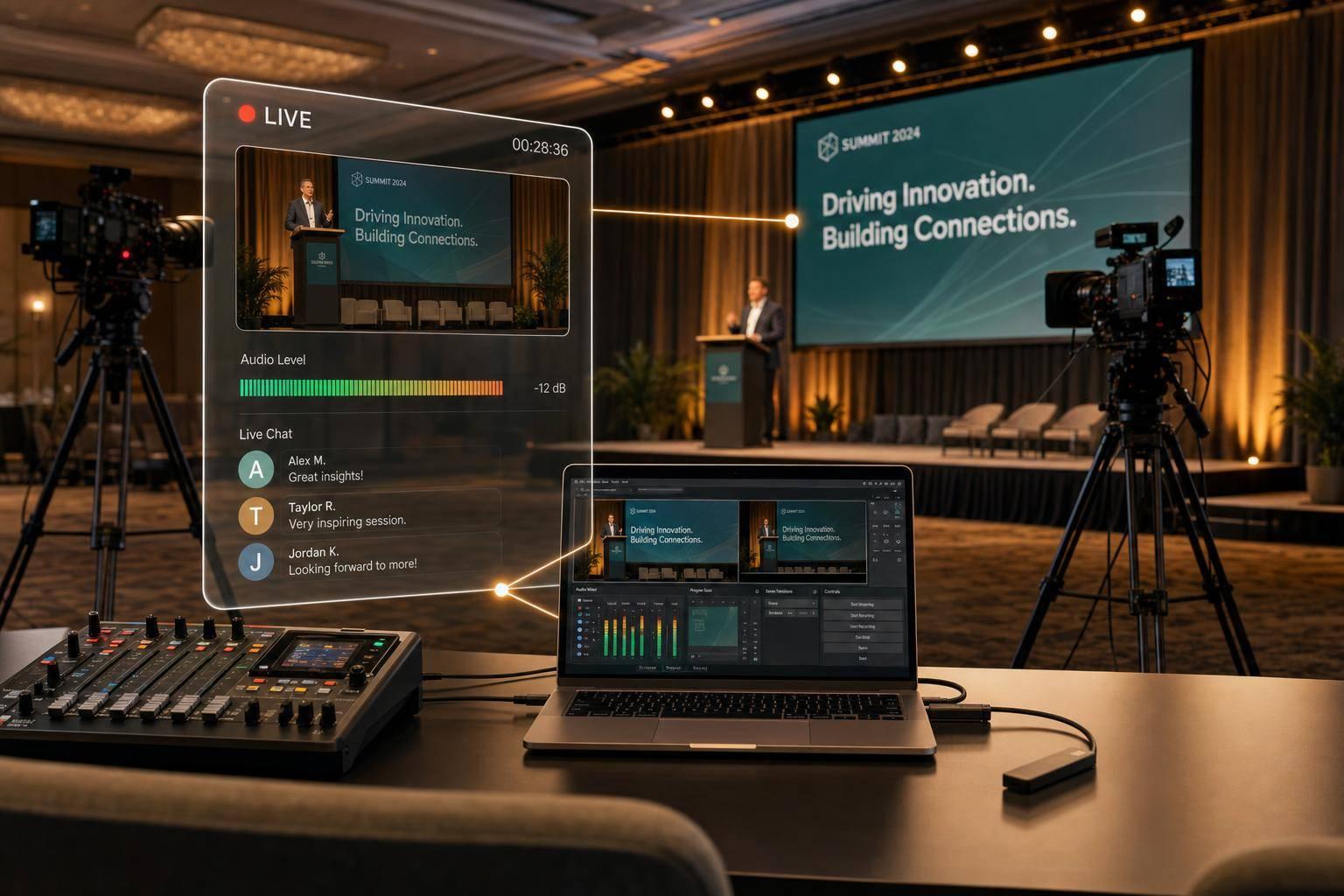
If your event has people in the room and people online, one vendor usually works better than two. From what I see in this roundup, the best fit depends on what matters most: planning help, broadcast control, studio access, visual polish, or nationwide room-and-stream support.
Here’s the short version:
- Corporate Optics fits executive town halls, board sessions, and shareholder meetings
- Meeting Tomorrow fits teams that need one company across many cities
- AVP.Live fits broadcast-heavy shows and studio-based programs
- GlassFire fits brand-led events where video quality matters a lot
- OnSite Live fits companies that want one crew to run both the room and the stream
A few facts stand out:
- Hybrid events often need more prep time than in-person-only or virtual-only programs
- Planners now spend about 30% of event budgets on hybrid tech, up from 12% in 2019
- Meeting Tomorrow reported 4,750 events across 1,466 cities in one year
- AVP.Live says many standard corporate events should be booked 2–4 weeks ahead
If I were picking from this list, I’d start with the event’s biggest risk. If the stream cannot go down, I’d lean toward the teams with deeper broadcast control. If the room experience is the top issue, I’d look harder at the providers with stronger onsite AV coverage. If both audiences matter equally, I’d want one team running the whole show.
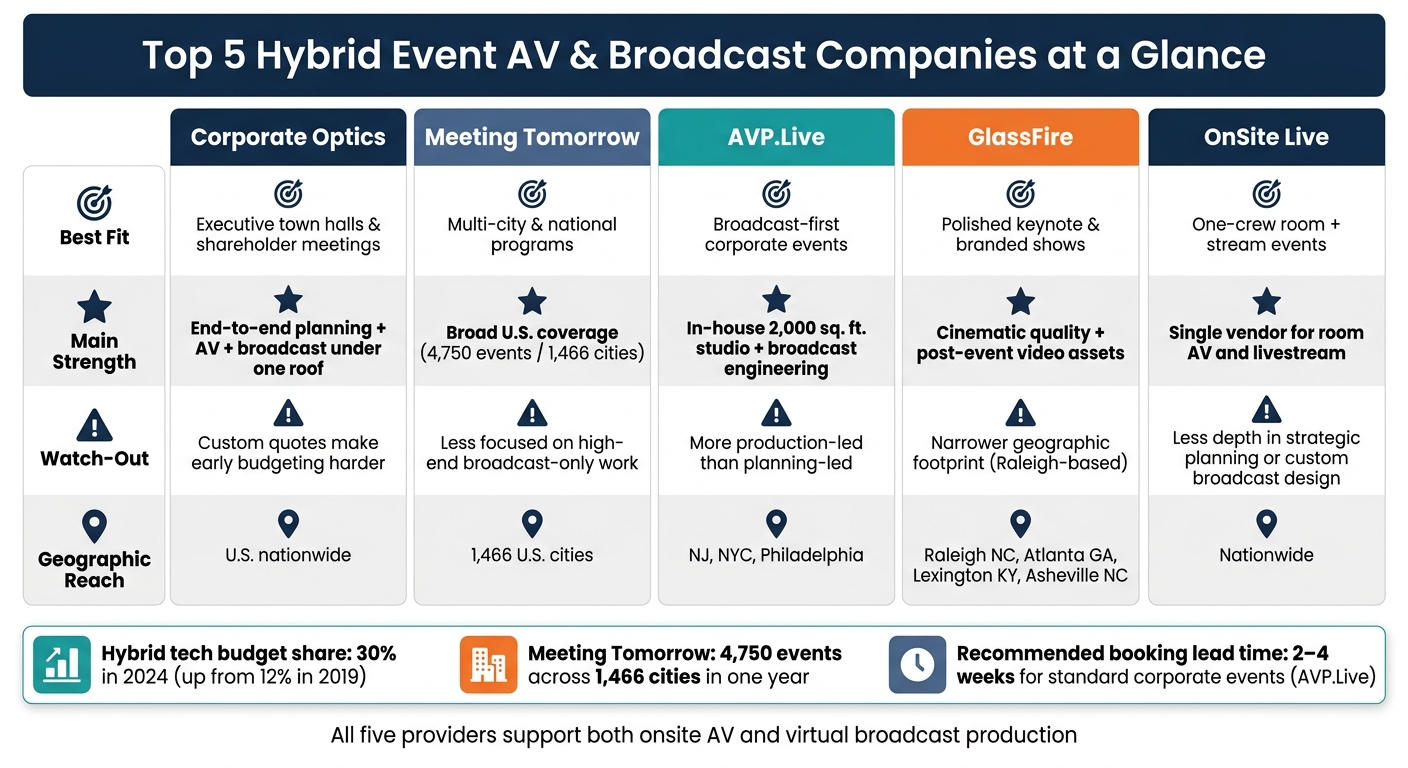
Top 5 Hybrid Event AV Companies: Side-by-Side Comparison
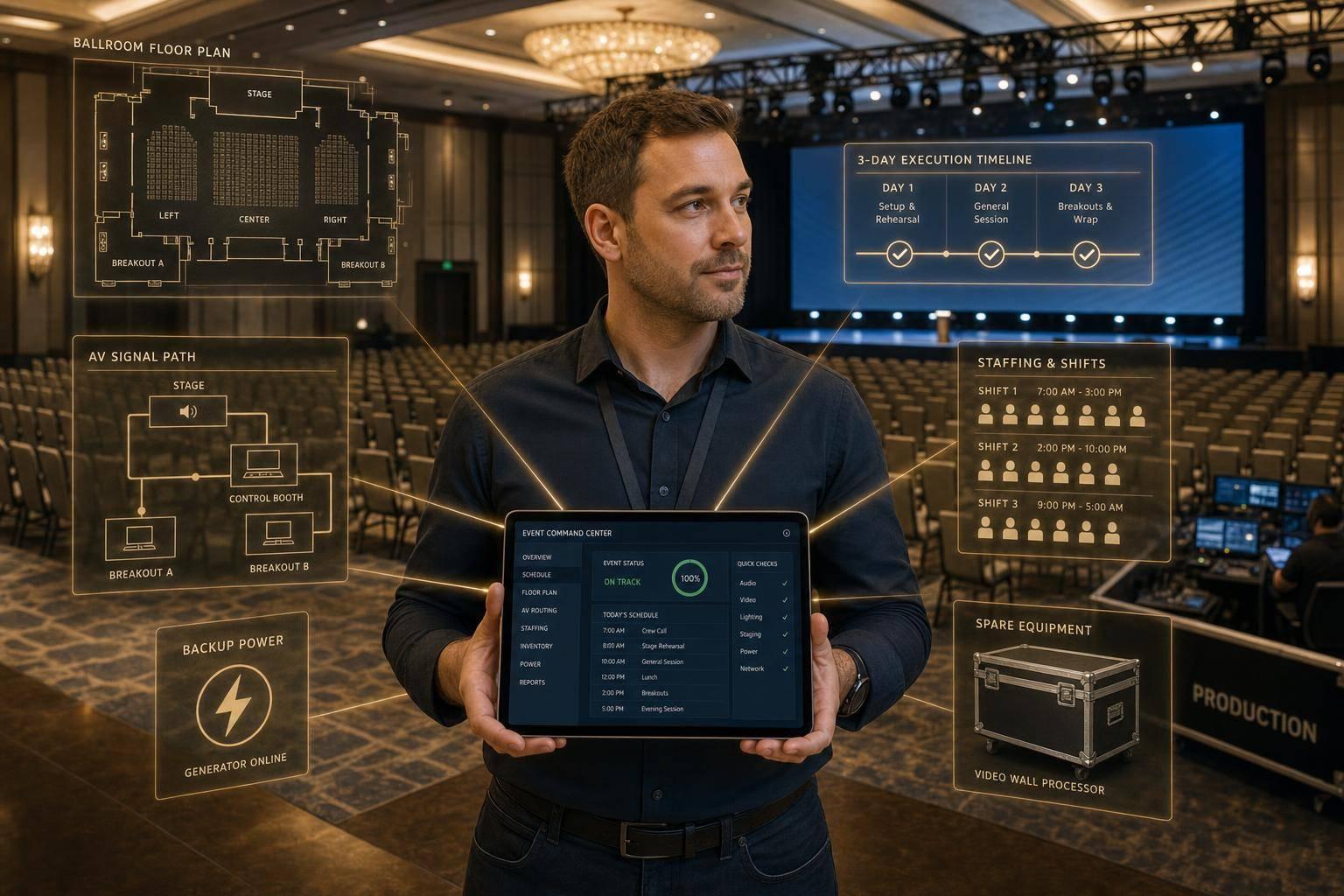
Behind the Scenes of a Hybrid Event AV & Production Set-Up
sbb-itb-ae35a94
Quick Comparison
| Company | Best fit | Main strength | Watch-out |
|---|---|---|---|
| Corporate Optics | Executive meetings and town halls | One team for planning, room AV, and livestream production | Custom quotes can make budgeting less clear early on |
| Meeting Tomorrow | Multi-city and national programs | Broad U.S. coverage and hybrid support at scale | Less focused on high-end broadcast-only work |
| AVP.Live | Broadcast-first corporate events | Studio option, engineering focus, and tight stream control | More production-led than planning-led |
| GlassFire | Polished keynote and branded shows | Strong visual style and post-event video assets | Smaller geographic footprint |
| OnSite Live | Meetings and conferences needing one AV/livestream crew | Room production and livestreaming under one vendor | Less depth on planning and custom broadcast setup |
So the takeaway is simple: all five can handle both sides of a hybrid event, but they do not solve the same problem in the same way. I’d use this list to match the provider to the pressure point, not just the event format. Following hybrid meeting planning best practices ensures you address these nuances effectively.
1. Corporate Optics
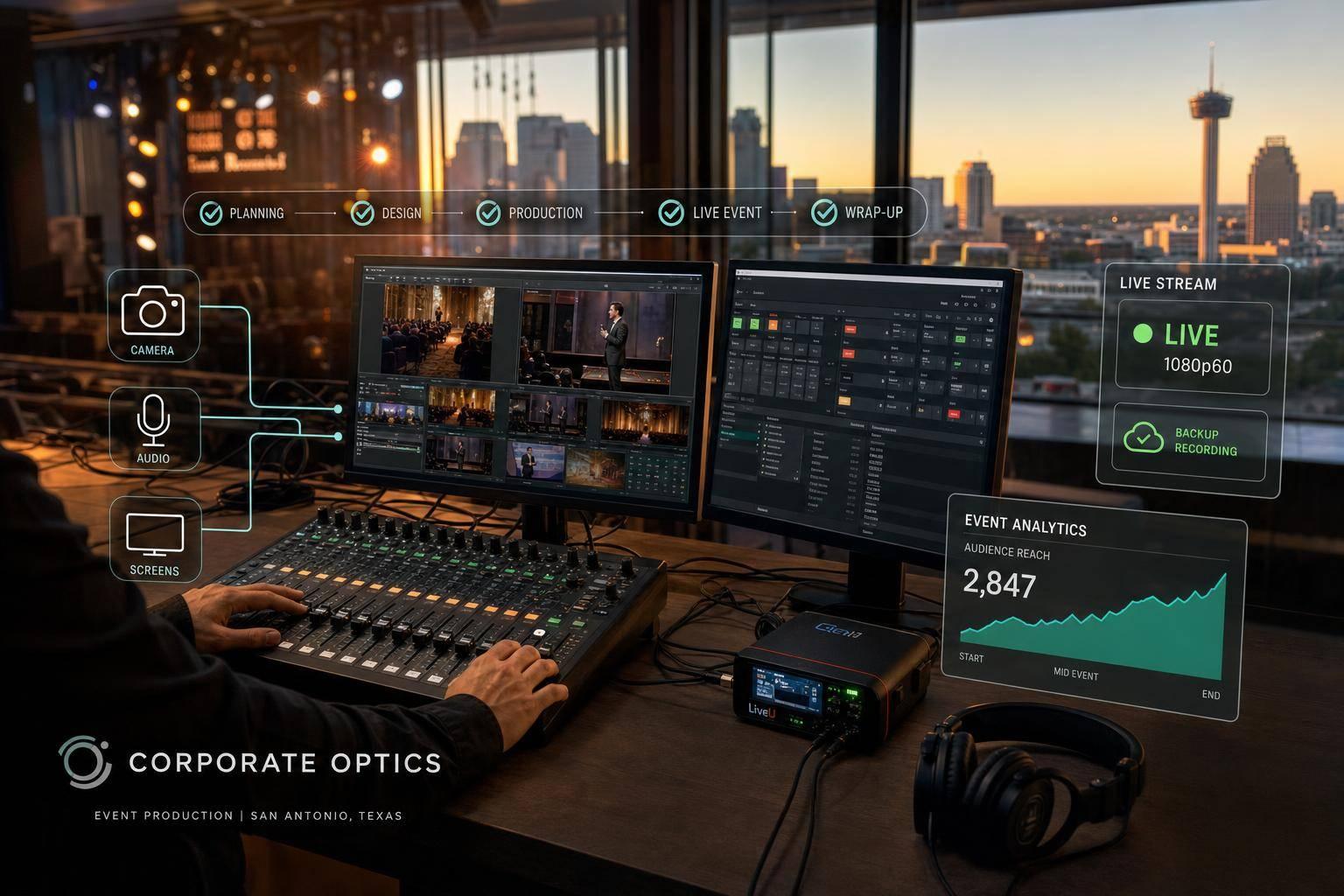
Corporate Optics is a U.S.-based technical event production company that works with Fortune 500 firms, major associations, and government clients. The team supports executive town halls, shareholder meetings, sales kickoffs, and leadership conferences through one production group that handles both broadcast and onsite delivery.
Virtual Broadcast Production
Corporate Optics manages the full lifecycle of a virtual production, from planning and live support to archiving. On the technical side, the team runs professional switching systems, connects with broadcast platforms, and maintains redundant signal feeds to help avoid interruptions. For remote audiences, it adds live Q&A, polling, and branded virtual environments.
Presenter support is built into the workflow too. Script writing, teleprompter services, and technical rehearsals help cut the risk of delivery issues during a live broadcast.
Onsite AV Execution
That same production discipline carries into the room. Corporate Optics handles stage and scenic design, lighting, audio management, and in-room production coordination. The team manages slide cueing, script timing, and media playback so the in-room experience stays on schedule.
For sensitive executive sessions, like board meetings, it also provides secure AV setups and secure communication systems with restricted-access protocols.
Hybrid Event Coordination
When in-person and remote audiences share one run of show, timing has to stay tight. Corporate Optics uses multi-camera streaming for hybrid events to keep run-of-show timing, speaker transitions, and remote Q&A aligned across both audiences. It also uses planning tools to support pre-event logistics and help control costs.
Technical Staffing and Contingency Support
Staffing can scale from smaller executive broadcasts to larger multi-room conferences. Roles include:
- Technical directors
- Audio engineers
- Video operators
- Stream producers
- Camera operators
- Lighting technicians
- Show callers
Contingency planning is part of the setup. Backup internet, power, microphones, playback systems, alternate streaming paths, and failover rehearsals are standard.
2. Meeting Tomorrow
Meeting Tomorrow focuses on hybrid event production at scale for companies with teams spread across many locations. It’s a nationwide corporate event production company that handles onsite AV and virtual broadcast production. In one year, the company reported 4,750 events across 1,466 cities.
Virtual Broadcast Production
The team handles the moving parts that keep a virtual program on track: platform setup, livestream encoding, run-of-show creation, speaker transitions, chat, and Q&A. They work across major webcast and meeting platforms, and they can stream from hotel ballrooms, corporate offices, or dedicated studios.
Onsite AV Execution
On the in-person side, Meeting Tomorrow provides nationwide AV production for hotels and other venues, and it can work with union or non-union labor. A typical setup may include:
- General sessions and breakout rooms
- Camera feeds for main screens
- LED walls and projectors
- PA systems and microphones
- Cameras, lighting, and switchers
These are the nuts and bolts behind the live room experience, from what the audience hears to what appears on screen.
Hybrid Event Coordination
Meeting Tomorrow builds hybrid formats for both the in-room crowd and remote attendees. That can mean virtual breakout rooms running at the same time as onsite sessions, along with moderated Q&A workflows that route online questions to panelists in the room.
For multi-site corporate meetings, the company can support hundreds of simultaneous locations using AV kits and onsite technicians connected to one central broadcast. Put simply, the goal is one run of show that works for both audiences.
Technical Staffing and Contingency Support
Its staffing bench includes audio engineers, video switchers, camera operators, lighting technicians, streaming engineers, and stage managers. On the backup side, planning may include redundant encoders, backup internet, mirrored slides, alternate dial-in options, and pre-recorded fallback content.
That kind of backup plan matters. If one part fails, the show still has a path forward. Reviewers point to organized delivery and fast response, and Trustpilot lists a 4.7/5 rating from 33 reviews.
3. AVP.Live
AVP.Live is geared toward corporate events that need broadcast-style production and onsite AV under one plan. It works with enterprise and Fortune 500 clients across New Jersey, New York City, and Philadelphia, supporting town halls, product launches, shareholder meetings, and executive broadcasts. The big draw is simple: the in-room event and the livestream follow the same run of show.
One thing that stands out is its in-house 2,000 sq. ft. virtual broadcast studio, which gives clients a studio option when they don't want or need an external venue. And when the event happens onsite, the same team runs both the room AV and the livestream.
Virtual Broadcast Production and Hybrid Coordination
AVP.Live handles broadcast-style corporate livestreams with graphics, switching, and live stream monitoring. Remote speakers are tested before event day for framing, audio, and connection quality. For major executive remarks, the team can pre-record segments and roll them into the live program. Streams can go to YouTube, a client website, or client-hosted servers. After the event, clients get edited recordings and engagement analytics.
Its hybrid setup keeps room AV, remote speakers, and online Q&A in one moderated flow. So when a speaker moves into audience questions, the production can shift between in-room microphones and remote chat or Q&A as part of the same segment. AVP.Live also offers a custom ticketing portal for both in-person and livestream attendees.
Onsite AV Execution
Before event day, the team runs an on-site technical survey to check room acoustics, sightlines, power distribution, and camera positions. If the event doesn't need an outside venue, the in-house studio is also available.
Technical Staffing and Contingency Support
Typical crews cover technical direction, camera, audio, graphics, and streaming support. On the backup side, AVP.Live uses backup encoders, alternate internet paths, spare microphones, and fallback playback to keep the event running if something goes sideways. Full technical run-throughs are used to simulate common failure scenarios before the event starts.
For timing, the company suggests booking at least 2–4 weeks in advance for standard corporate events, with more lead time for complex or multi-location programs.
No public pricing is listed; request a custom quote.
4. GlassFire
GlassFire is a production company based in Raleigh, NC. The team takes a cinematic approach to corporate events and broadcasts, with more attention on broadcast polish and content you can reuse later than on basic event support alone. Executive Producer Laura Macfie brings more than 15 years of corporate event experience.
Virtual Broadcast Production
GlassFire handles the core parts of virtual broadcast production, including multi-camera livestream direction, switching, encoder setup, and live comms between producers, presenters, and crew. Streams can be sent to Zoom, Teams, or custom webcast players. After the event, GlassFire can also provide clean recordings and highlight edits.
The company also runs a production-ready studio in Raleigh. It includes cinema cameras, lighting, audio kits, and support gear for polished studio broadcasts.
Onsite AV Execution
That same production style shows up onsite. For in-person events, GlassFire can manage camera, audio, lighting, playback, and comms from a central production position. If the venue’s AV setup needs help, the team can add gear to support it.
Hybrid Event Coordination and Technical Staffing
GlassFire coordinates hybrid events by planning the in-room experience and the livestream as one system. That includes camera placement, audio routing, lighting design, and platform settings during pre-production.
The company also assigns a technical producer or showcaller to handle timing, transitions, and contingencies across both formats. In plain English, one showcaller keeps the room cues and stream cues moving together instead of drifting apart.
Beyond Raleigh, GlassFire also has a presence in Lexington, KY; Atlanta, GA; and Asheville, NC.
No public pricing is listed, so quotes are custom.
5. OnSite Live
OnSite Live provides nationwide corporate AV, onsite capture, and livestreaming for meetings, town halls, and conferences. Its main draw is simple: one vendor handles both the room and the stream.
Virtual Broadcast Production
For virtual and hybrid events, OnSite Live manages the full livestream workflow: multi-camera capture, live switching, audio mixing for speech intelligibility, and encoding for delivery to a webcast or meeting platform. The result is a clean, broadcast-quality stream with slides, lower-thirds, and steady delivery. Technical checks and rehearsals are part of the process, which helps reduce surprises before showtime.
Onsite AV Execution
OnSite Live supplies both equipment and crew. A typical corporate setup can include PA systems, lavalier and handheld microphones, projectors or LED displays, confidence monitors, and stage lighting that looks good in the room and on camera.
There’s also some flexibility in how clients use the service. They can bring their own crew or use OnSite Live's production team, which means the support can be equipment-only or full-service.
Hybrid Event Coordination
This setup becomes even more useful when one run of show has to work for both in-person and remote audiences. OnSite Live supports events nationwide. A producer keeps stage cues and platform cues in sync throughout the event, including going live, opening Q&A, and rolling video.
Technical Staffing and Contingency Support
A typical OnSite Live production team can include:
- a producer
- a technical director for video switching
- camera operators
- an audio engineer
- a streaming specialist monitoring encoder health and platform connectivity
For mission-critical events, common safeguards include backup microphones, redundant signal paths, and a dedicated wired internet connection with cellular failover for the stream.
The key differences now come down to crew model, equipment flexibility, and how much production each provider keeps under one roof.
Pros and Cons by Provider
These providers all handle both onsite AV and broadcast production. But they don’t all work the same way. Some lean harder into planning. Others shine on live production. And some are built around deep technical crews, while others act more like a single point of contact for the whole event.
Use the comparison below to line up each provider’s strengths with your event format, internal team setup, and production needs.
| Company | Key Pros | Key Cons | Best For |
|---|---|---|---|
| Corporate Optics | End-to-end planning with AV and broadcast production under one roof; strong fit for executive and shareholder meetings with deep technical staffing and contingency support | Custom pricing and scope-dependent costs make upfront budgeting less predictable | Executive town halls and shareholder meetings |
| Meeting Tomorrow | 12 years of virtual and hybrid event experience; useful when one vendor must cover planning and execution nationwide | Broad service scope can dilute specialization on complex broadcasts | Organizations wanting one vendor to manage planning, logistics, and hybrid production together |
| AVP.Live | Broadcast engineering focus with in-house equipment and studio capability; detailed technical risk management around uplink quality, power, and union labor considerations | Stronger on production than planning | High-production corporate broadcasts, product launches, and shareholder meetings where technical precision is critical |
| GlassFire | Cinematic, content-first live and hybrid production with strong showcalling and multi-camera direction; post-event assets like clean recordings and highlight edits | Raleigh, NC-based with a narrower geographic footprint and a more specialized service model | Branded live events, keynote sessions, and town halls where remote audience experience and visual quality are top priorities |
| OnSite Live | Full-service corporate AV and livestreaming provider that manages room production and streaming for events ranging from small meetings to annual conferences | Onsite-focused, with less depth in strategic planning or custom broadcast design | Corporate meetings and conferences where one partner should own both the room and stream under one team |
A simple way to think about it: Corporate Optics and Meeting Tomorrow are often better fits when planning support matters just as much as show execution. AVP.Live leans more toward technical broadcast control. GlassFire is a stronger match for polished, brand-led shows. OnSite Live fits teams that want one crew to run the in-room and livestream sides together.
If your event has a lot riding on executive messaging, investor visibility, or a flawless remote feed, that difference can matter more than it first seems.
Conclusion
The last filter is simple: choose the provider that lines up with the part of your event that carries the most risk.
If the livestream can't fail, let broadcast quality lead the choice. If the in-room experience matters most, go with a team that has deeper onsite AV skill. And if you're running a hybrid town hall where remote and in-person audiences both need to feel fully included, one partner that can handle both sides is often worth the extra spend.
Start with the partner whose main strength matches your event's biggest pressure point.
Planners are now spending about 30% of their hybrid event budget on technology, up from 12% in 2019. That's a big jump. It also means integrated AV and broadcast isn't a one-off call anymore. It's a regular planning choice.
Build a relationship with a provider that fits the kinds of events you run most often. That can save time, lower risk, and lead to better results across your event calendar. For hybrid events, one production plan usually works better than two vendors.
FAQs
How do I choose the right hybrid event partner?
Choose a hybrid event partner that plans for both audiences from day one. You don’t want a last-minute livestream bolt-on. You want one team that sees the full picture and, ideally, runs the whole production stack under a single lead.
Before you sign anything, check two things: broadcast-grade control and reliability with redundancy. Then line up their strongest skill with your biggest risk. For some teams, that’s coordination. For others, it’s stream uptime or in-room execution.
When should I book a hybrid event production team?
Book your hybrid event production team as early as possible. That gives you time to lock in technical needs, sort out logistics, and avoid last-minute problems that can throw the whole event off course.
For a standard executive summit or an event with a custom-designed setting, try to book 8 to 16 weeks in advance. If you're planning a larger conference with more moving parts, like multi-venue logistics and detailed staging, 4 to 6 months ahead is the better window.
What backup plans should a hybrid event vendor provide?
A hybrid event vendor should have a documented, tested failover plan so the message keeps going when tech issues hit.
That means building in backup at the points most likely to fail. Key redundancies include dual encoders, separate internet paths, UPS power for critical hardware, a separate broadcast audio mix, spare microphones, backup playback machines and cameras, extra cable runs, and both local and cloud recordings.
Related Blog Posts
- 4 Meeting Production Companies That Excel At Seamless AV (audio/video), Lighting, and Stage Design for Corporate Conferences, and events
- Best Meeting Production Companies For General Session & Breakout Session AV Support
- End-To-End Annual Meeting Production Companies For Your Next Company Conference
- 3 Production Companies To Reach Out To Today Who Handle Av, Staging, Lighting, Show Calling, Technical Direction, Rehearsals, And Hybrid/Streaming.


Streamline your workflow, achieve more

Lorem ipsum dolor sit amet, consectetur adipiscing elit. Maecenas ac velit pellentesque, feugiat justo sed, aliquet felis.



Lorem ipsum dolor sit amet, consectetur adipiscing elit. Maecenas ac velit pellentesque, feugiat justo sed, aliquet felis.