Corporate Optics: Nationwide Conference Production With Local Market Expertise.

Chief Executive Officer
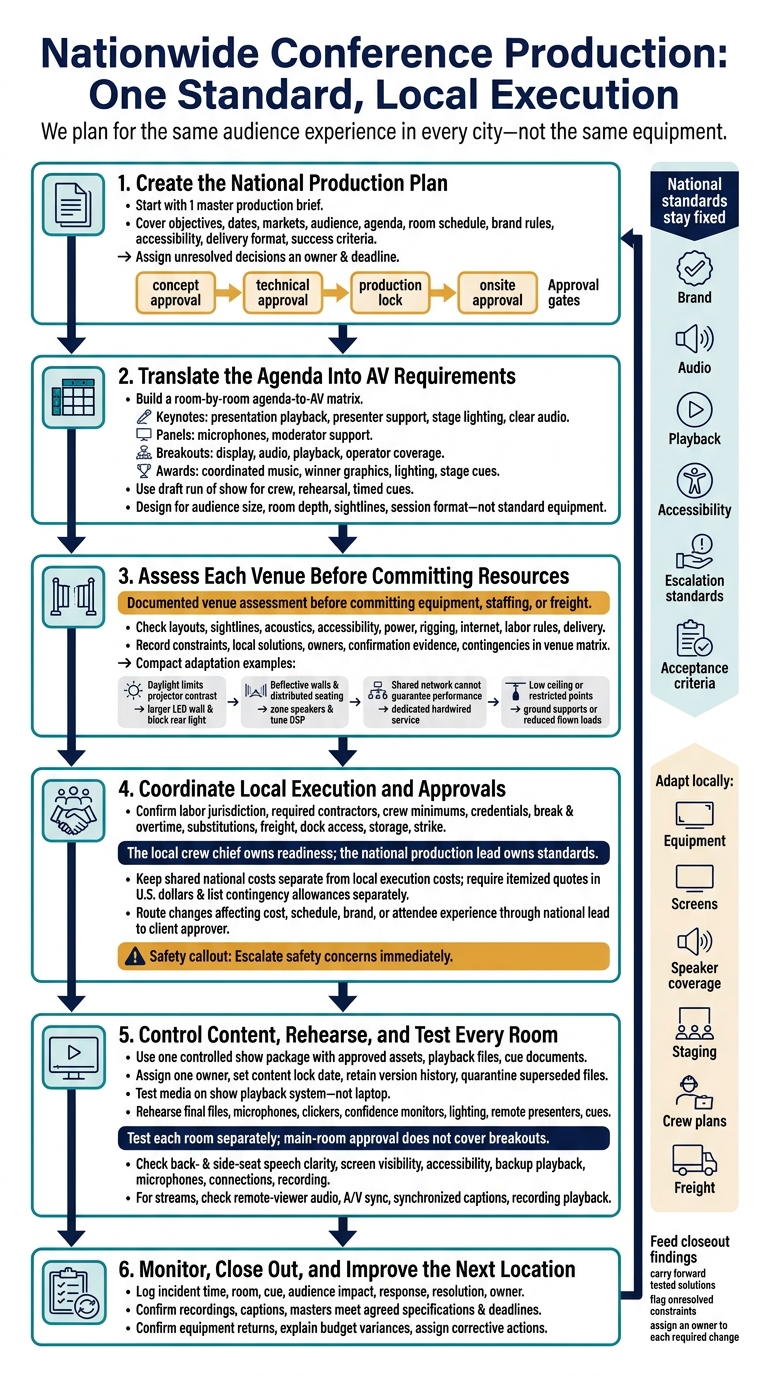
We plan for the same audience experience in every city - not the same equipment. At Corporate Optics, we start with 1 master production brief, assign decision owners, and check each venue before booking equipment, crews, or freight.
Our approach covers:
- National standards: Set brand rules, AV needs, budgets, approvals, and backup plans.
- Local planning: Check room layouts, power, internet, labor rules, and delivery access.
- Show control: Use approved files, rehearse presenters, and test every room - including streams and accessibility services.
- Closeout: Track issues, confirm media delivery and costs, and carry lessons into the next location.
The rule we follow: <u>keep the standards fixed</u>, while fitting the setup to each venue. That means checking what your audience sees and hears, not just whether the equipment turns on.
Nationwide Conference Production: One Standard, Local Execution
Create the National Production Plan
Create one master production brief that covers objectives, dates, markets, audience, agenda, room schedule, brand rules, accessibility, delivery format, and success criteria. The Corporate Optics national production lead uses this brief to control scope across markets, define who can make onsite decisions, and set approval gates for concept approval, technical approval, production lock, and onsite approval.
Assign every unresolved decision an owner and a deadline. The brief then serves as the baseline for turning the agenda into room-by-room AV requirements.
Turn the Agenda Into AV Requirements
Build a room-by-room agenda-to-AV matrix: keynotes need presentation playback, presenter support, stage lighting, and clear audio across the room. Panels add microphones for each participant and moderator support; breakouts need their own display, audio, playback, and operator coverage. Awards require coordinated music, winner graphics, lighting, and stage cues.
Use a draft run of show to turn these requirements into crew assignments, rehearsal windows, and timed cues. Design for the audience size, room depth, sightlines, and session format, not a standard equipment package.
Image magnification (IMAG) puts live camera close-ups on audience screens when presenters are hard to see. Confidence monitors face presenters and show slides, notes, timers, or remote participants. Remote sessions also need tested far-end audio, recording and streaming paths, captions, production internet, and backup playback. These AV requirements guide staffing, costs, and contingency planning.
Set the Budget, Approvals, and Backup Plans
Before finalizing local quotes, complete the production brief, AV matrix, venue matrix, technical scope, staffing plan, draft run of show, delivery schedule, budget, approval log, and risk register. Together, these documents set local operating limits and protect national standards.
Keep shared national costs separate from local execution costs, including equipment, freight, labor, venue fees, internet, power, taxes, and overtime. Require itemized quotes in U.S. dollars, with labor broken out by role and by setup, show, and strike days. List contingency allowances separately.
Send changes that affect cost, schedule, brand, or attendee experience through the national lead to the designated client approver. Escalate safety concerns immediately. Record each request, its impact, the decision, and the approval date.
In the risk register, give each critical failure point an owner, a response trigger, and an approved backup plan. Attach those decisions to the final run of show, noting each fallback point and who can authorize it.
sbb-itb-ae35a94
Plan AV for Each Venue and Market
Turn the master brief into room-by-room technical requirements.
Require a documented venue assessment before committing equipment, staffing, or freight. Keep brand, audio, playback, accessibility, and escalation standards fixed. Adjust screens, speaker coverage, and staging to fit each room.
Check Room Layout, Infrastructure, and Venue Rules
Create a room drawing that records dimensions in feet, seating, stage footprint, sightlines, acoustics, daylight, blackout capability, camera positions, accessibility routes, backstage space, and cable paths. These details guide viewing angles, sound clarity, and reliable cues.
Get written confirmation of power capacity, rigging points and load limits, fire-code restrictions, and house-AV requirements. Also confirm insurance requirements, dock access, freight-elevator dimensions, storage, strike deadlines, and venue contacts.
For hybrid sessions, confirm dedicated hardwired internet with guaranteed upload speed, network isolation, and on-site IT support. Test upload capacity, connection stability, and firewall requirements at the planned control position.
After the site walk, put the findings into a written technical brief and decision log.
Record Venue Requirements and Local Solutions
Attach venue drawings, service orders, engineering approvals, and test records to the technical brief. Use the matrix below to record each venue’s constraints and agreed solutions. Under “Confirmed on,” enter the actual date you receive evidence - not the approval deadline.
| Production category | National standard | Venue-specific constraint | Local solution | Owner | Confirmed on | Contingency |
|---|---|---|---|---|---|---|
| Displays | Approved resolution, aspect ratio, and confidence monitoring | Daylight limits projector contrast | Use a larger LED wall and block rear light | Technical director | Pending | Add displays or relocate audience |
| Audio | Speech intelligibility and backup microphones | Reflective walls and distributed seating | Zone speakers to the room; tune DSP; provide spare handhelds | A1 audio engineer | Pending | Add fills or change microphones |
| Playback | Approved files and redundant playback | Incompatible control-room inputs | Supply dual playback systems and signal conversion as needed | Playback operator | Pending | Use secondary laptop and mirrored files |
| Power | Separate, labeled production circuits | Limited capacity or electrician-only access | Submit power plan and approved distribution | Crew chief and venue engineering | Pending | Reduce nonessential loads or add approved power |
| Connectivity | Reliable production and streaming connection | Shared network cannot guarantee performance | Order dedicated hardwired service | Network lead and venue IT | Pending | Record locally or reduce stream complexity |
| Rigging | Approved scenic and lighting design | Low ceiling or restricted points | Use ground supports or reduce flown loads | Rigger and venue engineering | Pending | Reconfigure stage and lighting from floor positions |
Once the technical brief is locked, use it to coordinate labor, freight, and venue access.
Coordinate Local Crews, Equipment, and Freight
Confirm union status, applicable labor jurisdiction, required contractors, crew minimums, job classifications, break and overtime rules, and credentials. Be clear about who may handle power, rigging, lifts, and freight.
Verify equipment inventories and substitution rules, dock and elevator reservations, storage charges, return arrangements, and strike deadlines. Allow time for weather delays in shipping schedules. The local crew chief owns readiness; the national production lead owns standards.
| Task | Corporate Optics responsibility | Venue responsibility | Local vendor or crew responsibility | Client approval / escalation |
|---|---|---|---|---|
| Design and staffing | Approve standards; coordinate systems and staffing | Confirm building limits and rules | Verify labor, credentials, and availability | Client approves scope changes; national lead owns escalation |
| Audio and stage support | Coordinate departments | Confirm house-system access | A1 manages mix and RF; A2 handles microphones, batteries, and patching | Audio issues go to technical director |
| Playback, cameras, and cues | Control live sequence | Confirm camera positions and cable access | Manage approved media, backup playback, and camera shots | Client approves content |
| Rigging and power | Coordinate design requirements | Approve loads and connections | Qualified crews execute approved plans | Escalate safety concerns immediately |
| Equipment and freight | Approve package and delivery schedule | Confirm dock, storage, and strike access | Receive, inventory, deploy, and return equipment | Client approves cost changes |
Maintain Brand Standards During the Show
Once crews and rooms are in place, use one controlled show package to keep content, cues, and brand execution consistent across every market.
Manage Approved Show Files and Documents
Give every room team the same controlled package, including approved design assets, playback files, and cue documents. Assign one owner, set a content lock date, keep version history, and quarantine superseded files. One designated show producer should approve live changes and notify every affected room.
Publish delivery specifications for file formats, aspect ratios, resolution, frame rates, audio sample rates, loudness targets, and naming rules.
A 16:9, 1920 × 1080 package may suit the approved system; select the actual frame rate and audio targets with the video and audio leads.
Check codecs, fonts, linked media, captions, and audio-channel mapping on the show playback system - not a laptop. Then use that same approved package for each room’s rehearsal.
Rehearse Presenters and Test Each Room
Rehearse with final files, actual microphones, clickers, confidence monitors, camera positions, lighting, remote presenters, and show cues. Confirm names, titles, slide order, walk-on timing, video playback, and presenter handoffs.
Venue conditions affect sightlines, audio, and stream quality. Test each room separately; main-room approval does not cover breakouts. Check overflow rooms for synchronized feeds and readable graphics. Review streams as a remote viewer would, checking captions, A/V sync, and recording playback.
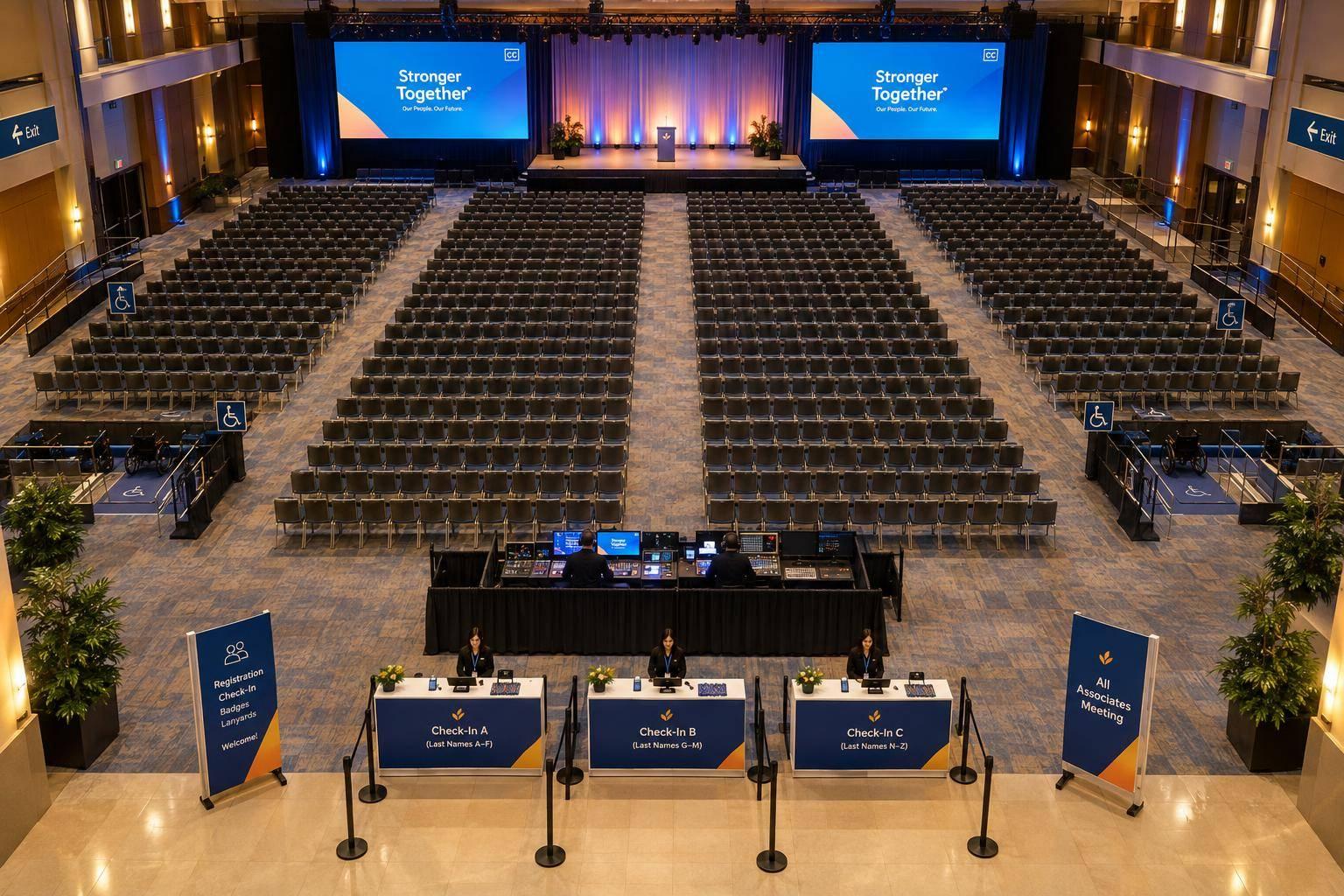
Test speech clarity and screen visibility from back and side seats. Also check accessible seating routes, assistive listening, and interpretation feeds where required.
Before doors open, verify that backup playback, microphones, connections, and recording work in the installed system. For streams, check that captions stay synchronized through encoding, delivery, and recording.
Check Show Quality and Complete Closeout
Log each incident with its time, room, cue, audience impact, response, resolution, and owner. At closeout, separate venue limitations from content or execution errors. Record corrective actions and their owners in the closeout log.
Apply the same control process to every room, and document any variance.
| Phase | Quality-control check | Owner | Acceptance criterion |
|---|---|---|---|
| Preproduction | ☐ Release approved content | Show producer | Every crew lead acknowledges the master package. |
| Load-in | ☐ Verify room systems | Technical director | Signal paths match approved documents, or deviations are signed off. |
| Rehearsal | ☐ Run presenters, cues, and accessibility checks | Stage manager | Every scheduled transition passes; required accessibility services work. |
| Live execution | ☐ Monitor brand and cue accuracy | Show caller | Only approved graphics and cues run, and changes are logged. |
| Streaming/recording | ☐ Monitor the delivered program | Stream engineer | Remote audio is clear, video and captions are synchronized, and test recordings play correctly. |
| Closeout | ☐ Confirm media delivery | Media manager | Recordings, captions, and masters meet agreed specifications and deadlines. |
| Closeout | ☐ Reconcile equipment, costs, and lessons | Operations manager | Returns are confirmed, budget variances explained, and corrective actions assigned. |
Conclusion: One Production Standard Across Locations
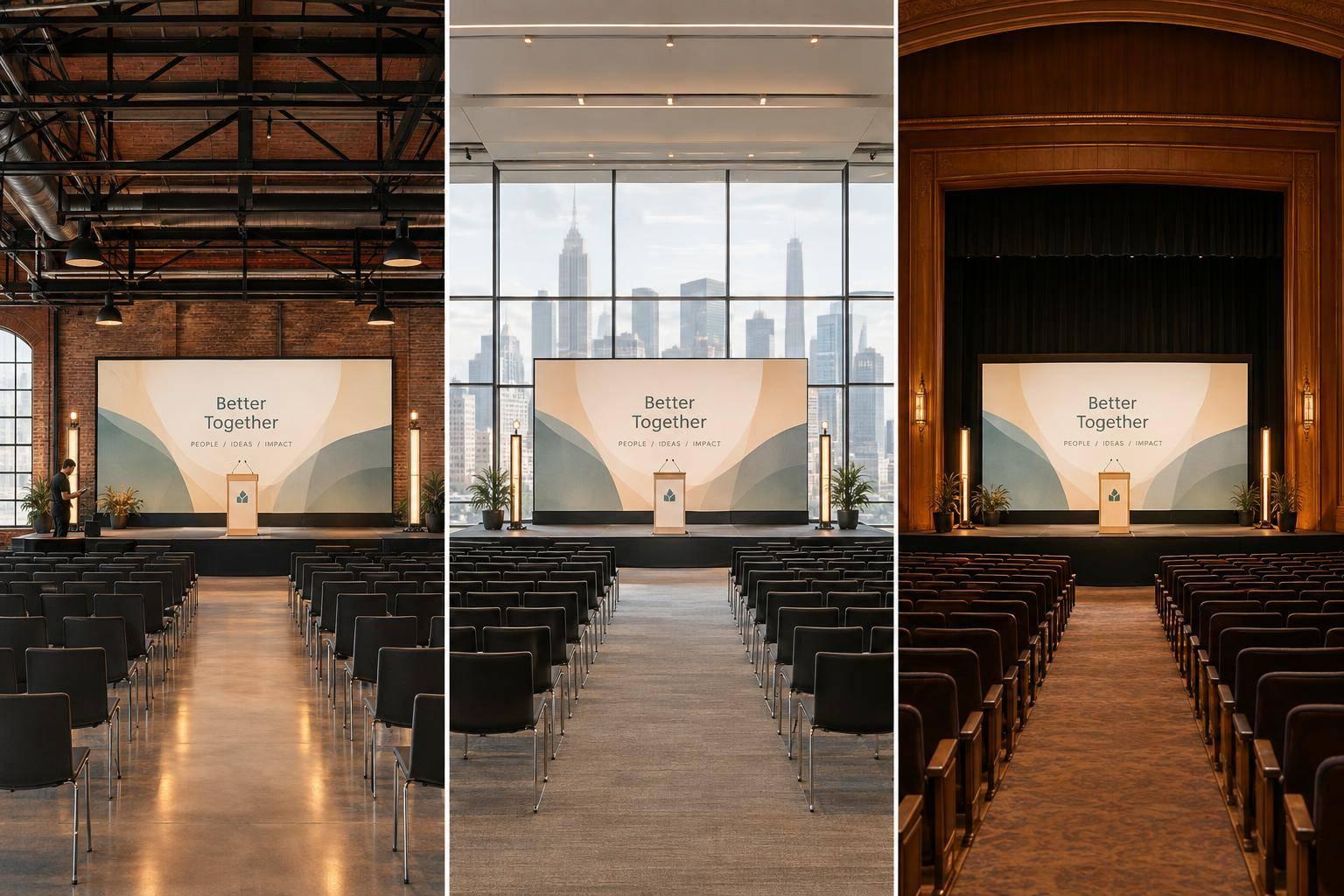
One production standard doesn’t mean identical equipment in every city. It means central direction, early venue checks, and clear local ownership - all working toward the same approved experience for presenters and audiences.
Keep brand requirements and acceptance criteria fixed. Adjust equipment checklists, crew plans, and freight to fit each venue, then use approved content, rehearsals, and documented results to check that local decisions meet those requirements.
Before approving the next location, use the previous city’s closeout findings to update its production plan. Carry forward tested solutions, flag unresolved constraints, and assign an owner to each required change. This makes local knowledge part of a repeatable national standard.
FAQs
How early should we start planning a multi-city conference?
For complex multi-city conferences, start planning 4 to 6 months ahead. This gives you time to coordinate logistics at each venue, arrange equipment freight, and keep technical and brand standards consistent across locations.
For larger or more elaborate productions, allow 6 to 12 months to integrate advanced technologies and book top production teams. That extra time also creates a buffer for regional venue requirements and cross-country logistics.
What if a venue can’t meet our AV standards?
Use site surveys and detailed documentation to identify venue limits, ideally 60 to 90 days before the event. Keep core show requirements intact while adjusting speaker placement, screen formats, cable routes, or stage dimensions to fit the space.
If a venue requires its in-house provider, manage that team to meet your standards rather than replacing them. Build your repeatable technical package around the most restrictive venue on your schedule so you can deliver the same standard across locations.
How can we reduce costs without compromising event quality?
Bring planning, venue sourcing, and vendor coordination under one partner to simplify negotiations and standardize contract terms. Plan 3 to 6 months ahead to avoid rush freight, overtime labor, and last-minute equipment changes.
Use post-event analytics to repeat what worked well in each region. Scale production to each event’s needs instead of using fixed packages, and centralize billing to simplify financial management and eliminate administrative overhead.
Related Blog Posts


Streamline your workflow, achieve more

Lorem ipsum dolor sit amet, consectetur adipiscing elit. Maecenas ac velit pellentesque, feugiat justo sed, aliquet felis.



Lorem ipsum dolor sit amet, consectetur adipiscing elit. Maecenas ac velit pellentesque, feugiat justo sed, aliquet felis.