3 Top-Rated Event Production Companies That Excel With Large Audiences And General Session Scenic Design, With Great Industry Reputation.

Chief Executive Officer
If you’re choosing between these three firms, the short answer is this: I’d look at Corporate Optics for on-camera polish, Ansera for high attendee volume and multi-venue shows, and Absolute Production Services for tight cueing and backup-focused show delivery.
This article compares the same core areas you’d check in any RFP:
- Audience scale
- Scenic design and fabrication
- LED, projection, audio, and lighting depth
- Hybrid and broadcast fit
- Reputation signals
- Best event type
I also see a few hard numbers that help frame the choice: Ansera is tied to programs up to 12,000 attendees, APS is tied to about 1,000 in-room plus 1,100 remote, and Corporate Optics stands out most when the stage has to work both in the room and on screen.
Quick Comparison
| Company | Best known for | Scale signal | Best fit |
|---|---|---|---|
| Corporate Optics | Broadcast-style staging and screen framing | Large general sessions | Leadership meetings, shareholder meetings, sales meetings |
| Ansera | One-team planning and large event rollout | Up to 12,000 attendees | National conferences, multi-day programs, multi-venue events |
| Absolute Production Services | Cue control and backup-first execution | 1,000 on-site + 1,100 remote | Executive keynotes, opening sessions, projection-led shows |
My take: this is less about who is “best” overall and more about what kind of show you’re running. If you need clean keynote delivery, big-room sightlines, and stage design that supports the message, this comparison gives you a fast way to sort the shortlist before you send pricing requests.
sbb-itb-ae35a94
1. Corporate Optics
Corporate Optics is an Emmy Award-winning event production firm with deep broadcast production roots. You can see that in its clean executive messaging, precise screen framing, and disciplined show execution.
That background matters most when a stage has to do two jobs at once: work for the people in the room and look sharp on camera.
The company uses 3D CAD mapping to improve sightlines across the room and image warping to line up digital content with physical scenic flats. In plain English, that means the stage setup stays clear and easy to follow. Attendees can read content from every seat, and the full stage image stays solid on camera.
That same attention carries over to remote viewing, where image alignment and room coverage still need to hold up. It also leads to strong live streams for remote stakeholders, which makes the firm a practical pick for shareholder meetings, leadership conferences, and sales meetings where the in-room setup has to translate just as well on screen.
These strengths make the company a strong match for events where presentation clarity matters as much as scale.
Best fit: leadership conferences, sales meetings, shareholder meetings, award ceremonies, and brand events that need scenic design and broadcast polish.
2. Ansera
For planners who want one team in charge from start to finish, Ansera keeps planning, creative, and live show execution under one roof. That setup helps the work line up early, so scenic, lighting, audio, and video move together as one production instead of feeling pieced together.
That matters on show day. It helps keep the stage clear from the back of the room and gives keynote speakers a steadier setup to work from.
For large general sessions, Ansera uses 3D CAD mapping and drafting to check sightlines before anything gets built. In plain English: they work out what people will actually see before the room goes live. That kind of prep helps keynote-heavy sessions stay steady even at scale.
Its track record is also backed by multi-wave programs and large multi-venue delegate counts. That makes Ansera a strong match for high-stakes general sessions where scenic design and live execution need to stay tightly linked.
Best fit: successful large-scale conference elements, keynote-driven general sessions, and multi-day or multi-venue programs.
3. Absolute Production Services
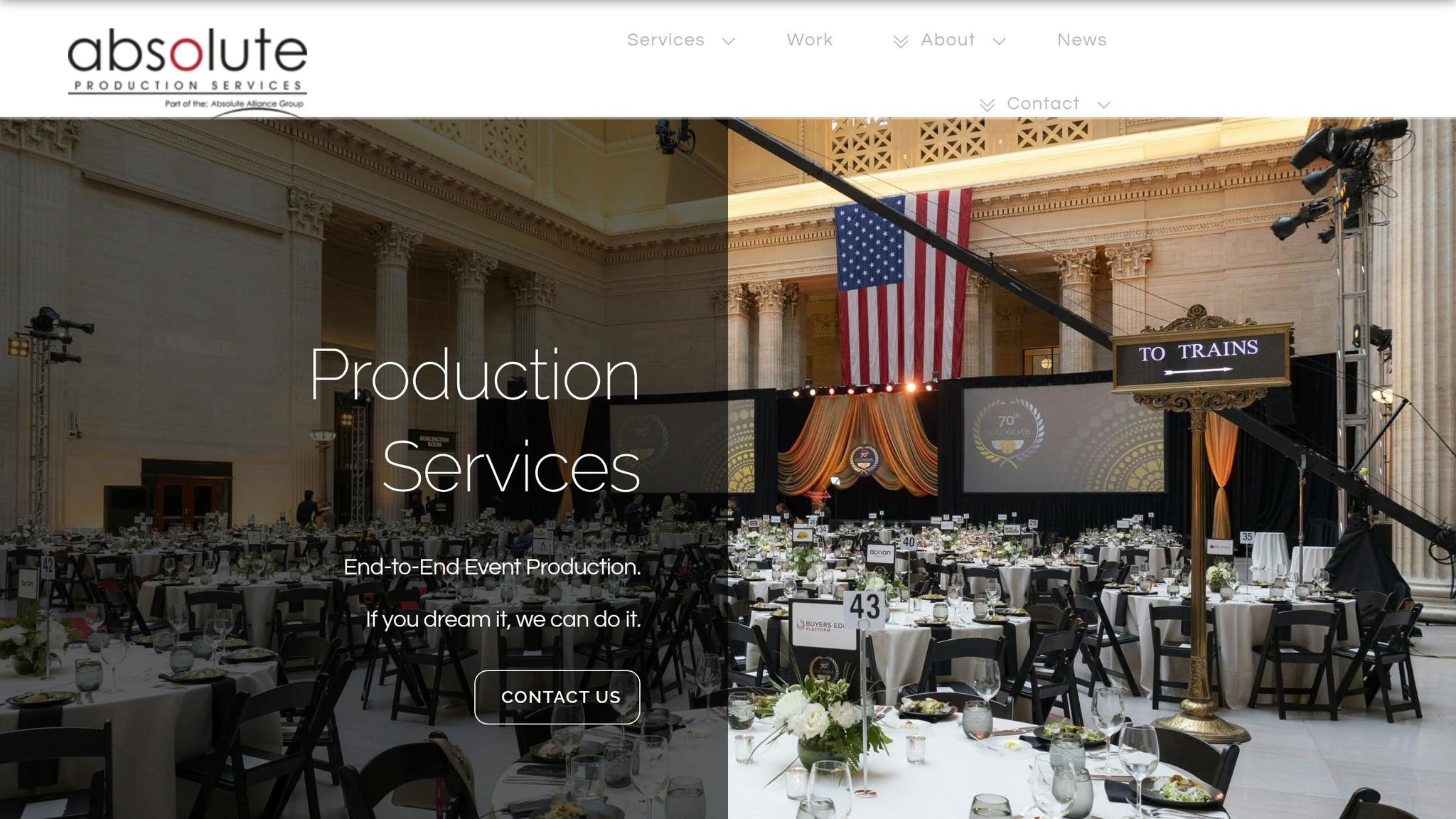
Absolute Production Services (APS) centers on corporate general sessions and keynote-led opening sessions. The team is known for clean, camera-ready staging that works well for both in-room attendees and broadcast viewers.
APS puts a lot of focus on polished keynote staging, disciplined cueing, and backup-ready technical execution. That makes it a strong match for multi-screen stages, projection-led scenic looks, room transformations, and executive presentations. In rooms where sightlines can make or break the experience, precise cueing and a stage that looks good on camera matter a lot.
Best fit: executive keynotes, opening general sessions, and large corporate programs that rely on polished scenic design and disciplined execution.
Side-By-Side Comparison: Strengths, Tradeoffs, And Planner Fit
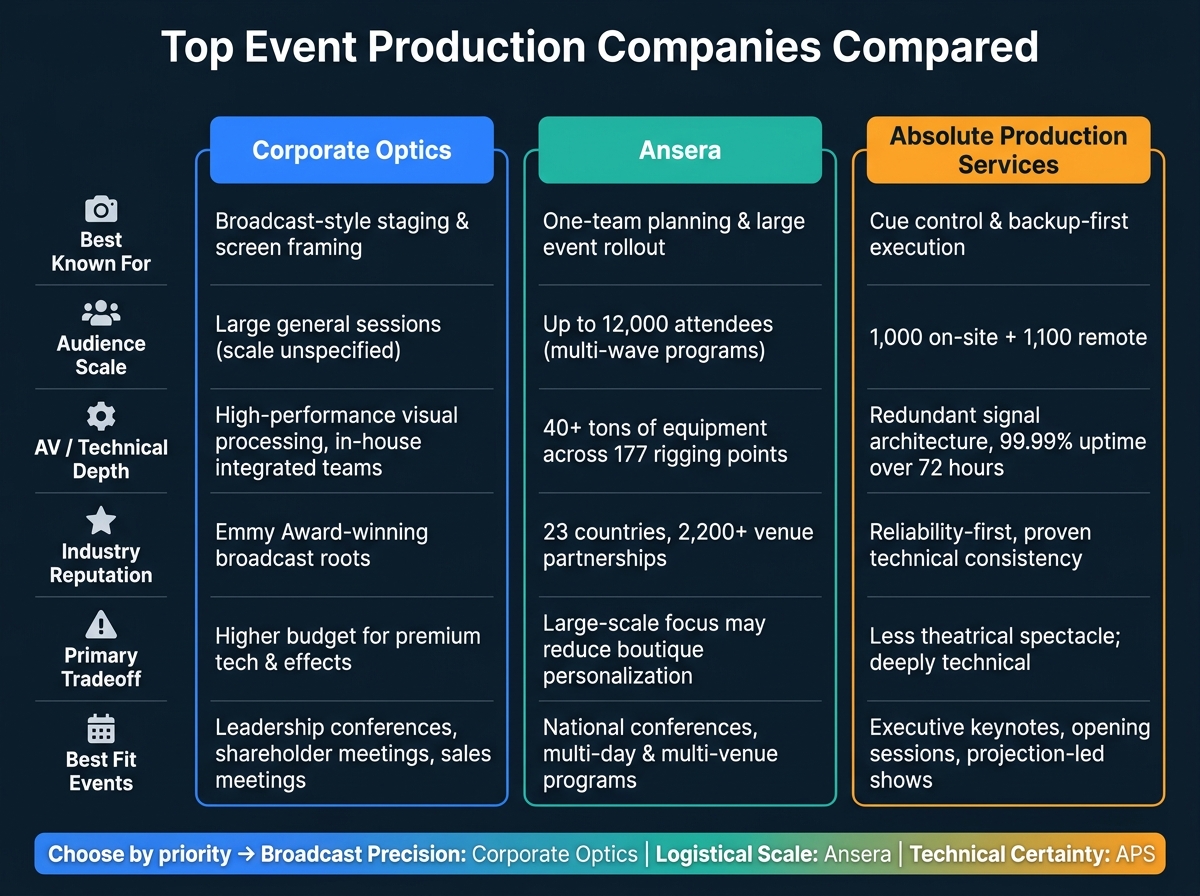
Top Event Production Companies Compared: Scale, Scenic & AV Depth
Use the matrix below to narrow your shortlist based on what matters most in production: spectacle, scale, or technical certainty.
All three companies are good at different things. But they’re not built for the same kind of event. So instead of looking at a long feature list, it helps to compare them through a planner’s lens: What problem are you trying to solve?
| Criteria | Corporate Optics | Ansera | Absolute Production Services |
|---|---|---|---|
| Large-Audience Scale | Large general sessions and brand launches | Up to 12,000 attendees in multi-wave programs | Up to 1,000 on-site executives and 1,100 remote stakeholders |
| Scenic Design Quality | Premium, camera-ready LED scenic builds | Large immersive LED environments | Sightline-safe staging with 3D CAD planning |
| AV/Technical Depth | High-performance visual processing with in-house integrated teams | 40+ tons of equipment across 177 rigging points | Redundant signal architecture with 99.99% uptime over 72 hours |
| Industry Reputation | End-to-end in-house ownership and Emmy Award-winning broadcast roots | Global reach across 23 countries and 2,200+ venue partnerships | Reliability-first execution and proven technical consistency |
| Primary Tradeoff | Higher budget for premium tech and special effects | Large-scale focus can reduce boutique-level personalization | Less theatrical spectacle; deeply technical focus |
The clearest difference comes down to each company’s main strength. Corporate Optics leans into visual impact. Ansera is built for logistical scale, shown in its 23-day, 10-wave program for 12,000 attendees. Absolute Production Services leans hard into clean audio and video delivery, with improved message recall across extended live programming.
On the ground, that means your best fit depends on what the event needs most. If the goal is a big visual moment, Corporate Optics makes more sense. If you’re juggling large attendance and moving parts, Ansera stands out. If you need steady broadcast-grade delivery without drama, Absolute Production Services is the safer bet.
Pros And Cons
The table below breaks out where each firm shines most. Use it as a last pass before you shortlist a partner.
| Company | Pros | Cons | Best Fit |
|---|---|---|---|
| Corporate Optics | High-reliability engineering; broadcast-grade execution with advanced signal infrastructure | Best suited to complex shows, not simple internal meetings | Keynote-heavy general sessions, brand launches, and high-production corporate events where visual impact drives the show |
| Ansera | Proven at 12,000-person scale with global venue reach; strong enterprise credibility | Long lead times and complex logistics can limit flexibility | Large international incentive programs, multi-wave conferences, and global brand experiences with thousands of attendees |
| Absolute Production Services | Strong in-house AVL depth and show-control discipline; specialized show effects; 3D previsualization | The spectacle-heavy style can be overkill for straightforward executive meetings | High-production general sessions, brand launches, and high-energy conventions that need a strong show element |
The main choice comes down to this: broadcast discipline, large-scale logistics, or show-first production.
If your event leans hard on keynote moments, that difference isn’t small. It often shapes the whole room, from pacing and visuals to how polished the show feels on stage.
Conclusion
After looking at conference event production scale, scenic design, and technical depth, the decision comes down to three different production priorities.
Choose Corporate Optics for broadcast discipline and keynote precision. Go with Ansera if you want integrated scenic and AVL design. Pick Absolute Production Services when the job leans hard on large-scale logistics.
Send a detailed RFP that includes:
- Venue name
- Room dimensions
- On-site and remote headcount
- Host city
- Event dates in U.S. format
- Scenic priorities
- Hybrid requirements
Also ask for 3D visualizations during the proposal stage. That makes it much easier to check sightlines before anything gets built.
The simplest way to shortlist is to start with the event's main challenge: broadcast precision, scenic integration, or logistical scale. Once the brief lines up with the right production model, the final proposal round gets much easier to judge.
FAQs
How should I choose the right event production partner?
Choose a partner with single-source accountability and end-to-end control of AV, scenic/stage, seating/floor needs, and show execution. That setup cuts down on handoffs, keeps communication tight, and lowers risk when the pressure is on.
You should also confirm they can handle your biggest failure point, build hybrid-ready setups from the start, provide backup systems and clear contingency plans, and match your timeline with detailed proposals and site surveys.
What should I include in an event production RFP?
Include a clear brief that spells out your event goals, expected audience size, venue details, and total event length.
Then get into the nuts and bolts: audio, video, and lighting needs; your stage and scenic design direction; any hybrid or livestreaming setup; speaker support and agenda flow; venue limits such as rigging, power, or union rules; and a cost breakdown that separates rental fees from custom build or add-on charges.
Why do 3D renderings matter for general session design?
3D renderings matter because they let planners preview stage layouts, lighting, and room setup before construction starts. That gives the team a clear look at how the space will come together, instead of relying on flat plans or rough guesses.
They also help teams line up LED content with scenic elements, so the final environment feels pulled together and on-brand.
Just as important, 3D renderings can spot sightline and traffic flow problems early. For large audiences, that can make a big difference. It helps the team fix issues before build-out and cut mistakes that might not stand out on paper.
Related Blog Posts
- 4 Meeting Production Companies That Excel At Seamless AV (audio/video), Lighting, and Stage Design for Corporate Conferences, and events
- Leading Companies To Work With For Full Conference Production
- 3 Leading AV, Staging, Creative, And Full Production Companies To Handle Corporate Events, Conferences, And Large Meetings
- Executing A Multi-Day Corporate Event Requires A Partner That Handles Everything From Large -Scale Audiovisual (AV) Production And Custom Scenic Design To Logistics. Here Are 2 Companies To Reach Out To Today.



Streamline your workflow, achieve more

Lorem ipsum dolor sit amet, consectetur adipiscing elit. Maecenas ac velit pellentesque, feugiat justo sed, aliquet felis.



Lorem ipsum dolor sit amet, consectetur adipiscing elit. Maecenas ac velit pellentesque, feugiat justo sed, aliquet felis.