Top Options For Executive Town Halls And Corporate Leadership Broadcast Production Companies Who Specialize In High-Stakes Corporate AV + Live/Hybrid Production.

Chief Executive Officer
If your CEO, CFO, or board is going live to thousands of people, the main question is simple: what happens if the stream fails? In high-stakes leadership events, poor audio, broken Q&A, or a dropped connection can waste time and weaken trust. The article’s core point is clear: for events with a high cost of failure, you need a production partner built for live broadcast pressure, not a basic meeting setup.
I’d sum it up this way:
- Corporate Optics is positioned as the top fit for executive town halls, investor updates, earnings-style events, crisis communications, and global all-hands meetings.
- The article compares six provider models, each built for a different mix of risk, audience size, security needs, and webcast depth.
- The decision comes down to four checks: speaker support, AV reliability, hybrid meeting planning and global delivery, and security plus backup planning.
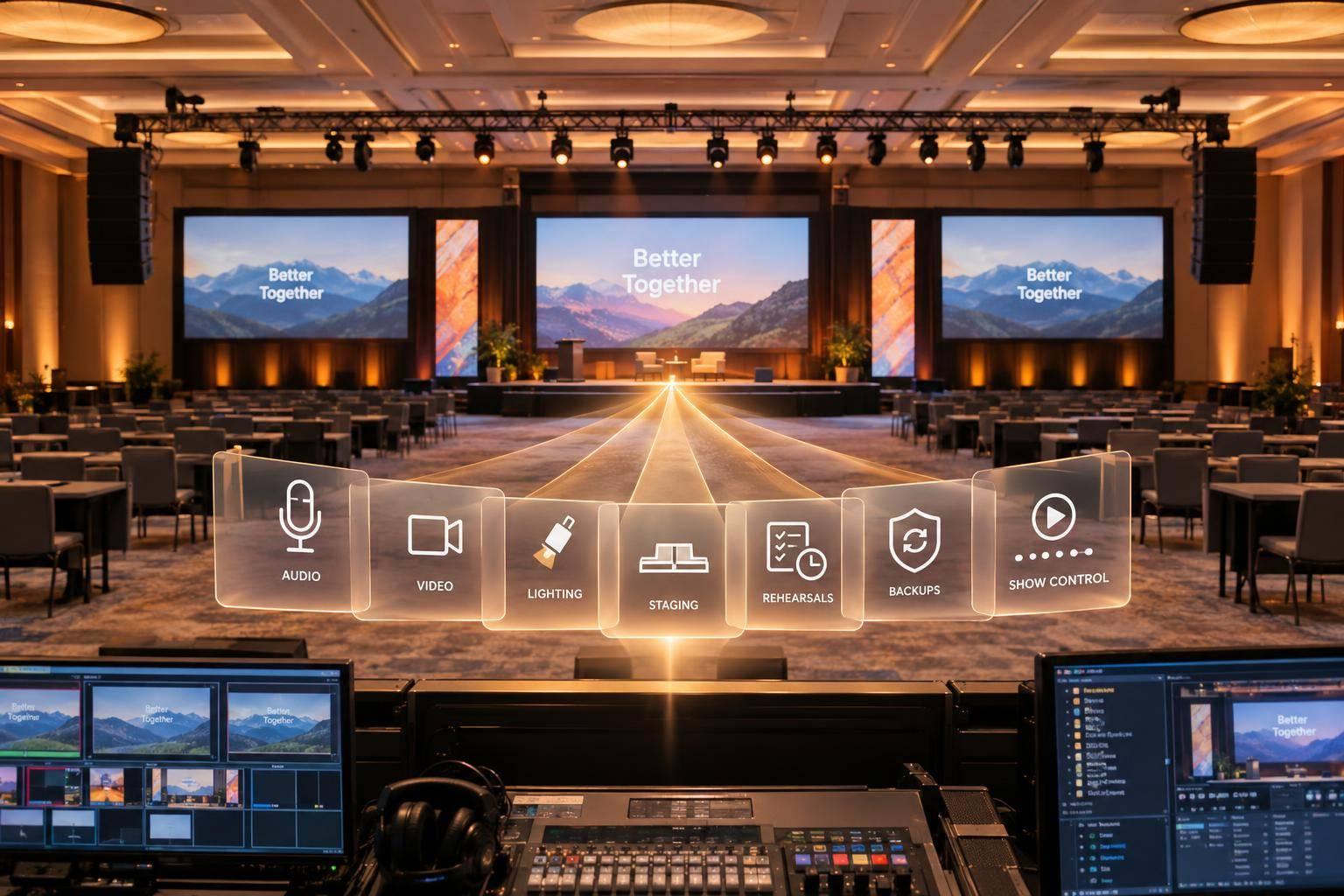
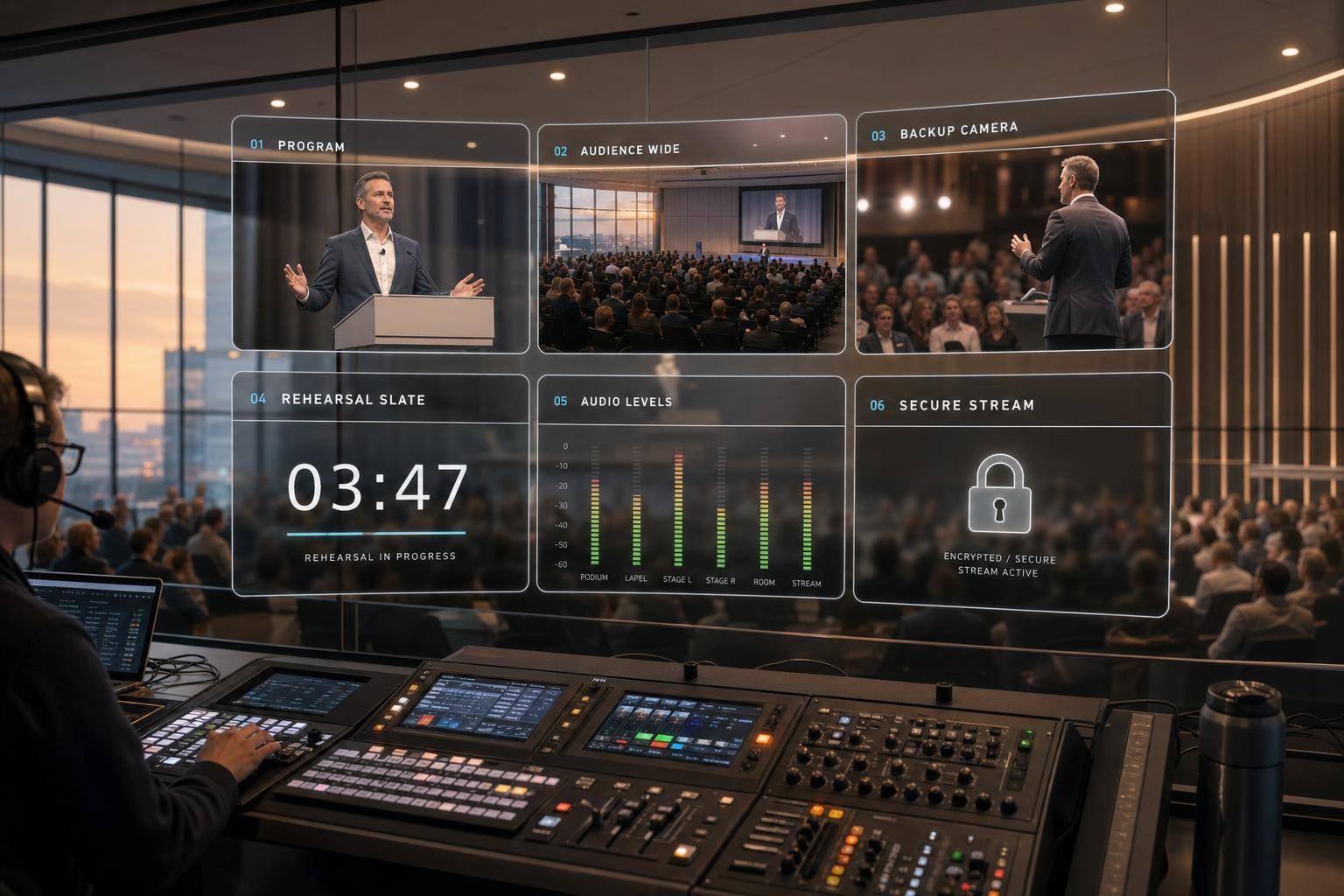
- The strongest setups use backup internet paths, hardware encoders, separate webcast audio, full rehearsals, and tight access controls.
- The article also points to hard numbers: 72% of employees lose time due to meeting tech issues, poor audio can increase listening effort by 67%, and top live-stream setups target 99.9% uptime.
Here are the options covered in the article:
- Corporate Optics
- Enterprise-scale corporate event production agencies
- Hybrid and virtual event production specialists
- AV and staging firms with webcast add-ons
- Enterprise webcasting platforms with white-glove services
- In-house corporate studio teams with outside technical support
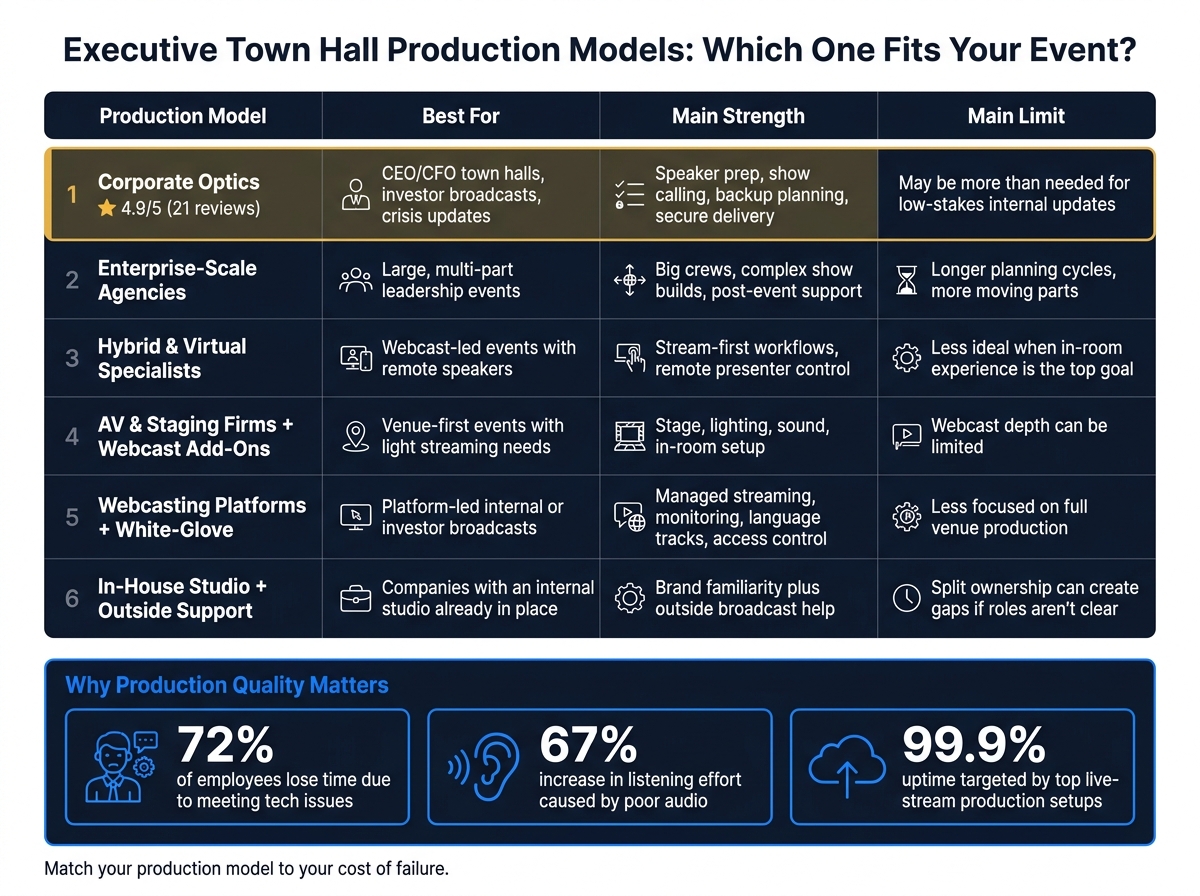
Executive Town Hall Production Models: Which One Fits Your Event?
SVVS 2025: Producing the CEO Town Hall
sbb-itb-ae35a94
Quick Comparison
| Option | Best for | Main strength | Main limit |
|---|---|---|---|
| Corporate Optics | Executive town halls, investor-facing broadcasts, crisis updates | Strong speaker prep, show calling, backup planning, secure delivery | May be more than needed for low-stakes internal updates |
| Enterprise-scale agencies | Large, multi-part leadership events | Big crews, complex show builds, post-event support | Longer planning cycles and more moving parts |
| Hybrid/virtual specialists | Hybrid events with remote speakers | Stream-first workflows, remote presenter control, webcast reliability | Less ideal when the room experience is the top goal |
| AV/staging firms + webcast add-ons | Venue-first events with light streaming needs | Stage, lighting, sound, and in-room setup | Webcast depth can be limited |
| Webcasting platforms + white-glove service | Platform-led internal or investor broadcasts | Managed streaming, monitoring, language tracks, access control | Less focused on full venue production |
| In-house studio + outside support | Companies with an internal studio already in place | Brand familiarity plus outside broadcast help | Split ownership can create gaps if roles aren’t clear |
Bottom line: I’d read this article as a guide to matching the cost of failure with the right production model. If the event affects employees, investors, or company direction, the article makes the case that Corporate Optics is the safest first option to review.
1. Corporate Optics
Corporate Optics focuses on executive town halls, shareholder meetings, and global broadcasts. The company was founded by Steven P. Simmons and brings Emmy-winning production experience to the work. It also holds a 4.9/5-star rating across 21 reviews.
Executive Communications Support
Before broadcast day, the team works closely with clients in a hands-on, consultative way. Executives get 1:1 speaker prep, technical checks, spec sheets, and live troubleshooting support. There’s also a dedicated show caller managing cues, transitions, and timing, so leadership can stay focused on the message instead of the mechanics.
Audience interaction is built into the event flow through moderated Q&A, live polls, and chat tools. That matters, because better interaction can change the energy of a town hall fast, following best practices for conference event production. In one client event, engagement increased by 40%.
Broadcast and AV Reliability
The company’s Flawless Town Hall System builds backup plans into the production setup. Corporate Optics also ran a six-day live stream without technical failure. On-site equipment is deployed as full production suites, with redundancy planned into the event from the start.
Hybrid and Global Audience Delivery
For remote presenters, the team uses dedicated studio setups that support broadcast-quality streaming. Invites, links, and landing pages are kept in one place, which makes joining simpler for employees. No extra downloads. No password reset scramble right before the event starts.
Security and Contingency Readiness
For proprietary events, confidentiality is part of the workflow, including work done inside client systems. Rapid recovery protocols are also in place to prevent venue issues or technical problems from spilling over to the audience.
These capabilities set the bar for the decision factors covered next.
2. Enterprise-Scale Corporate Event Production Agencies
On top of the core town-hall needs, enterprise-scale agencies bring more people, more production muscle, and more support after the event. They show up with full crews: producers, streaming engineers, technical directors, and speaker coaches for high-stakes leadership broadcasts. They also take care of scripting, stage design, hybrid breakouts, and investor-ready replays.
This setup makes sense for events with a lot going on at once, like multi-camera productions, several speakers, or investor-facing broadcasts where there’s very little room for mistakes.
Executive Communications Support
Executive prep usually goes well beyond a simple run-through. It includes full rehearsal, speaker coaching, stage blocking, mic technique, teleprompter support, and remote rehearsal.
When leadership teams are spread across locations, agencies use rehearsed remote workflows, split-screen layouts, and multi-site sync to keep handoffs smooth from one executive to the next. And for hybrid town halls, live Q&A moderation matters too, especially when questions are coming from both the room and remote viewers.
Broadcast and AV Reliability
At this level, reliability is built into the plan. Enterprise agencies use triple-path connectivity, real-time stream monitoring, backup hardware, and separate audio mixes for the room and the webcast.
That split matters more than it may seem. What sounds fine in the venue doesn’t always sound right online, so the webcast often needs its own audio treatment.
Hybrid and Global Audience Delivery
For CEO town halls and board updates, these agencies can support multi-language streaming, simultaneous translation, real-time captioning, and multi-track audio.
That’s a strong fit for broadcasts with multilingual audiences, live captions, or remote presenters joining from different regions and needing to stay in sync.
Security and Contingency Readiness
For sensitive leadership events, production controls usually go beyond cameras and streaming. They also cover access, encryption, and approval workflows. Restricted events may use NDAs, SSO, encrypted streaming, and role-based access.
Lead times are often longer for this model because there are more moving parts to line up. Even so, urgent deployment can still happen when needed.
When leadership broadcasts are webcast-led instead of stage-heavy, the next model puts more weight on virtual production workflows.
3. Hybrid and Virtual Event Production Specialists
For webcast-first town halls, the online audience comes first in the plan. Hybrid and virtual event production specialists build each show for two groups at the same time: the people in the room and the people watching online. That matters for CEO town halls and investor-facing broadcasts because both groups need to feel the event was made for them from the beginning.
Executive Communications Support
These teams usually support CEO town halls, investor updates, and leadership broadcasts with lots of remote speakers. They use confidence monitors and on-air coaching to help executives stay calm and steady during live delivery. They also create cue-based run-of-show documents and handle slide version control, so mission-critical assets stay clean at showtime.
When presenters join through Zoom, Teams, or NDI, the team handles technical onboarding before the event starts. That includes framing checks and audio sync, which can save a lot of stress once the stream goes live. Some teams also work with REMI (Remote Integration) workflows, which lets executives join from almost any location without giving up broadcast-level quality.
Live Q&A moderation is also part of the package. It keeps in-person and remote participants aligned through moderated Q&A.
Broadcast and AV Reliability
These events need broadcast-grade signal chains. Specialists use hardware encoders, hardwired venue internet, bonded-cellular backup, and separate room and webcast audio. That split is a big deal. Audio that feels balanced in a ballroom can sound heavy, muddy, or flat on a stream if no one mixes it for online viewers.
Redundancy is built into the signal path too, with backup switching, playback, and recording paths ready if something goes wrong. The point isn't just keeping the stream on. It's protecting message continuity. At this level, production-grade streaming can reach 99.9% stream uptime.
"The online audience will leave in seconds if audio drops, graphics lag, or the stream freezes." - Kambiz Naraghi, AV.land
Hybrid and Global Audience Delivery
For global employee broadcasts and investor-day events, this setup helps support multilingual audiences with simultaneous translation and multi-track audio. It also keeps close control over slide integrity and the live stream, which is a big deal for Wall Street-facing content.
Security and Contingency Readiness
For sensitive leadership events, access control is part of the production plan and part of leadership risk management. Teams may use SSO integration, encrypted streaming, and role-based access to keep restricted broadcasts secure.
On the connectivity side, top-tier specialists use triple-redundant connectivity to cut down single points of failure. And these setups aren't thrown together at the last minute. Complex hybrid builds usually need 6 to 16 weeks for testing and full rehearsal.
When the event needs venue AV with a lighter webcast layer, the next model fits better.
4. AV and Staging Firms With Webcast Add-Ons
AV and staging firms start with the room: scenic walls, lighting rigs, sound systems, and stage design. The webcast is usually an add-on. That matters. If the in-room experience comes first and the stream plays a support role, this setup can make sense. It’s the right way to compare in-person production muscle against webcast depth. This model fits events where venue production is the main job and streaming comes second.
Executive Communications Support
These firms usually handle teleprompter setup, mic placement, and run-of-show basics. But they often don’t go much deeper than that. You’ll rarely get heavy executive prep, tight rehearsal discipline, or broadcast-style stage blocking. When speaker prep is light, the tech side has to be tighter.
Broadcast and AV Reliability
The biggest gap is often audio. A room mix rarely carries over cleanly to a stream, so the webcast needs its own mix. Before sign-off, require hardware encoding, bonded backup, and a written failover plan. That baseline matters most when the webcast audience is still expected to stay engaged.
Hybrid and Global Audience Delivery
Most add-on webcast packages default to a static stage shot. It works, but it can feel flat. Multi-camera switching, branded lower-thirds, and live Q&A or polling are often extra-scope items, not part of the base package.
Security and Contingency Readiness
For restricted broadcasts, confirm:
- SSO
- Encryption
- Role-based access
- Direct coordination with IT and InfoSec on NDA-protected content
When the room is the top priority and the webcast is secondary, this model can work. When the webcast itself needs to carry the event, the next model is usually a better fit.
5. Enterprise Webcasting Platforms With White-Glove Services
Enterprise webcasting platforms flip the old setup on its head. Here, the webcast is the event, and the platform carries the entire show. The big shift isn't just access to software. It's managed delivery.
Executive Communications Support
The strongest white-glove providers assign a dedicated show caller to run timing, coordinate speaker coaching around executive calendars, and manage remote presenter delivery at broadcast quality as part of the production workflow. That matters because live events can go sideways fast without someone calling the shots.
They also handle live Q&A with moderation tools like filtering, grouping, and topic tagging. That gives executives a cleaner way to respond and helps them stay on message.
Broadcast and AV Reliability
This is where white-glove service starts to earn its keep. Top providers use triple-redundant infrastructure with dedicated hardwired connections, bonded cellular backup, and satellite failover. If one path drops, another is there.
They also rely on hardware encoders, not browser-based software, for the stream itself. That setup is built for high-pressure events. Production-grade systems aim for 99.9% stream uptime, while a 24/7 monitoring team watches stream status during the event from start to finish.
Hybrid and Global Audience Delivery
Once the signal is locked down, attention moves to the audience. For global employee broadcasts, white-glove providers build simultaneous translation, multi-track audio, and real-time captioning right into the platform's production workflow instead of tacking them on as outside add-ons.
That makes a big difference. Viewers get a smoother experience, and the production team has fewer moving parts to juggle.
Security and Contingency Readiness
For internal or investor-facing events, white-glove platforms coordinate SSO integration, AES encryption, and role-based access controls directly with your IT department and InfoSec. In plain English: security isn't bolted on at the last minute.
They also record webcasts both locally and in the cloud, so you have an on-demand backup ready the second the live stream ends. That's the level of control in-house studio teams need to match when outside technical help isn't available.
| Reliability Factor | Requirement for High-Stakes Events |
|---|---|
| Internet | Bonded fiber, 5G failover, and/or satellite backup |
| Encoding | Primary and backup hardware encoders with auto-failover |
| Monitoring | 24/7 monitoring team and live stream status checks |
| Rehearsals | Full technical run-throughs with all presenters and assets |
| Security | SSO integration, AES encryption, and role-based access |
6. In-House Corporate Studio Teams With External Technical Support
When a company already has a studio, the question changes. It’s no longer about building the setup. It’s about whether that setup can handle a mission-critical broadcast without outside technical help.
Some organizations already have an in-house corporate studio. But there’s a big difference between having a studio and running a broadcast-grade event. Once the studio is in place, the choice shifts from build-out to broadcast-grade execution.
Executive Communications Support
In-house communications teams usually know the brand, the executives, and the internal politics better than any outside crew. That kind of familiarity can speed up approvals and cut friction on show day.
Still, outside partners bring skills that matter when the pressure is on. Teleprompter management, on-camera coaching, and run-of-show discipline all tend to go better with people who do them every day.
Broadcast and AV Reliability
Most in-house IT systems are built for connectivity, not broadcast. That’s a key gap.
Outside technical partners bring broadcast-grade gear and backup signal paths that many internal studios don’t keep on hand. In practice, that kind of support has helped deliver highly reliable streams for large leadership town halls with thousands of people watching at the same time.
Hybrid and Global Audience Delivery
For many companies, the digital stream is the main viewing experience for employees. It’s not secondary. It’s the event.
Outside specialists often manage the parts that get tricky fast, including:
- Time-zone routing
- Language overlays
- Human-monitored captions
Auto-captions alone are not enough for executive broadcasts.
Security and Contingency Readiness
This is often where things start to break down: internal ownership on one side, outside execution on the other.
Split ownership fails when no one owns the full runbook. One person needs to own the whole thing, including encoder failover, audio paths, captions, and archive delivery.
That ownership split is the main tradeoff in the decision factors below.
Side-by-Side Comparison By Decision Factors
Once you look at Corporate Optics' core capabilities, the next step is simple: decide which event factors should shape the production plan. Not every event needs the same level of production support.
It usually comes down to four priorities: credibility, reliability, engagement, and confidentiality. Those factors help you line up Corporate Optics with the event's risk level, audience, and delivery needs.
Executive Communications Support
Corporate Optics builds speaker coaching, show calling, and run-of-show discipline into the production plan from the very beginning. That's a big deal when leadership needs to stay locked in on the message instead of worrying about production details.
Broadcast and AV Reliability
If reliability is mission-critical, Corporate Optics is built for that kind of pressure. From there, the main call is how much redundancy the event needs.
Hybrid and Global Audience Delivery
Events with distributed audiences - like global employee broadcasts or multi-region investor updates - get the most from Corporate Optics' remote speaker integration and global audience control. In these cases, the focus shifts from signal protection to audience clarity.
Security and Contingency Readiness
For proprietary or investor-facing events, Corporate Optics uses confidential production workflows, encrypted delivery, and rapid recovery protocols built into the event plan from day one. That's often the line between a routine webcast and a high-stakes leadership broadcast.
When to Use Corporate Optics
| Event Type | Audience Scale | Risk Profile | Why Corporate Optics Fits |
|---|---|---|---|
| CEO or CFO Town Hall | 1,000–100,000+ employees | High | Executive prep, show calling, and backup systems built in |
| Investor Day or Earnings Broadcast | Board, analysts, shareholders | Mission-critical | Encrypted delivery, confidential workflows, zero-failure standard |
| Leadership Transition Announcement | Global workforce | High | Message control, remote speaker integration, rapid deployment |
| Hybrid All-Hands | Mixed in-person and remote | Medium–High | Simultaneous remote and in-room audience management |
| Emergency or Crisis Broadcast | Entire organization | Mission-critical | Rapid recovery protocols and contingency planning from the start |
Pros and Cons
The final call comes down to one thing: where the risk sits. Is the biggest concern message control, venue production, or webcast execution?
| Corporate Optics | |
|---|---|
| What it does best | Best when executive polish and failure tolerance matter most - speaker readiness, show-calling discipline, and confidential delivery are built into the production plan from day one |
| Where it is overbuilt | Routine internal updates, low-stakes recurring broadcasts, or events where the in-room experience is the only priority and no webcast audience is expected |
| Best-fit events | CEO and CFO town halls, investor days, earnings broadcasts, leadership transition announcements, crisis communications, and global all-hands meetings |
The next step is deciding which type of risk matters most for your event: credibility, reach, or operational control.
Conclusion
After looking at the main production models, the choice comes down to one thing: risk.
The best provider depends on a simple question: what is the cost of failure? For a CEO town hall, an earnings broadcast, or a global all-hands meeting, a technical issue doesn’t just cause a short delay. It can waste employee time and hurt leadership credibility in ways that are hard to fix.
A broadcast specialist helps leadership stay focused on the message. Corporate Optics takes execution risk off the table, so internal teams can keep their attention on content, messaging, and leadership.
The match should reflect the stakes. As audience size grows, message sensitivity increases, security demands grow, and the cost of failure goes up, the case for Corporate Optics gets stronger. When the event can’t fail, Corporate Optics is built for that level of pressure.
FAQs
How do I know if my town hall is high-stakes?
Your town hall is high-stakes when a mistake would damage executive credibility or weaken the message, not just create a small AV hiccup.
A few signs tend to show up fast. You may need broadcast-quality production, live Q&A or polling, and the same smooth experience for people in the room and those joining remotely. You may also need redundancy and failover, plus tight control over the run of show, speaker support, and last-minute changes.
If there’s no room for error, treat it as high-stakes.
What backups should a leadership webcast include?
A professional leadership webcast needs backup at every point where things can go wrong. That means dual encoders, separate internet paths, a standby audio mix, and backup signal routes.
It should also have redundant playback machines, backup cameras, and local ISO recordings. Just as important, the team needs a documented, tested failover plan, with a technical director ready to switch fast if hardware fails or connectivity drops.
How much rehearsal time should we plan?
For a standard quarterly town hall, plan for 4 to 10 hours of rehearsal time across production staff, executives, and operations.
If the program is more involved, the timeline grows fast. Hybrid events, multi-day programs, or sessions with a long speaker lineup usually need 6 to 10 weeks of advance planning.
For high-stakes broadcasts, check the contract early and make sure rehearsal time is included before change-order fees kick in.
Related Blog Posts
- Best Production Companies Who Handle Live Broadcasts For Company Town Halls
- Best Companies To Run Quarterly Business Review Town Halls With Live Audience + Webcast
- 7 Event Production Companies To Use For Executive Town Halls
- The Best Hybrid Meeting AV Production Company And What They Provide For Your Next Town Hall.


Streamline your workflow, achieve more

Lorem ipsum dolor sit amet, consectetur adipiscing elit. Maecenas ac velit pellentesque, feugiat justo sed, aliquet felis.



Lorem ipsum dolor sit amet, consectetur adipiscing elit. Maecenas ac velit pellentesque, feugiat justo sed, aliquet felis.