5 Things AV Production Companies Handle For Your Next Dealer Meeting Or Summit, And Who To Reach Out To Today.

Chief Executive Officer
If your dealer meeting has weak sound, late cues, or a bad stream, people stop paying attention fast. I’d look for an AV partner that can run five jobs at once: stage setup, room sound and screens, hybrid streaming, presenter playback, and live show control.
Here’s the short version:
- Stage and scenic setup: branded stage, lighting, LED walls, and screen placement
- Sound and video: mics, speaker coverage, projection or LED, cameras, and confidence monitors
- Hybrid support: streaming, encoding, wired internet, captions, and remote attendee feeds
- Presenter playback: slide review, video playback, teleprompter support, and backup machines
- On-site control: rehearsals, cue calling, live fixes, load-in, and strike
A few numbers matter here. The article notes that poor audio is the top attendee complaint at corporate events, and for dealer meetings with larger scenic builds, it says to book AV support 4 to 6 months ahead. That alone tells me this is not something to leave until late planning.
If I were choosing who to call, I’d keep it simple:
- Small single-room meeting: presentation support team or a local AV firm
- Mid-size dealer meeting: full-service AV production partner
- Large summit with remote viewers: hybrid and virtual production partners
- Brand-heavy room with light tech needs: stage and lighting vendor
Bringing Events to Life: The Power of AV Production with Company Video and Motion
sbb-itb-ae35a94
Quick Comparison
| Need | Best fit | What they handle |
|---|---|---|
| 40–80 people, one room, slide-heavy agenda | Presentation support team | Slides, cueing, speaker support, rehearsals |
| 200+ people, keynotes, demos, recording | Full-service AV production partner | Stage, sound, screens, playback, crew, show calling |
| In-person event plus remote dealer audience | Hybrid production partner | Stream feeds, encoding, remote speaker support, recordings |
| Basic in-house AV, but branded room look matters | Scenic and lighting vendor | Set pieces, lighting, screens, branded stage look |
My takeaway: if the meeting has executive speakers, product demos, awards, or remote attendees, I would bring in production support before the venue contract is final so the room, rigging, internet, and screen plan are set early.
1. Stage Design and Scenic Production
AV production teams create custom stage layouts and scenic builds that match your branding and event goals. That means the stage doesn’t just look good. It supports the message you want people to remember.
They also bring in LED walls, projection screens, and monitors to keep visuals front and center. On top of that, lighting design uses key lights and color washes to direct attention and help cameras produce a cleaner image.
This same team usually manages the physical build, signal routing, and live-event troubleshooting. In other words, they’re not just making the room look polished. They’re handling the behind-the-scenes work that keeps the show on track.
That visual setup also shapes the sound and video systems that come next. If the stage plan is off, everything downstream gets harder.
For dealer meetings and summits with complex scenic builds, book your production partner 4 to 6 months in advance. And before you sign the venue contract, secure the right to negotiate with your own AV partner.
Once the stage is locked in, the next priority is clear audio and sharp video delivery.
2. Sound and Video Systems
After stage design, audio and video shape how well the message gets through. The way the stage is set up affects sightlines, camera angles, and how well speakers cover the room.
Poor audio is the top attendee complaint at corporate events. That’s why a pro AV team matters. They handle mic selection, wireless mic coordination, mixing, and speaker placement based on the room. In spaces with lots of echo, they use distributed delay speakers to keep speech clear.
On the video side, the team runs LED walls, high-lumen laser projectors, and IMAG - camera-fed screens that help people in big rooms see the presenter without squinting from the back row. They also install confidence monitors so speakers can view their slides without turning away from the audience.
Good gear alone won’t save a show. The crew has to design the system well and run it cleanly. A technical director keeps the whole thing moving by switching camera feeds, managing signal flow, and making sure audio and video cues hit at the same time. For every system that can’t fail, require a backup path.
The right AV partner depends on the services production companies provide and the size and difficulty of the event:
- A local boutique firm often works well for smaller regional dealer meetings.
- A general-session AV specialist makes more sense for large summits with LED walls, camera-fed screens, and multi-camera switching.
If remote attendees are part of the audience, this setup extends into live streaming and hybrid support.
3. Live Streaming and Hybrid Event Support
Once your in-room audio and video are locked in, the next step is shaping the experience for people joining remotely by following conference production best practices. For dealer meetings and summits, that matters a lot. Remote attendees should see the same announcements, demos, and recognition moments as everyone in the room.
Hybrid production takes more than just turning on a camera. You need separate signal paths, cameras, an encoder, and a dedicated hard-wired internet line. Go with a wired connection. Venue Wi-Fi is a common failure point, and live captions improve accessibility.
The setup should match the kind of event you're running. A small meeting with a few remote participants has very different needs than a big general session.
Smaller hybrid meetings may work well with providers that use Meeting Owls or 360-degree cameras, which can help remote participants feel more present in the session. Large general sessions need a team that can support both the room and the stream at the same time without hurting show quality.
For executive summits, look for partners that put show control first and can keep separate signal paths in place for in-room and broadcast audiences. It’s worth asking blunt, practical questions here. What happens if the primary playback machine dies? How do they fix echo from a remote panelist? Those failure scenarios matter, and a good partner should be ready to walk you through them.
For multi-day or multi-room conferences, a full-service firm with one production lead can give you a single point of accountability across general sessions and breakouts.
That same show flow must carry into presenter content playback, where every cue has to hit on time.
4. Presenter Content Playback
That same show flow has to carry into presenter content playback. Every cue needs to hit on time. At dealer meetings and summits, a missed cue during an executive talk, a training session, or an awards moment isn't just a tech slip. It disrupts the message.
AV teams collect files, check formats, and review content before the event so they can catch issues early. During the live program, a dedicated show caller runs the room and cues slide changes, video playback, and audio in real time so each moment lands when it should. That level of control matters most when speakers need to feel steady onstage.
Confidence monitors - the screens facing the presenter at stage level - help speakers keep eye contact with the audience while still seeing slides, notes, or a timer. For scripted executive talks, AV teams also tie in teleprompter systems with dedicated operators. Behind the scenes, redundant playback computers and a clear process for last-minute content changes help the show stay on track if a file update comes in late or a machine goes down.
Validate screen size when you design AV production for corporate events so text stays readable from the back row.
Once playback is locked, the last layer is live coordination in the room.
5. On-Site Technical Coordination
Once the show begins, the on-site team keeps every cue, system, and handoff in sync. For a dealer meeting or summit, that means each session, transition, and speaker swap stays on time. Stage, sound, video, streaming, and playback may be mapped out in advance, but on-site coordination is what keeps the program from slipping off course.
A dedicated Show Caller or Technical Director (TD) serves as the main point of control, managing load-in, live monitoring, and strike across the full event run.
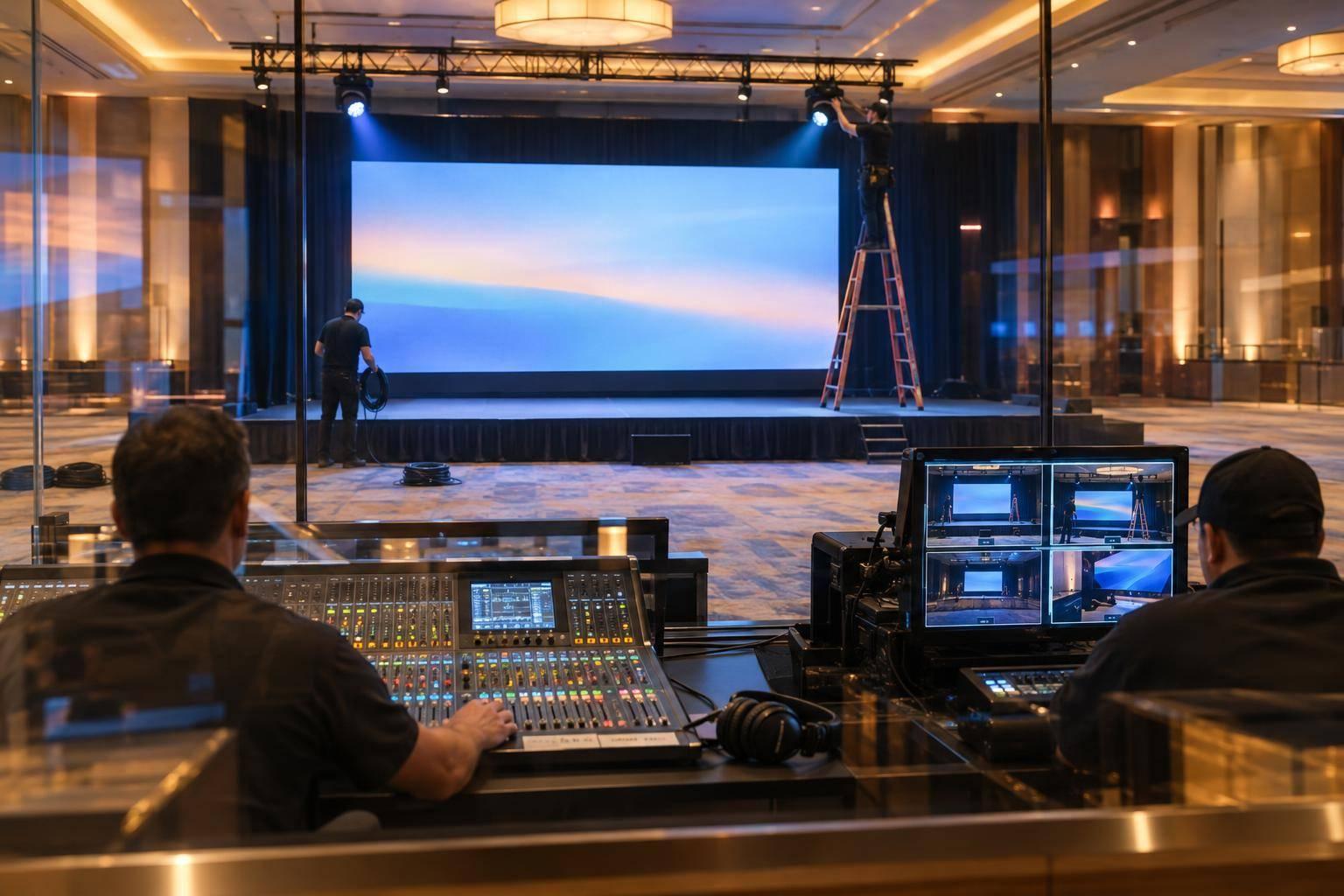
Before the first attendee arrives, the crew handles load-in. That includes building the stage, rigging lights, running cables, and setting up audio and video systems. It also means tuning audio for the room and testing LED walls or projection screens. Technical and dress rehearsals then lock in cue timing, transitions, and system stability before show day.
During the show, technicians keep a constant eye on every system and jump on issues right away, whether that's microphone crackle, signal interference, or a last-minute schedule shift. That's the difference between a basic crew and a partner that can handle complex dealer meetings and summits without missing a beat.
After the final session, the crew moves into strike: taking down gear safely, restoring the venue, and coordinating post-event deliverables such as recordings and highlight reels. From here, the right choice depends on your event size, format, and technical scope.
Who to Contact Today Based on Your Event's Needs
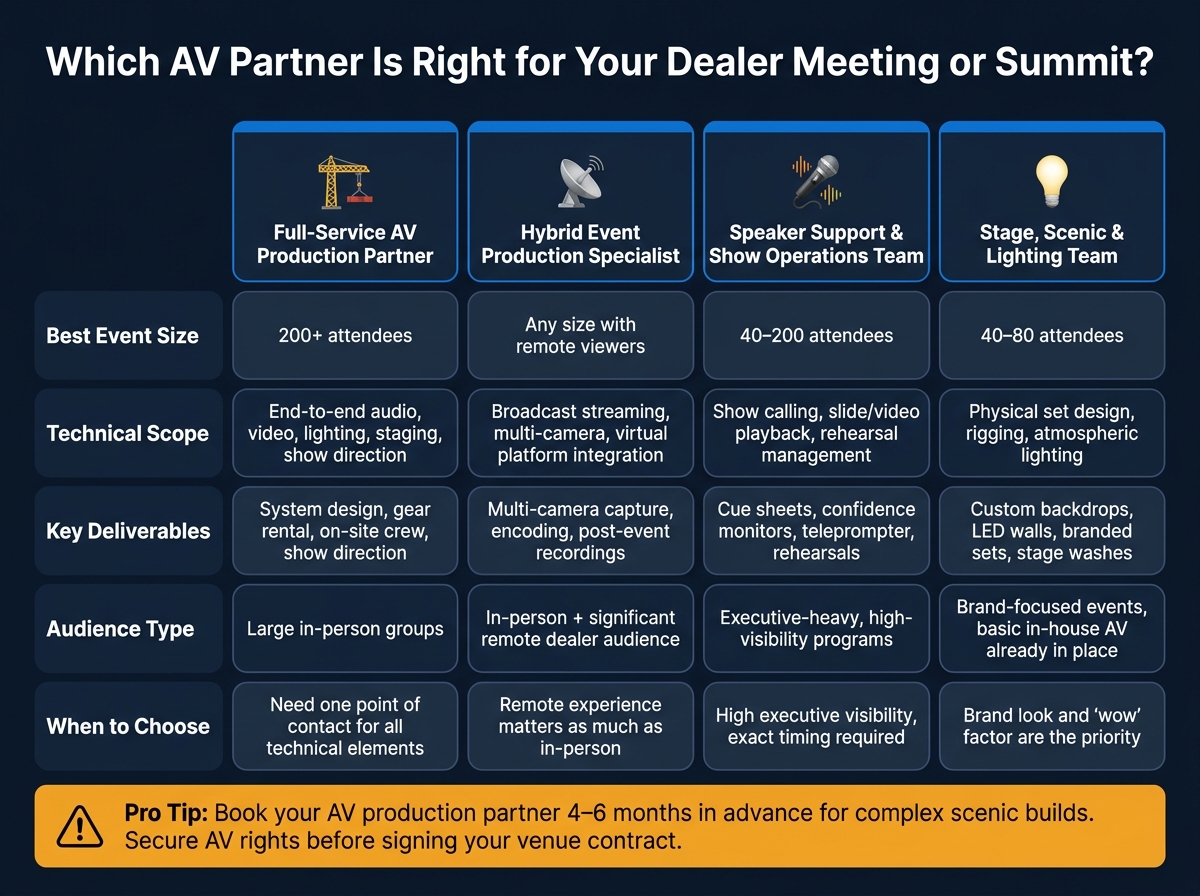
AV Partner Types for Dealer Meetings & Summits: Quick Comparison Guide
The right AV partner comes down to event size, format, and risk level. A 50-person dealer council meeting needs one kind of support. A 500-person national summit needs something else entirely.
For most mid-to-large dealer meetings and summits, a full-service AV production partner is usually the best first call. That kind of team can take on the whole job: stage design, scenic production, audio and video systems, live streaming, presenter content playback, and on-site show management. Just as important, it takes a big chunk of coordination off your internal team.
| Event Scenario | Best Partner Type | Why It Fits |
|---|---|---|
| 200+ attendees, executive keynotes, product demos, recording | Full-service AV production partner | Integrated staging, AV, content playback, show calling, and recording under one team |
| Large in-person event with a significant remote dealer audience | Hybrid production partner | Broadcast-quality encoding, redundant feeds, remote speaker management, and remote audience features |
| 40–80 attendees, single room, modest staging, content-heavy agenda | Presentation support team | Presentation management, run-of-show cueing, and executive support without a large production footprint |
| Small meeting with basic in-house AV already in place | Scenic and lighting vendor | Branded look, simple PA, and projection or LED without full-scale production costs |
Next, compare the partner types side by side.
Partner Comparison Table
Not every AV partner is right for every event. The table below lines up each partner type with event size, technical demands, and audience mix. Each one ties back to one or more of the five jobs covered above: staging, AV systems, hybrid support, playback, and show control. Use it to match the right partner to the parts of the show where the risk is highest.
| Partner Type | Best Event Format | Technical Scope | Typical Deliverables | When to Choose |
|---|---|---|---|---|
| Full-Service AV Production Partner | Large-scale conferences, summits, product launches | End-to-end technical setup: audio, video, lighting, staging, and show direction | System design, gear rental, on-site crew, show direction | When you need one point of contact to run all technical and physical elements |
| Hybrid Event Production Specialist | Global town halls, multi-hub meetings, summits with large remote audiences | Broadcast-quality streaming, multi-camera capture, virtual platform integration | Multi-camera capture, encoding, virtual platform management, post-event recordings | When the remote audience experience matters just as much as the in-person experience |
| Speaker Support & Show Operations Team | Executive meetings, award ceremonies, complex general sessions | Show calling, presentation playback, backstage show flow, rehearsal management | Cue sheets, slide and video playback, confidence monitors, rehearsal management | When the program has high executive visibility and timing needs to be exact |
| Stage, Scenic & Lighting Team | Galas, brand launches, high-impact activations | Physical environment design, rigging, atmospheric lighting | Custom backdrops, LED walls, branded sets, stage washes, wayfinding signage | When brand look and the "wow" factor matter most |
The strongest event setups usually have one production lead tying together staging, AV, playback, and show calling. That matters more than it may seem. If those pieces live in separate lanes, small misses can stack up fast.
Bring production into venue selection early. That gives your team time to check ceiling height, room acoustics, and show-calling needs before contracts are signed.
With the partner type narrowed down, the next step is choosing the team that fits your event scope.
Conclusion
Those five connected responsibilities only work when they run as one production plan. When the technical parts are aligned, the audience stays with the message instead of getting distracted by what’s happening behind the scenes.
Stage design, sound and video, streaming, playback, and on-site coordination work best when they’re handled as one system. If your dealer meeting or summit has any room for technical failure, bring in production support early.
Corporate Optics is the right fit for dealer meetings and summits that need one team to handle staging, AV, streaming, playback, and show control. Contact Corporate Optics before the venue contract is signed so the room, screens, and stream are planned from the start.
FAQs
When should I book AV support?
Book AV support as early as you can. A simple rule of thumb:
- 300+ attendee conferences: 4 to 6 months ahead
- Major events or executive summits: 3 to 6 months ahead
- Smaller, single-day events: at least 6 to 10 weeks ahead
Getting started early gives your AV partner more time to manage budgets, fine-tune room layouts, and lock in technical requirements.
What type of AV partner fits my event?
Choose based on your event’s complexity, audience size, and what you need most.
For a small internal meeting with basic audio or a few microphones, your in-house IT team may be enough.
But once the setup gets more involved, the stakes change. If you need projector alignment, balanced sound, smooth video transitions, or full staging and hybrid support for a major dealer meeting or summit, it’s smart to bring in professional AV technicians or a full-service production company.
What backups should an AV team have?
Reliable AV production partners plan for failure before the event starts.
That means building backup into every system that matters so the show can keep moving without a hitch. Think spare microphones, extra projectors, backup audio and video signal paths, and, for hybrid events, a second internet connection or streaming feed.
If something goes down or a signal drops, the on-site technical director should be ready to switch to the backup plan right away.
Related Blog Posts
- 4 Meeting Production Companies That Excel At Seamless AV (audio/video), Lighting, and Stage Design for Corporate Conferences, and events
- Best Meeting Production Companies For General Session & Breakout Session AV Support
- End-To-End Annual Meeting Production Companies For Your Next Company Conference
- 3 Production Companies To Contact For Leadership Summits On The East Coast, NYC To Orlando


Streamline your workflow, achieve more

Lorem ipsum dolor sit amet, consectetur adipiscing elit. Maecenas ac velit pellentesque, feugiat justo sed, aliquet felis.



Lorem ipsum dolor sit amet, consectetur adipiscing elit. Maecenas ac velit pellentesque, feugiat justo sed, aliquet felis.