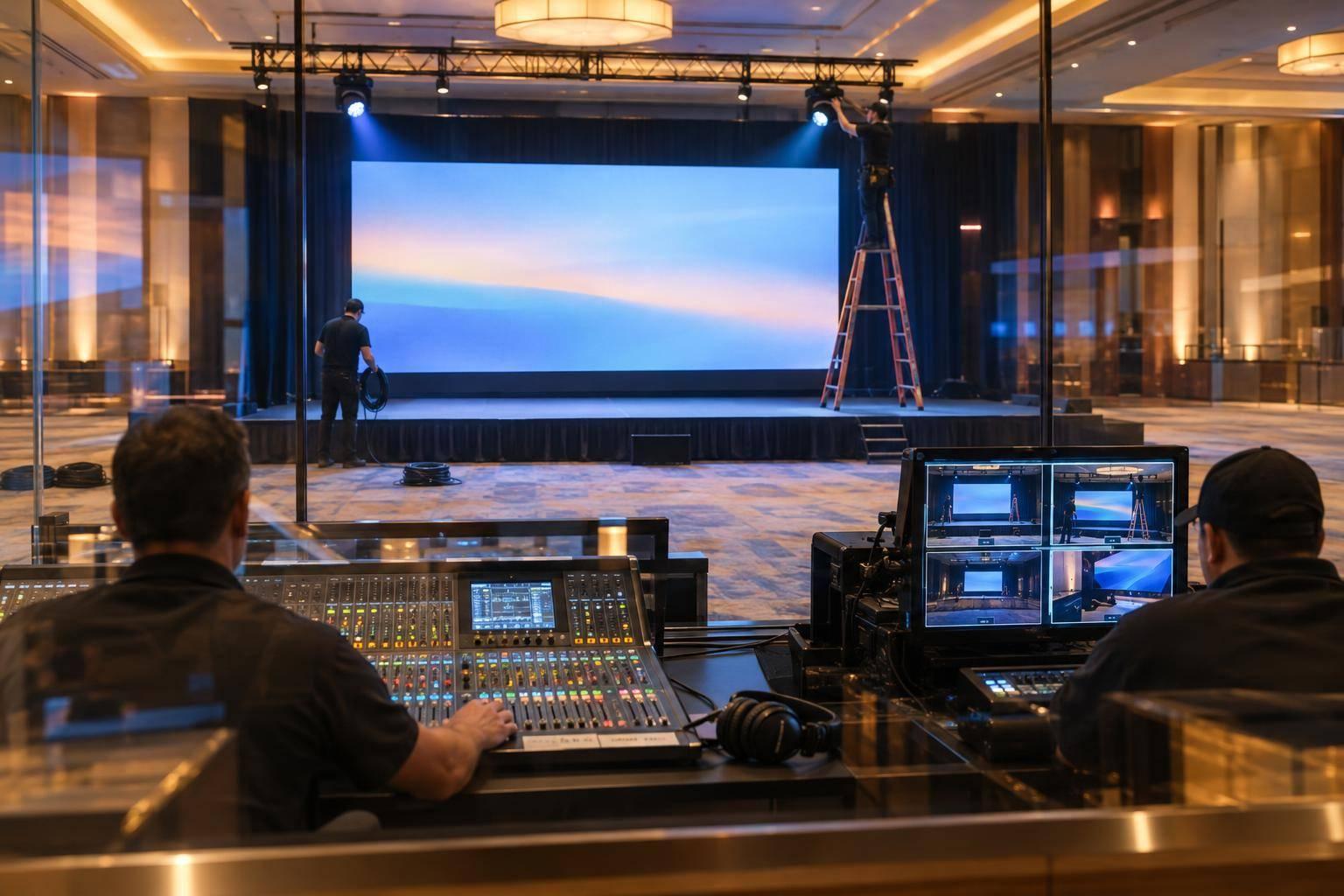
Local AV Company vs. A Traveling Production Partner: What Multi-City Corporate Programs Should Consider

Chief Executive Officer
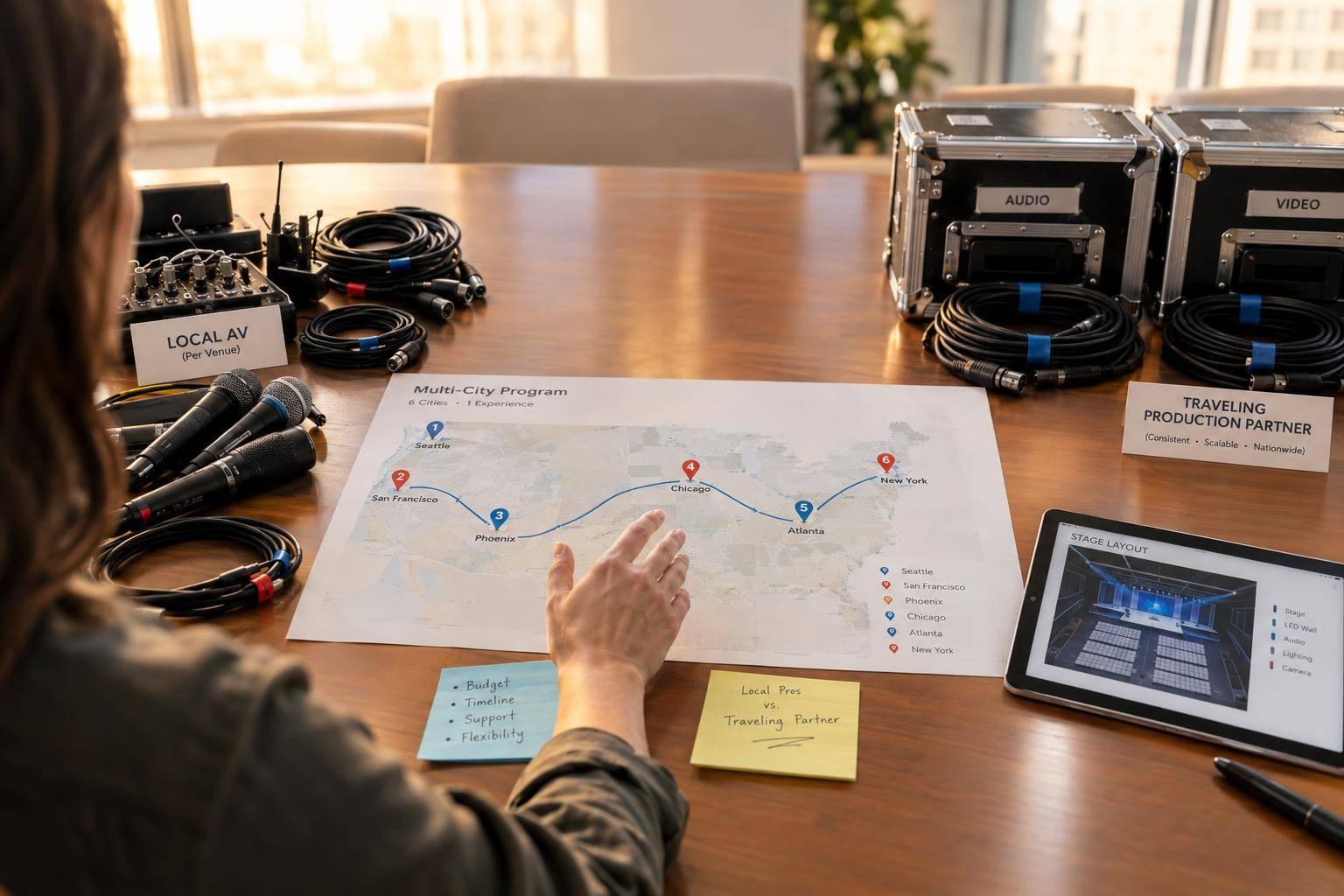
I’d choose based on the whole program - not the lowest city quote. Local AV crews often fit varied venues and tighter travel budgets. A traveling partner often fits a repeatable show. This is especially true when you need to plan and execute a global corporate broadcast across multiple time zones. A central lead with local crews can combine both approaches.
Before choosing, I’d compare total costs in dollars, confirm venue rules, and check that every stop allows time for setup, rehearsal, crew rest, and freight. I’d also name one person to own show standards, approvals, and problems.
Quick Comparison
| What I’d compare | Local AV companies | Traveling partner | Central lead + local crews |
|---|---|---|---|
| Show consistency | Requires shared specs and crew briefings | Core team carries show knowledge between stops | Central lead sets standards for local teams |
| Venue needs | Local knowledge and nearby resources | Must confirm each venue’s limits | Local teams work within central standards |
| Crew continuity | Crews change by city | Confirm which roles travel | Lead stays; local crews change |
| Equipment and freight | Local inventory may vary | Repeatable package adds shipping costs | Selected gear comes from local suppliers |
| Total cost | Include repeat briefings and venue fees | Include travel, hotels, freight, and travel-day labor | Include central management and local costs |
| Schedule | Check local staffing and access | Check transit, crew rest, and equipment overlap | Coordinate both schedules |
| Accountability | Assign one owner across providers | Confirm one escalation owner | Define authority between lead and crews |
My final check: score each option from 1–5, with priority weights totaling 100%. But I’d treat the score as a guide - not a substitute for written quotes, venue checks, and a workable calendar. The best fit is the one that can deliver your show at every stop, with <u>clear ownership and priced backup plans</u>.

Multi-City AV: Local vs. Traveling vs. Hybrid
Event A/V Essentials Part 5: Creating Your Onsite Production Schedule - Logan Clements
sbb-itb-ae35a94
Local AV Companies vs. a Traveling Production Partner
A local AV model uses a different provider or crew in each city. A traveling production partner puts one team in charge across stops, while still using local labor or rentals when a venue calls for them.
| Decision factor | Local AV companies | Traveling production partner |
|---|---|---|
| Venue knowledge | May know dock access, house AV policies, labor rules, power, and rigging. | Must research each venue and coordinate local requirements. |
| Local response | Nearby technicians and replacement gear can help fix problems quickly. | Keeps one escalation path; replacement gear may need to come from local suppliers. |
| Travel expenses | Usually cuts crew airfare, hotel, and per diem costs. | Adds travel, lodging, per diem, travel-day labor, and freight costs. |
| Equipment access | Uses local inventory, so substitutions may vary by city. | Can keep a repeatable equipment package, but adds shipping, storage, and handling costs. |
| Re-briefing | Every crew needs show-file handoffs, briefings, and rehearsals. | The core crew carries presenter preferences, cue procedures, and show knowledge from stop to stop. |
| Production consistency | Depends on how each crew interprets the specifications. | Provides more continuity when technical leads and operating procedures stay the same. |
| Accountability | Responsibility can get split across project managers and venue teams. | One team can own approvals, escalation, and reporting. |
These factors help you choose a model; they don’t make one the winner in every case.
Local execution may fit varied venues or travel-sensitive budgets; a traveling core often fits a repeatable executive roadshow.
Use them to decide where your program needs local flexibility and where it needs centralized control.
Local AV: Venue Knowledge and Local Resources
Local knowledge helps only if it matches the venue’s actual limits. Get freight-elevator limits, dock reservations, labor minimums, overtime policies, and rigging approvals in writing. House AV fees, power, internet, and venue labor can still change the quote.
Require one technical specification for every city. It should cover signal flow, screen resolution, cueing, presenter workflow, and rehearsal expectations. Equipment substitutions should need approval. A local crew’s venue knowledge works best when it supports the same technical spec used at every stop.
Traveling Partner: Consistent Crews and Central Ownership
A traveling partner keeps show files, presenter preferences, content approvals, and escalation procedures intact across stops. Confirm which roles travel to every stop rather than assuming the whole crew will.
| Central responsibility | Venue-specific task |
|---|---|
| Maintain technical design, show files, cue structure, and equipment standards. | Confirm dimensions, sightlines, power, internet, and rigging limits. |
| Assign technical leadership and the escalation owner. | Book access windows, docks, freight elevators, and local labor. |
| Control content versions, presenter preferences, and backups. | Adjust the setup for house equipment, room layout, and venue restrictions. |
| Set rehearsal, soundcheck, and contingency procedures. | Provide required local stagehands, riggers, electricians, or specialty technicians. |
| Approve substitutions and track changes across stops. | Source approved rentals and replacement gear; carry out load-in and strike. |
Require a written local-venue plan that names who supplies labor, rental equipment, power, rigging, and emergency repairs. If a venue requires its in-house provider, the traveling partner may need to manage that team rather than replace it.
That puts the next question on the table: how does centralized control hold up against venue limits and local labor rules?
Check Production Standards, Venue Limits, and Accountability
Once you’ve chosen the model, check whether every city can deliver the same show standard. Quality depends on process, not geography.
| Criterion | Local AV companies | Traveling production partner |
|---|---|---|
| Consistent execution | Each crew needs shared standards and acceptance checks. | Leaders, show files, procedures, and equipment need continuity. |
| Documentation | Providers need common templates and version control. | Central documentation still needs city-specific input. |
| Change control | Local teams handle venue-specific adjustments. | Central leadership approves changes. |
| Local adjustments | Local rentals and substitutions must meet shared standards. | Local subcontractors need clear authority and standards. |
Set the standards first, then plan venue-specific changes.
Set Shared Show Standards and Presenter Procedures
Define which roles must stay consistent and how replacements receive a handoff. Use the same cue language, monitor layouts, media formats, playback, recording, streaming, and emergency cues. Rehearse with the actual presentations, videos, microphones, cameras, stage setup, and show sequence.
Keep a version-controlled cue sheet that includes clock time, segment, presenter, media file, audio and lighting actions, caller, and transition. Name a document owner, freeze a show-ready version before rehearsal, and log approved changes.
Debrief after every stop. Give each issue an owner, due date, and corrective action before the next load-in. AVIXA’s ANSI/AVIXA D401.01:2023 defines the minimum documentation needed to coordinate and deliver audiovisual communication-system projects. Documentation is part of delivery - not optional paperwork.
Confirm Each Venue's Technical Requirements
Record each venue’s power, rigging, internet, load-in, labor, and access requirements. Check house-AV exclusivity rules, union staffing rules, rigging approval, and freight-elevator schedules against the actual setup plan.
Keep the core show fixed; adjust the room design. Maintain playback and presenter standards while changing speaker placement, screen format, cable routes, or stage dimensions. Build the repeatable package around the most restrictive venue, not the largest room.
Accountability matters because multi-city programs can fail at handoffs, not just at load-in.
Assign Owners From Planning Through Strike
Name one production lead and spell out the scope: microphone, camera, and screen counts; crew hours; rehearsal blocks; deliverables; and whether venue charges are included.
Local contracts can still work when one lead controls the schedule, standards, approvals, and issue log. That ownership keeps the show from drifting between cities. Set an escalation path from department lead to production lead to corporate program owner. Require written approval for changes affecting safety, schedule, budget, brand presentation, or presenter experience.
Use this checklist:
- Technical design and venue approvals: Name the decision owner and the person responsible for securing rigging, power, internet, and house-rule approvals.
- Labor, equipment, and transport: Assign responsibility for staffing, compatibility checks, freight timing, receiving, and strike.
- Fallback plans: Name who deploys and tests alternate microphones, playback, recording, and connectivity. Define what triggers each fallback.
- Final cost closeout: Assign responsibility for collecting actual hours and charges, checking them against scope, and obtaining corporate approval of the final cost.
Compare Total Program Costs and Scheduling
With standards and ownership set, check whether each model fits the same budget and calendar. Price both against the same scope across all cities, using the technical scope, venue assumptions, and deliverables already defined for each stop. Compare matched scope - not headline prices. Include labor, rehearsals, media deliverables, and cancellation terms.
Separate Shared Costs From Per-City Expenses
Use the same pricing sheet for both models to keep the comparison apples to apples. Complete the worksheet separately for each model, enter quoted amounts in U.S. dollars, and mark unpriced items TBD.
Use actual costs for each city rather than multiplying one city’s quote across the program. Separate reusable planning from expenses that repeat at each stop, and don’t count equipment twice.
| Cost category | Shared program cost | Per-city costs | Program total | Required pricing basis |
|---|---|---|---|---|
| Show design, technical direction, and preproduction | TBD | TBD | TBD | Reusable design, planning meetings, and central management |
| Local onboarding and site visits | TBD | TBD | TBD | City-specific preparation and travel |
| Equipment and backup inventory | TBD | TBD | TBD | Matching technical scope; rentals, substitutions, spares |
| Crew labor and rehearsals | TBD | TBD | TBD | Roles, hours, rehearsal duration, minimum calls, overtime |
| Recording or streaming | TBD | TBD | TBD | Camera count, coverage hours, editing, and delivery requirements |
| Travel and freight | TBD | TBD | TBD | Airfare, hotels, per diem, ground transport, packing, storage, return freight |
| Venue services | TBD | TBD | TBD | House AV, labor, rigging, power, internet, loading fees, applicable commissions |
| Insurance, permits, and taxes | TBD | TBD | TBD | Coverage requirements and applicable charges |
| Cancellation, postponement, and change-order exposure | TBD | TBD | TBD | Rates, deadlines, deposits, nonrecoverable commitments |
| Contingency reserve | TBD | TBD | TBD | Documented risks and approved spending authority |
| Program total | TBD | TBD | TBD | Shared costs + all city costs + reserve |
Get overtime triggers and rates, weekend premiums, and travel-day charges in writing. For cancellation or postponement, compare dollars at risk by deadline. Include booked labor, hotel deposits, dispatched freight, and unused rentals.
Keep potential cancellation costs separate from the base total unless you incur them. Fund contingency for identified risks rather than hiding it in equipment rates.
Check Crew and Freight Plans Against the Calendar
Build a leg-by-leg schedule covering strike, packing, freight transit, crew travel, load-in, setup, rehearsal, show, load-out, and the next venue’s access window. Base it on the venue access, labor, and freight limits already confirmed for each city.
Check crew rest, dock access, overnight freight, weekend and holiday rates, minimum calls, overtime, and equipment overlap. If the next venue opens before the prior city’s equipment can be fully struck and transported, price the alternatives before accepting the schedule: a second equipment package, advance freight, a split crew, or local rentals.
Schedule risk changes cost, not just timing.
| Risk | Local-provider cost exposure | Traveling-partner cost exposure | Planned response | Contingency owner |
|---|---|---|---|---|
| Delayed flights | Fewer traveling roles may require replacement coverage | Delayed specialists may require replacement labor or added rehearsal hours | Earlier arrivals and qualified alternates | Production manager |
| Delayed equipment | Shipped sub-rentals may require rush replacements | Delayed freight may require expedited shipping or replacement rentals | Shipment tracking and reserved backup rentals | Logistics lead |
| Unavailable local inventory | Matching equipment or spares may require higher-cost substitutions | Damaged gear may exceed traveling spares and require local rentals | Confirm holds and approved substitutes | Technical director |
| Late venue access | Compressed setup may add labor costs despite local knowledge | Added overtime and schedule disruption may affect subsequent stops | Written access windows and a compressed setup plan | Client lead, coordinating with venue manager |
Set a spending limit and escalation path for each contingency owner. Require priced responses - not assurances - for rush rentals, overnight shipping, extra labor, and local rentals. List the schedule assumptions that would change the budget most.
Conclusion: Choose Based on Program Priorities
Choose the model that fits the full program’s priorities: consistency, venue variation, total cost, and accountability. The examples below show how those priorities shift by program type.
Compare Two Example Programs
A standardized executive roadshow favors continuity in recurring cues, confidence monitor sightlines, and slide advance cues. A regional series with different projection, rigging, loading, or power needs often favors local crews.
Before choosing a model, use site surveys to check venue limits and logistics.
| Condition | Favors local AV | Favors a traveling partner |
|---|---|---|
| Budget | Local equipment and labor can avoid airfare, hotels, per diems, and freight | One team can reuse equipment, documentation, show files, and workflows across many stops |
| Transport | Venues need very different systems, or freight movement is difficult | Equipment can move predictably between nearby or sequential cities |
Consider a Central Lead With Local Crews
A hybrid model pairs program consistency with flexibility at each venue. One lead oversees the technical spec, show file, documentation, escalation, and reporting. Local crews provide labor and selected gear.
Use the matrix below to weigh your options. Set weights that reflect your program’s priorities and total 100%. Then score each model from 1 to 5 using documented evidence: 1 means poor fit, 3 means workable with controls, and 5 means strong fit. Multiply each score by its weight and divide by 5.
Criterion Planner weight Local AV score (1–5) Local weighted points Traveling partner score (1–5) Traveling weighted points Production consistency 20% 3 12 5 20 Total cost 20% 4 16 3 12 Venue variation 15% 5 15 3 9 Equipment logistics 10% 4 8 3 6 Crew continuity 15% 3 9 5 15 Schedule complexity 10% 3 6 3 6 Accountability 10% 3 6 5 10 Total 100% 72/100 78/100
These example scores favor a standardized program, where consistency and accountability carry more weight than venue variation. Replace the example weights and scores with ones supported by site surveys, proposals, crew assignments, technical requirements, and the event calendar.
FAQs
When do travel costs outweigh crew continuity?
Local teams make sense for simple, low-risk setups with standardized technical requirements. In these cases, travel, lodging, and per diem costs can outweigh the value of keeping a dedicated crew that already knows the setup.
For high-stakes executive presentations, multi-room agendas, or complex signal flows, a traveling core team is still needed to guard against technical failures and inconsistent brand presentation.
How can I test AV consistency before booking?
Check that the provider uses consistent technical specifications, equipment, and team training across locations. Ask if a dedicated core team travels with the event to keep workflows and brand standards consistent.
Request CAD stage plots, 3D visualizations, or virtual tours of past setups to check design accuracy. When possible, arrange on-site technical surveys or virtual demonstrations to see how the provider handles complex venues and works remotely with local suppliers.
What contract terms prevent gaps in accountability?
Assign one point of contact to oversee production from planning through teardown. Before you sign, check that your statement of work, production plan, and escalation structure spell out who owns each decision, handoff, and technical requirement.
Keep contracts in one place so terms, pricing, and cancellation policies stay consistent. Confirm that your partner uses a master playbook with CAD drawings, equipment lists, and version-controlled show files. This keeps standards consistent and makes ownership clear across venues.
Related Blog Posts
- Leading Meeting Production Companies For AV-heavy Events
- End-To-End Annual Meeting Production Companies For Your Next Company Conference
- Leading Companies For Corporate AV, Hybrid Events, And Full-Service Production
- Executing A Multi-Day Corporate Event Requires A Partner That Handles Everything From Large -Scale Audiovisual (AV) Production And Custom Scenic Design To Logistics. Here Are 2 Companies To Reach Out To Today.



Streamline your workflow, achieve more

Lorem ipsum dolor sit amet, consectetur adipiscing elit. Maecenas ac velit pellentesque, feugiat justo sed, aliquet felis.



Lorem ipsum dolor sit amet, consectetur adipiscing elit. Maecenas ac velit pellentesque, feugiat justo sed, aliquet felis.