The Most Respected Conference Production Companies For AV Production, Stage Design, Scenic Builds, Seating/Floor Planning And Show Execution.

Chief Executive Officer
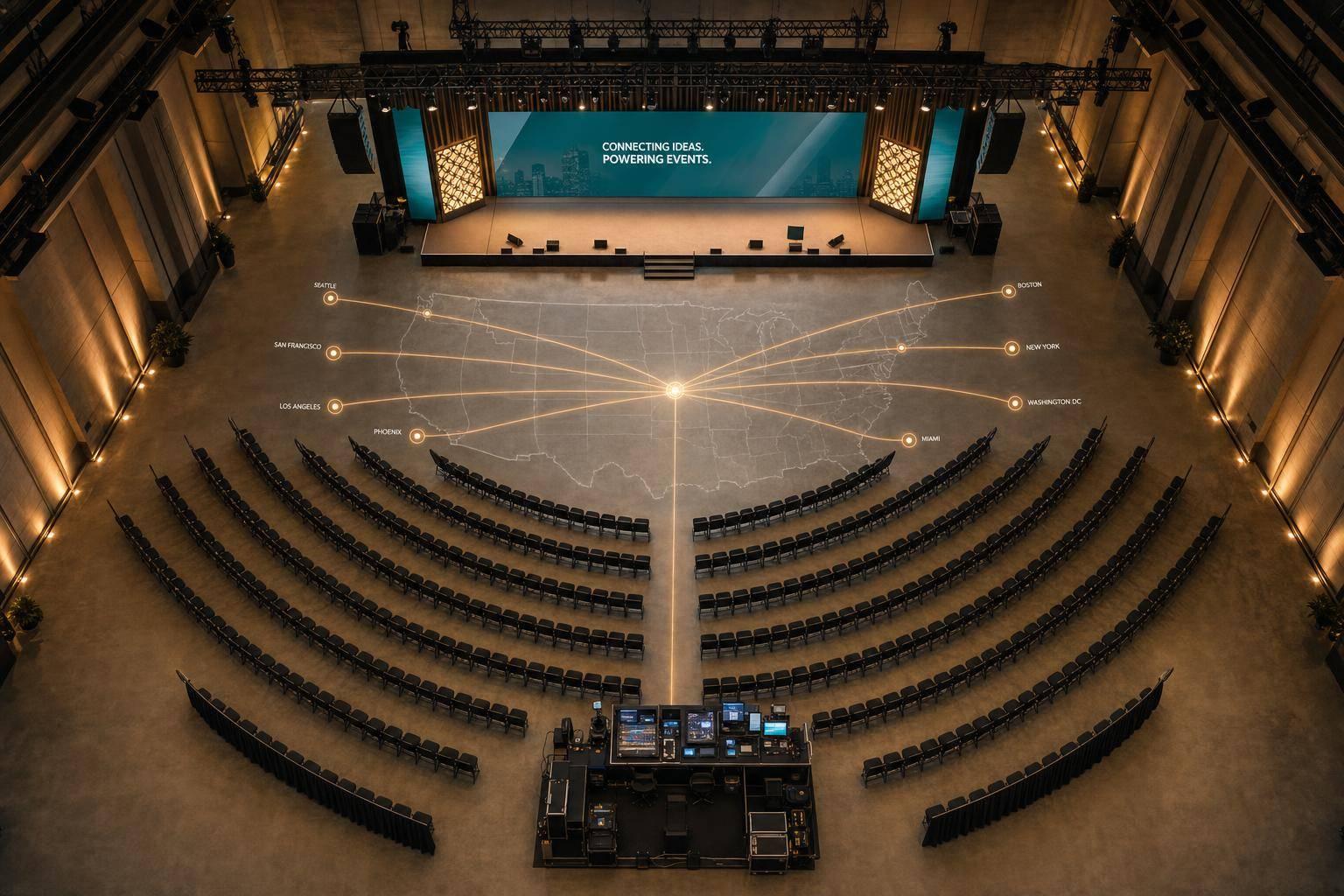
If you’re planning a U.S. conference with a budget of $150,000 to $500,000+, the best choice depends on one thing: how much risk, scale, and show control your event needs.
I’d narrow this article down like this:
- Corporate Optics fits teams that want one partner for AV, scenic, seating, speaker support, and live show calling.
- Freeman fits very large conferences, trade shows, and multi-city programs that need big inventory and national reach.
- Clarity Experiences fits stage-first events where room layout, scenic depth, and live audience focus matter a lot.
- AV Alliance member firms fit events spread across many cities that need local crews under shared standards.
- Event Production Network member firms fit regional and national programs that want one contract with local venue knowledge.
- Regional U.S. specialists fit single-city events where venue know-how and one project lead can cut mistakes.
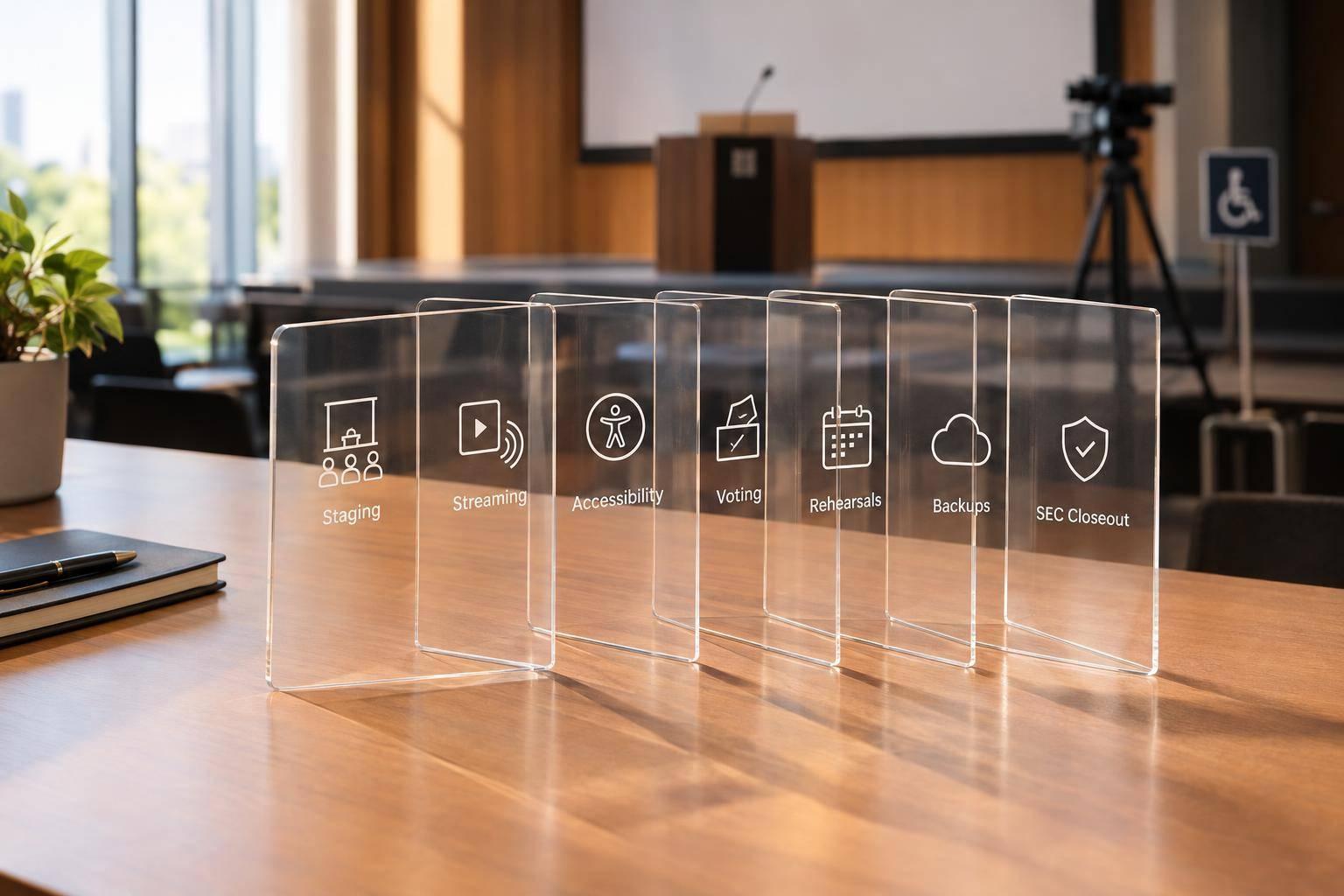
This comparison looks at the things that usually decide whether a conference runs well or starts slipping on show day:
- Audio dependability
- Sightlines
- Stage and scenic fabrication quality
- ADA-aware seating and floor plans
- Backup systems
- Technical rehearsals
- On-site show execution
A few numbers set the stakes. Executive summits often need 8 to 16 weeks of prep. Large conferences may need 4 to 6 months. Freeman handles 4,500+ live events per year. Clarity supported 10,000 attendees at Cvent Connect 2024. Regional firms like Rocket Productions can run 12+ rooms under one project manager.
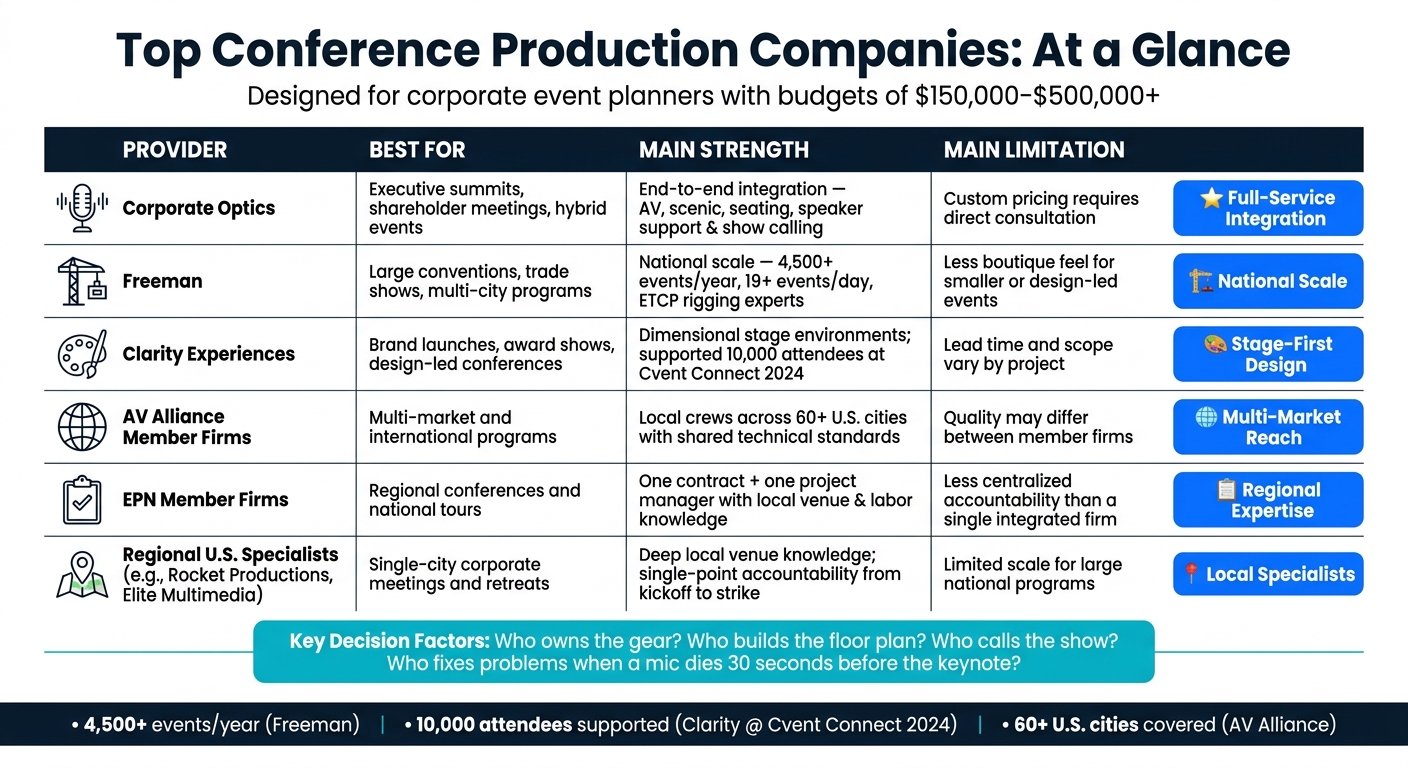
Top Conference Production Companies Compared: AV, Scenic & Show Execution
Quick Comparison
| Provider | Best For | Main Strength | Main Limitation |
|---|---|---|---|
| Corporate Optics | Executive summits, shareholder meetings, hybrid events | One team across planning, AV, scenic, seating, and show calling | Pricing requires direct consultation |
| Freeman | Large conventions, trade shows, multi-city programs | National scale, rigging depth, large AV systems | Less boutique feel for some events |
| Clarity Experiences | Brand launches, award shows, design-led conferences | Stage environments built around audience focus and live flow | Lead time and scope vary by project |
| AV Alliance member firms | Multi-market and international programs | Local crews across many markets with shared standards | Quality may differ by member |
| EPN member firms | Regional conferences and tours | One contract plus local venue and labor knowledge | Less direct control than one in-house firm |
| Regional U.S. specialists | Single-city corporate meetings and retreats | Venue familiarity and one main point of contact | Less reach for large national programs |
If I were making the call, I’d look past brand names and focus on who owns the gear, who builds the floor plan, who calls the show, and who fixes problems when a mic dies 30 seconds before a keynote.
sbb-itb-ae35a94
1. Corporate Optics
Corporate Optics handles conference production from end to end, from agenda planning to live show calling. Their Discover, Design, Develop, Deliver process gives the whole project a clear path for planning, scripting, and run-of-show development. In plain English, it keeps the plan, the stage, and show-day execution moving in the same direction from day one.
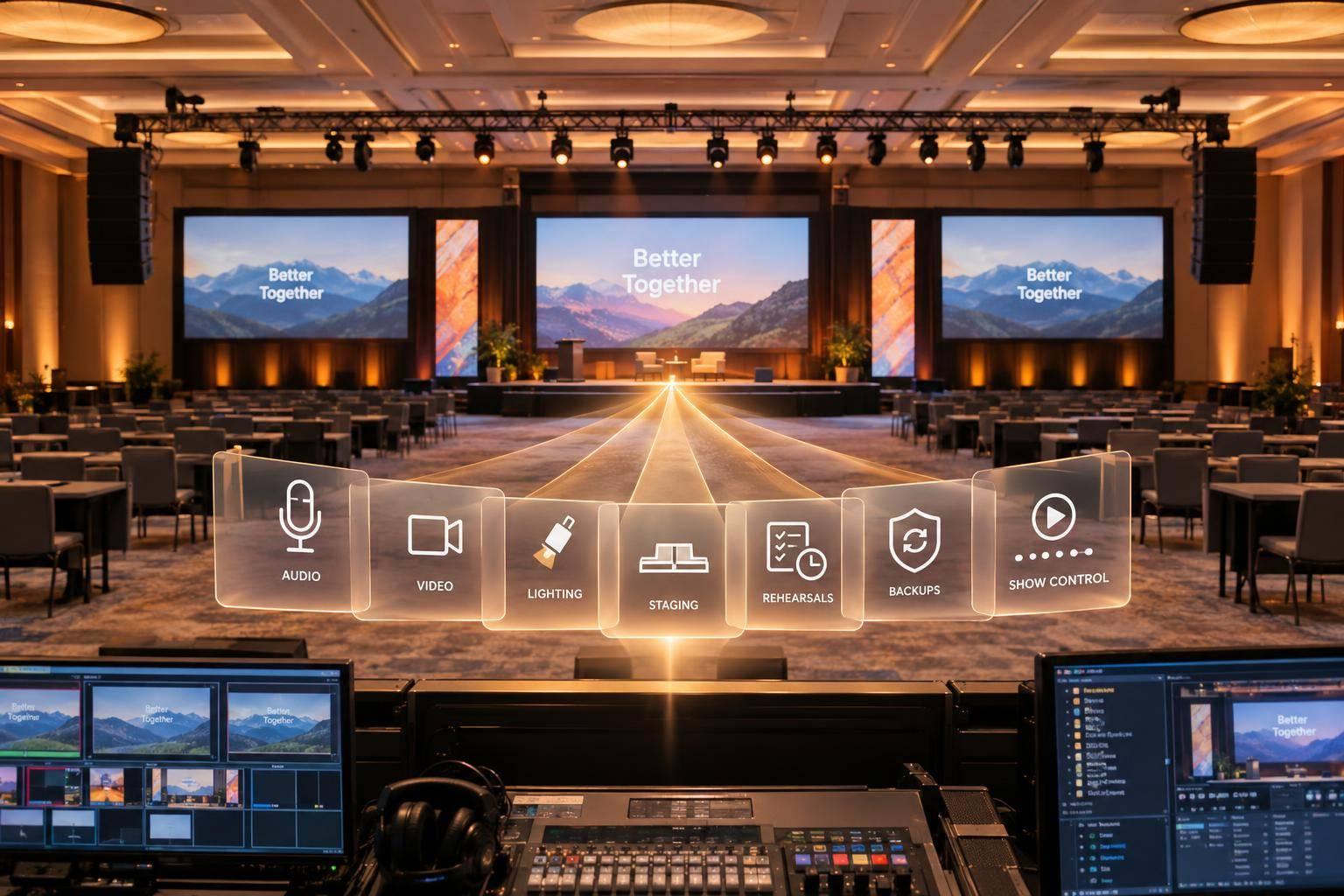
On the AV and lighting side, Corporate Optics supports IMAG, large-scale and curved LED walls, switching systems, redundant signal feeds, and broadcast-style live streaming for both in-room and remote audiences. IMAG helps people see what's happening in bigger ballrooms and convention halls, where a distant stage can feel tiny. Dynamic lighting and LED pillars also add depth to the room without making the stage feel crowded.
For scenic and stage design, the team manages custom fabrication, branded scenic walls and backdrops, and digital renders that line up the physical build with on-screen LED content before production starts. That matters because it turns the stage into one unified environment, not a patchwork of separate pieces assembled on site. Corporate Optics also handles speaker reveals and custom stage entrances for product launches and keynote moments, where timing and visual impact have to land just right.
Seating and floor planning get the same level of care. Corporate Optics builds room layouts around attendee sightlines, ADA-aware aisles, wheelchair positions, and clear egress paths. The team also plans executive work areas and attendee flow so the room works well in practice, not just on a render. Those decisions shape how people move through the space and how the brand shows up in the live setting.
Speaker support runs through the YEP! 360º Concierge Team, which manages on-site speaker help and last-minute presenter issues. AI-powered teleprompter tools, confidence monitors, professional coaching, and technical rehearsals work alongside dedicated show calling, technical direction, and tight cueing built into the run of show. After the event, post-event analytics track audience engagement and event performance, giving teams a sharper view of what worked and what to fine-tune next time.
2. Freeman
Freeman is one of the best-known names in large-scale conference production. The company delivers 4,500+ live experiences each year and manages 19+ events per day.
On the AV side, Freeman handles broadcast-quality video, projection mapping, custom LED installs, live video switching, and live-updated digital wayfinding. For large, complex builds, that range matters. You’re not just booking screens and staging. You’re coordinating a full show system that has to work under pressure.
Its ETCP-recognized rigging experts bring a steady level of safety and precision to arena-scale setups, backed by regional rigging hubs in San Francisco, Las Vegas, and Atlanta. That gives planners a bit more confidence when the build is large, the ceiling plot is dense, and the timeline is tight.
Freeman Blue Echo adds a planning layer before anyone loads in. It creates photorealistic 3D venue walkthroughs with measurement-grade accuracy within 1 inch, which helps teams catch sightline and traffic problems early. That can save a lot of pain later, especially when a room looks fine on paper but feels very different once booths, lighting, and seating are in place.
You can see that approach in recent event work. At Shoptalk 2025, Freeman built the stage, track rooms, and expo floor around the "Alchemy" theme. At ServiceNow Knowledge 2024, it used modular builds to support multiple sponsor tiers in an efficient way.
That blend of scale, planning, and on-site delivery leads nicely into the next set of providers, which take a different approach to how events get built and run.
3. Clarity Experiences
Clarity takes a more design-led route. It ties stage visuals closely to what happens live in the room. Clarity Experiences builds events around AV, stage design, scenic depth, audience experience, and show execution. The focus is on dimensional stage environments, not flat setups that lean too hard on LED screens.
On the AV side, Clarity handles audio, video, lighting, LED walls, and digital signage. Its scenic work is tied to audience sightlines in a direct way. By adding depth and dimension to the stage, the team helps keep attention where it should be and cuts down on the dead-zone effect that often shows up in flat, screen-heavy rooms.
At Wiley's "Accelerate" sales kickoff in Los Angeles, Clarity built a V-shaped center screen, an arrowhead thrust stage, and triangular seating to push more interaction. The set also let the ballroom split into three breakout rooms in 10 to 15 minutes. That same kind of flexibility carries over into hybrid events too.
For Cvent Connect in June 2024 at the Henry B. González Convention Center in San Antonio, the event reached 10,000 attendees - 5,000 in person and 5,000 virtual - with two 100-foot curved screens and 16 breakout rooms. When a keynote mic failed, the team fixed it in seconds. When a breakout session pulled in more people than expected, they streamed it into an overflow room within five minutes. That kind of show control matters. The same discipline that supports the live audience also carries over to the virtual side, so both groups get a steady experience even when things get hectic.
Clarity also works behind the scenes to cut preproduction friction. It negotiates venue power, rigging, and internet costs directly, which lowers those costs by an average of 50%.
4. AV Alliance Member Firms
This model works well for conferences that need the same level of execution in more than one market. AV Alliance member firms pair local crews with shared technical standards across 60+ U.S. cities, which makes them a strong fit for multi-market conferences that want consistency without leaning on unvetted sub-rentals. Membership points to a shared way of working, so a company’s visual identity can stay aligned from one market to the next.
One production lead for audio, video, lighting, and staging also cuts down on handoff mistakes on show day. That matters most when the stakes are high, like a CEO keynote or a product reveal.
Relevant deliverables include line-array audio, wireless microphones, FOH engineering, LED video walls, seamless presentation switching, programmed lighting cues, custom stage builds, CAD layouts, rigging plots, seating design, and on-site show calling. In plain terms, that helps keep sightlines, audio clarity, and show cues steady from market to market. And because crews are local, it also helps with labor, rigging, and venue limits.
Local teams can deal with union rules, dock access, and venue power or rigging limits before those issues turn into show-day problems. A pre-load-in site survey helps spot trouble early, before load-in starts.
5. Event Production Network Member Firms
When consistency across markets matters, regional firms can be a smart fit. Event Production Network member firms bring strong local venue and labor knowledge, especially at large convention centers.
That local know-how pays off before load-in starts. Preproduction at the local level helps spot freight, rigging, and signal issues before they turn into show-day headaches. It also makes complex multi-room programs easier to manage.
For large multi-room programs, this model gives planners one contract and one project manager from kickoff to strike.
Core deliverables usually include:
- Custom stage builds
- Branded scenic environments
- LED video walls
- Audio
- Lighting
- Live show calling
It also helps to look at who owns the gear. Firms that own their core inventory often have better quality control and faster troubleshooting than teams that lean heavily on sub-rentals.
National conferences need early booking to lock in crews, gear, and venue access. It’s also smart to confirm gear ownership and in-house crews, since both shape reliability and response time. Those tradeoffs set up the pros and cons below.
6. Regional U.S. Corporate Event Production Specialists
Regional specialists stand out for two simple reasons: they know the local venues, and they can run the whole show through one team. That matters most when your event stays in one city and venue know-how can save time, money, and headaches. Instead of juggling separate vendors, you get end-to-end AV, staging, and show execution from people who already know the room.
Rocket Productions is a good example in Atlanta. The company supports conferences at venues like Georgia World Congress Center, handling general-session staging, LED walls, and breakout AV across 12+ rooms under one project manager. It also brings more than 15 years of experience with Atlanta-area conferences and keeps dock specs, power maps, rigging data, and IATSE protocols on file for major conference venues across metro Atlanta. That kind of venue memory can make a big difference when timing is tight.
Elite Multimedia plays a similar role in Nashville. The firm has been in business for nearly 20 years and uses Nashville’s central location to cut freight costs and speed load-ins across an 800-mile service radius. It handles AV, lighting, audio, and staging for conventions of up to 15,000 attendees.
Both firms lean on local crews, but each gets an edge from working close to home. In plain terms, that often means faster planning, smoother load-ins, and tighter control inside the venue.
Another plus: both companies offer single-point accountability. One project manager stays with the job from the first RFP through the final strike.
Pros and Cons
The profiles above lay out the main options. Here, the goal is simpler: boil the tradeoffs down to what matters most.
At the core, this choice is about control vs. scale. Integrated firms cut down on handoffs and keep more of the work under one roof. Network models, on the other hand, give you broader reach and access to local crews in more markets.
Broadcast-grade production also matters more than many teams expect. If the in-room crowd and the remote audience are both a priority, the event has to work for both. Investor days, executive summits, and hybrid events with large online audiences need careful planning for the stage, the room, and the stream. Hybrid events need camera-first design, not a setup built only for people sitting in seats.
Use the comparison below to line up the provider model with your event size, geography, and level of technical risk.
| Provider | Main Pros | Main Cons | Best-Fit Event Types |
|---|---|---|---|
| Corporate Optics | End-to-end integration across AV, scenic, sightlines, seating, and show calling; speaker support; post-event analytics | Custom pricing requires consultation | Executive summits, shareholder meetings, broadcast productions, hybrid events |
| Freeman | National and global scale; extensive AV inventory | Less room for boutique customization | Large conventions, trade shows, multi-city programs |
| Clarity Experiences | Dimensional stage environments tied directly to sightlines and live execution | Customization and lead times can vary by project | Brand launches, awards galas, high-design corporate events |
| AV Alliance Member Firms | Broad geographic coverage; local labor and gear can reduce shipping costs | Quality can vary between member firms; multiple handoffs can create gaps | International events, multi-city tours, association meetings |
| Event Production Network (EPN) Member Firms | Networked local crews with shared standards | Less centralized accountability than a single integrated firm | National tours, regional conferences requiring local crews |
| Regional U.S. Corporate Event Production Specialists (e.g., Rocket Productions, Elite Multimedia) | Deep local venue knowledge; single point of accountability from kickoff to strike; flexible custom builds | Limited scale for large national programs; may lack in-house fabrication for complex sets | Regional corporate meetings, town halls, executive retreats |
A simple way to think about it: if your event has a lot of moving parts and little room for error, tighter integration often makes life easier. If you need coverage across many cities or countries, a network model may be the better fit.
Conclusion
After looking at AV production, stage design, scenic builds, floor planning, and show execution, the choice comes down to fit. The core question is simple: what does your event need, and who can deliver it from start to finish?
Put the most weight on single-source accountability, in-house fabrication, hybrid-ready design, and local venue knowledge. Those factors do the most to cut risk and give you more control on show day.
Pick the partner whose AV, scenic, seating, and show-calling strengths match the room, the audience, and the amount of execution risk involved.
FAQs
How early should I book conference production?
For executive summits and investor days with custom environment design, start planning 8 to 16 weeks in advance. That gives your team enough room to shape the space the right way instead of scrambling at the last minute.
For conferences or large all-hands meetings with complex staging, broadcast production, or multi-venue logistics, plan for 4 to 6 months. Once multiple moving parts enter the picture, the timeline can stretch fast.
Some partners can work on tighter turnarounds. Still, booking early makes life a lot easier. It leaves time for site surveys, CAD floor plans, and technical validation so execution runs smoothly.
What should I ask about backup systems?
Ask how they handle failover and redundancy for critical signal paths, and how the system keeps running if a primary component fails. Also confirm whether they run technical rehearsals to test those plans before the event goes live.
Ask about real-time monitoring and how technicians are dispatched if a room or system needs support. These safeguards shouldn't be an afterthought - they need to be built into the infrastructure from day one.
How do I choose the right production partner?
Choose a single-source production partner that handles audio, video, lighting, scenic design, and show execution under one contract. That setup cuts down on handoffs, avoids split accountability, and closes the communication gaps that can slow a show down.
You should also look for detailed pre-event documentation and a dedicated project manager who stays with the job from planning through strike. Strong in-house fabrication and technical talent matters too, especially when plans shift or custom build work is part of the show. And make sure the partner’s planning model fits your timeline and the scope of the event. A small meeting and a large general session don’t need the same process, so the fit has to be right.
Related Blog Posts


Streamline your workflow, achieve more

Lorem ipsum dolor sit amet, consectetur adipiscing elit. Maecenas ac velit pellentesque, feugiat justo sed, aliquet felis.



Lorem ipsum dolor sit amet, consectetur adipiscing elit. Maecenas ac velit pellentesque, feugiat justo sed, aliquet felis.