Best Conference Production Teams For End‑To‑End Conference Production Across The U.S.

Chief Executive Officer
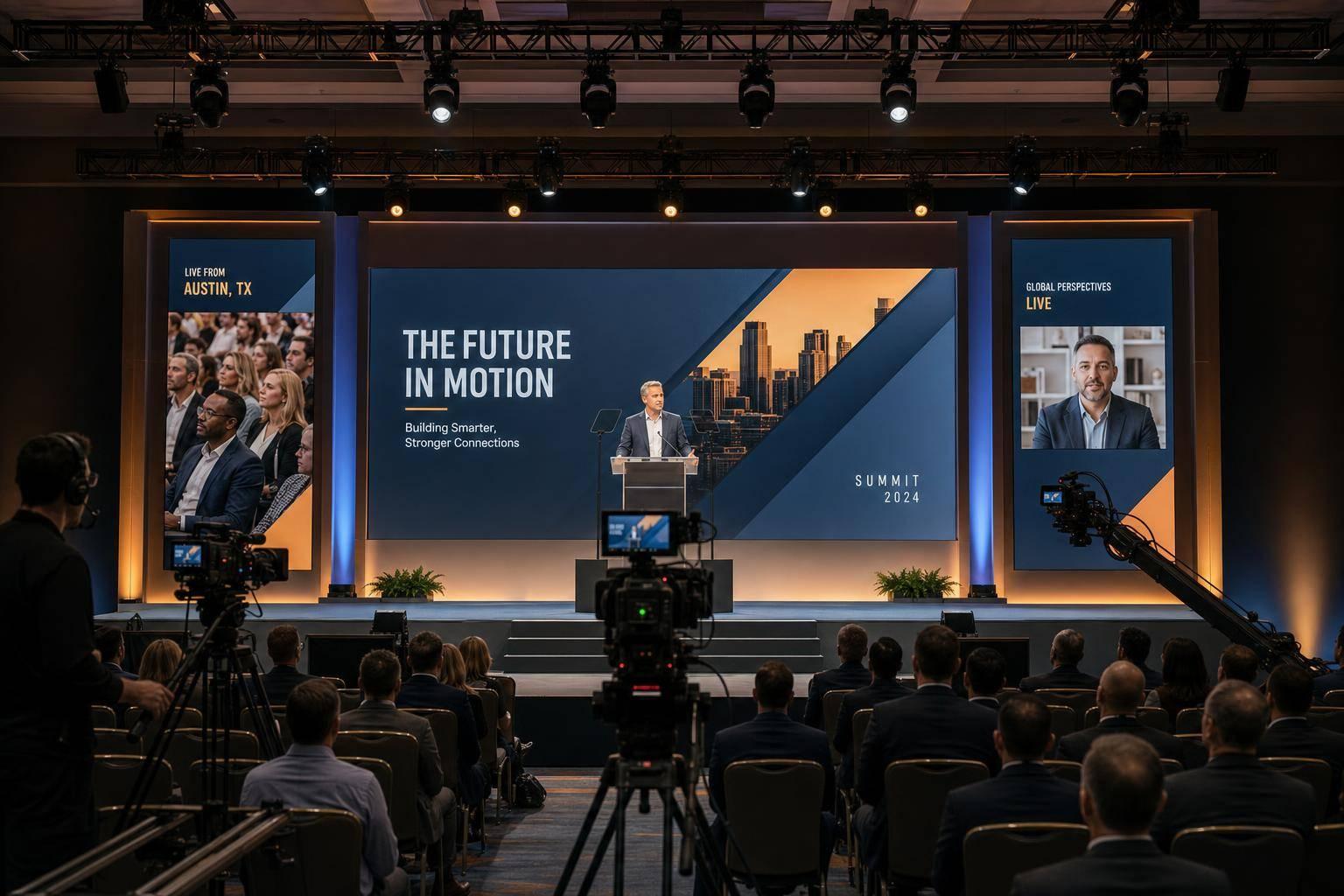
If you need one team to run planning, staging, AV, streaming, and speaker support across the U.S., these eight names are the main ones to compare. In this article, I look at Corporate Optics, Freeman, Encore, AVI-SPL, ON Services, Projection, Meeting Tomorrow, and INNOVATIVE through four buyer checks: nationwide delivery, production scope, hybrid/livestream work, and executive presentation support.
Here’s the short version:
- Corporate Optics fits executive-heavy conferences that need one team from planning to post-event work.
- Freeman fits large national programs with venue-by-venue setup changes and big hybrid shows.
- Encore fits hotel and venue conference programs, especially repeat events inside its venue network.
- AVI-SPL fits enterprise meetings that need steady account support, broadcast over IP, and tight keynote control.
- ON Services fits multi-city events that need the same show standards across stops.
- Projection fits content-led conferences where slides, visuals, and speaker prep matter a lot.
- Meeting Tomorrow fits high-volume, multi-location programs with distributed crews and hybrid support.
- INNOVATIVE fits meetings where broadcast-style delivery and presentation control are at the top of the list.
A few numbers help frame the buying decision:
- Corporate conference budgets often run from $5,000 to $100,000+ (you can use a hybrid event cost calculator to refine these estimates)
- Freeman handles 19+ events per day
- Encore supports about 400,000 events per year
- Meeting Tomorrow has produced 4,750 events across 1,466 U.S. cities in one year
- Nearly 75% of Fortune 500 events now include a virtual or hybrid piece
If I were choosing, I’d focus on four simple questions:
- Can the team deliver the same show quality in every city?
- Do they own the whole production stack, or will I juggle multiple vendors?
- Can they follow hybrid meeting planning best practices to ensure backup plans and stable streaming?
- Can they support senior speakers with rehearsals, teleprompters, slides, and live cue control?
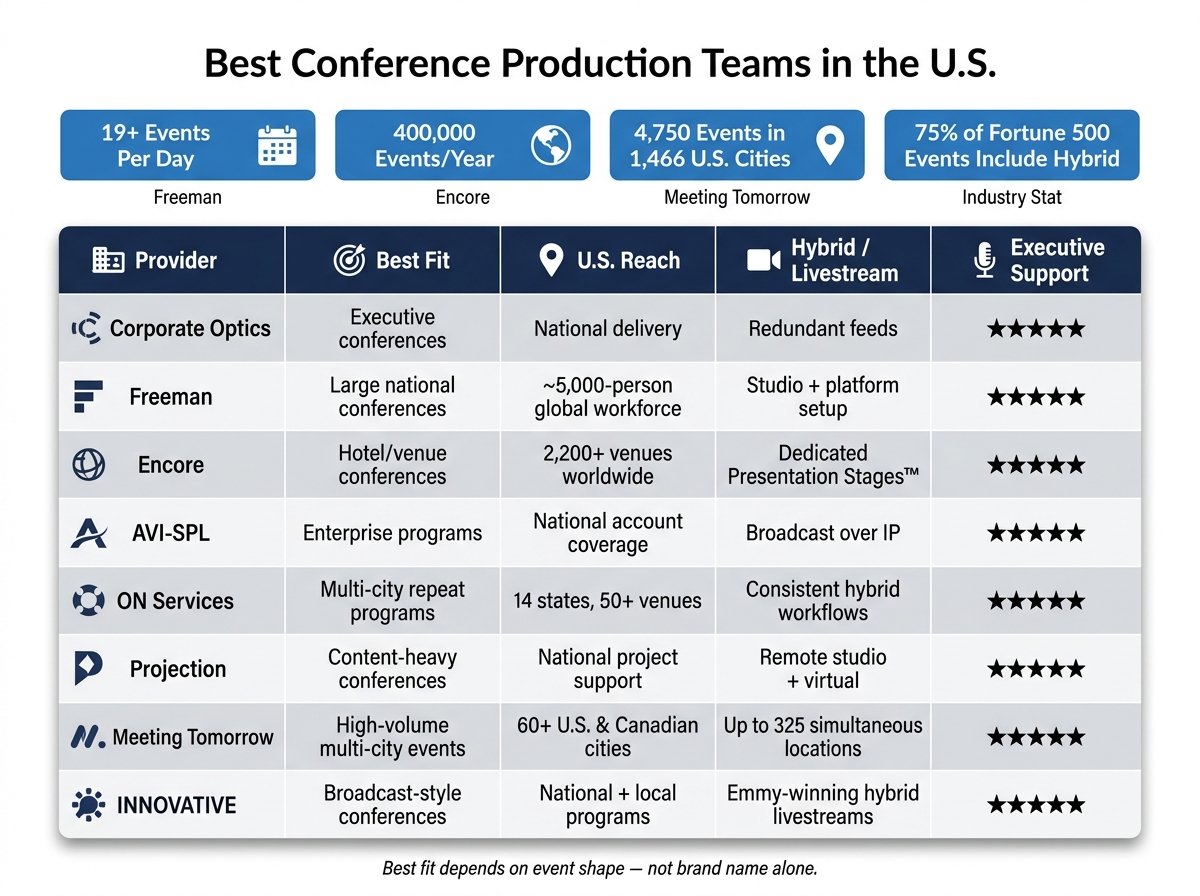
Quick Comparison
| Provider | Best Fit | U.S. Reach | Hybrid / Livestream | Executive Support |
|---|---|---|---|---|
| Corporate Optics | Executive conferences | National delivery | Yes, with redundant feeds | Strong |
| Freeman | Large national conferences | Large national workforce | Strong studio and platform setup | Strong |
| Encore | Hotel/venue conferences | Large venue network | Dedicated streaming stages | Strong |
| AVI-SPL | Enterprise programs | National account coverage | Broadcast over IP | Strong |
| ON Services | Multi-city repeat programs | 14 states, 50+ venues | Yes | Strong |
| Projection | Content-heavy conferences | National project support | Strong virtual and remote studio work | Strong |
| Meeting Tomorrow | High-volume multi-city events | 60+ cities | Strong with backup workflows | Strong |
| INNOVATIVE | Broadcast-style conferences | National and local programs | Strong hybrid livestreams | Strong |
The main takeaway: I’d pick the team based on the event shape, not the brand name alone. A CEO keynote, a hotel conference circuit, and a 100-city rollout do not need the same kind of production partner.
Best Conference Production Companies: Side-by-Side Comparison
Your playbook for executing complex conferences
sbb-itb-ae35a94
1. Corporate Optics
Corporate Optics stands out when a conference needs tight coordination, polished delivery, and strong support for senior speakers.
Founded by Steven P. Simmons, Corporate Optics manages conference production from the first idea and venue selection to on-site delivery and post-event support. For multi-day events, the team also handles agendas, technical planning, vendor coordination, and on-site staffing. Pricing is custom and based on each event’s scope and technical needs.
Production Scope
The team provides AV, scenic and lighting design, and custom stages for board meetings and leadership conferences. For board and shareholder meetings, it uses secure AV and privacy protocols.
That same level of control carries over to live and hybrid event delivery.
Hybrid and Livestream Execution
Its virtual and hybrid setups use professional switching, redundant signal feeds, and live broadcast platforms. The team also supports interactive Q&As, audience polls, and post-event archiving.
Executive Presentation Support
Presentation support includes scriptwriting, teleprompter services, rehearsals, and slide deck management to cut down on speaking errors. For awards ceremonies, the team syncs scripts, nominee videos, trophy handoffs, walk-up music, and lighting cues into one smooth show flow.
2. Freeman
Freeman has been delivering live experiences for nearly a century and now handles 19+ events per day on average. That scale matters. It means fewer handoffs between preproduction, venue setup, live show delivery, and post-event support. For recurring conferences, that's a big deal because one team can handle venue planning, staging, and live execution under the same roof.
U.S. Reach and Production Scope
Freeman's global workforce of nearly 5,000 supports nationwide delivery. For multi-city programs, the team also runs site visits to spot venue gaps early. That can save a lot of pain later.
A good example is the HIMSS conference. At the Orange County Convention Center in Orlando, Freeman built digital signage infrastructure because the venue didn't have built-in screens. When the event moved to the Venetian Expo in Las Vegas, Freeman plugged graphics straight into the venue's existing screens instead.
So the pattern is pretty clear: Freeman adjusts production to fit the venue, rather than forcing the same setup everywhere.
That same approach shows up in its hybrid and streaming work too.
Hybrid and Streaming Capabilities
Freeman partners with Hubilo and uses studio-based production with multi-camera control rooms, LED or green-screen backdrops, and dedicated control-room feeds. That setup helped Webex One reach 23,000 virtual attendees and 16.7 million keynote views, which was up 42% year over year.
Streaming is only part of the job, though. Freeman also handles speaker content and what happens on stage in the moment.
Executive Presentation Support
Freeman's proprietary Orchestrate platform manages presentation content from submission through live stage delivery, including last-minute file updates and tech troubleshooting for keynotes and breakout sessions. Blue Echo maps venues in 3D to within ±1 inch.
Put together, those tools help cut down on last-minute content problems and venue-planning delays.
3. Encore
Encore is a strong fit for large hotel- and venue-based conferences that need production support built into the event. The company handles about 400,000 events each year and has close to 12,000 team members across 23 countries.
U.S. Reach and Production Scope
Encore serves as the in-house production partner at more than 2,200 hotels and venues worldwide. That gives its teams early knowledge of each location’s power, rigging, and internet setup. For multi-city programs, Encore uses a shared event history database, so teams in different venues can see past event goals and budget preferences. That helps clients skip the usual reset at every stop.
Encore also has local scenic and exhibit warehouses. In plain terms, that can help cut drayage and shipping costs, which can add up fast on touring programs.
Hybrid and Streaming Capabilities
Encore runs dedicated Presentation Stages™ and Pop-Up Studios built for polished streaming and recording. These spaces support live switching, remote presenter coordination, and real-time interpretation for multilingual sessions.
That setup is most useful when a session needs to shift fast between live, recorded, and remote formats. If your agenda changes on the fly, or speakers join from different places, that kind of control can save a lot of stress.
Executive Presentation Support
For high-stakes keynotes, Encore provides dedicated show callers, stage managers, and cue-to-cue rehearsals. That kind of backstage structure matters when timing is tight and there’s no room for missed cues.
The International City/County Management Association used Encore's Presentation Stage in Washington, D.C., for its Executive Director to record remarks before a live moderated Q&A. Jeremy Figoten, Director of Conferences & Sponsorships, said:
"We utilized Encore's Presentation Stage in Washington, DC for our Executive Director to record his remarks and the first-rate production team kept the look and feel of the general sessions at a high-level... they were also with us every step of the way with our keynote speakers."
That level of cue control matters most in keynote-heavy programs with tight run-of-show needs.
4. AVI-SPL
AVI-SPL pairs central planning with on-the-ground crews to keep service steady from one location to the next. That setup fits enterprise conference programs that need repeatable delivery, hybrid broadcast support, and tight show control.
U.S. Reach and Production Scope
Recurring programs tend to run better when show standards stay the same and preproduction moves faster. With AVI-SPL, the same account team and technicians can remain on the account, and 3D stage renderings help lock in the room layout before load-in.
That same approach carries over to hybrid sessions and main-stage presentation support.
Hybrid and Streaming Capabilities
Its Enterprise Broadcast team supports all-hands meetings, shareholder events, and customer presentations over existing IP networks, which can make distribution simpler. Its hybrid setups also support live translations, real-time virtual events, and on-demand session replays.
This is geared toward common conference formats, such as:
- General sessions
- Executive remarks
- Multilingual programming
Executive Presentation Support
For keynotes and leadership sessions, AVI-SPL can deploy LED walls, multi-camera coverage, and live show calling to manage cues and transitions. The team has also received recognition from the Strategic Account Management Association (SAMA) for six consecutive years, including the 2023 award for C-Suite Support and Engagement.
That level of control matters most when a conference blends live speakers, remote presenters, and fast cue changes.
5. ON Services
ON Services brings 40+ years of live event work to corporate conference production, with operations in 14 states and in-house AV in 50+ venues across the U.S. Its venue partners include the Georgia World Congress Center, the San Diego Convention Center, and the Cobb Galleria Centre.
The company handles planning, design, execution, and post-event support. For teams running conferences in more than one city, that matters. You want the show to feel the same from stop to stop, not like you're starting from scratch every time.
U.S. Reach and Production Scope
Its ON Site division serves as the in-house AV partner at major convention centers, backed by regional warehouses. For multi-city programs, ON Services uses modular production frameworks to help enterprise teams repeat and tailor technical setups and brand standards across cities and regions.
Recent acquisitions, including CMI AV and Video West, have also expanded its national footprint.
Hybrid and Streaming Capabilities
When an event serves both in-room and remote audiences, the main goal is simple: make the experience feel steady on both sides. ON Services supports hybrid events with live streaming and workflows built to give in-person and virtual attendees a consistent experience.
Executive Presentation Support
For leadership sessions, the job often comes down to tight presentation control. ON Services provides centralized presentation management for keynotes, including version control and speaker access. It also offers speaker coaching, custom animation, motion graphics, live show calling, and on-site filming.
ON Services Studio gives planners a way to review stage designs and estimate pricing earlier in the planning process.
Its strongest use case is a multi-city program that needs repeatable production standards without rebuilding the show each time.
6. Projection
Projection handles conference production from the first idea to the on-site show. Its work leans heavily on presentation design and virtual delivery, which makes it a good match for content-heavy conferences where polished visuals and tight speaker prep matter just as much as logistics.
U.S. Reach and Production Scope
Projection supports the full conference lifecycle, including registration areas, on-site offices, breakout sessions, and satellite locations. Its event IT is built for fast access, stable connectivity, and steady workflows across registration, breakouts, and satellite spaces. On the content side, its in-house team produces opening videos, lower thirds, title animations, stingers, and branded slide templates.
In plain terms, this is the kind of setup that fits conferences where the slides, stage visuals, and speaker flow can make or break the session.
Hybrid and Streaming Capabilities
That same content-first mindset carries into hybrid and virtual events. Projection begins with the audience experience, then builds the platform around it. Its team handles live and recorded segments, takes in pre-recorded content, and delivers final files for platform use. It also offers remote studios with broadcast-quality capture, plus dedicated audio, video, and lighting support.
If a conference needs the virtual side to feel as polished as the room itself, that approach can make a big difference.
Executive Presentation Support
For high-stakes general sessions, Projection offers a Virtual Speaker Ready Room - a one-on-one setup where presenters get direct help with video, audio, and lighting before they go live. The team also schedules speakers, coaches pre-recorded content, and manages rehearsals and live show programming in-house.
That mix of tight creative control and hands-on speaker support leads neatly into the next team’s way of handling conference execution.
7. Meeting Tomorrow
Where Projection leans into tight control over content, Meeting Tomorrow is built for running events across many places at once.
Meeting Tomorrow has supported virtual events since 2008 and hybrid events since 2009. Today, it averages 719 events across 130 cities per month and produced 4,750 events across 1,466 U.S. cities in one year.
U.S. Reach and Production Scope
The company works through a network of hundreds of vetted technicians and equipment warehouses across the U.S. and Canada. That setup matters when a program needs to roll out in many markets without turning into a mess.
For multi-city programs, Meeting Tomorrow offers flat-rate pricing, so the same meeting setup costs the same in different cities. That helps teams avoid awkward billing surprises from one region to the next. Instead of juggling separate vendors in each market, clients work with one account team that manages execution across locations.
Hybrid and Streaming Capabilities
Meeting Tomorrow's broadcast setup can support up to 325 simultaneous locations for multi-site events. That's a big deal for brands running a shared experience across a large footprint.
To reduce risk, the team builds backup plans into hybrid shows. Those plans include:
- 4G internet backups
- Onsite encoding
- Pre-recorded content options
- A remote viewer support line
That kind of preparation matters most when speakers in the room and viewers online both need the live show to work without hiccups.
"The entire team was nothing but professional and gracious, and I really leaned on their expertise leading up to our hybrid event. Not only were they a source of comfort and confidence, they came to us with suggestions to make it even better." - Kara Gladish, Manager of Customer Experience, Webex Events
Executive Presentation Support
For high-pressure sessions, Meeting Tomorrow offers dedicated presenter support, including mandatory tech checks, platform training, wardrobe coaching, and rehearsal management. In other words, it doesn't just handle the stream. It also helps speakers show up ready.
One example: the team produced a live virtual fundraiser for Habitat for Humanity Seattle, King County that raised over $1.6 million, beating the prior year's in-person total.
Its clearest fit is high-volume, multi-city conference delivery. That scale-first model leads into the next team's approach.
8. INNOVATIVE
INNOVATIVE brings broadcast television experience to corporate conferences, with a clear focus on live delivery and repeatable execution. The team supports events that range from local high-stakes presentations to national meetings and hybrid livestreams.
Its production work spans creative design, video production, presentation management, brand design, and full-scale event execution. That mix matters most when buyers are weighing hybrid reliability, presentation control, and show consistency.
U.S. Reach and Production Scope
INNOVATIVE handles end-to-end conference production for both national and local programs. That means planning, creative, delivery, and live troubleshooting all sit inside one workflow.
For event teams, that can make a big difference. Instead of juggling separate vendors for each part of the show, they can keep the process under one roof.
Hybrid and Streaming Capabilities
INNOVATIVE supports hybrid livestreams for national meetings, backed by an Emmy Award-winning background in broadcast television. In plain terms, it brings a TV-style production mindset to business events.
That experience helps support broadcast-quality delivery for both in-room and remote audiences. The same discipline also carries into speaker prep and live session management, where small mistakes can turn into big headaches fast.
Executive Presentation Support
For high-stakes presentations, INNOVATIVE manages the process from the first script draft through final delivery and also handles live troubleshooting on site.
Its strongest value shows up in conferences where broadcast-quality presentation control and hybrid delivery sit at the top of the priority list.
How Each Team Performs Across The Four Key Buying Factors
Choosing a conference production team usually comes down to four things: reach, ownership, hybrid execution, and executive presentation support. The comparison below turns those team profiles into a practical buyer's checklist. It helps you see which teams stand out when national coverage, full-service control, hybrid delivery, and executive support all need to work together.
Nationwide Delivery
The main question here is simple: can the team deliver the same people, specs, and standards in every city?
Meeting Tomorrow works in 60+ major U.S. and Canadian cities, including Atlanta, Chicago, and Las Vegas, through a technician network that operates across union and non-union venues. That setup can cut freight and labor costs compared with hotel AV. If you're running a roadshow or multi-stop program, it's smart to ask whether the same technical lead stays with the event across all stops.
| Provider | Primary Strength | Logistics Strategy |
|---|---|---|
| Meeting Tomorrow | 60+ major U.S. and Canadian cities | Technician network; works in union and non-union venues |
| Freeman | Global workforce of nearly 5,000 | Venue-adaptive production; site visits to spot gaps early |
| Encore | 2,200+ hotels and venues worldwide | In-house venue knowledge; shared event history database |
| ON Services | 14 states; in-house AV in 50+ venues | Modular frameworks; regional warehouse network |
Reach is useful. But it matters more when the same team can also run the full production stack.
End-to-End Production Scope
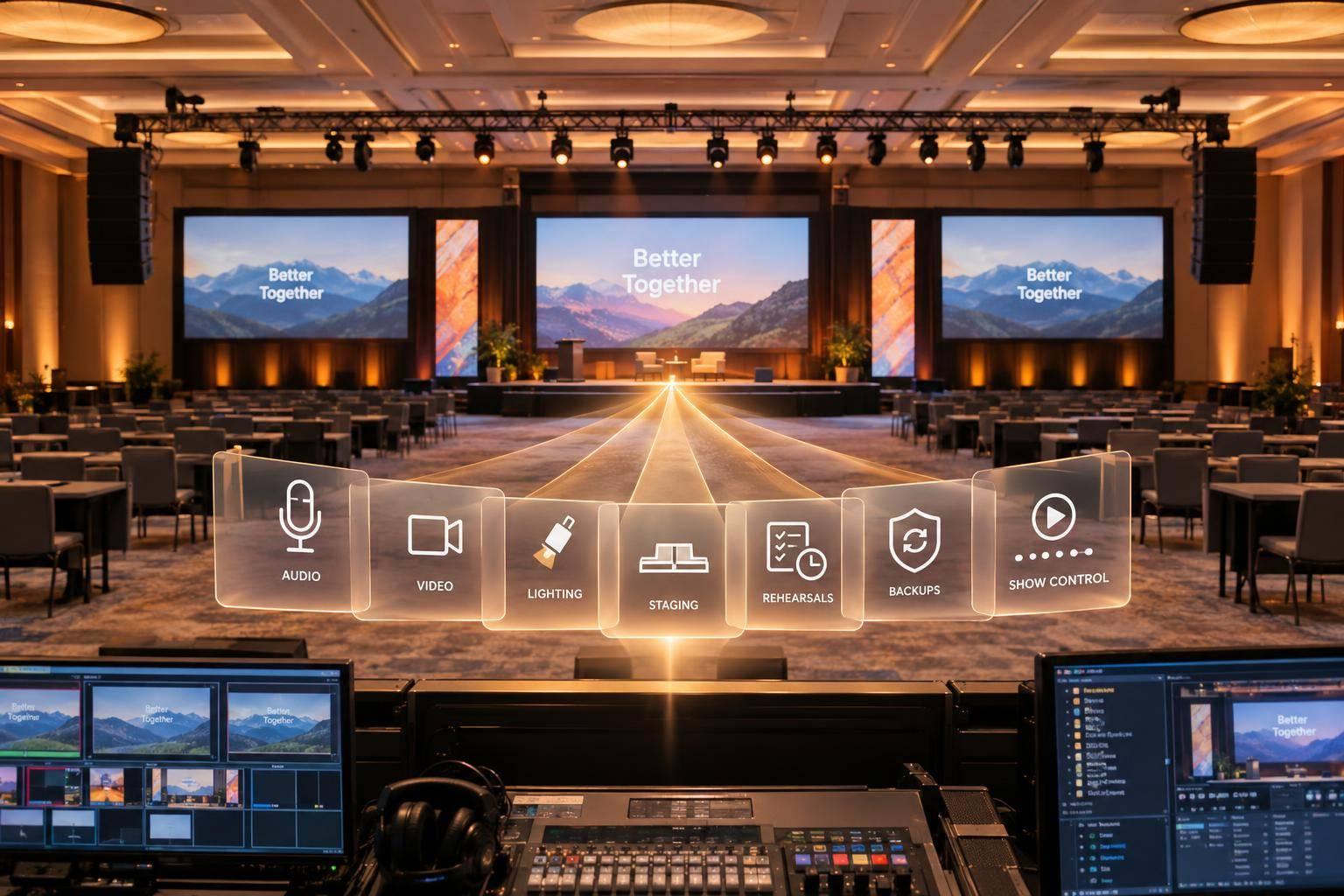
A real end-to-end partner handles everything from pre-production to post-event reporting. The standard here is whether staging, scenic, AV, lighting, show calling, and on-site logistics sit under one account team instead of being split across multiple vendors.
Corporate Optics covers that full scope with agenda development, on-site staffing, speaker support, stage design, audiovisual production, venue sourcing, vendor coordination, live streaming, and post-event analytics, all under one team.
That kind of setup can make life a lot easier. Fewer handoffs usually means fewer surprises.
Full-service execution matters even more when the event has to work for people in the room and people watching online.
Hybrid and Livestream Capability
Nearly 75% of Fortune 500 events now include a virtual or hybrid component. So hybrid production isn't a side feature anymore. It's part of the main brief.
Strong hybrid teams don't just stream what's happening in the room. They build a separate viewer experience for the remote audience. That includes dedicated graphics, camera angles, and interaction systems for online attendees, plus encoding, platform configuration, and remote speaker rehearsals as part of the workflow.
For larger hybrid programs, ask a direct question: does the provider have broadcast-grade infrastructure and redundant signal paths? If the answer is vague, that's a red flag.
For leadership sessions, that level of technical control also has to carry over to the people on stage.
Executive Presentation Quality
C-suite keynotes and investor days need a higher bar. This isn't just about making the room look good. It's about helping senior speakers stay calm, sharp, and on-message.
Look for teams that treat the following as standard, not add-ons:
- teleprompter operation
- confidence monitors
- precision lighting
- scheduled rehearsal windows
Branded scenic design and cinematic lighting also signal executive-level polish. In high-stakes sessions, the small details do a lot of heavy lifting.
| Event Need | Best Provider Profile |
|---|---|
| Multi-city roadshow | Teams with master specification protocols |
| Large-scale hybrid conference | Single-source enterprise providers |
| High-stakes CEO keynote | Technical-first production teams |
| Interactive global summit | Hybrid-specialist teams |
Pros and Cons
The summary below turns the earlier profiles into a fast comparison. If you've already looked at each company, this is the quick decision layer: who fits, where the tradeoffs are, and what kind of event each one suits best.
| Provider | Pros | Cons | Best For |
|---|---|---|---|
| Corporate Optics | Full end-to-end scope under one team; agenda planning through post-event support; speaker support, scenic design, and live streaming | Pricing varies by event scope; requires consultation to quote | High-stakes executive conferences and hybrid events needing single-source ownership |
| Freeman | Venue-adaptive production; proprietary content management via Orchestrate; strong hybrid broadcast infrastructure | Scale can mean less flexibility for smaller or simpler programs | Large-scale conferences and multi-city programs needing consistent nationwide delivery |
| Encore | In-house presence at 2,200+ venues; shared event history database; dedicated Presentation Stages for polished streaming | Best value realized at partner venues; less advantageous outside that network | Hotel- and venue-based conferences with recurring multi-city needs |
| AVI-SPL | Consistent account teams across programs; 3D stage renderings for pre-production; enterprise broadcast support over IP networks | Stronger fit for enterprise scale; may be heavier than needed for smaller events | Enterprise programs needing repeatable hybrid delivery and C-suite presentation support |
| ON Services | In-house AV at 50+ venues; modular frameworks for multi-city repeatability; centralized presentation management | Regional footprint concentrated in specific markets; less presence outside core venue partnerships | Multi-city programs needing consistent production standards across stops |
| Projection | Strong content production in-house; Virtual Speaker Ready Room for presenter prep; broadcast-quality remote studio capture | Leans heavily toward content and virtual delivery; less emphasis on large-scale live logistics | Content-heavy conferences where presentation design and speaker prep drive the experience |
| Meeting Tomorrow | Nationwide distributed crew network; avoids hotel AV commissions; strong hybrid support across 60+ U.S. and Canadian cities | Crew consistency from city to city can vary with a distributed model | High-volume, multi-city hybrid events and hotel-based conferences |
| INNOVATIVE | Emmy Award-winning broadcast background; end-to-end ownership from creative through live delivery; strong hybrid livestream execution | Broadcast-first approach may be more than needed for lower-stakes internal meetings | National meetings and hybrid conferences where broadcast-quality delivery is the priority |
A simple way to read this table: some firms lean toward single-team ownership, some shine in venue networks, and others stand out for broadcast-style hybrid delivery. That difference matters. A polished executive summit has very different needs than a repeatable roadshow across several cities.
The next section distills these tradeoffs into the simplest buyer takeaways.
Conclusion
Across the eight teams above, the right fit comes down to budget, lead time, scope, and execution quality.
Start with total cost, not just the line item on the proposal. That means looking at overtime, freight, last-minute changes, and venue commissions. In-house venue AV providers often pay 40%+ commission to the hotel, and that cost is often passed on to the client.
Timing matters just as much. Plan 8–16 weeks ahead for custom scenic work and 4–6 months ahead for complex multi-city programs. If the timeline gets shorter, cost goes up and risk goes with it.
After that, the next call is simple: should one team run the whole program? In many cases, that makes life a lot easier. When one team owns the full production, inventory, crew, and brand standards stay steady across cities. That kind of consistency matters when technical specs, speaker support, and executive presentation quality need to hold up from one market to the next.
The best conference production partner is the one that can handle planning, staging, AV, livestreaming, and show calling without adding extra handoffs.
FAQs
How far in advance should I book conference production?
Plan for 8 to 16 weeks for executive summits and events with custom environment design.
For larger, more complex conferences with multi-venue logistics, broadcast production, and detailed staging, 4 to 6 months is usually the better window.
That said, some production teams can work on shorter timelines when business needs call for it.
What should I ask before hiring one production team?
Ask who owns accountability for the program, how project management runs day to day, and who holds technical ownership.
You’ll also want to confirm whether you’ll have one dedicated production manager from scoping through the post-event debrief, or if that role shifts between phases.
Then get clear on staffing and gear:
- Does the team use its own equipment and crews, or does it rely on subcontractors?
- If subcontractors are involved, who manages them and checks quality on site?
For multi-city programs, ask how they keep quality and brand standards consistent from one market to the next. That matters a lot when several venues, crews, and timelines are in play.
You should also ask how they handle:
- contingency planning
- signal-path redundancy
- hybrid streaming
- multi-room coordination
Those details tell you how the team works when things are smooth - and when they’re not.
How can I tell if a hybrid event setup is reliable?
A solid hybrid event setup gets planned from the start. You can’t bolt the virtual piece on at the last minute and expect it to work well. The production team needs to treat remote viewers and in-person attendees as two separate audiences, each with the same level of care.
That usually means looking for broadcast-grade equipment, dedicated streaming operators, and backup systems for any signal path that could bring the show down. It also helps to use platform-agnostic delivery, so you’re not boxed into a single tool or channel. And from the first session to final strike, one centralized technical direction team should be running the whole thing.
If that sounds like overkill, think of it this way: a hybrid event is basically two events happening at once. If one side gets less attention, people notice fast.
Related Blog Posts


Streamline your workflow, achieve more

Lorem ipsum dolor sit amet, consectetur adipiscing elit. Maecenas ac velit pellentesque, feugiat justo sed, aliquet felis.



Lorem ipsum dolor sit amet, consectetur adipiscing elit. Maecenas ac velit pellentesque, feugiat justo sed, aliquet felis.