Top Multi-Day Conference Production Companies For Large Corporate Audiences.

Chief Executive Officer
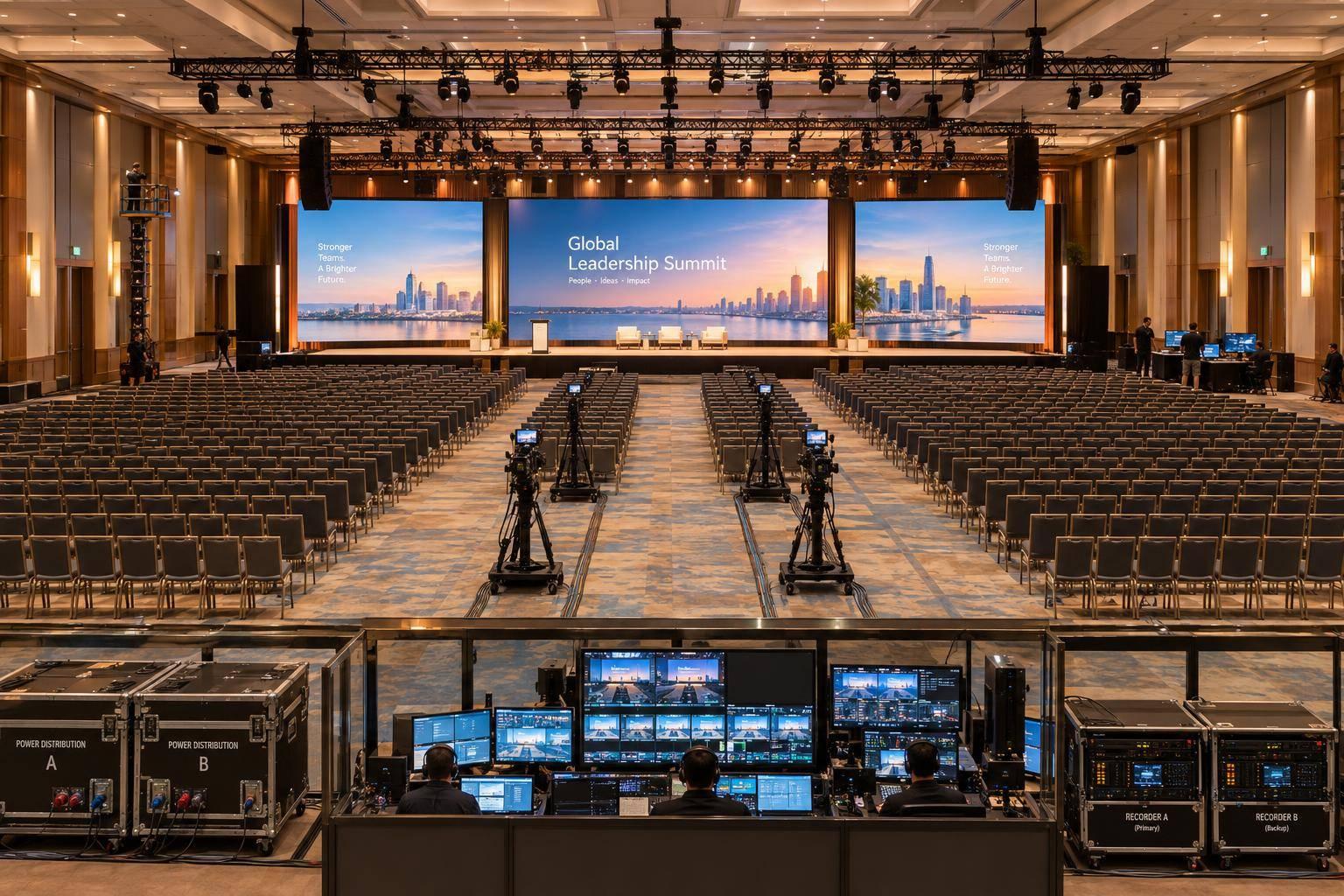
Compare Corporate Optics, Freeman, Encore, and PRG by room coverage - not just equipment lists. Before requesting prices, give all four the same brief: attendance, concurrent rooms, show days, broadcast needs, and budget in USD. Require named staff, backup plans, and itemized costs.
Each company offers a different starting point. Corporate Optics lists planning and production support, Freeman combines AV with event logistics, Encore pairs production with venue-based teams, and PRG supports equipment-heavy shows. The deciding factor is what each provider commits to delivering across every room and day.
Quick Comparison
| Company | Main focus | Staffing and location checks | Experience to verify |
|---|---|---|---|
| Corporate Optics | Planning, AV design, speaker support, and livestreaming (including livestreaming shareholder meetings) | Concurrent-room capacity, local crews, and backup equipment | Comparable multi-day corporate conferences |
| Freeman | AV, broadcast, content, and logistics | Dedicated versus shared technicians and city-specific resources | Keynote experience versus full-conference coverage |
| Encore | Venue-based AV and meeting production | House labor, regional crews, and room ownership | Similar attendance, room counts, and staffing needs |
| PRG | Audio, video, lighting, scenic, and engineering | Department leads, regional equipment, freight, and union labor | Projects matching the event’s technical demands |
Encore reports a presence in about 40 U.S. states, while PRG reported 199 team members on its IAAPA 2025 project. Those figures provide context - not a staffing promise. Compare references, presentation workflows, recordings, overnight resets, and total costs before choosing a partner.

Conference Production Companies: Compare Fit and Room Coverage
1. Corporate Optics
Evaluate Corporate Optics on its ability to coordinate AV across an entire conference, not just support individual rooms.
AV and Broadcast Production
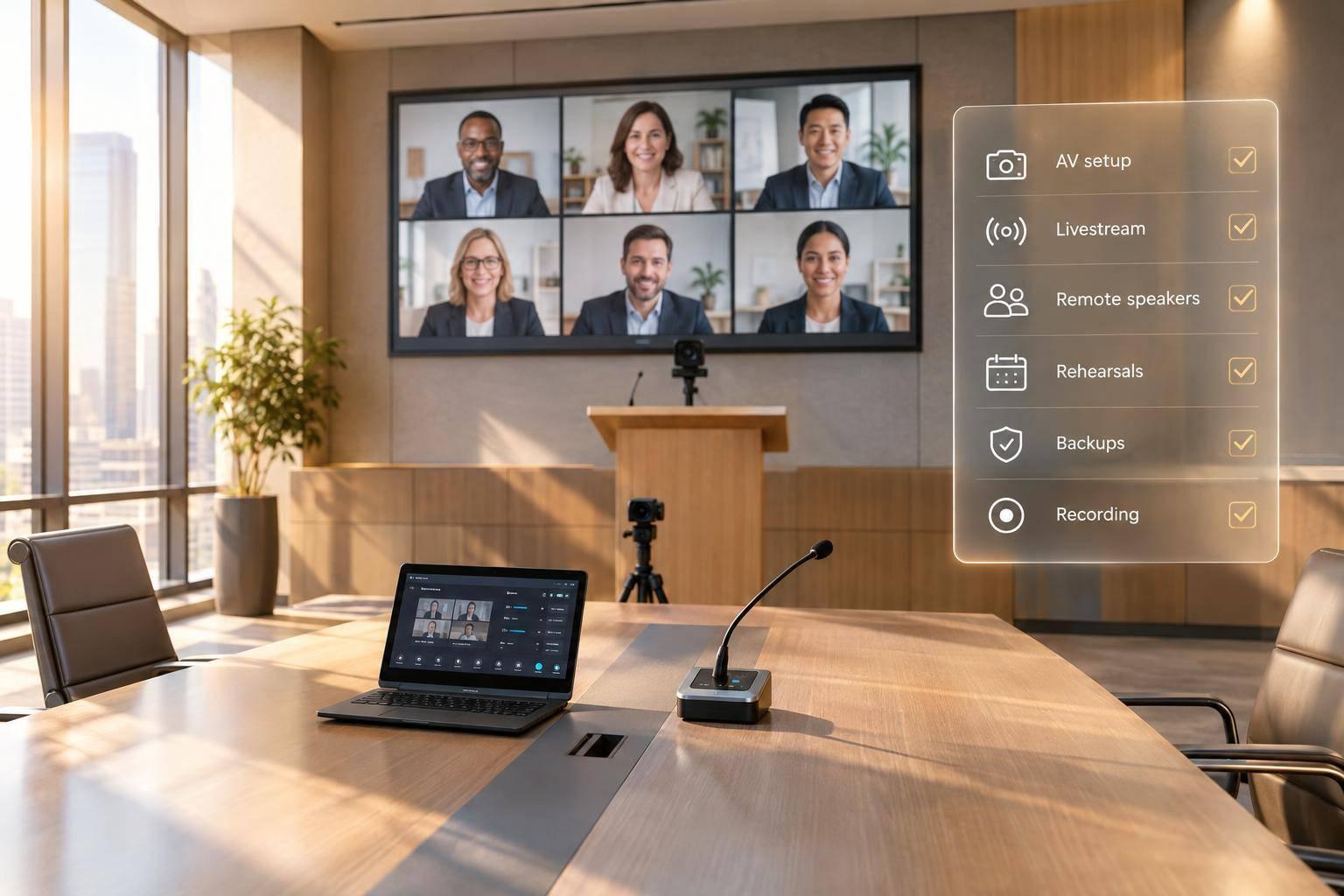
Corporate Optics lists AV design, scenic and lighting production, speaker support, and livestreaming among its services. For general sessions and breakouts, build stage setup, lighting, presentation handling, cue-to-cue rehearsals, and remote-speaker testing into the production schedule. Include time for presentation collection and confidence-monitor checks.
Set requirements for streaming resolution, captions, recordings, privacy controls, and post-event access. Require a written failover plan for network loss, playback failure, and remote-speaker disconnects.
With the AV scope in place, check how the team will cover multiple rooms and show days.
Multi-Room Staffing and Execution
Corporate Optics also lists planning, on-site staffing, and vendor coordination. Ask for a room-by-room staffing matrix covering show callers, technicians, speaker support, rehearsals, and overnight changeovers for general sessions and breakouts.
Confirm the maximum number of rooms the company can support at once using its own staff and local partners. Assign named responsibility for load-in, testing, live operation, and strike.
Clarify who coordinates venue AV, internet, decorators, catering, and security - and who can approve changes when sessions overlap. If technicians cover more than one room, require a written plan for handling simultaneous requests.
Then check whether the company’s conference history and local resources support the proposed staffing plan.
Conference Experience and Geographic Fit
Available materials do not list attendee counts, concurrent-room totals, or on-site performance data. To verify capacity across general sessions, breakouts, and multiple show days, request two comparable multi-day corporate conference references. Each should include dates, audience size, room count, broadcast scope, and outcomes.
For your event city, confirm access to local crew, equipment, and backup inventory, along with any travel or freight needs. The available information does not establish a local production footprint.
sbb-itb-ae35a94
2. Freeman
AV and Broadcast Production
Freeman brings AV production, conference event production including planning, content, technology, logistics, and on-site execution into one plan. That scope helps coordinate keynotes, content control, and sponsor requirements. Its published services include show management, video and presentation production, live switching, broadcast cameras, content capture, presenter management, livestreaming, and hybrid-format support.
Best fit: conferences that need keynotes, recorded content, and sponsor deliverables in one production plan. Get broadcast outputs, captioning, and backup systems confirmed in writing. Then check how the team will handle simultaneous rooms and session changes.
Freeman’s official InfoComm case study identifies it as AV production lead for the week-long event at the Las Vegas Convention Center. Its documented scope included full AV production for three headline Keynote Theater sessions, with staging, audio, lighting, and video systems. That shows keynote production experience, not full-event coverage.
Multi-Room Staffing and Execution
Published services alone don’t establish concurrent-room capacity or staffing ratios. Ask Freeman to explain how presentation updates reach each room, who manages shared signal feeds, and how staff escalate technical issues when sessions overlap.
The proposal should include a room-by-room scope, equipment list, deadlines, rehearsal schedule, signal plan, staffing chart, and escalation steps. It should also separate dedicated engineers from shared support and identify overnight reset crews and venue labor responsibilities.
Location coverage only helps if the proposal specifies local crew, freight, and venue support for your event city.
Conference Experience and Geographic Fit
Freeman lists U.S. locations in major convention markets, including Dallas, Denver, Las Vegas, Orlando, and Atlanta, plus Toronto and Dubai. That network suits conference programs that rotate between cities, but each city’s proposal should still spell out equipment availability, local labor, freight, and venue relationships.
For broadcast-heavy programs, require a separate technical design and confirm local staffing and support.
3. Encore
AV and Broadcast Production
Encore handles end-to-end production for live, hybrid, and virtual conferences. Services include audio, video, lighting, staging, rigging, scenic design, and on-site technical direction. Its conference materials also mention livestreaming, virtual stages, and on-demand access. Best fit: venue-based conferences with shared production and meeting technology. Confirm how teams will coordinate presentation updates, streams, and recordings across general sessions and breakouts over multiple days.
Ask for separate general-session and breakout quotes, with line items for recording, streaming, internet, power, and backup gear. Public materials don’t define a standard room package or broadcast spec. With this venue-based model, planning goes beyond equipment: clarify who controls venue labor, rigging, and infrastructure.
Multi-Room Staffing and Execution
Encore’s venue-based model makes property coordination a key part of vendor selection. Confirm which services the venue controls, including rigging, power, internet, and labor. Require named owners for leading AV teams in show calling, presenter prep, room support, breaks, and overnight resets. Encore documents production management and technical delivery, but public sources don’t provide fixed staffing ratios or standard pricing.
Conference Experience and Geographic Fit
Encore reports a presence in about 40 U.S. states and more than $500 million in equipment inventory. Available case studies show experience with plenaries, breakouts, stage management, and presenter prep. However, they don’t include enough attendance, room-count, staffing, or performance data to verify delivery of a specific large-scale corporate conference.
For a multi-city conference, request two comparable multi-day references. Confirm each location’s venue staff, regional crews or subcontractors, and freight arrangements, along with how production leadership will stay consistent across all days.
4. PRG
AV and Broadcast Production
PRG brings together audio, video, lighting, rigging, scenic, automation, engineering, and production management for corporate conferences. Its services cover general sessions, LED walls, projection, playback, content distribution, and broadcast capture. It suits technically demanding conferences with multiple rooms, complex stage designs, and heavy infrastructure needs. The next step: confirm that coverage extends to every room and show day.
For scale, PRG’s IAAPA 2025 project used seven broadcast cameras, 426 lighting fixtures, Disguise media servers, more than 8 miles of cabling, and 652,900 pounds of equipment across six sessions, dozens of breakout rooms, and hundreds of exhibitor booths.
IAAPA is an industry event, not a typical internal corporate conference. Use those numbers as context, then check how the setup translates to your room count and multi-day schedule.
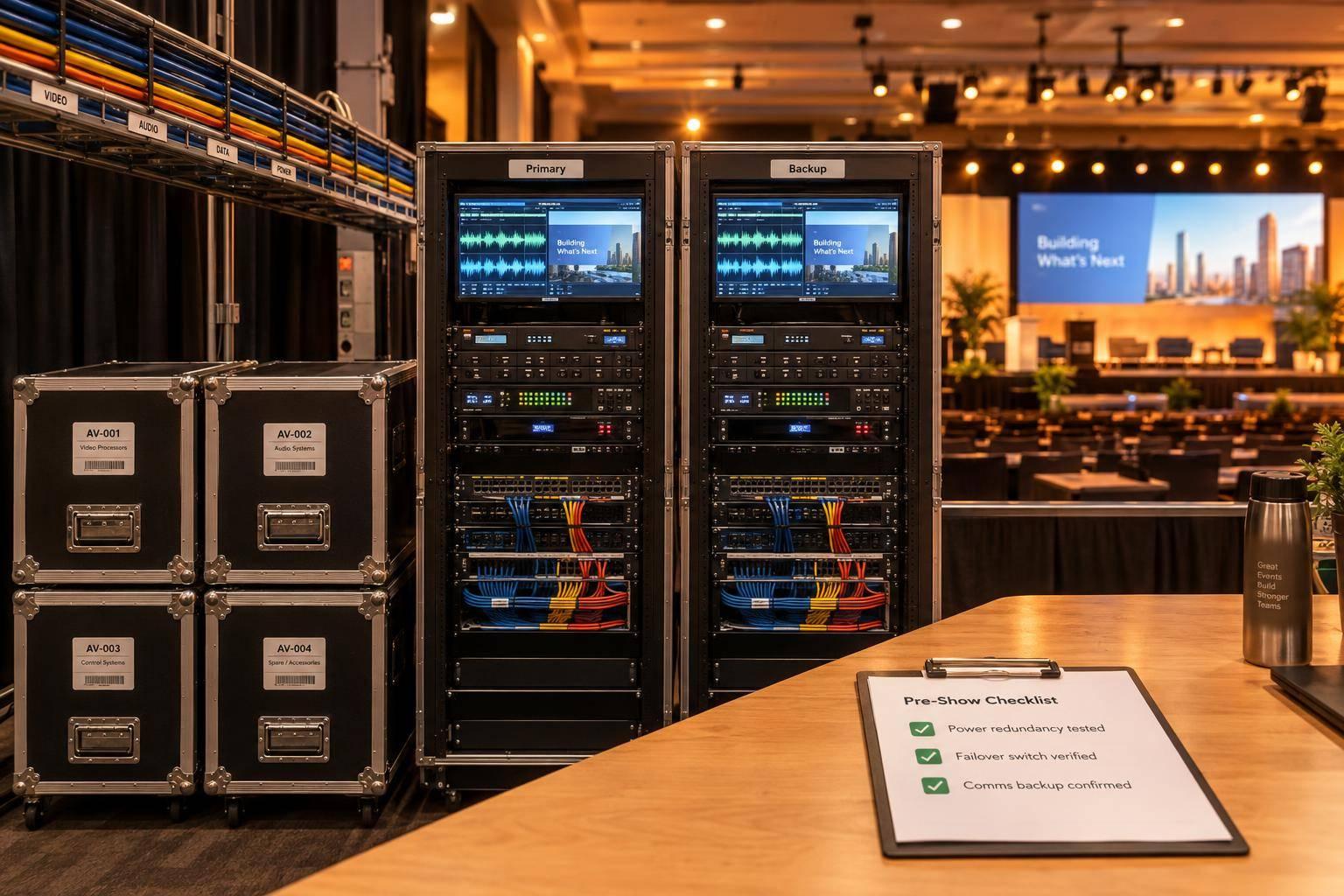
Confirm whether the camera package covers image magnification (IMAG) only or includes recording, livestreaming, and post-event delivery. Request signal-flow diagrams that show switching, playback, backups, encoding, and transmission across general sessions and breakouts.
Multi-Room Staffing and Execution
PRG reported 199 team members and 198 wireless RF channels on the IAAPA 2025 project; treat those figures as a scale reference, not a standard staffing model.
Ask PRG to connect its signal-flow plan to crew coverage: what will it handle itself, what will it subcontract, and who owns system integration?
Before load-in, require department-specific communication channels, an RF coordination plan, and a room-by-room coverage schedule. That schedule should name the people responsible for simultaneous issues, late presentation changes, overnight resets, backup playback, and replacement technicians.
Conference Experience and Geographic Fit
PRG reported support for the SNMMI Annual Meeting in Los Angeles, covering plenary sessions, meeting rooms, digital posters, and the exhibition floor with audio, lighting, video, digital signage, production management, and technical labor.
Ask which regional operation will supply equipment and engineering support, how it will handle freight and union labor, and who approves rigging loads and power distribution. Request project references that match your room count and technical complexity, not just audience size.
Apply the same checks - AV workflow, room coverage, and local support - to the remaining production requirements below.
AV and Broadcast Across General Sessions and Breakouts
Compare the proposed system, not just the service list. Published capabilities don’t tell you which equipment, operators, or backups are reserved for your conference. Use this matrix to check what each proposal still needs to spell out.
| Company | General-session production | Breakout AV | Broadcast and recording | Presentation management | Items to verify in the proposal |
|---|---|---|---|---|---|
| Freeman | Keynote and breakout production are listed; confirm each room’s package, staffing, and backups. | Verify equipment and dedicated versus shared support for each room. | Cameras, switching, capture, and livestreaming are listed; confirm committed outputs. | Presentation management, live captions, and multilingual support are listed; confirm workflows. | Display specifications, rigging engineering, camera counts, captioning, and backup equipment. |
| Encore | Public materials cover a broad range; get exact room coverage, broadcast scope, and the support model in writing. | Require a room-by-room equipment and staffing plan. | Confirm whether the package covers livestreaming only or full broadcast production, including recording and editing. | Confirm intake deadlines, version control, and remote-speaker support. | Stage and scenic scope, displays, engineering, captions, recording deliverables, and failover. |
| PRG | A broad technical scope is listed; confirm per-room packages, staffing, and presentation-system details. | Verify room-specific inventory and support assignments. | Switching, streaming, capture, editing, and on-demand video are listed; confirm included deliverables. | Rehearsals and presentation management are identified; confirm the conference-wide workflow. | Committed inventory, remote contribution, captions, recording formats, and backup paths. |
Even a well-equipped production can run into trouble when ownership is unclear across rooms, show days, and deliverables.
For the general session, require one written technical design. The quote must also specify the breakout-room inventory matrix, presentation deadlines and version control, remote-speaker return video, return audio, and talkback path, captioning method, and broadcast deliverables.
A camera feed is not a full broadcast package. Require separately priced line items for switching, graphics, playback, encoding, recording, caption feeds, backups, and demonstrated failover.
With the technical scope defined, check whether the team can staff every room across every show day.
Multi-Room Staffing and On-Site Delivery
Once the AV plan is set, delivery depends on clear ownership of every room and shift.
Require one accountable production team with named leaders and room leads. Assign operators, engineers, speaker support, and presentation staff for every day and shift, covering both plenaries and breakouts. Confirm dedicated versus shared coverage, call times, meal breaks, overtime assumptions, and backup staffing. Set the same expectations for employees, local hires, union crews, and subcontractors: everyone needs clear supervision and accountability.
Use the matrix below to check whether each team can maintain the same standard across plenaries, breakouts, and overnight resets.
| Company | General-session and breakout coordination | Staffing accountability | Venue and union coordination | Contingency response | Proposal checks |
|---|---|---|---|---|---|
| Freeman | Request named production, show-calling, and breakout leads. | Assign room-readiness checks and shift handoffs. | Document who handles rigging, electrical, union labor, and labor minimums. | Require an event-specific escalation chart. | List rooms with dedicated technicians. Name who approves overtime and relief labor. |
| Encore | Map reporting lines and room ownership across project managers, room leads, speaker support, and streaming teams. | Assign shift coverage and backup technicians. | Define handoffs among venue-based teams, regional crews, and house labor. | Set room-level response targets and decision-making authority when failures happen at the same time. | Name who controls shared technicians across rooms running at the same time. |
| PRG | Map production management and technical labor across plenary, meeting, and exhibition spaces. | Define the authority of technical leads and the on-site labor manager. | Document union coordination, credentials, transport schedules, and access windows. | Require procedures for content-routing failures and unavailable rooms. | Name owners for room readiness, crew replacements, and escalation across venues. |
Assign presentation management to a named owner. Require a speaker-ready-room lead, centralized file intake, a timestamped version log, and approval before revised files reach room operators. Specify who tests embedded media, confidence monitors, and remote-speaker connections. For late changes, name an approver and require confirmation that the correct room received the approved file.
Rehearsal and reset plans should spell out who works, when they work, and who signs off. Reserve full technical rehearsals for general sessions and targeted checks for breakouts. Each entry should name the presenter, required crew, acceptance criteria, and the person responsible for unresolved issues.
Between show days, overnight schedules must cover room reconfiguration, battery charging, cable inspection, equipment testing, file synchronization, recording backups, room cleanup, and morning readiness. Specify which rooms reset at the same time and who signs off on each one. Also document how late sessions affect crew hours and what happens if a room cannot be restored on schedule.
Require a visual escalation chart connecting the first responder, room lead, technical director, production manager, venue contact, and client decision-maker. Set response targets and identify who can approve a session delay, a room change, or continuing without a failed element. Price rehearsal labor, overnight work, overtime, and backup staffing separately in U.S. dollars.
Next, test how each proposal handles broadcast, room coverage, and local support across the full agenda.
Project Experience, Location, and Partner Selection
Once AV and staffing requirements are set, check whether each proposal fits the event’s destination, schedule, and scale.
Match the documented scope to your agenda. Then confirm destination staffing, equipment access, and travel commitments in the proposal. Apply the same checks to every proposal: verified scope, local capacity, and clear commercial terms.
| Company | Verified project scope | Geographic checks | Best-fit use case | Procurement question |
|---|---|---|---|---|
| Corporate Optics | Listed services include event planning, audiovisual design, speaker support, livestreaming, and post-event analytics. Verify large-conference capacity through three comparable references. | Confirm destination staffing, equipment access, and travel requirements. | Combined planning and production, subject to verified multi-day, multi-room capacity. | Which services does the company perform itself, and who is responsible for local support and consistent delivery across rooms and show days? |
Before awarding the contract, work through this final procurement checklist:
- Destination: Document venue exclusivity, union rules, load-in requirements, rigging, and internet limits. For international events, resolve customs, power, language, insurance, and tax requirements.
- Proof and responsibility: Check references against attendance, concurrent rooms, operating hours, and multi-day delivery. Confirm Corporate Optics’ exact responsibilities. Approve contingency plans with written response and acceptance criteria.
- Commercial terms: Require an itemized USD proposal that separates equipment, labor and overtime, travel, freight, rigging, power, internet, recording, streaming, venue fees, and taxes. Identify exclusions, change-order and cancellation terms, and priced backup options.
FAQs
How far ahead should I book conference production?
Book weeks or months ahead, depending on your event’s complexity:
- Small internal meetings: 6 to 10 weeks
- Executive summits or custom scenic builds: 8 to 16 weeks
- Large-scale or multi-venue conferences: 4 to 6 months
- Major conventions or large-scale event series: 6 to 14 months
Booking early helps secure resources and leaves time for site surveys, technical drawings, and show-flow planning. That means fewer technical risks and less chance of last-minute rush charges.
How many AV technicians does my conference need?
AV staffing depends on your conference’s complexity, room count, and simultaneous sessions - not just attendance. Share your draft agenda, room count, and technical requirements with potential partners so they can map out crew roles and staffing needs.
Technicians may cover multiple rooms or work in one assigned space. Ask for an itemized staffing count in your proposal, with coverage for rehearsals, show-day execution, and backup needs.
How can I reduce production costs without sacrificing reliability?
Check the venue’s policies before booking. Independent production support may cost less than in-house packages, even after vendor fees. Ask for itemized proposals in U.S. dollars that break out labor, equipment, and logistics so you can spot unnecessary costs.
A partner that owns its equipment can save you 25–30% compared with third-party rentals. Finalize your scope and book your team 8–16 weeks ahead to avoid premium labor rates and last-minute freight charges.
Related Blog Posts
- 7 Companies To Use for Large-Scale & Multi-Day Conference Production
- Leading Conference Production Companies
- Leading Companies To Work With For Full Conference Production
- Have A Multi-Day Conference To Plan? Let Corporate Optics Be Your AV Conference Technical Production Partner (And Why We’re Your Best Choice!)


Streamline your workflow, achieve more
Lorem ipsum dolor sit amet, consectetur adipiscing elit. Maecenas ac velit pellentesque, feugiat justo sed, aliquet felis.



Lorem ipsum dolor sit amet, consectetur adipiscing elit. Maecenas ac velit pellentesque, feugiat justo sed, aliquet felis.