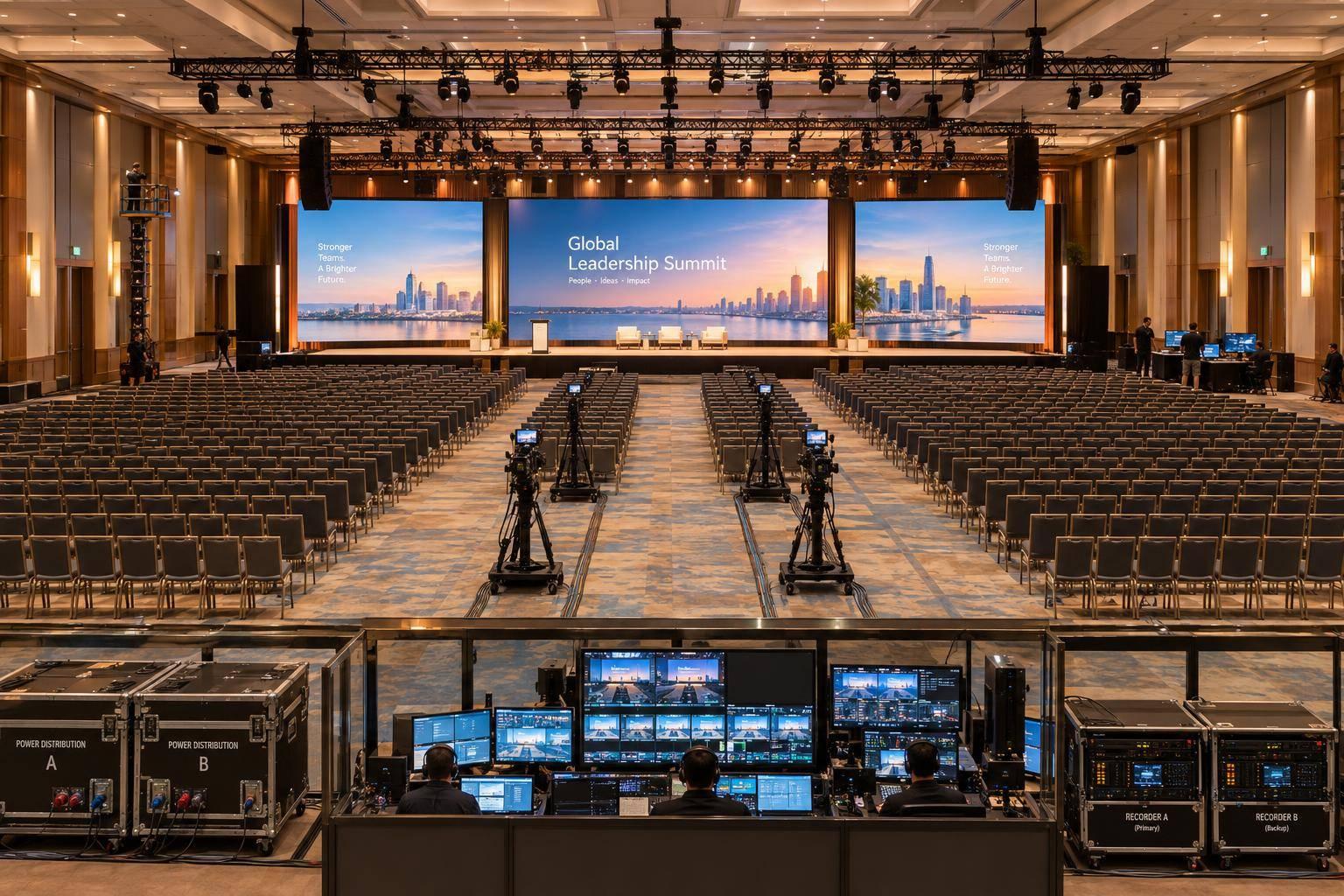
Trusted Conference Production Companies Corporate Planners Hire Again And Again.

Chief Executive Officer
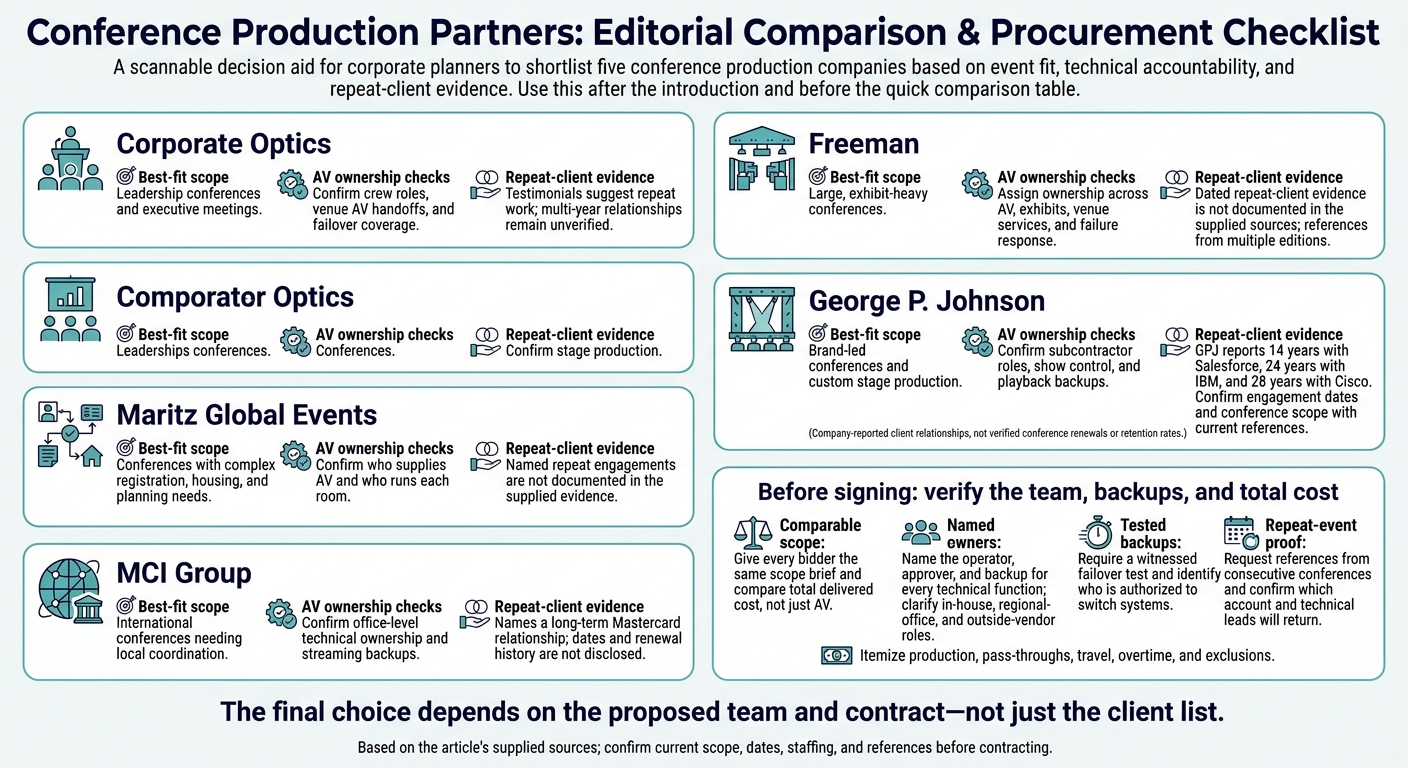
Compare conference production companies on who owns the work - not just the client list. This shortlist covers Corporate Optics, Freeman, George P. Johnson, Maritz Global Events, and MCI Group, weighing conference scope, AV delivery, backup plans, costs, and proof of repeat clients.
GPJ reports client relationships lasting 14 to 28 years, while repeat-hiring records for the other firms are either undated or not documented in the supplied sources. Before signing, request references from consecutive conferences, named technical leads, tested backups, and itemized pricing.
Quick Comparison
| Company | Best-fit scope | AV and backup checks | Repeat-client support |
|---|---|---|---|
| Corporate Optics | Leadership conferences and executive meetings | Confirm crew roles, venue AV handoffs, and failover coverage | Testimonials suggest repeat work; multi-year relationships remain unverified |
| Freeman | Large, exhibit-heavy conferences (following AV production best practices) | Assign ownership across AV, exhibits, venue services, and failure response | Request references from multiple editions |
| George P. Johnson | Brand-led conferences and custom stage production | Confirm subcontractor roles, show control, and playback backups | Reports 14 years with Salesforce, 24 with IBM, and 28 with Cisco |
| Maritz Global Events | Conferences with complex registration, housing, and planning needs | Confirm who supplies AV and who runs each room | Named repeat engagements are not documented |
| MCI Group | International conferences needing local coordination | Confirm office-level technical ownership and streaming backups | Names a long-term Mastercard relationship; dates are not disclosed |
The final choice depends on the proposed team and contract. Compare the same scope across bids, then check who returns next year, who handles failures, and which costs sit outside the quoted price.
Conference Production Companies: Fit, AV Ownership, and Repeat Clients
1. Corporate Optics
Conference scope and scale
Corporate Optics plans and produces recurring conferences and leadership events using a four-stage workflow: Discover, Design, Develop, Deliver. Its services cover venue logistics, vendor coordination, scenic design, lighting, audio, and video.
Company materials describe multi-day leadership conferences, annual meetings, awards ceremonies, and confidential board meetings. They don’t verify attendance limits, so confirm capacity for both your general session and breakouts.
AV execution and reliability
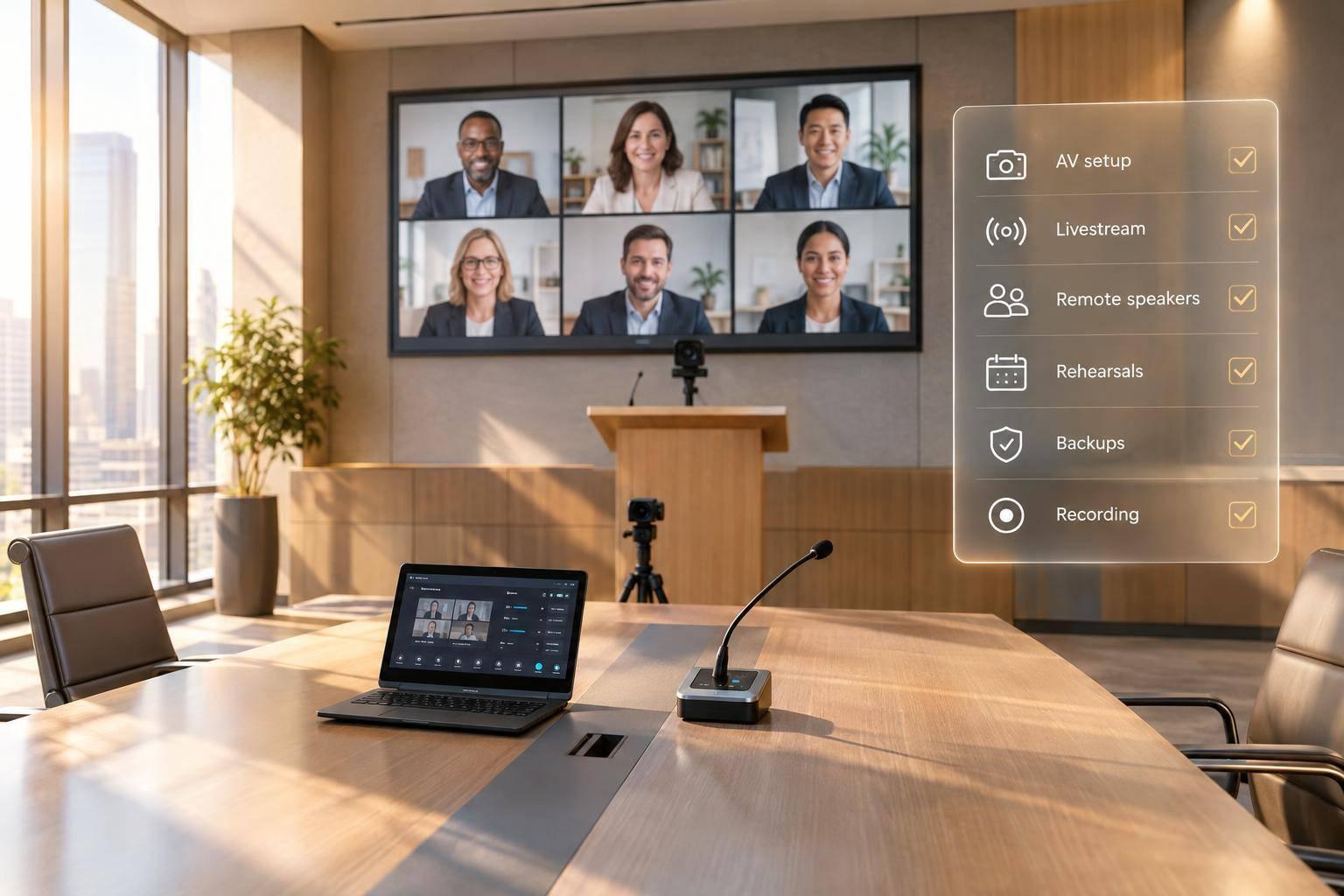
A service list only tells part of the story. Rehearsals, cues, and live switching need to work under pressure. Corporate Optics handles script writing, teleprompters, presentation coordination, and rehearsals. For virtual and hybrid events, its materials describe switching, redundant signal feeds, interactive Q&A, and post-event archiving - all relevant when speaker timing and live cues leave little room for error.
Redundant feeds aren’t a full backup plan. Ask for proposals that spell out internet failover, backup playback, rehearsal time, and who takes responsibility for on-site failures.
The company also mentions planning and post-event analytics, but the available results don’t verify its performance claims. Before signing, agree on reporting deliverables, measurement methods, and delivery dates.
Repeat business and client service
Repeat hires often depend on responsive service and consistent on-site work. Company-published testimonials suggest repeat engagements, but the available evidence doesn’t verify multi-year client relationships or retention data.
The workflow suits planners who want planning, stage production, presenter support, and hybrid delivery handled through one process. Check who owns each task, what backup coverage includes, and how costs break down. Confirm which AV, scenic, and streaming work the company performs itself. Request an itemized quote covering labor, equipment, scenic fabrication, streaming, travel, venue fees, rehearsals, overtime, contingencies, and analytics.
sbb-itb-ae35a94
2. Freeman
Conference scope and scale
Freeman suits large, exhibit-heavy conferences with general sessions, breakouts, sponsors, and complex venue logistics. Its case studies show it can deliver conferences at this scale, but they don’t verify repeat hiring.
The company combines show management, exhibit services, logistics, AV production, and on-site support, which reduces vendor coordination. For a small executive meeting, weigh whether that broader staffing and management model justifies the cost. It matters most when one team needs to coordinate exhibits, sessions, and AV without handoffs.
AV execution and reliability
Freeman supports staging, content presentation, signage, and keynote AV. The value of its integrated model depends on one team owning conference management, exhibit logistics, and AV from load-in through teardown.
Request a written ownership map covering internet, power, rigging, shipping, labor, content, and exhibitor communications. Also require a failure-response plan that names the technical lead and explains how venue-controlled services will be restored or bypassed.
Repeat business and client service
To judge whether this model works for recurring programs, request client references covering multiple editions. Ask for engagement dates and the work performed each year.
Name the account executive, senior producer, technical director, show caller, venue liaison, and escalation contact in the contract. Confirm who stays assigned through teardown, and set response deadlines for exhibitor questions and change orders.
For exhibit-heavy programs, compare total delivered cost - not just AV. Include labor, drayage, material handling, rigging, internet, power, shipping, overtime, cancellation terms, and change-order rates.
3. George P. Johnson
Conference scope and scale
George P. Johnson (GPJ) suits conferences built around brand storytelling and custom scenic design. Its services cover live, hybrid, and virtual programs, including general-session design and production, broadcast video, live streaming, speaker management, and logistics. GPJ fits executive conferences, flagship meetings, product launches, and global programs that need consistent brand-led execution year after year.
Before approving a build, ask GPJ to tie each scenic element to a communication goal. A custom stage should help attendees understand the message, not just add fabrication, freight, and installation costs. On large programs, the design needs an equally disciplined technical plan.
AV execution and reliability
GPJ brings together strategy, design direction, scenic design, technology, and production. Its live-production services include stage design, show visualization, keynote content production, audio, video and lighting design, stage management, choreography, and broadcast staging. Its public materials don’t establish that GPJ staffs every technical role or owns every piece of equipment in every market.
Make technical accountability part of your review. Request a responsibility matrix covering GPJ’s in-house roles, subcontractors, local AV providers, venue-required labor, equipment ownership, and escalation contacts. Ask for a written technical plan that details show-control architecture, LED or projection redundancy, backup playback, and streaming failover.
Before signing off on scenic design, check screen sightlines, confidence-monitor placement, stage access, and maintenance access behind the set. Rehearse playback and streaming failover with the approved set in place. These checks matter most for recurring programs, where each edition needs to meet the same standard.
Repeat business and client service
Repeat business is the clearest signal that this model holds up over time. GPJ reports long client tenures:
14 years with Salesforce, 24 years with IBM, and 28 years with Cisco.
Check those figures with current references to confirm scope, dates, and consistency across editions. Ask who owns the relationship from pitch through post-event reporting, who handles design and technical approvals, and how changes are priced and documented across locations.
4. Maritz Global Events
Conference scope and scale
For repeat programs, confirm whether Maritz places strategy, logistics, and production under one accountable team. Its meeting planning and production services cover experience design, event strategy, sourcing and contract procurement, registration, and housing. That mix may suit conferences with complex attendee logistics.
Ask for separate pricing for management, registration technology, housing, design services, AV and production management, travel, staffing, and third-party vendors. No public rate card was identified. Check whether this range of services helps the team deliver - or adds another layer between planning and execution.
AV execution and reliability
What matters is who runs the room, calls the cues, and manages the backups. Public material does not verify how Maritz delivers AV services. Confirm whether an in-house team owns AV delivery or relies on AV partners.
Require one named technical lead and a responsibility matrix that spells out staffing and vendor roles. Ask for a run of show, backup-power and failover plans, and emergency escalation procedures. For annual conferences, look for repeatable show control, not just one successful event.
Repeat business and client service
The supplied evidence does not document named repeat engagements or long-term client contracts. Ask for references covering multiple editions of programs similar in attendance, geography, format, and complexity. Across those editions, verify account-team continuity, billing accuracy, issue resolution, and change-order handling.
Require post-event reporting that connects registration, attendance, engagement, room-block performance, and business outcomes. Use those references to assess whether the same team can deliver the next edition at the same standard.
5. MCI Group
Conference scope and scale
MCI suits programs where cross-border coordination matters as much as show production. MCI Group operates MCI, its association-management and corporate-events brand, through 64 offices in 34 countries. Services include strategy, registration, housing, destination logistics, production, and hybrid meeting planning. For international congresses and conventions, assess MCI by program complexity - not assumed attendance.
AV execution and reliability
Start by checking whether one office owns the technical chain, from design to troubleshooting. MCI offers sound, lighting, staging, streaming, and audiovisual production, but its public materials don’t show a consistent staffing or equipment model across offices.
Ask the contracting office to name who handles technical design, equipment procurement, show calling, and troubleshooting across countries. Those responsibilities need clear owners to keep technical standards consistent across recurring programs.
MCI Canada supported 500 speakers over four conference days for the Canadian Society of Civil Engineers, using EventsAir’s OnAIR and AIRCast tools to manage simultaneous virtual sessions.
That example shows session coordination, not on-site redundancy. For a similar program, require remote-speaker rehearsals, tested streaming failover, and leading AV teams with a named owner for each virtual room.
Repeat business and client service
MCI identifies a long-term partnership with Mastercard supporting the European Business Summit. The source doesn’t disclose the start date, renewal history, or measurable results. Treat it as evidence of a client relationship, not a measured retention record.
Before signing, confirm which office owns the account, how local teams report to the global lead, and who controls budget changes across countries. Use those answers to assess account ownership and how issues get escalated when planning repeat business.
Conference Scope: Services, Formats, and Scale
This table separates verified services from work that needs confirmation. Use it to map each company’s scope, then use the next section to check technical ownership and backup plans.
| Company | Planning and vendor ownership | Production and attendee logistics | Event fit and scale |
|---|---|---|---|
| Corporate Optics | Planning, presenter support, scripts, rehearsals, and vendor coordination. | Direct: technical AV, lighting, and scenic design. Coordinated: venue selection and catering. Confirm registration, platform ownership, and transportation scope. | Executive-focused leadership conferences, annual meetings, and board meetings, delivered on-site or in hybrid formats; no published maximum attendance. |
| Freeman | Event concepts and global, regional, and local coordination; confirm agenda, venue, and supplier ownership. | AV, presentation management, digital signage, and expo/keynote production; confirm supplier roles, registration, and housing. | Conference/expo, educational, and hybrid programs. Work in Las Vegas and London shows multi-market reach. |
| George P. Johnson | Strategy, event concepts, content, and event management; specify who approves the agenda and owns venue/vendor contracts. | Live production, registration, housing, transportation, security, and staffing; confirm scenic scope and supplier roles. | Large branded conferences with connected attendee logistics; confirm geographic coverage for the proposed program. |
| Maritz Global Events | Confirm agenda ownership, venue sourcing, and vendor oversight in the proposal. | Confirm scenic, AV, registration, housing, transportation, and staffing scope in the proposal. | Request a comparable project with attendance, number of rooms, and production scope; the supplied evidence includes no verified scale example. |
| MCI Group | Confirm agenda decisions, venue contracts, and supplier approvals in the proposal. | Confirm scenic fabrication and attendee-logistics scope in the proposal. | Check the proposed team’s experience with the format and location; request a comparable project with attendance, number of rooms, and production scope. |
Documented scale shows past work - not promised capacity. Look beyond whether a company has delivered one large event. Ask whether it can deliver the same standard across editions.
For smaller executive meetings, focus on confidentiality, speaker preparation, and decision-making. For expos or international programs, request a responsibility matrix covering agenda, venues, suppliers, scenic production, registration, housing, transportation, and local delivery. Label each task in-house, regional-office delivery, or outside vendor.
Scope is only part of the decision. The next check is who owns AV delivery when the room goes live.
Once scale is clear, compare bids against the same scope - not just the headline price. Give every bidder the same scope brief using a corporate event checklist and require separate line items for production, pass-throughs, travel, overtime, and exclusions.
AV Delivery: Technical Roles and Backup Plans
Once the scope is clear, confirm who runs the room when the show starts.
What a team delivers live matters more than what it claims it can do. The contract must assign every technical function.
| Company | Documented technical delivery | Delivery model and reliability evidence | Confirm before signing |
|---|---|---|---|
| Corporate Optics | Technical rehearsals, speaker coordination, and run-of-show development. | Four-stage workflow with contingency planning built into Develop. | Who owns playback; whether there’s a dedicated show caller; streaming/broadcast scope; redundant equipment; and where its crew’s duties end and venue AV takes over. |
| Freeman | Meeting-room AV, presentation management, overflow viewing, streaming, and remote-speaker technical support. | Used prerecorded presentations alongside live content to reduce glitch risk while keeping live interaction. | Room-by-room audio design, scenic/AV interface drawings, rehearsal coverage, show calling staff, failover tests, and authority to handle escalations. |
| George P. Johnson | Camera, lighting, and background kits for remote presenters. | Preparation for presenters in separate locations helped standardize their on-screen appearance. | In-room audio, scenic/video integration, playback, rehearsal and show calling roles, streaming ownership, and backup connections. |
| Maritz Global Events | Technical production management and AV sourcing. | Public material doesn’t provide event-level technical detail; confirm which roles are in-house and which are sourced. | Named owners for sound, lighting, video, scenic, playback, speaker support, rehearsals, show calling, streaming, and broadcast. |
| MCI Group | Production, streaming, and broadcast services. | Public material doesn’t provide event-level technical detail; confirm the local team’s responsibilities. | Local delivery of sound, lighting, video, scenic, and playback; speaker preparation; rehearsals; show calling; and tested broadcast backups. |
Use these examples to turn service claims into named responsibilities.
Before signing, name the operator, approver, and backup for every technical function. Lock in the load-in, rehearsal, show, and load-out schedule. Settle venue AV responsibilities, access hours, power, and union labor arrangements before load-in.
Request a room-by-room staffing plan. It should name who handles audio, switching, playback, speaker support, and show calling for every concurrent session.
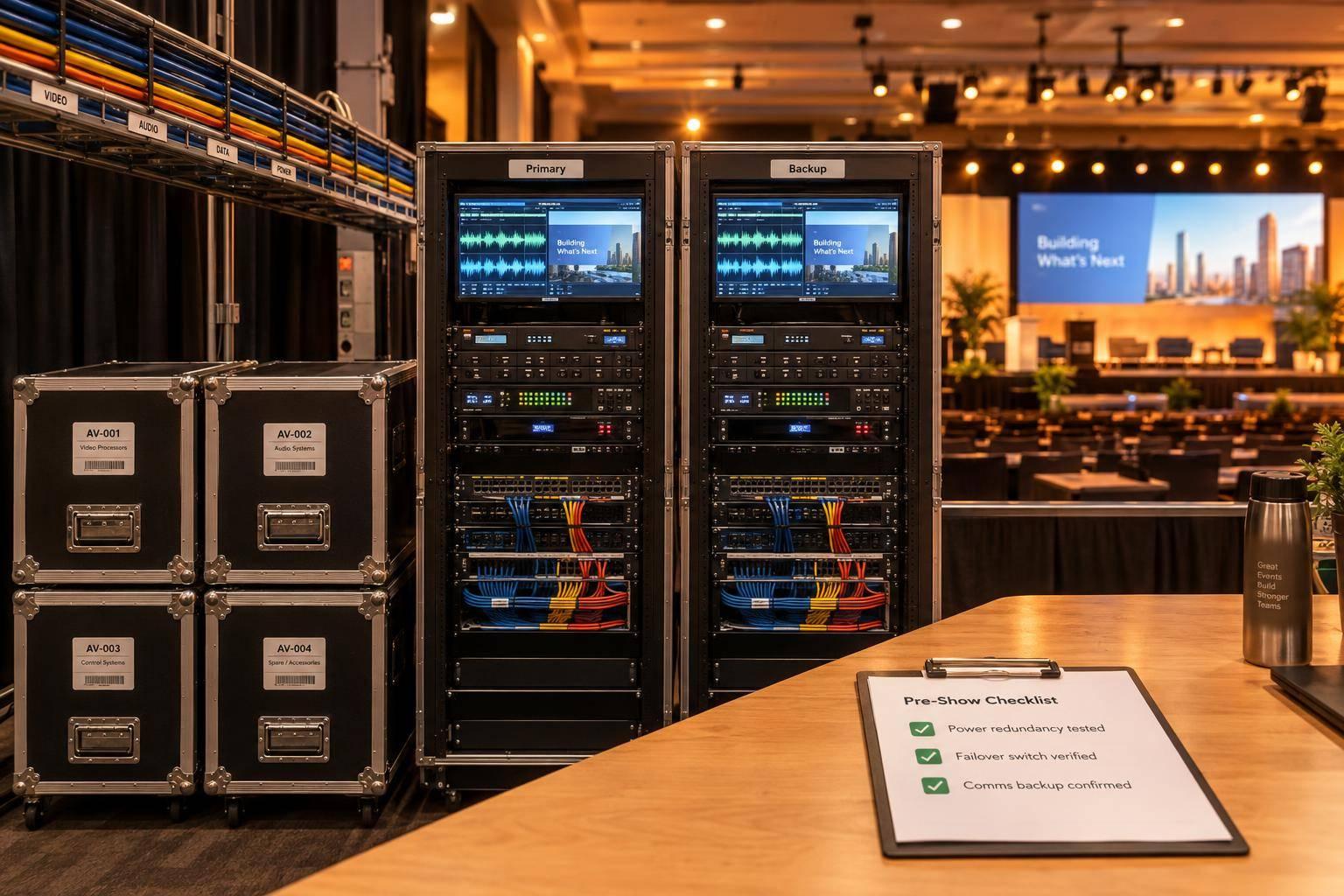
Require proof that backups work. The proposal should specify spare microphones, offline presentation copies, backup playback, power protection, independent internet paths, and spare encoders. Require a witnessed failover test, and name the person authorized to switch systems.
For broadcast delivery, specify captions, interpretation, recording formats, and archive handoff. The on-site escalation plan must state who receives an incident report, who decides the response, and how the planner gets updates. A label alone isn’t enough:
“technical support.”
Repeat Clients, Trade-Offs, and Your Final Shortlist
Use this final filter to assess whether each firm can deliver consistently - not just handle one conference. Keep the shortlist provisional until every firm provides references from consecutive conferences. Check who will return for your next event, not just which company signs the contract.
| Company | Dated repeat-client evidence | Service continuity and unresolved ownership |
|---|---|---|
| Corporate Optics | Not documented. | Four-stage program management offers a repeatable workflow based on successful large-scale conference elements. Confirm whether the account lead and production crew will return, and request client references. |
| Freeman | Not documented. | Logistics coordination supports recurring programs. Confirm team continuity and who is responsible for the overall production outcome. |
| George P. Johnson | Reports long client tenures. Confirm engagement dates and conference scope. | Brand-led production supports recurring programs. Verify which technical staff remain assigned, who owns the account, and references for similar scopes. |
| Maritz Global Events | Not documented. | Integrated planning and logistics need clear production accountability. Confirm returning technical leads and who controls outside suppliers. |
| MCI Group | Identifies a long-term Mastercard relationship, but does not disclose dates or renewal history. | Cross-border delivery needs consistent local ownership. Confirm returning office leads and technical standards across locations. |
FAQs
How far ahead should I book Corporate Optics?
Bring in Corporate Optics when planning begins or you're selecting a venue so there's time for site surveys and technical validation. Lead times vary by complexity:
- Executive summits or custom environments: 8–16 weeks.
- Most large or multi-day conferences: 4–12 months.
- Large-scale logistics, complex scenic work, or major flagship programs: 8–16 months.
Starting early helps prevent last-minute issues and gives the team more time to define the budget and technical scope.
How can I verify a production team's reliability?
Choose teams that own their equipment, maintain consistent staffing, and have backups for critical systems. Ask for staffing plans, backup gear lists, and pre-event engineering notes. Speak directly with the show caller to gauge their experience.
Ask whether they provide dual signal-path redundancy, “Day Zero” stress testing, or rapid-response kits for on-site hardware failures. Confirm they use 2D or 3D CAD plans to check sightlines and technical logistics early in planning.
How can I prevent unexpected production costs?
Ask for an itemized proposal in U.S. dollars that breaks down deliverables, labor, equipment, and possible venue surcharges. Make sure the agreed scope includes every capability you need. A service listed by a provider isn’t a guaranteed deliverable.
Working with one partner can cut total costs by 10%–20% by removing duplicate vendor fees and venue commissions. Check the venue’s AV policies and power and rigging fees early. Using an outside provider may trigger inflated charges.
Related Blog Posts
- Leading Conference Production Companies
- Leading Companies To Work With For Full Conference Production
- Have A Multi-Day Conference To Plan? Let Corporate Optics Be Your AV Conference Technical Production Partner (And Why We’re Your Best Choice!)
- Top Multi-Day Conference Production Companies For Large Corporate Audiences.



Streamline your workflow, achieve more

Lorem ipsum dolor sit amet, consectetur adipiscing elit. Maecenas ac velit pellentesque, feugiat justo sed, aliquet felis.



Lorem ipsum dolor sit amet, consectetur adipiscing elit. Maecenas ac velit pellentesque, feugiat justo sed, aliquet felis.