Looking For A Conference Production Company To Handle Venue Logistics, Layouts, And AV Needs? Reach Out To These 3 Companies Today.

Chief Executive Officer
If you need one team to run venue logistics, room layouts, and AV, these are the three names to look at first: Corporate Optics, Meeting Tomorrow, and Freeman.
I’d narrow the choice by event type first. Corporate Optics fits executive and board-level meetings. Meeting Tomorrow fits mid-size and multi-city programs, with support for events up to 5,000 attendees and a footprint of 719 events in 130 cities each month. Freeman fits large-scale conferences and trade shows, with 4,500+ live experiences a year and 98 years in the business.
Before I pick any partner, I’d check four things:
- Venue logistics: dock timing, load-in order, teardown, walkthroughs
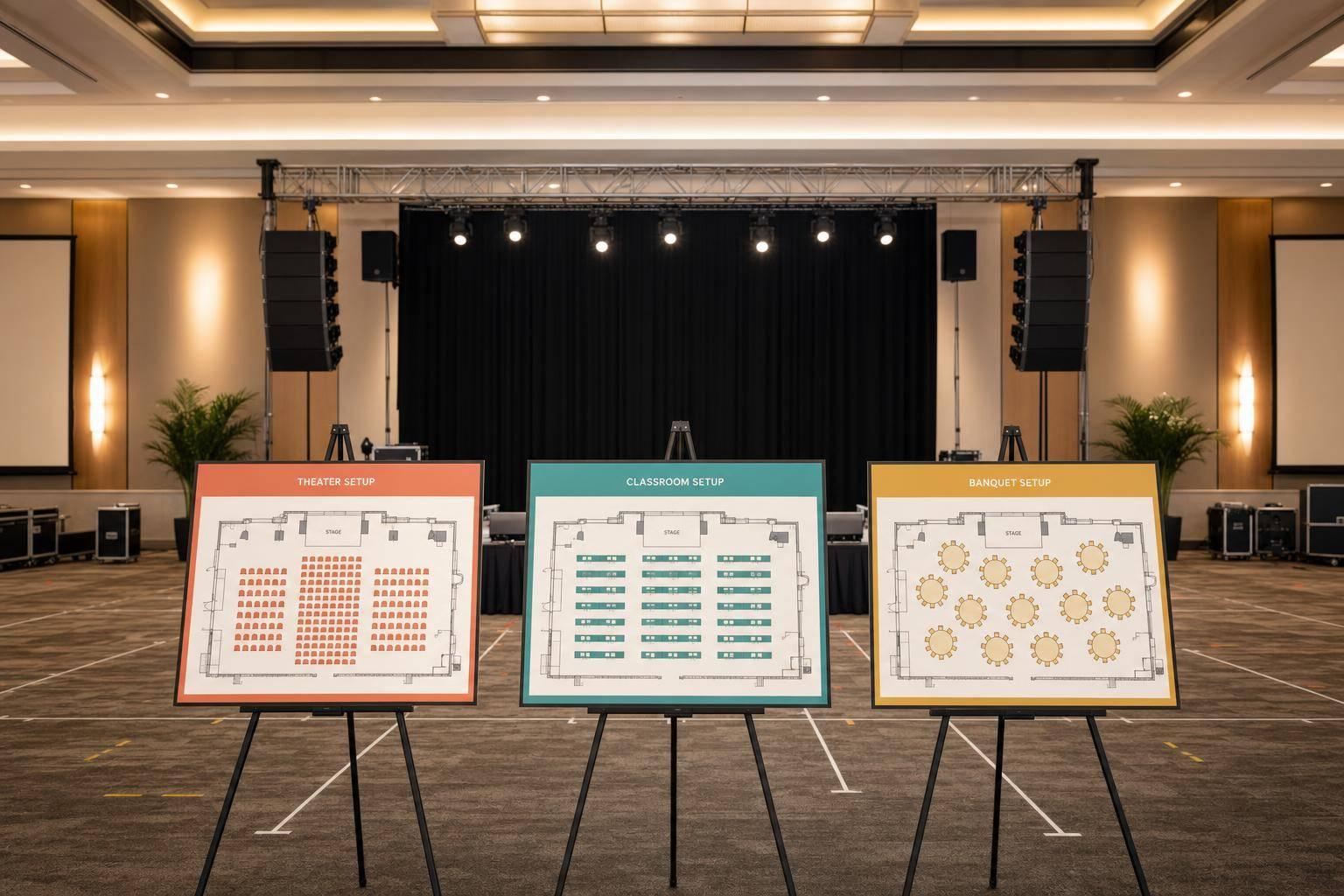
- Layout planning: CAD files, seating plans, rigging plots, 3D views , and an event agenda builder
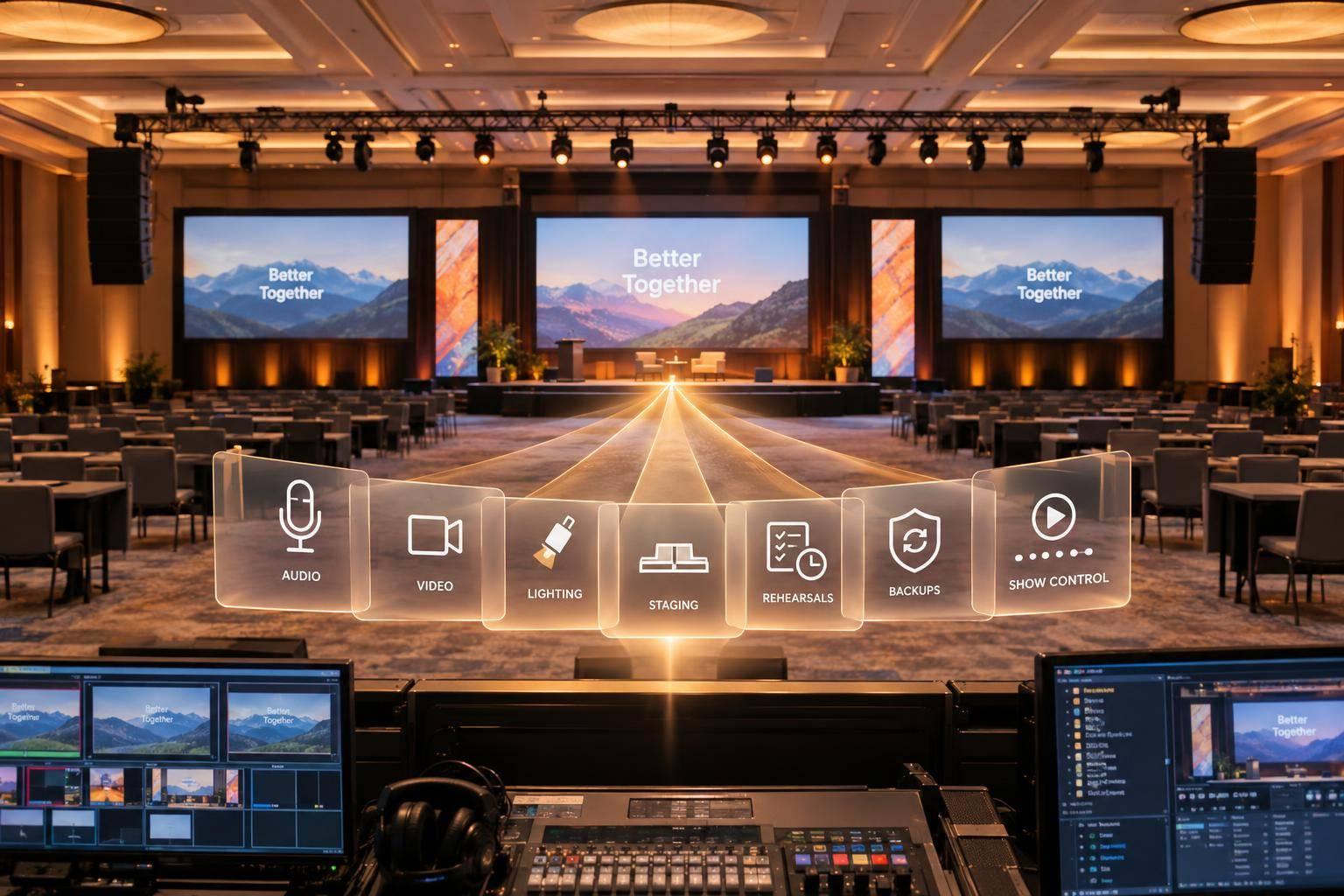
- AV setup: backup signal paths, RF planning, streaming support, LED sizing
- Point person: one project manager from planning through strike
Event A/V Essentials Part 5: Creating Your Onsite Production Schedule - Logan Clements
sbb-itb-ae35a94
Quick Comparison
| Company | Best fit | Event size | What stands out |
|---|---|---|---|
| Corporate Optics | Executive conferences, leadership meetings, board meetings | Small to mid-size executive programs | Secure AV handling, speaker support, hybrid backup feeds |
| Meeting Tomorrow | Mid-size conferences, recurring city-to-city programs | Up to 5,000 attendees | One contact, national coverage, hybrid support since 2008–2009 |
| Freeman | Large conventions and expo-heavy shows | Large-scale programs | Expo logistics, 3D floor planning, multi-room AV support |
If I were making the call today, I’d match the company to the room count, floor complexity, and audience size first - then bring them in 6 to 12 months ahead for larger events so rigging, power, layout, and budget don’t get locked too late.
What Conference Planners Should Look For In A Production Partner
Before you reach out, screen partners in four areas that decide whether your event stays on track or starts to drift. Use these checks to cut down your shortlist before you compare company profiles.
Venue logistics: Check how they handle dock scheduling, load-in sequencing, teardown coordination, and pre-event walkthroughs. Those walkthroughs should catch power, rigging, and egress issues before show day.
Room and floor layout: Ask for CAD drawings, rigging plots, 3D renderings, seating charts, and dedicated technicians for multi-room programs. If a partner can’t map the space well, small layout problems can turn into big day-of headaches.
AV and technical production: Look for redundant signal paths, RF coordination, LED walls matched to viewing distance, and separate planning for any virtual layer. That split matters more than people think. An in-room show and a virtual experience often need different production choices.
Project accountability: Require a named project manager who stays with the event from planning through strike. One point of contact can save a lot of back-and-forth when timing gets tight.
With those checks in hand, the next three companies are built for conference logistics, layouts, and AV execution.
1. Corporate Optics
Corporate Optics is a full-service technical event production company for corporate conferences, leadership meetings, shareholder meetings, board meetings, and hybrid broadcasts. In plain terms, it can handle the planning details, build the room, and run show-day AV under one roof.
Its service scope includes venue coordination, room and floor layout planning, scenic fabrication and design, audiovisual production, and speaker support. That makes it a solid fit for planners who don’t want to juggle a bunch of vendors just to get one event out the door.
The company’s workflow is built to keep planning and on-site execution in sync. Its Discover, Design, Develop, Deliver process gives teams a clear path from kickoff to strike, which helps keep preproduction organized and show day less chaotic.
On the technical side, Corporate Optics supports audio, lighting, 4K video, rigging, slide deck management, and redundant signal feeds for hybrid events. So if your event has both an in-room audience and remote viewers, there’s backup built into the setup where it counts.
Corporate Optics is a strong match for C-suite and board meetings in particular. The company puts a lot of focus on confidentiality, with secure AV handling and controlled room access. It also cites a 99.5% success rate over 10 years.
2. Meeting Tomorrow
Meeting Tomorrow is a strong fit for planners who want nationwide reach and one team to handle logistics, room layouts, and AV for large corporate programs. It’s a nationwide AV and event production company with 20+ years of experience supporting conferences, multi-day corporate meetings, sales kickoffs, and annual conventions in hotels and convention centers across the country, including both union and non-union venues. Following best practices for conference event production ensures these large-scale logistics run smoothly. The company produces 719 events in 130 cities each month.
One practical upside stands out right away: as an outside AV provider, Meeting Tomorrow can help cut hotel AV markups. On the planning side, the team manages full RFPs, conducts site visits to confirm a venue will work, and handles shipping and receiving. On the production side, it delivers custom scenic design, modular staging, lighting, and sound. That range lets it support everything from small meetings to conferences with up to 5,000 attendees.
Hybrid and virtual events are another area where the company has deep experience. Meeting Tomorrow has offered virtual event services since 2008 and hybrid meeting planning since 2009. Its hybrid support covers onsite encoding, cellular internet backups, pre-recorded audio and video backup plans, and required tech checks for remote speakers. That kind of prep can save a program when a speaker’s Wi-Fi goes sideways five minutes before showtime.
Planners also get a single point of contact and a dedicated account team that stays with the program from planning through strike. For recurring events, Meeting Tomorrow can even send the same technical director to different cities. If you’re running a multi-city conference series, that kind of consistency can make life a lot easier.
Amanda McCoy, Chief Operations Officer, The Financial Brand, said: "They were an extension of our planning team and put in as much care as our employees do. Couple this with the flawless onsite production and ability to pivot no matter the curve ball thrown – we simply couldn't imagine working with anyone else."
3. Freeman
Freeman produces 4,500+ live experiences each year and brings 98 years of experience to large conferences and trade shows.
On the logistics side, Freeman covers the nuts and bolts that keep big events moving: install and strike, shipping, material handling, electrical, and rigging. That matters when you're dealing with packed expo halls, tight schedules, and multi-room programs where one delay can throw off the whole day.
Freeman also gives planners a way to see the floor before move-in starts. Freeman Blue Echo turns convention centers into photorealistic 3D floor plans, so teams can check traffic flow, sight lines, and sponsor placement ahead of time. It uses measurement-grade venue data with accuracy to within ±1 inch. In plain English, that means fewer surprises when the doors open.
For AV and technical production, Freeman handles stage rigging, stage management, projection mapping, LED lighting, sound design, and live streaming. Its crews support general sessions, breakout rooms, and live streaming across large-scale programs. At Shoptalk 2025, Freeman's AV and production teams tied the main stage, multiple track rooms, and the expo area to a single creative theme.
Freeman is a strong fit when scale, floor complexity, and AV delivery all have to work together without drifting out of step.
Side-By-Side Comparison
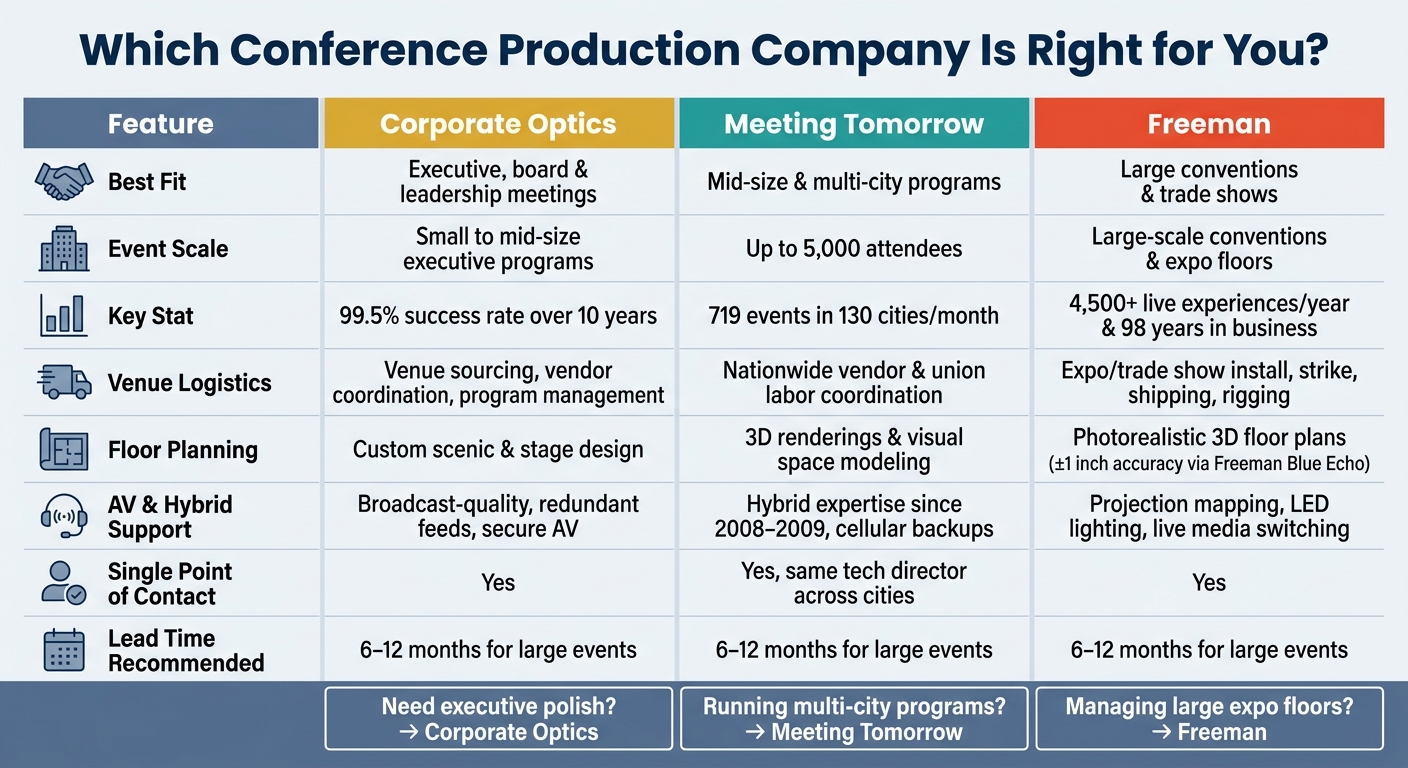
Conference Production Companies Compared: Corporate Optics vs Meeting Tomorrow vs Freeman
If venue logistics, room layout, and AV sit at the top of your list, this breakdown makes the choice a lot easier. It lines up event size, logistics support, and AV needs so you can see which team fits the job.
| Corporate Optics | Meeting Tomorrow | Freeman | |
|---|---|---|---|
| Ideal Event Type | High-stakes leadership and executive conferences with live-streamed elements | Mid-size conferences and multi-city programs | Large conventions and expo-heavy footprints |
| Event Scale | Executive gatherings, board meetings, and leadership events | Mid-size conferences up to 5,000 attendees | Large conventions with heavy expo and trade show needs |
| Venue + On-Site Logistics | Program management, venue sourcing, and vendor coordination | Nationwide vendor management, union labor coordination, and hands-on on-site coordination | Large-scale expo and trade show logistics |
| Floor Plan + Scenic Planning | Customizable scenic and stage design | 3D renderings and visual space modeling | Large expo-floor planning and exhibitor coordination |
| AV + Hybrid Support | Broadcast-quality production, scenic, lighting, and redundant feeds | Consistent AV execution across locations with hybrid expertise since 2008 | Projection mapping, specialized exhibit AV, and live media switching |
Here’s the simple read on where each one tends to work best.
Corporate Optics makes sense for executive events where control matters. If the room needs to feel polished, the show needs to run cleanly, and AV handling has to stay secure, this is the lane they fit.
Meeting Tomorrow works well for planners running multi-city programs. The big draw is consistency from one location to the next, which can save a lot of stress when you're trying to keep the same experience across several stops.
Freeman stands out when scale becomes the hard part. If you’re dealing with a large convention, a busy expo floor, or many rooms that all need AV support at once, Freeman is built for large conventions, expo floors, and multi-room AV coordination.
Final Takeaway
After looking at scale and support, the choice comes down to fit. Pick the partner whose size and way of working line up with your conference.
Corporate Optics is a good match for executive conferences and leadership events. Meeting Tomorrow works well for multi-city programs and events with up to 5,000 attendees. Freeman is the right fit for the biggest conferences and trade shows that need more complex infrastructure.
Once you’ve narrowed your list, timing moves to the top of the list. For large conferences, bring in your production partner 6 to 12 months in advance so you can confirm rigging, power, budget, and layouts before plans are locked in.
FAQs
How far in advance should I book a production partner?
It depends on the size of your event and how much is involved.
Executive summits, galas, and flagship conferences are best booked 6 to 12 months in advance. Large events with complex staging or multi-venue logistics often need 4 to 6 months of lead time.
For smaller corporate productions, 4 to 8 weeks is usually the minimum. Booking early also helps you lock in crew and equipment, especially during peak seasons.
What should I ask about AV backups before signing?
Before you sign anything, ask about their failover plan and redundancy setup. You want to know how they back up critical signal paths and whether they have standby systems for core services like internet and audio.
It’s also smart to ask how they handle real-time troubleshooting and speaker support. That way, if a presenter needs a last-minute content update or a tech problem pops up, the team can deal with it without throwing off your program.
How do I know if I need one project manager for the whole event?
You need a single project manager if you want to avoid coordination mistakes and the usual finger-pointing that happens when several vendors are involved.
If your event has more moving parts, like multi-room breakouts, hybrid streaming, or large-scale AV, one manager gives you a single point of accountability from planning and site logistics to final strike. That means fewer crossed wires, fewer last-minute scrambles, and more time for you to focus on the content and the people in the room.
Related Blog Posts


Streamline your workflow, achieve more

Lorem ipsum dolor sit amet, consectetur adipiscing elit. Maecenas ac velit pellentesque, feugiat justo sed, aliquet felis.



Lorem ipsum dolor sit amet, consectetur adipiscing elit. Maecenas ac velit pellentesque, feugiat justo sed, aliquet felis.