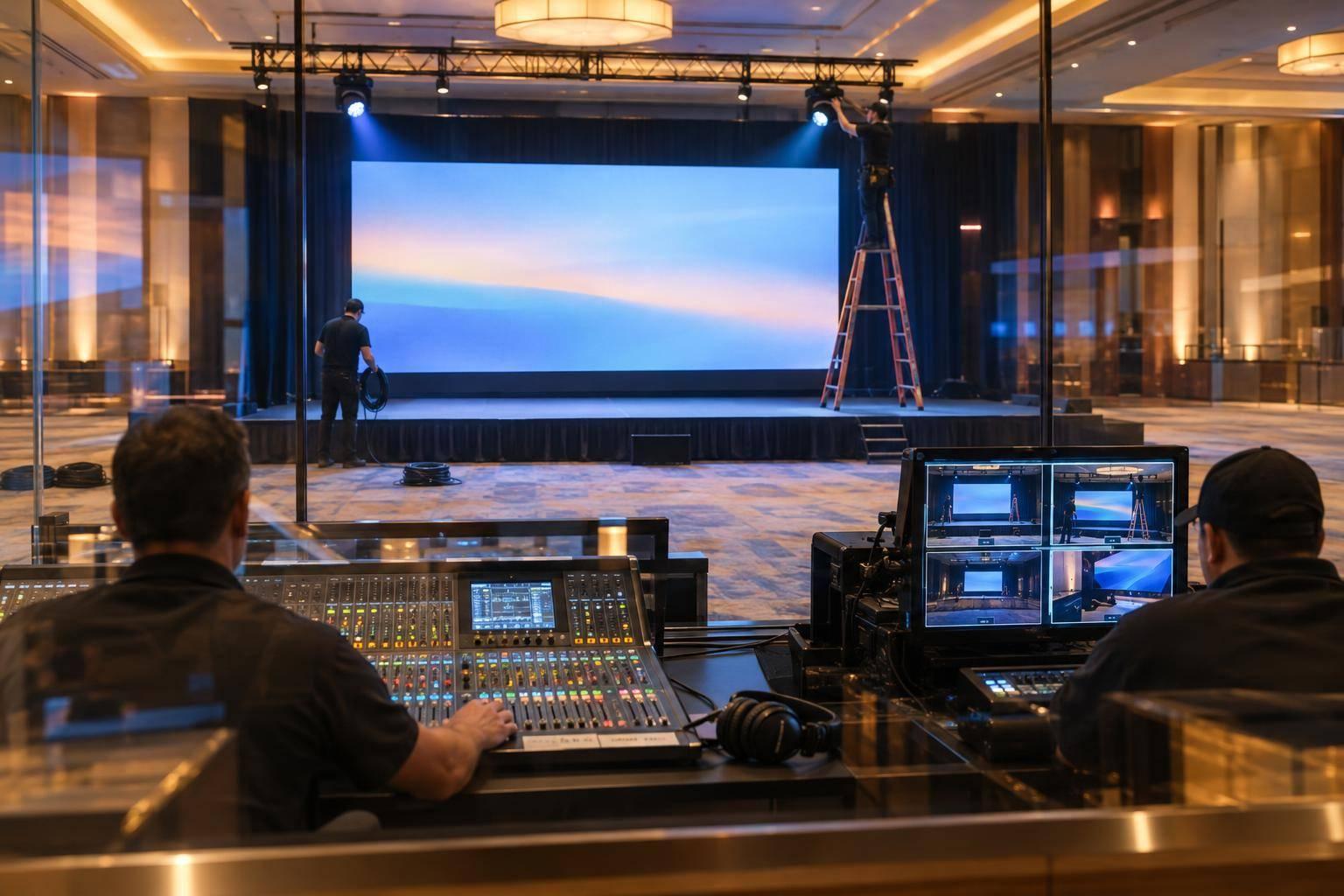
The Hidden Risks Of Cutting Your Corporate Meeting AV Budget

Chief Executive Officer

I’d cut decorative lighting and scenery before cutting microphones, trained operators, rehearsals, or tested backups. A lower AV quote can cost more if failures lead to delays, emergency rentals, overtime, or lost recordings.
My rule: reduce the show, not your ability to hear, see, and recover. Before approving a smaller budget, I’d check:
- Sound and presentations: Can everyone hear clearly, see the slides, and play videos with sound?
- Staffing and testing: Who handles overlapping tasks, and has the full system been tested with final files?
- Recovery: Are backup laptops, microphones, network connections, power, and recording paths tested - and assigned to someone?
- Total costs: What venue fees, labor charges, and replacement costs sit outside the quote?
- Scope: Can fewer cameras, simpler scenery, or fewer recorded sessions meet your goals?
When venue requirements and labor rules remain unsettled, I’d use 10%–15% as a contingency planning baseline.
<u>The saving only makes sense if the meeting can still run - and recover.</u>

Corporate Meeting AV Budget: What to Keep and What to Cut
How Equipment, Staffing, and Testing Cuts Disrupt Meetings
The cuts that hurt first usually remove the equipment, people, and checks that keep meetings clear, controlled, and ready to recover when something goes wrong.
Unclear Audio and Presentation Failures
Hybrid-meeting surveys show that weak audio leads attendees to use laptop speakers and microphones, turn off video, or switch to phone audio. Poor microphone choice or speaker placement can cause weak pickup, echo, or feedback. Test speech from both the presenter position and the audience area. Choose equipment for the room’s size and layout - not just its price.
Skip slide prep, and content may appear only on the presenter’s laptop, or embedded video may play without sound. Collect final files ahead of time. On the designated presentation computer, check resolution, aspect ratio, fonts, video playback, and audio routing. Confirm HDMI, USB-C, or DisplayPort connections and any required adapters.
For executive keynotes, keep a second charged laptop with the same checked files, local copies on both laptops, and a tested clicker. A PDF can serve as a fallback deck. With too few people watching for problems, these failures can get worse fast.
Too Few Operators and Too Little Testing
Staff for simultaneous tasks, not device count. One operator handling slides, audio, recording, and streaming can’t reliably manage every cue while fixing a connection failure. Separate presentation and room-audio duties when they overlap, and assign someone to streaming and remote-participant support. If you have only one operator, simplify transitions and give a trained internal contact specific secondary duties.
A device check tells you whether each unit works. An end-to-end signal-path test checks the full route from the microphone or presentation computer to speakers, displays, recording, and the online audience.
Content verification checks every deck and video. A speaker rehearsal checks microphone use and cue timing. Schedule these checks before attendees arrive, using final content and the actual presenters. For hybrid events, test wired upload speed from the streaming position and run a load test before attendees arrive. If that test fails, you need a tested backup to avoid a delay.
Critical Equipment Without Tested Backups
Cutting a spare microphone, laptop, network path, power fallback, or recording path can turn one failure into a stopped program or lost content. Match the backup to the consequence:
A tested wired microphone may cover wireless failure; a configured secondary connection may restore streaming; independent recording may preserve content during an outage.
Assign recovery roles in the run sheet: who swaps the microphone, who switches playback, who restores streaming, and when to move to audio-only mode. Then rehearse those actions. A spare that is unpaired, uncharged, or untested isn’t a real backup.
Those failures can quickly lead to overtime, rework, and avoidable attendee frustration. To prevent a single-point failure, each backup needs to be tested, assigned, and ready to use.
The Financial and Reputation Risks of a Lower AV Quote
Hidden Fees and the Cost of Downtime
Those cuts can also leave you facing costs that don’t appear in the quote. Compare the full meeting cost, not just the AV subtotal. Check venue labor, internet, power, house-engineer, Wi-Fi, overtime, and change-order fees. Document who pays each charge and who can approve changes. Before accepting the quote, require written technician roles, call times, rehearsal duration, and overtime rates.
Estimate downtime as minutes × meeting cost per minute, plus recovery labor and replacement costs. Keep cash outlays separate from lost time.
The damage can go beyond the budget. Missed audio, slides, video, captions, or recordings can leave attendees questioning the team’s preparation and the meeting’s value long after the delay ends. Track survey results, support tickets, stream metrics, delay logs, and stakeholder feedback. In one industry survey, 48% of respondents named attendee satisfaction as the most important success indicator.
Compare Each Budget Cut With Its Risks
For every proposed cut, ask what could fail, how long recovery would take, and what a replacement would require. Base your answers on rehearsal results and written replacement terms - not assumed recovery times. The table below separates interruptions you can recover from during the meeting from failures that stop the program. Apply the same cost test to each cut.
| Proposed reduction | Failure scenario | Likely meeting impact | Possible added cost | Safer alternative |
|---|---|---|---|---|
| Remove backup playback | Primary presentation computer or playback device fails | Content stops; recovery requires a program pause | Replacement rental, expedited delivery, overtime | Keep a tested backup computer, playback path, adapters, and current files on site |
| Reduce technical staffing | One operator handles audio, slides, recording, and streaming at once | Missed cues and slower recovery | Overtime, emergency technician hire, refunds or credits | Keep coverage for critical functions and assign clear escalation roles |
| Shorten rehearsal time | Decks, video, audio levels, clickers, cues, and network paths aren’t tested together | Live errors delay the opening or transitions | Additional labor, emergency equipment changes, repeated sessions | Keep a focused technical rehearsal; test the highest-risk segments first |
| Reduce network capacity | Streaming, cloud presentations, remote speakers, or captions run on guest Wi-Fi or an overloaded shared connection | Connection failure interrupts remote participation or content delivery | Upgraded service, emergency hotspot or circuit, overtime | Use a dedicated production circuit with monitoring and a tested independent backup |
Approve a saving only when the remaining safeguards cover what could go wrong. A minor visual compromise isn’t the same as losing an executive broadcast or a recording that stakeholders rely on. Beside each proposed cut, document the recovery owner, tested recovery time, replacement availability, and costs you could owe under the contract.
sbb-itb-ae35a94
Lower AV Costs Without Sacrificing Reliability
Sort AV Spending Into Required, Conditional, and Optional Items
Rank the risks, then cut from the bottom of the priority list. Reduce production scope - not clarity, recovery plans, or schedule protection. Keep support for keynotes, panel transitions, audience questions, remote speakers, livestreams, and required recordings. Classify spending by what audiences and presenters need, not by which equipment looks most impressive.
| AV item | Classification | Decision criterion | Safer saving opportunity |
|---|---|---|---|
| Main-room microphones and speech reinforcement | Required | Attendees must understand keynotes, panels, and questions | Cut decorative audio features, not microphone coverage or operator expertise |
| Presentation playback and confidence monitors | Required | Slides, video, and speaker notes must work reliably | Standardize formats and combine playback devices after testing |
| Qualified AV operators | Required | Agenda complexity calls for active control | Match staffing to the run of show while keeping coverage for critical transitions |
| Speaker support and rehearsal | Required | Presenters and media need technical preparation | Standardize templates and deadlines; keep technical checks |
| Tested signal and equipment backups | Required | Failure would stop speech, presentations, streaming, or recording | Back up only paths where failure would have a high impact, but test each backup before show day |
| Livestreaming | Conditional | Required only when remote participation or online distribution is an objective | Use a simpler single-camera workflow or remove streaming if it isn't required |
| Recording | Conditional | Required for compliance, training, or distribution | Record the main program rather than every breakout |
| Cameras | Conditional | The format requires close-ups, remote participation, or replay | Use fewer angles or fixed shots |
| Scenic design and decorative lighting | Optional | Supports visual or branding goals that aren't required | Simplify scenery, color changes, and lighting effects first |
Before approving the quote, document every required path and the steps to restore it if something fails.
Write Down Technical Requirements and Recovery Steps
Create one requirements sheet covering room layout, capacity, sightlines, microphones, presentation formats, confidence monitors, remote speakers, livestreaming, recording, internet, power, rigging, access windows, staffing, rehearsal times, and deadlines. Add signal and backup paths for audio, video, internet, and power. Identify each item's location and owner, who supplies it, and who approves changes. Then test the system under event-day conditions.
Keep a risk register with one row for each critical failure point. Each row should include the risk, likelihood, impact, owner, prevention measure, activation trigger, fallback, escalation contact, required resources, and maximum acceptable recovery time. Rehearse the trigger points and handoffs during the technical run-through.
Backups need to cover playback, network, power, and recording, not just spare microphones. Record each backup path, its owner, and its test date. Use this planning process to match technical coverage to the agenda and cut production extras that don't support core communication.
Verify Venue Fees and Set Aside Contingency Funds
Confirm every venue charge that could change the final bill. Before approval, get written confirmation of house labor rules, load-in and load-out limits, overtime triggers, internet, power, rigging, patching, equipment handling, and technician charges.
Set aside funds for changes and unresolved requirements. Use 10%–15% as a planning baseline when the venue, run of show, internet, rigging, and labor rules are still unsettled.
Conclusion: Cut Optional Features, Not Meeting Safeguards
Cutting AV support weakens the safeguards that keep a meeting audible, on time, and able to recover when something goes wrong. That can mean downtime, extra costs, and damage to your reputation.
Judge savings by the risk they create - not just the quote they trim. Before approving a cut, ask what could go wrong, who will handle recovery, and what downtime will cost. Savings are acceptable only if recovery stays fast and responsibility is clear.
Approve a lean budget only when you have a plan, tested backups, a rehearsal, and contingency funds in place. Cut decorative lighting and elaborate scenery first - not clear communication or a tested recovery path.
FAQs
How can I tell if an AV quote is too low?
A much lower quote may leave out key costs - and lead to costly change orders later. Compare proposals line by line against the same written brief, not just the total price.
Look for vague or bundled pricing, labor listed as a single line item, and missing costs for rehearsal time, redundancy, freight, or overtime. Ask the vendor to explain unusually low prices and provide an itemized breakdown of equipment, labor, and service fees.
How do I determine the AV staffing my meeting needs?
Start with your meeting’s complexity, goals, and format. A simple, single-room meeting with slides and microphones may need just one technician. Hybrid streaming, multiple speakers, complex staging, or precise timing call for a full-service team.
Plan staffing for each room and role, including technical direction, show calling, and specialists. Confirm coverage for rehearsals, troubleshooting, and overlapping sessions, plus backup support and union requirements. Ask for a crew list with roles, qualifications, and shifts.
How can I measure the ROI of reliable AV?
Compare total event costs - venue, catering, and production - with business results, including revenue growth, new partnerships, and operational efficiency. Track attendee engagement, Net Promoter Scores, and Q&A participation to assess how attendees responded.
Check your final invoice against your locked budget and onsite issue logs. Review labor hours and added equipment against the original production plan to confirm that spending was approved. Document challenges and results to fine-tune future budgets and show how the event protected your reputation and avoided costs tied to technical failures.
Related Blog Posts
- Need A Budget-Friendly Meeting Planning Production Team? We Recommend These 5
- The Strongest Meeting‑Planning Companies For Technical Production And Av
- A/V Production Teams Who Specialize In Executive-Level Meeting Production
- 3 Reasons To Work With Corporate Optics With Full-Service AV Production Experience For Your Next Conference.



Streamline your workflow, achieve more

Lorem ipsum dolor sit amet, consectetur adipiscing elit. Maecenas ac velit pellentesque, feugiat justo sed, aliquet felis.



Lorem ipsum dolor sit amet, consectetur adipiscing elit. Maecenas ac velit pellentesque, feugiat justo sed, aliquet felis.