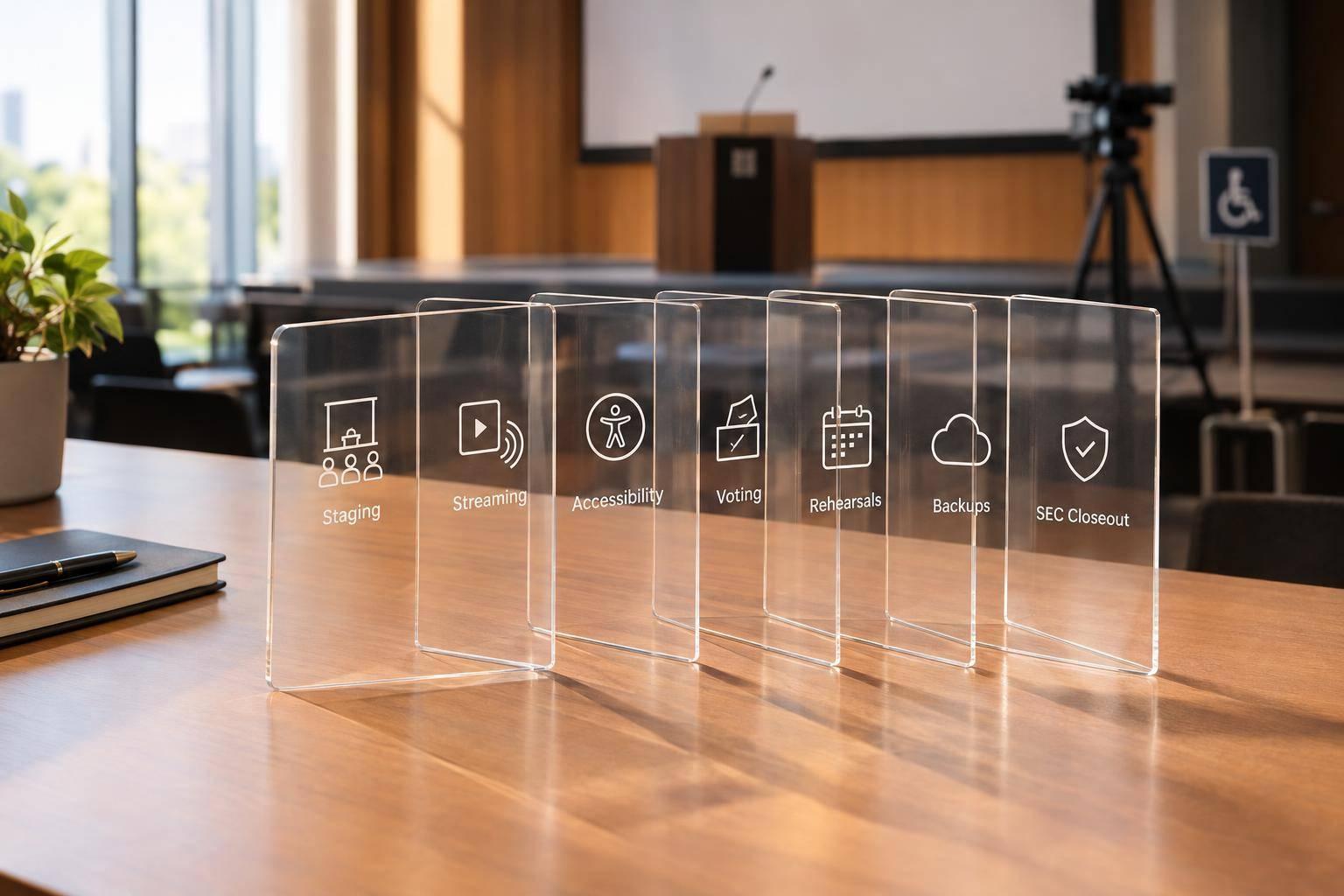
3 Reasons To Work With Corporate Optics With Full-Service AV Production Experience For Your Next Conference.

Chief Executive Officer
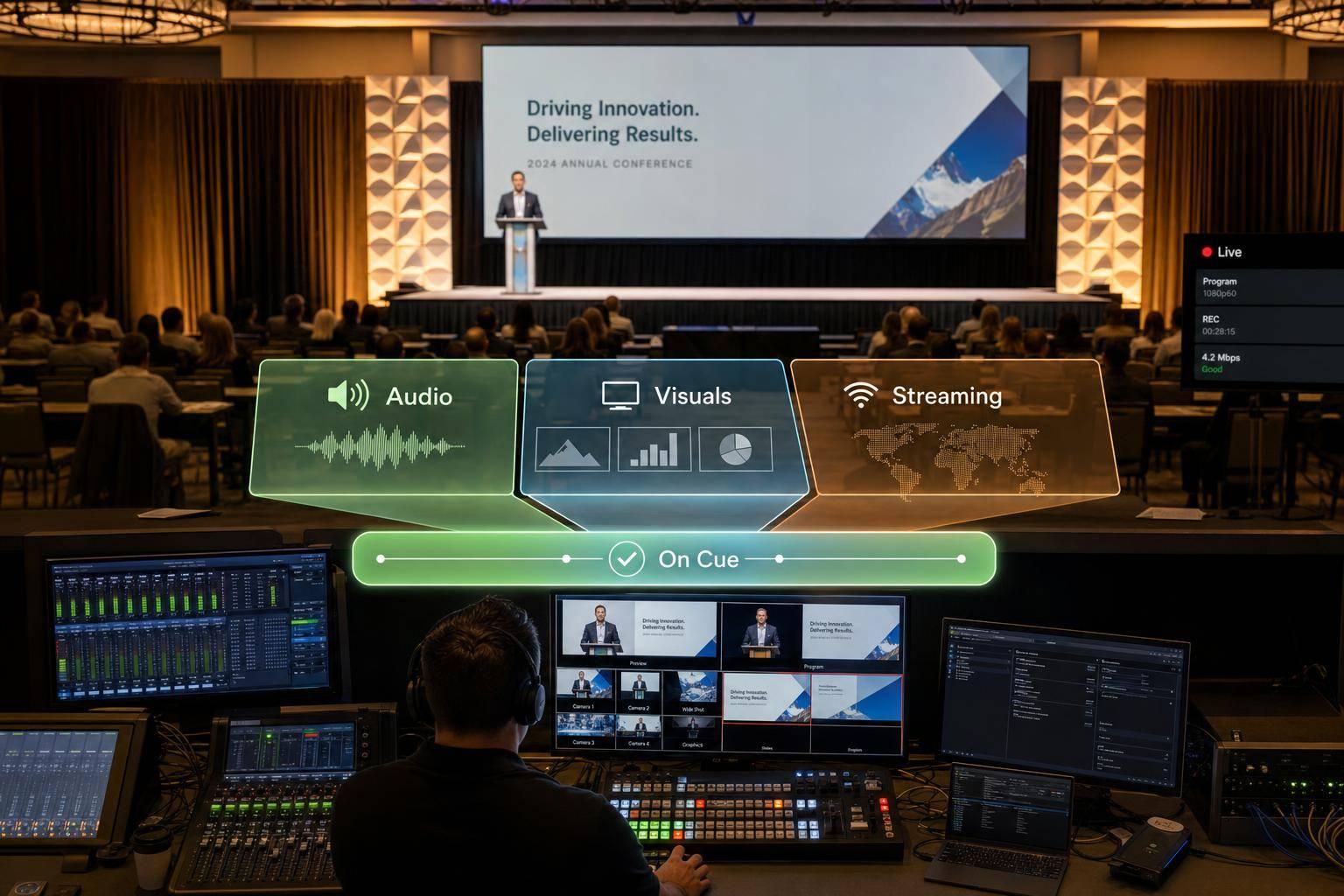
If your AV fails, your conference feels broken. This article comes down to three points: one team handling audio, video, lighting, staging, and streaming cuts down on mix-ups; strong show control helps keep sessions on time; and steady production quality improves how people experience every room. That matters when 81% of attendees say production quality affects their event experience, and 68% say major AV problems can affect whether they return.
Here’s the short version:
- One AV partner means fewer handoff problems
- Clear show management helps keep timing under control
- Steady sound, visuals, and streaming improve the attendee experience
- Backup plans help limit tech issues before they affect the room
This is not just about gear. It’s about who owns the plan, who runs the show, and who fixes issues when the schedule changes.
| Reason | What it means for you |
|---|---|
| One team across all AV | Fewer vendor gaps and one main point of contact |
| Show management experience | Better cue timing, room flow, and schedule control |
| Steady production quality | Clearer audio, cleaner visuals, and a better event experience |
If you’re planning a conference, the main takeaway is simple: full-service event production can make the event easier to run and less risky on show day.
1. Integrated Full-Service AV That Simplifies Conference Execution
Running a conference means juggling a lot at once. When audio, video, lighting, staging, and streaming are split across different vendors, small gaps in communication can turn into big problems. Corporate Optics cuts down that complexity by handling AV under one roof, from early planning to post-event file delivery.
Pre-Event Planning and System Design
That work starts well before load-in. The team maps each session’s technical needs to the agenda, including AV production best practices for large conferences regarding microphones, playback, video, interpretation, and streaming. They also serve as the main technical contact with the venue, checking rigging, power, bandwidth, and venue labor rules.
That matters more than it might seem. Instead of the organizer chasing updates across several vendors, there’s one team keeping the technical side lined up. Fewer handoffs usually means fewer surprises once the conference starts.
On-Site Technical Execution and Show Calling
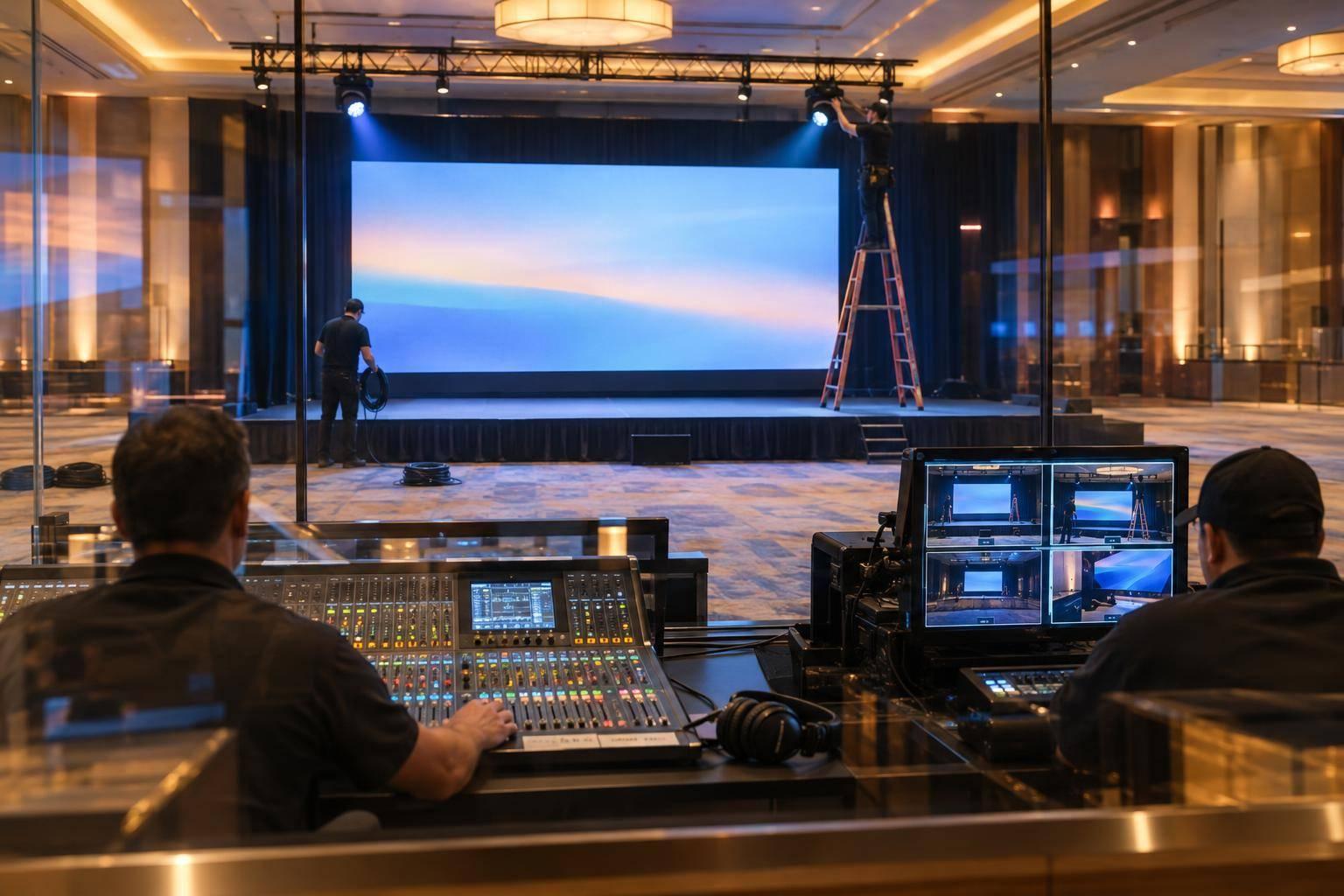
On-site, one cross-trained crew manages audio, video, lighting, staging, and streaming. A dedicated show caller runs the plenary from a central production office, using cue sheets and real-time intercom across departments.
Breakout rooms are handled by technical leads using standard room setups. That keeps session quality steady and helps rooms turn over fast between sessions. Daily check-ins give schedule changes one clear path, which makes a big difference when plans shift mid-day. If a speaker runs long or a system needs a fallback, the team can react fast without confusion.
Contingency Planning and Risk Reduction
Corporate Optics builds backup systems into the design from the start. For keynotes and general sessions, that includes redundant playback laptops feeding a switcher with pre-programmed instant failovers, spare wireless microphones, and dedicated power circuits or UPS support for critical systems.
Streaming setups include dual encoders with failover configurations and local recording backups. Each technical area - audio, video, lighting, and streaming - has a designated lead and a clear escalation path. So if something goes sideways, the response is immediate and decision-making stays clear.
Those layers of backup help protect timing, clarity, and confidence in every room.
Attendee and Stakeholder Experience Impact
For attendees, the end result is a smoother event. Consistent sound system tuning across every room keeps speech clear and easy to follow. Consistent visuals, coordinated lighting, and polished transitions between segments keep the focus on the content instead of the production.
Speakers get standardized presenter tools and one clear technical point of contact, which can lower stress and help them deliver with more confidence. Sponsors and internal stakeholders get steadier execution of their content. And after the event wraps, the same team manages recordings and file delivery.
sbb-itb-ae35a94
2. Experienced Show Management That Reduces Technical and Schedule Risk
Most conference problems start with two things: unclear ownership and weak control of timing. Corporate Optics uses a show-management process that turns technical plans into a controlled live event, which helps protect the conference from delays, confusion, and visible mistakes. That matters because experienced show management keeps complex AV tied to the conference schedule instead of letting it drift.
Pre-Event Planning and System Design
Before show day, Corporate Optics uses discovery meetings to lock in the agenda, cue sheet, room sequence, and speaker prep. Special elements like hybrid participation using multi-camera streaming or live polling are flagged early and built into the run-of-show before load-in starts. Speaker briefings also cover timing, mic use, and issue escalation, so people know what to do before they step onstage.
On-Site Technical Execution and Show Calling
On site, a show caller keeps sessions on cue and on time. Using a timed run-of-show, the show caller directs cues and transitions through live communication with the crew. For multi-track events, Corporate Optics keeps plenary sessions and breakouts aligned under one production command structure. That kind of control matters most when the agenda shifts or a cue needs an immediate fix.
Contingency Planning and Risk Reduction
Corporate Optics sets response protocols for speaker dropouts, hardware issues, and schedule changes. Because decision owners and response steps are set ahead of time, small issues stay offstage instead of turning into public problems. When the show stays on time, the audience can feel it in every room.
3. Production Quality That Improves the Conference Experience for Attendees
Production quality shapes what people take away from a conference. It affects how clearly they hear speakers, how sharp the visuals look, and how smoothly each session moves from one moment to the next. And when every room, cue, and feed follows the same standard, people notice - even if they don’t say it out loud.
On-Site Technical Execution and Show Calling
Precise cueing makes transitions feel planned, not clunky. That includes everything from video rolls and lighting changes to awards walk-ups. It also gives speakers room to focus on what they’re saying instead of worrying about what might go wrong on stage.
Clear audio has a direct effect on the audience experience. It can boost engagement by up to 40% and increase information retention by around 30%. For hybrid sessions and livestreams, Corporate Optics coordinates camera, audio, and signal paths so remote attendees get the same level of clarity as people in the room. When that work is done well, the production feels smooth from start to finish.
Attendee and Stakeholder Experience Impact
Attendees don’t judge a conference only by the keynote. More often, they remember the weakest room. If one breakout has poor sound, lagging slides, or awkward delays, that can color their view of the whole event.
Consistent AV quality across every session format shows that the organizer respects attendees’ time and the money they spent to be there. That matters because one poll found that 68% of attendees would think twice about returning to an event where they experienced serious AV problems. Corporate Optics standardizes AV across all spaces, which helps protect the event’s reputation long after the conference wraps. That kind of consistency comes from one production plan managing every room, cue, and session. Following a proven conference planning process ensures these standards are met across the entire event.
Full-Service AV vs. a Fragmented Multi-Vendor Approach
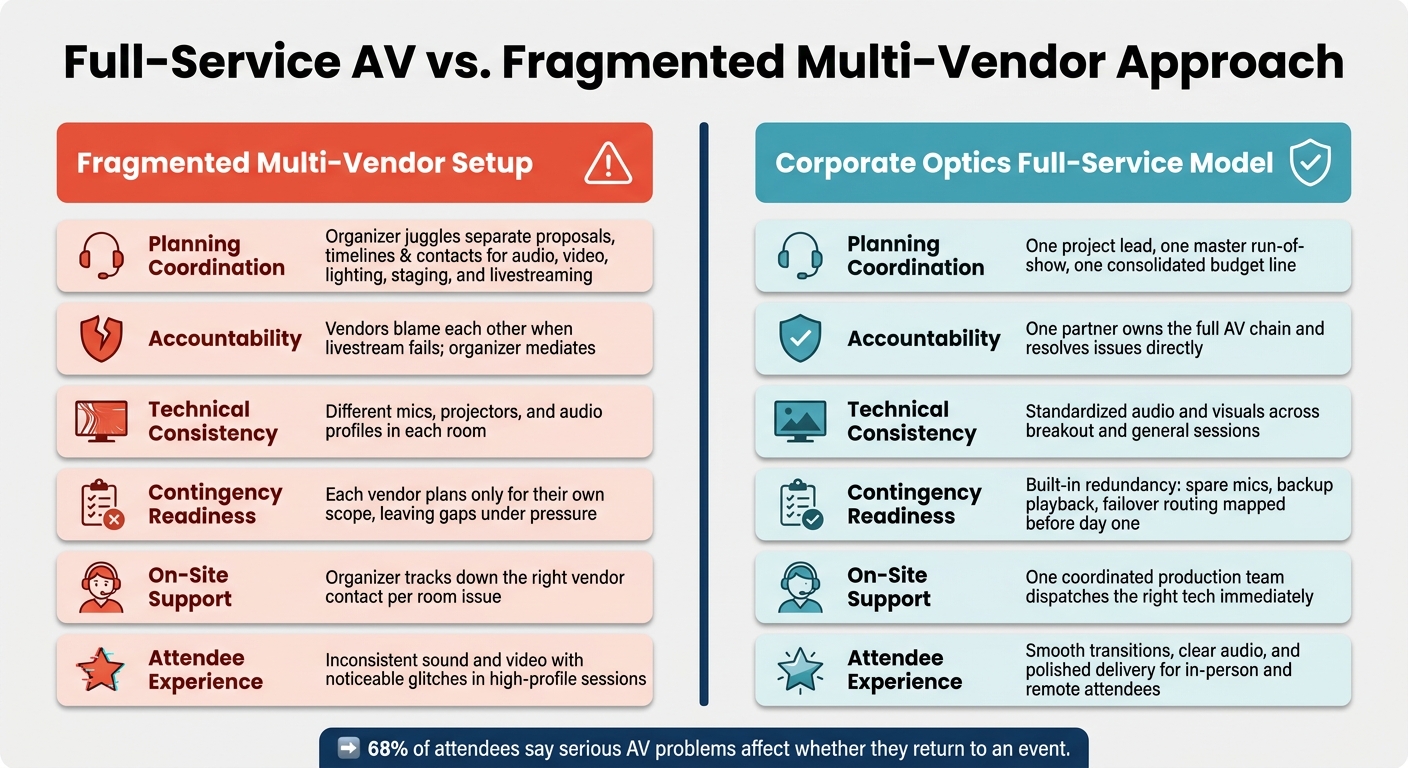
Full-Service AV vs. Multi-Vendor: Conference Production Comparison
Those three benefits don’t happen by accident. They depend on how the AV setup is run behind the scenes.
When a conference uses multiple AV vendors, friction shows up fast. You’re dealing with separate timelines, different points of contact, and gear standards that weren’t built to work together. And when something breaks, the blame game starts. One vendor points at another, the venue gets pulled in, and the organizer ends up trying to sort it out in real time.
Corporate Optics works as one integrated partner, with single ownership of the full production chain from load-in through wrap. That setup changes how issues are handled and how the event feels from start to finish.
Here’s the operational difference that matters most.
| Area | Fragmented Multi-Vendor Setup | Corporate Optics Full-Service Model |
|---|---|---|
| Planning Coordination | Organizer manages separate proposals, timelines, and contacts for audio, video, lighting, staging, and livestreaming | One project lead, one master run-of-show, one consolidated budget line |
| Accountability | If the livestream fails, vendors can blame each other and the venue while the organizer mediates | One partner owns the full AV chain and resolves issues directly |
| Technical Consistency | Different mics, projectors, and audio profiles in each room | Standardized audio and visuals across breakout and general sessions |
| Contingency Readiness | Each vendor plans only for their own scope, leaving gaps under pressure | Built-in redundancy such as spare mics, backup playback, and failover routing mapped before day one |
| On-Site Support | Organizer has to track down the right vendor contact for each room issue | One coordinated production team dispatches the right tech immediately |
| Attendee Experience | Inconsistent sound and video, with noticeable glitches in high-profile sessions | Smooth transitions, clear audio, and polished delivery for in-person and remote attendees |
That last point is where people feel the difference most. Attendees may never see the production workflow, but they notice bad audio, awkward handoffs, and stream issues right away. A single AV partner cuts down on those weak spots because the team is working from the same plan, with the same priorities, and the same show flow.
So when you’re reviewing AV options, don’t look at line-item pricing alone. Ask about shared infrastructure, unified show calling, and essential equipment for global broadcasts or contingency planning.
Conclusion
Running a conference well means fewer surprises on show day. And when fewer things go wrong, risk drops and the experience gets better in every room.
Integrated AV cuts down on vendor friction. Experienced show management helps keep the schedule on track. Consistent production quality protects the attendee experience from start to finish. Put it all together, and attendees, speakers, and sponsors leave with a stronger impression of the conference.
That’s the value of working with one experienced AV partner across the full conference lifecycle.
One integrated AV plan makes conferences easier to manage and more consistent from start to finish. If your next conference has a packed agenda and real stakes attached to it, review your run-of-show with Corporate Optics to catch gaps in audio, video, lighting, or hybrid event streaming before show day.
FAQs
What does full-service AV include?
Full-service AV covers everything from pre-event planning and technical design to end-to-end production execution.
That includes:
- audio, video, lighting, and staging
- livestreaming and show direction
- run-of-show coordination and cue calling
It also covers system integration, backup planning, rehearsals, on-site technical support, and post-event deliverables like recordings, edits, and analytics.
When should I bring in the AV team?
Bring in your audiovisual production partner as early as you can. For most large conferences, book the team 4 to 6 months in advance. If the event has complex logistics, custom scenic work, or a larger show setup, plan for 8 to 16 months.
Getting them involved early gives the team time to handle site surveys, check the tech plan, and spot problems before they turn into expensive on-site issues. It also helps you lock in technical needs, budgets, and logistics so the event runs more smoothly.
How does Corporate Optics handle AV backups?
Corporate Optics relies on pre-planned AV backup protocols to deal with technical issues fast, without throwing the event off track.
That means they come prepared with spare microphones, redundant mixing boards, backup playback laptops and streaming encoders, dual signal paths, UPS power, redundant recording paths, and on-site rapid-response gear.
They don’t just bring backup gear and hope for the best, either. They check these systems before the event with stress testing and signal-flow diagrams so failover can happen smoothly if something goes wrong.
Related Blog Posts


Streamline your workflow, achieve more

Lorem ipsum dolor sit amet, consectetur adipiscing elit. Maecenas ac velit pellentesque, feugiat justo sed, aliquet felis.



Lorem ipsum dolor sit amet, consectetur adipiscing elit. Maecenas ac velit pellentesque, feugiat justo sed, aliquet felis.