How Far In Advance Should You Book A Meeting Production Company? Lead Times By Event Type (Hint – At Least 4 Months Out)

Chief Executive Officer
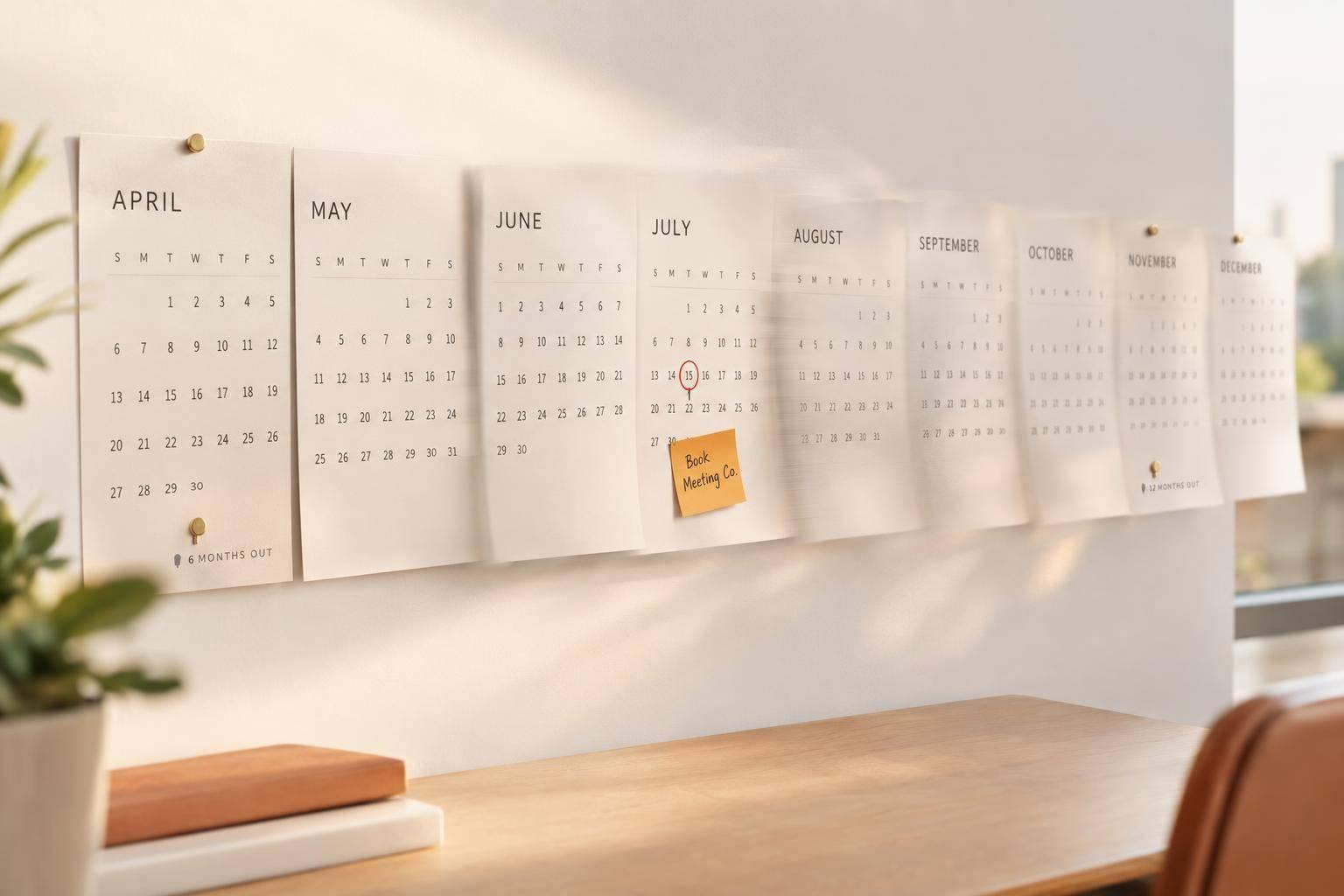
I recommend signing with a meeting production company at least four months before your event - not just starting your search. For larger or more complex programs, plan on 6–12 months.
Here’s the booking window I’d use:
- Small corporate meetings: 4–6 months.
- Large conferences: 6–12 months, with multi-room programs toward the longer end.
- Annual company meetings: 6–12 months, allowing time for executive approvals and rehearsals.
- Hybrid events: 4–6 months for simple programs; 6–12 months for multiple rooms, remote speakers, or separate broadcast crews.
The event date isn’t your only deadline. I’d check venue cutoffs and crew availability first, then leave time for scope review, budget approval, and signing. Custom staging, restricted load-in, and streaming tests can all move that deadline earlier.
<u>Already less than four months out?</u> Ask for a feasibility review now. Reduce scope if needed, but protect testing and rehearsal time.
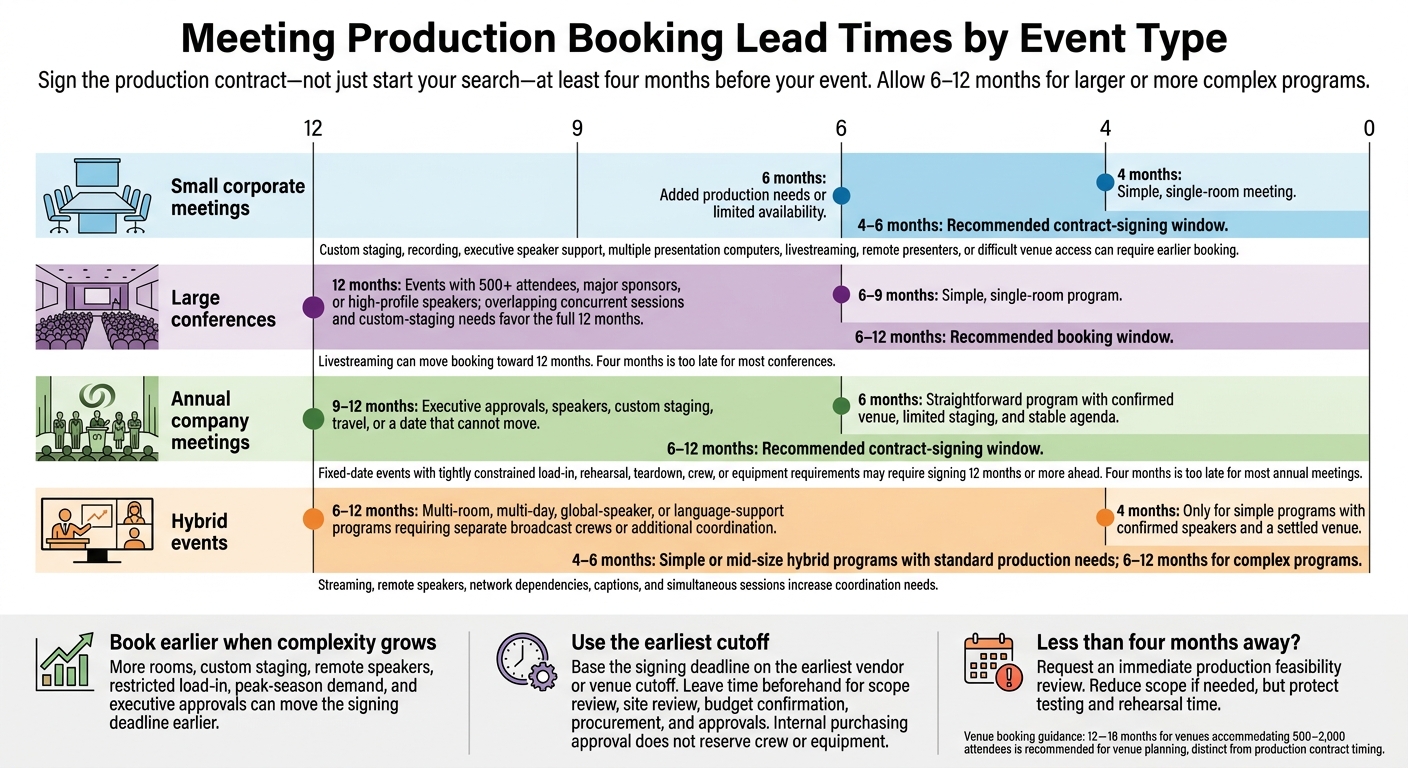
Meeting Production Booking Lead Times by Event Type
1. Small Corporate Meetings
A small corporate meeting is a single-room meeting, workshop, board meeting, or internal presentation with a small audience, a simple agenda, and a few speakers. The AV setup may include microphones, a presentation screen or projector, a confidence monitor, playback, basic room lighting, and an on-site AV technician.
Recommended Booking Window
Sign the production contract 4–6 months before the meeting. Four months works for a simple meeting. Allow six months when production needs or limited availability add risk. That extra time lets the producer confirm equipment, crew, venue rules, insurance, access, and rehearsal timing.
Production Complexity
Use a corporate event timeline generator and plan on six months if you need custom staging, recording, executive speaker support, or multiple presentation computers. Livestreaming and remote presenters also need more lead time for internet testing, remote-speaker rehearsals, and backup playback procedures - even if everyone else fits in one room. As production needs grow, extend the booking window beyond the four-month baseline.
Vendor and Venue Availability
Even a simple meeting may need an earlier booking if the date or venue limits your options. Aim for six months - or start earlier - during busy corporate-event periods, around major holidays, or in high-demand destinations. Before signing, get written confirmation that the crew is reserved for load-in, rehearsal, and show day, not just the meeting itself.
Check house-AV policies and load-in access before finalizing the scope. A short setup window can change staffing needs and mean you need to book earlier. Collect presentation files in time to test videos and unusual formats before rehearsal.
sbb-itb-ae35a94
2. Large Conferences
Large conferences need more planning time. More rooms mean more staff, and complex stage setups add work long before the doors open.
Recommended Booking Window
Book the production company 6–12 months before a large conference. Allow 6–9 months for a simple, single-room program and 9–12 months for multi-day or multi-room conferences. Plan on 12 months for events with 500+ attendees, major sponsors, or high-profile speakers. Four months is too late for most conferences.
Production Complexity
Concurrent sessions and custom staging take time for design, staffing, fabrication, shipping, installation, and rehearsals. Allow the full 12 months when these needs overlap. Livestreaming can also move the booking timeline toward 12 months.
Ask for a production schedule with deadlines for design approval, equipment reservations, speaker content collection, crew assignments, and rehearsals. Aim to finish production design and place major equipment orders 3–6 months before the event. That leaves the final months for content preparation and technical coordination.
Vendor and Venue Availability
The venue often sets the booking deadline. Start venue and production discussions at least 12 months ahead when your dates are fixed. Larger venues may require an earlier commitment: venue-planning guidance suggests 12–18 months for 500–2,000 attendees. Use that venue booking window as the outer limit for production planning.
Before signing, ask your production partner to review rigging limits, electrical capacity, freight elevator dimensions, storage, and house labor rules. Request a preliminary staffing plan that covers every concurrent room and allows for room turnover between sessions. An open date doesn’t mean the vendor has the production capacity you need.
Annual company meetings often follow a similar timeline, though executive approvals and script reviews can require earlier bookings.
3. Annual Company Meetings
Recommended Booking Window
Annual meetings involve conference-level planning, with executive approvals adding another layer. Sign the production contract 6–12 months before the meeting. Six months can work for a straightforward program if the venue is confirmed, staging is limited, and the agenda is stable.
Allow 9–12 months when you need to coordinate executive approvals, speakers, custom staging, travel, or a date that can’t move. Four months is too late for most annual meetings.
Production Complexity
Executive annual meetings need time for script, video, legal, and investor-relations approval. Put script, video, legal review, and cue-sheet deadlines in a written production calendar. Approve the overall production concept first, followed by speaker materials and then cue sheets.
Collect slides and media 6–10 weeks out, and lock the run of show 2–4 weeks out. Keep the final 72 hours for executive rehearsal, walk-ons, teleprompter checks, video transitions, and backup plans. Booking early helps protect that rehearsal time when messaging changes. For hybrid events, allow extra time for streaming, remote speakers, and venue coordination.
Vendor and Venue Availability
For a fixed-date event, confirm availability for load-in, rehearsals, and teardown - not just the meeting itself. Sign contracts 12 months or more ahead when these requirements leave little room for scheduling changes. Before signing, check the venue’s exclusive AV arrangements and get written commitments for key crew and specialty equipment.
Set an internal sign-off deadline nine months out. If you’re already four months out, cut scope, confirm venue restrictions, and lock in written staffing, equipment, rehearsal, and content deadlines.
4. Hybrid Events
Hybrid events involve streaming, remote speakers, and network dependencies. That means they need more lead time than a standard in-room meeting.
Recommended Booking Window
Book 4–6 months ahead for a mid-size hybrid event. Four months works only for simple programs with confirmed speakers and a settled venue. Allow 6–12 months for multi-room, multi-day, global-speaker, or language-support programs that need separate broadcast crews and more coordination.
Once you set the date, lock in the technology plan in phases.
Production Complexity
Hybrid production serves two audiences: in-room and online. Book early enough to meet these milestones. At 12–16 weeks out, review the venue’s technology and choose a streaming platform. By 8–12 weeks out, define Q&A, polls, captions, and speaker transitions.
Schedule remote-presenter checks 1–4 weeks before the event, using each speaker’s device and location. Test audio, lighting, screen sharing, connectivity, and backup contact methods. Hold a full technical rehearsal at least 48 hours before showtime to test the feed, recording, captions, remote speakers, and backup connections.
Vendor and Venue Availability
Verify upload speed - not just Wi-Fi. Before finalizing the streaming workflow, test the venue connection. Confirm approved network access and any restrictions on outside streaming equipment. Reserve streaming technicians, remote-speaker support, and camera operators early. Simultaneous sessions may need separate crews and equipment.
If the event is less than four months away, request an immediate production feasibility review. Reduce the number of rooms and camera positions, and cut custom graphics. Protect testing and rehearsal time.
Production Needs That Require Earlier Booking
If the baseline windows above fit your event, check the production scope below for needs that move your deadline earlier. Headcount matters, but room count, presenters, and technical systems set the deadline.
These factors can mean booking earlier. They’re not reasons to shorten the recommended windows above.
| Event type | Room count and audience size | AV, speakers, and content | Rehearsals and backups | Effect on lead time |
|---|---|---|---|---|
| Small corporate meeting | One room with a simple layout. | Basic audio, displays, and presentations. | Presentation testing, spare microphones, and backup playback. | Use the baseline only if venue access is simple. Book earlier for custom staging or difficult access. |
| Large conference | A general session plus concurrent breakout rooms. | Multiple display systems, switching, and larger crews. | Coordinated room rehearsals and playback/display backups. | Book earlier for fabrication, restrictive facilities, or peak-season demand. |
| Annual company meeting | Executive participation and show timing drive complexity. | Scripted remarks, videos, teleprompters, and timed transitions. | Executive rehearsals, cue-to-cue, dress rehearsal, and final media and backup files. | Add time for executive rehearsals and approvals. |
| Hybrid event | In-room and online audiences. | Cameras, encoding, captions, remote speakers, and return feeds. | Failover testing and backup connectivity, encoding, and power. | Book earlier for multiple remote speakers, complex graphics, or accessibility needs. |
Before approval, check circuit locations, amperage, cable runs, and load-in access. For conferences, also check freight elevators, dock hours, rigging points, and facility rules for labor, fire safety, and insurance. Custom scenery needs more than setup time. Build in time for design approval, fabrication, shipping, and installation.
For annual meetings, schedule executive rehearsals when you book production and put one person in charge of file versions. A cue-to-cue rehearsal checks transitions. A dress rehearsal checks the full program with presenters and the actual show systems. Allow time for both when setting your booking deadline.
Once you’ve set the scope, venue constraints determine whether the timeline still works. For hybrid production, test failover - not just connectivity. Run a private test stream for at least 20 minutes, then deliberately disconnect the primary internet path to confirm failover works. Check backup power for critical controls and name the person authorized to activate the contingency plan. Leave time for corrections and a second test.
Set Your Booking Deadline Around Vendor and Venue Availability
Your event-type timeline may fit, but vendor and venue cutoffs can push the signing date earlier. Base your signing deadline on the earliest vendor or venue cutoff - not just the event date. If technical needs affect your venue choice, involve the production partner during venue selection.
Check major conventions in the host city, holidays, and seasonal demand. Each can limit availability sooner than expected.
| Event type | Deadline-changing constraint |
|---|---|
| Small corporate meeting | Early venue service-order cutoffs or technician availability during conventions and holidays. |
| Large conference | Facility deadlines for labor, rigging, and dock access, or specialized-crew reservation cutoffs. |
| Annual company meeting | Venue and crew availability for dates that can't move, including crews experienced with executive meetings. |
| Hybrid event | Broadcast-crew and captioning availability or strict internet order deadlines. |
Use the earliest applicable cutoff above to set your deadline, then lock in crew, equipment, and access around it. If that cutoff falls before your event-type booking window, book by the earlier date.
Get the venue’s deadlines in writing. Request cutoffs for electrical and internet orders, rigging approval, labor calls, floor plans, certificates of insurance, dock reservations, and final changes. Assign someone to handle each deadline, and request the current rate sheet to check late and expedited charges.
Work backward from the earliest cutoff. Treat consultation, scope, and proposal review as one planning step. Leave time for site review, budget confirmation, procurement, and internal and venue approvals before signing.
Internal purchasing approval does not reserve resources. Secure crew, equipment, fabrication, and broadcast commitments promptly after signing.
Conclusion: Book 4 Months Ahead - or Earlier for Complex Events
Plan to book at least four months ahead. Aim for 4–6 months for small corporate meetings and mid-size hybrid events with standard production needs. Allow 6–12 months for large conferences, annual company meetings, and complex hybrid programs. These are planning targets, not firm minimums. If your event is less than four months away, request a feasibility review.
Set your contract-signing deadline before starting vendor selection, budget review, and internal approvals. Move that deadline earlier if you add breakout rooms, custom staging, simultaneous sessions, or remote presenters.
Come to the first call with your event date, venue options, audience size, room count, format, draft agenda, budget, and requirements for presentations, branding, and content. Use a hybrid event cost calculator to refine these estimates. For hybrid events, also bring details about the expected online audience, remote speakers, streaming platform, internet access, recording needs, and whether sessions will be live, prerecorded, or both. These details help the producer scope your event quickly.
FAQs
Can I book production before my agenda is final?
Yes, you can - and should - bring in a production partner before your agenda is final. Share your event goals and expected attendance so the team can assess what’s feasible, identify technical needs, and provide accurate proposals while you’re still working on the agenda.
Booking early helps secure your preferred dates and gives you more time to work together as your logistics and content take shape.
What if my production needs change after signing?
Follow your production partner’s change order process. A professional production company should have a clear, documented procedure for handling adjustments.
Before signing, discuss how your partner handles change orders and logistical challenges. Make sure the contract spells out roles, responsibilities, and how changes to the scope of work are handled. This helps reduce friction as your needs change.
What should I prioritize when booking last minute?
Be clear about change orders and how your partner will handle unexpected technical problems. Ask about backup equipment, dual signal paths, and secondary power sources. Confirm that a designated project manager or incident commander will be on-site to lead the work.
Set aside a 10–15% contingency fund in your budget to cover added costs and potential equipment limitations tied to last-minute bookings.
Related Blog Posts
- Top Production Companies to use for Leadership Conferences in 2026
- Best Production Companies To Work With Who Handle Staging, Content, Production, And Logistics
- 5 Recommended Large-Scale Event Production Partners For Annual Meetings
- 10 Questions To Ask Before Hiring A Corporate Meeting Production Company.


Streamline your workflow, achieve more

Lorem ipsum dolor sit amet, consectetur adipiscing elit. Maecenas ac velit pellentesque, feugiat justo sed, aliquet felis.



Lorem ipsum dolor sit amet, consectetur adipiscing elit. Maecenas ac velit pellentesque, feugiat justo sed, aliquet felis.