Recommended AV Production Companies For Corporate Meetings And Events.

Chief Executive Officer
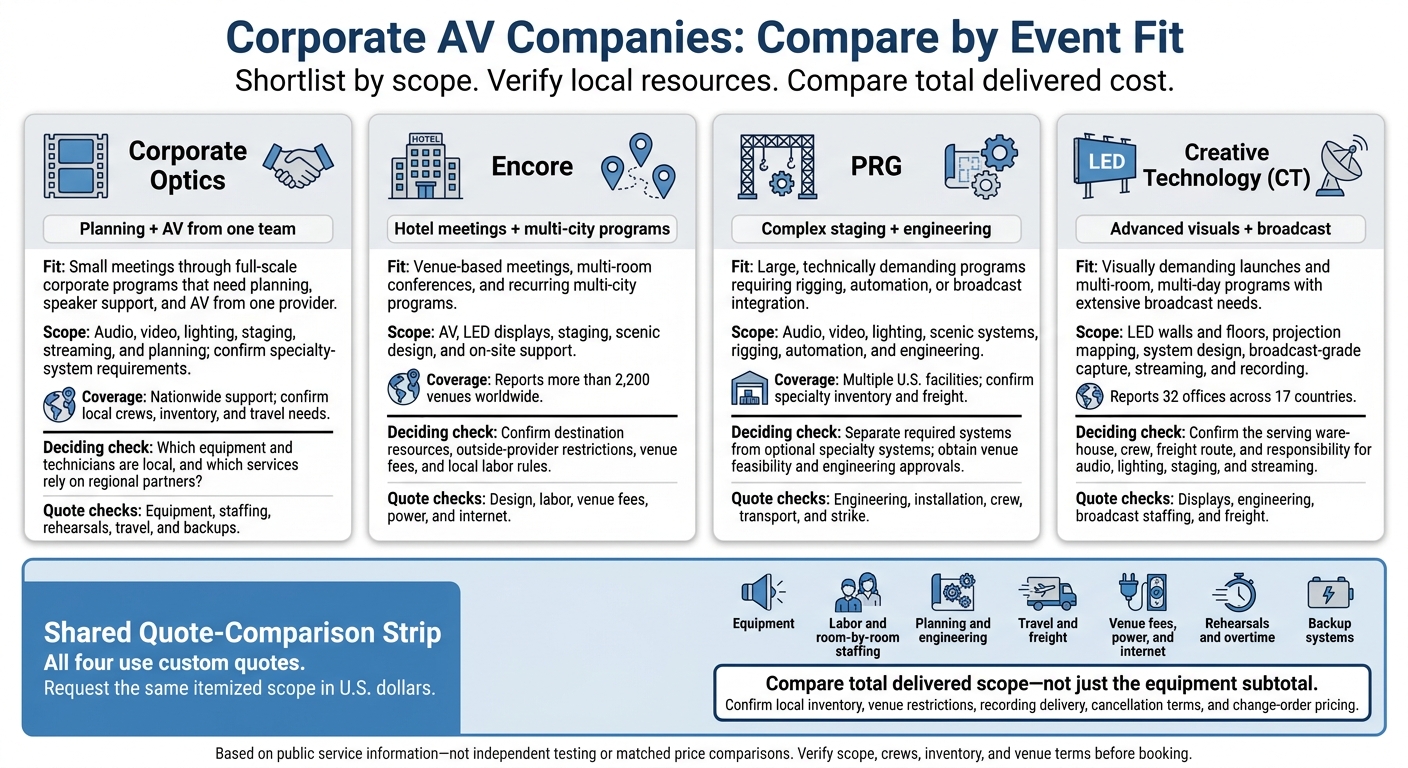
Compare Corporate Optics, Encore, PRG, and CT by event scope - not just equipment price. Request the same itemized quote from each, including planning, equipment, crew, travel, venue fees, and backup systems.
Corporate Optics fits programs that need planning and AV from one team. Encore suits hotel meetings and multi-city events. PRG fits complex staging, rigging, and automation. CT suits large displays and broadcast-heavy programs.
Quick Comparison
| Provider | Main services and event fit | Coverage to verify | Pricing checks |
|---|---|---|---|
| Corporate Optics | Audio, video, lighting, staging, streaming, and planning for small meetings through full productions | Nationwide support; confirm local crews and travel needs | Equipment, staffing, rehearsals, travel, and backups |
| Encore | AV, staging, scenic design, and on-site support for hotel meetings and multi-room conferences | Reports more than 2,200 venues worldwide; confirm destination resources | Design, labor, venue fees, power, and internet |
| PRG | Engineering, AV, rigging, and automation for large, complex shows | Multiple U.S. facilities; confirm specialty inventory and freight | Engineering, installation, crew, transport, and strike |
| CT | LED, projection, system design, and broadcast production for visually demanding events | Reports 32 offices across 17 countries; confirm U.S. crew and inventory | Displays, engineering, broadcast staffing, and freight |
All four use custom quotes. Compare total costs in U.S. dollars, then check room-by-room staffing, venue restrictions, rehearsal time, recording delivery, and cancellation terms. These recommendations reflect public service information - not independent testing or matched price comparisons.
Corporate AV Companies: Compare by Event Fit
1. Corporate Optics
AV, Staging, and Technical Support
Confirm Corporate Optics’ scope for audio, video, lighting, stage design, streaming, recording, speaker support, and live Q&A, polls, and moderated chat. Put that scope in a written production plan, with clear specs for displays, stage layout, streaming, and recordings, before reviewing staffing and rehearsal needs.
Require a written run of show that names who handles speaker rehearsals, playback, microphones, cues, remote handoffs, and backups. For hybrid programs, request reporting on attendance, watch time, Q&A, and poll participation. Once the workflow is set, confirm where the crew is based and whether staff will be local or traveling.
Coverage and Event Size
For South Florida events, verify whether Corporate Optics uses local crews or brings in personnel. Match staffing, scenic complexity, and backup systems to your format, whether it’s a small meeting, leadership session, awards event, hybrid program, or broadcast.
Pricing and Costs
Request itemized pricing for equipment, labor, travel, scenic fabrication, connectivity, streaming platforms, rehearsals, overtime, and backup gear. Ask for three priced options:
- Meeting-room AV
- Full in-person production with staging
- Hybrid or broadcast production with redundant streaming and analytics
Use the same scope sheet for the comparison below. That makes it easier to compare equipment, labor, and support on equal terms, including staffing and redundancy levels.
sbb-itb-ae35a94
2. Encore
AV and Staging
Encore provides audio, video, LED walls and displays, lighting, scenic design, staging, rigging, and event technology. Its integrated production model suits general sessions, plenaries, and branded corporate programs.
Confirm what’s included before pricing design and staffing. Ask who handles power, internet, event platforms, and audience-engagement tools - don’t assume they’re part of the package.
Planning and Technical Support
Encore’s design services can include production and scenic design, CAD drawings, and 3D visualization. Request plans that show sightlines, screen placement, and room layout. Keep design fees separate from content revisions and playback operation.
Also define who handles preproduction, show calling, and onsite execution, along with which rooms will have dedicated technicians.
Coverage and Event Size
Once scope and staffing are clear, check whether Encore can supply local crews and equipment at your destination. Encore reports supporting more than 2,200 venues worldwide, so its reach extends beyond the United States.
For conferences, multi-room programs, and repeat events across cities, check Encore’s current office or venue directory for each destination. Confirm local crew and equipment availability, too. For recurring programs, ask which equipment specifications, content files, and operating procedures can stay consistent across locations.
Pricing and Costs
With scope and coverage set, compare quotes line by line. Encore custom-quotes its services; it does not publish a standard U.S. package rate. Request separate costs for equipment, labor, project management, design, content, and venue charges.
Before signing, get the venue’s AV policy. Confirm exclusivity rules, outside-vendor restrictions, and requirements or charges for rigging, internet, power, union labor, and after-hours work. Check minimum labor calls, overtime, cancellation terms, and change-order rates as well.
3. PRG
AV and Staging
PRG is a better fit when an event needs more than standard meeting-room AV. It brings together audio, video, LED displays, projection, rigging, scenic systems, automation, and engineering for complex corporate events. It’s best suited to large, technically demanding programs, including multi-room conferences, launches, exhibitions, and broadcast-style events.
Planning and Technical Support
With that many systems in play, someone needs clear ownership of the technical work. Request a dedicated project manager and named technical leads for installation, rehearsals, show operation, and strike.
When you choose a production company for a virtual broadcast, ask for camera-friendly lighting, clean audio mixes, switching, recording, redundant playback, and a technical rehearsal schedule. Before approving flown LED or automated scenery, get a venue feasibility review that covers loads, attachment points, power, and safety approvals.
Coverage and Event Size
PRG lists U.S. facilities in New Windsor and New York, New York; Secaucus, New Jersey; Nashville, Tennessee; Orlando, Florida; Dallas, Texas; Las Vegas, Nevada; and San Fernando, California. Confirm which office will service your event, along with local inventory, crew availability, transportation schedules, and a backup plan for your city. A nearby office doesn’t mean every specialty system is available locally.
PRG reports supporting the Society of Nuclear Medicine and Molecular Imaging’s Los Angeles event for 13 consecutive years, serving 8,000+ professionals. Its scope covered plenary sessions, meeting rooms, digital posters, and the exhibition floor, including production management and technical labor.
Pricing and Costs
Specialized gear comes with logistics costs - not just equipment charges. PRG pricing usually increases with engineering, rigging, automation, and strike labor.
Request itemized costs for design and engineering, equipment, project management, crew, transportation, installation, rehearsals, show days, rigging, scenic fabrication, automation, and strike. Ask for a reduced-scope option, and confirm equipment transfers, standby charges, substitution terms, and change-order rules. For a simple meeting, trim the quote to the systems you need.
4. Creative Technology
AV and Staging
CT’s strength is high-end displays and broadcast integration. Creative Technology (CT) suits visually demanding corporate events, including general sessions, product launches, exhibitions, and large meetings. Its materials list LED walls and floors, projection and projection mapping, cameras, playback, audio, lighting, staging, and broadcast-grade capture, streaming, and recording.
Use LED in bright rooms, projection mapping on architectural surfaces, and live camera feeds to help remote viewers see the action. Confirm which equipment CT owns, rents, or expects the venue to supply.
Planning and Technical Support
CT focuses on custom system design and technical engineering. Ask for content-testing deadlines, playback and graphics specifications, and named camera, lighting, and broadcast operators.
For hybrid sessions, spell out who handles streaming, captioning, and recording formats. Request separate camera recordings, not just the program feed.
Coverage and Event Size
CT reports 32 offices across 17 countries, with U.S. locations in Los Angeles, Des Plaines, Panorama City, and Norcross. Confirm which warehouse, crew, and freight route will serve your event. Don’t assume the full inventory is available locally.
At the 2024 Milken Institute Global Conference, CT supported 13 concurrent general-session rooms, breakouts, entertainment, and web broadcasts across four days, with more than 1,000 presenters. Working with Vision Matrix Productions, Panasonic, and the Beverly Hilton, CT used an end-to-end SMPTE 2110 IP system. CT reports that it simplified cabling, reduced installation time, and made signal routing more flexible.
The project shows CT’s fit for multi-room, multi-day programs with heavy broadcast needs, where complex visuals and signal routing matter as much as room count.
Pricing and Costs
CT publishes no standard rate card. For budget comparisons, request separate scopes for baseline presentation AV and higher-end LED and broadcast production.
Ask each scope to itemize display specifications, engineering, content integration, technical staffing, freight, travel, and venue charges. For small meetings, check whether minimum staffing and engineering fees make sense for the work involved.
Compare AV Services, Support, Coverage, and Costs
The table compares each provider’s services, staffing, coverage, and quote structure.
| Comparison area | Corporate Optics | Encore | PRG | Creative Technology |
|---|---|---|---|---|
| Production scope | Combined audio, visual, lighting, and scenic production; confirm the scope for specialty systems. | Combined AV, LED displays, staging, and scenic design; confirm venue-specific rigging duties. | Audio, video, lighting, scenic systems, rigging, and automation for technically complex productions. | LED walls and floors, projection mapping, audio, lighting, and staging; well suited to visually demanding programs. |
| Hybrid and broadcast | Streaming; define broadcast requirements separately. | Hybrid events, live switching, content capture, and streaming-platform integration. | Livestreaming, broadcast, virtual production, and on-demand editing. | Broadcast-grade capture, streaming, and recording. |
| Planning and on-site support | Event planning, AV design, and on-site support; specify operator assignments. | Creative services, program management, stage management, and show calling; confirm dedicated staffing for each room. | Design, engineering, production managers, labor managers, and specialist crews. | Custom system design and technical engineering; specify camera, lighting, and broadcast operator assignments. |
| Coverage and local resources | Nationwide support; confirm local crews, inventory, and travel needs. | More than 2,200 venues worldwide; confirm resources and venue arrangements at your destination. | Multiple U.S. facilities; specialty inventory and crew availability vary by location. | Reports 32 offices across 17 countries; confirm which warehouse will serve the event and the freight route. |
| Event scale and best use case | Small meetings through full-scale corporate programs that need planning, speaker support, and AV from one provider. | Venue-based meetings, multi-room conferences, and recurring multi-city programs. | Large, complex productions requiring rigging, automation, or broadcast integration. | Visually demanding launches and multi-room, multi-day programs with extensive broadcast needs. |
| Quote model | Custom quote; no public rate card. | Custom quote; no public rate card. | Custom quote; no public rate card. | Custom quote; no public rate card. |
Use the table to check your scope, then verify crews, inventory, and venue charges in the written proposal. A capability list is not a scope. Separate basic meetings from complex productions, and confirm who supplies and operates critical systems.
To assess budget fit, compare matching scopes in U.S. dollars, with separate costs for equipment, labor, travel, freight, rigging, streaming, and overtime. Compare the total delivered scope - not just the equipment subtotal - and confirm change-order rules before booking.
Provider Trade-Offs and Event Fit
Use these tables to compare quotes and match each provider to your event.
| Provider | Advantages | Key trade-offs | Questions to confirm |
|---|---|---|---|
| Corporate Optics | Best for programs that need one team to handle planning, speakers, and technical delivery. | Destination resources vary by city. | Which equipment and technicians are local? Which services rely on regional partners? Does the quote include site visits, travel, freight, and backup gear? |
| Encore | Best when venue coordination and hotel logistics take priority. | Venue terms can limit flexibility and add costs. | What outside-provider restrictions, buyout fees, labor rules, rehearsal limits, and service charges apply? |
| PRG | Best for engineered shows with complex technical demands. | Simple meetings rarely need specialty systems or the logistics that come with them. | Can the quote separate required local resources from optional specialty systems? |
| Creative Technology | Best for advanced video, projection, and visual-control needs. | Responsibilities beyond visual systems must be clearly assigned. | Who handles audio, lighting, staging, show calling, streaming, and troubleshooting outside the visual package? |
Next, narrow your shortlist by event type. Each option depends on the provider confirming the scope and support your program needs.
| Event requirement | Conditional shortlist and deciding check |
|---|---|
| Small executive meetings | Corporate Optics, or Encore for venue integration. Confirm discreet staffing, confidentiality, and a right-sized package. |
| Multi-room conferences | Corporate Optics or Encore; PRG for complex production. Require room-by-room staffing for simultaneous sessions. |
| Leadership or shareholder meetings | Corporate Optics or Encore; PRG for complex staging or broadcast. Confirm secure content handling, confidence monitors, rehearsals, and redundant communications. |
| Awards or galas | Any shortlisted provider with confirmed full-production scope. Check cue calling, presenter support, playback reliability, and guest sightlines. |
| Launches or brand experiences | Any shortlisted provider that confirms it can bring the brand concept into the production. Verify reliable playback and repeatable show cues. |
| Hybrid or broadcast programs | Any shortlisted provider with confirmed broadcast scope. Check remote-speaker workflows, backup encoders, internet responsibility, and recording delivery. |
| Extensive LED, rigging, or automation | PRG fits engineered rigging and automation; Creative Technology fits in-depth visual-system needs. Require engineering documentation and venue approval. |
Request at least one comparable reference that matches your venue type, attendee count, room count, broadcast requirements, and production complexity. Then use the booking checklist to confirm scope, staffing, venue rules, and total delivered cost.
Final Recommendations and Booking Checklist
Use this checklist to match your event’s scope, venue, and budget with the right provider.
Venue and access: Before approving a proposal, check access, rigging limits, storage, and requirements tied to the location, room size, ceiling height, power, internet capacity, and attendance. Verify any exclusive or preferred in-house AV requirements, outside-vendor fees, local labor rules, and available equipment and technicians.
Quote and staffing: Get itemized pricing in U.S. dollars for audio, video, lighting, staging, rigging, streaming, labor, travel, overtime, and venue charges. Check quantities, specifications, labor hours, assumptions, and who supplies each system. Identify the production manager, technical director, department leads - including the streaming/broadcast lead - and on-site technicians. Document their approval authority, escalation paths, phone numbers, and email addresses.
Schedule and resilience: Before rehearsals begin, confirm design and content approvals, testing and rehearsal deadlines, show responsibilities, and backup systems. Agree on file ownership and delivery dates for final files and recordings.
Contract terms: Before signing, review insurance and liability, cancellation and postponement terms, payment milestones, data security and confidentiality, licensing and accessibility responsibilities, and written change-order pricing.
Final decision: Score proposals on verified scope, technical design, staffing, venue fit, backup systems, local support, schedule, and total delivered cost. Check a similar case study and references before choosing the proposal with the fewest unresolved assumptions. Book only when the proposal matches the venue, staffing plan, and total delivered scope.
FAQs
How early should I book corporate event AV?
Book early to leave time for site surveys, CAD drawings, and detailed show-flow planning. This helps reduce technical risk and avoid last-minute rush charges. How far ahead should you book? It depends on the event:
- Small internal meetings: 6–10 weeks.
- Executive summits with custom scenic builds: 8–16 weeks.
- Large-scale conferences: 4–6 months.
- Major conventions or multi-city event series: 6–14 months.
How can I reduce AV costs without risking reliability?
Check your venue’s policies before booking. Independent production companies can cost less than in-house packages, even after vendor fees. Ask for itemized proposals in U.S. dollars that break out labor, equipment, and logistics so you can spot unnecessary expenses.
Choose partners who own their equipment. This can save 25–30% compared with third-party rentals, and it means they know the gear they’ll be using. Plan 8–16 weeks ahead to avoid premium labor rates and last-minute freight charges.
What happens if my AV needs change after booking?
Review your contract’s change-order terms now. They should spell out who can approve billable changes, how those changes are priced, and whether markups apply.
Your initial contract should also define how to handle late adjustments and who can make decisions on event day. Shorter timelines or changed requirements often increase costs and technical risk. Put these terms in writing so everyone follows the same process.
Related Blog Posts


Streamline your workflow, achieve more
Lorem ipsum dolor sit amet, consectetur adipiscing elit. Maecenas ac velit pellentesque, feugiat justo sed, aliquet felis.



Lorem ipsum dolor sit amet, consectetur adipiscing elit. Maecenas ac velit pellentesque, feugiat justo sed, aliquet felis.