Top AV Production Partners For Large Corporate Meetings With National Full‑Service Experience And Strong On‑Site Execution.

Chief Executive Officer
If your AV team misses cues, loses stream uptime, or fumbles load-in, your meeting pays for it fast. My read of this review is simple: for large U.S. corporate meetings, I’d judge each partner on four checks only - technical scope, on-site execution, national logistics, and risk controls.
Here’s the short version:
- Corporate Optics looks strongest overall for high-pressure meetings that need tight show control and backup planning.
- Encore brings big-market reach, deep venue ties, and a large labor bench.
- Eleven Eleven AV stands out for process, hybrid support, and multi-city consistency.
- The article also points to other partner models like AVFX, AVI Event Services, and CitiView AV in the side-by-side ratings, though those profiles are lighter in the main write-up.
- For programs in the $25,000 to $250,000+ range, the main issue is not just gear. It’s whether the team can keep the show steady when something goes wrong.
If I were screening AV firms for a sales kickoff, leadership summit, or hybrid town hall, I’d ask for these four items before signing:
- staffing plan
- run-of-show ownership
- backup gear list
- pre-event engineering notes to design AV production effectively
That’s the core takeaway from the article: pick the team that owns execution risk, not just the equipment.
Bringing Events to Life: The Power of AV Production with Company Video and Motion
sbb-itb-ae35a94
Quick Comparison
| Partner | Main Strength | Best Fit |
|---|---|---|
| Corporate Optics | Strong control across scope, crew, freight, and backup systems | High-stakes corporate meetings and hybrid sessions |
| Encore | National scale, venue relationships, and large crew base | Large meetings across hotels and major venues |
| Eleven Eleven AV | Clear workflow, hybrid support, and repeatable delivery | SKOs, leadership meetings, and roadshows |
| AVFX | Deep technical range in side-by-side ratings | Gear-heavy shows and polished stage delivery |
| AVI Event Services | Strong execution and logistics in side-by-side ratings | Multi-city programs needing repeatable setup |
| CitiView AV | Broad market coverage in side-by-side ratings | Programs that need reach across locations |
My bottom line: this article is less about who has the most gear and more about who can keep a live corporate meeting under control from rehearsal through show close. For those managing distributed audiences, choosing the right hybrid event production companies is equally critical.
1. Corporate Optics
Against the core criteria above, Corporate Optics stands out for its grip on scope, crew, logistics, and backup planning. Corporate Optics is a U.S.-based full-service technical event production firm founded by Steven P. Simmons, built for high-stakes corporate meetings such as national sales kickoffs and large-scale hybrid events.
Technical Scope
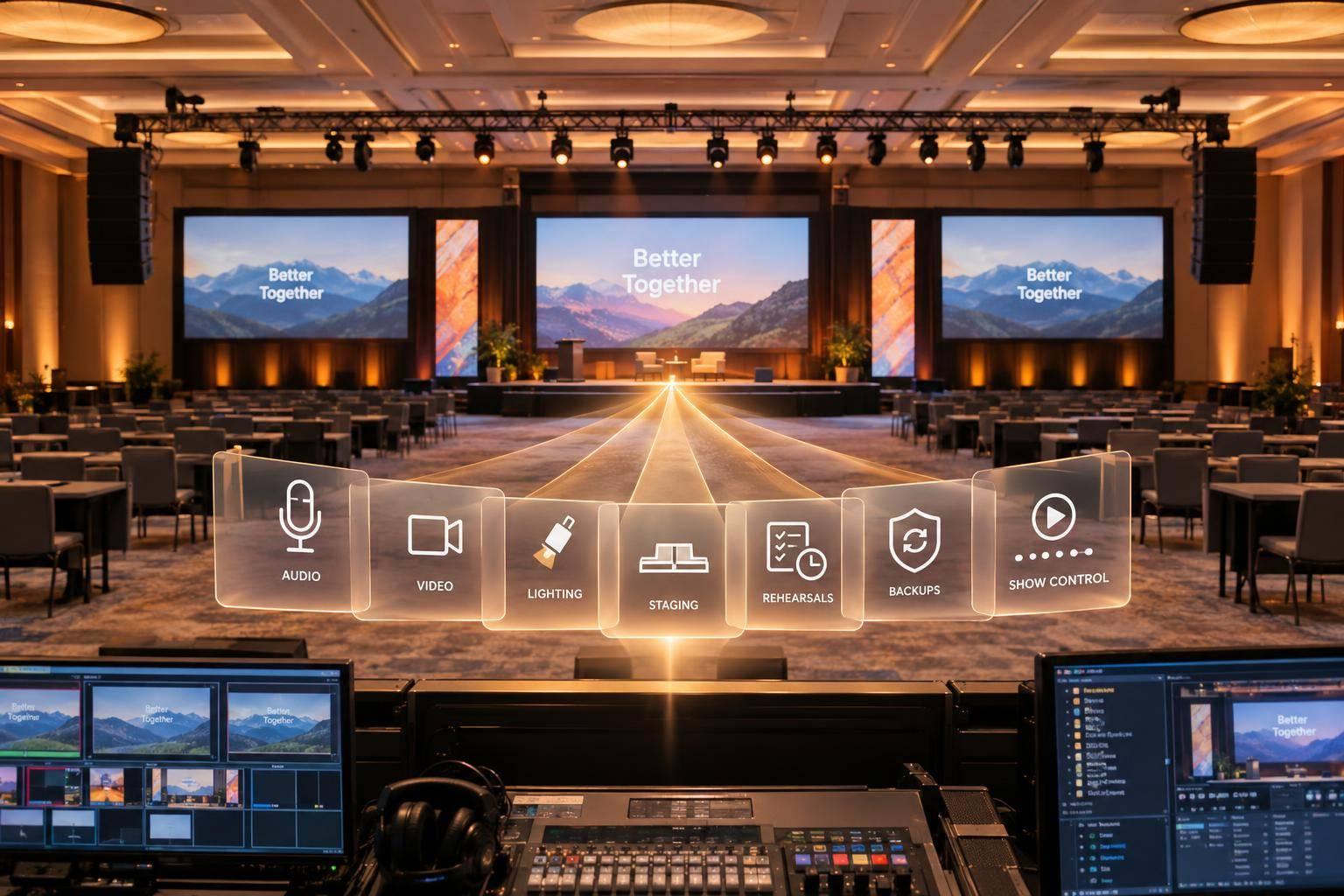
Corporate Optics handles the AV setup big meetings rely on. Its staging work includes modular stage builds, custom scenic pieces, integrated branding and signage, and ADA-compliant access. Audio is built around line-array PA systems with digital mixing consoles, redundant wireless mic packages, and real-time monitoring suited for large general sessions.
Video support covers 4K-capable switching, multi-camera packages, confidence monitors, large-format LED walls, and 4K laser projection for high-visibility corporate messaging. Lighting rigs use programmable LED fixtures and moving heads, pre-programmed for executive walk-ons, branded stage looks, and product reveals.
For hybrid and streaming needs, Corporate Optics ties in enterprise encoding for Zoom, Teams, or webcast portals. The team also works directly with venue IT to support stable, low-latency streams. A show caller, producer, and graphics operator keep the run of show on track, while playback systems and media servers make room for last-minute content changes without knocking the live session off course.
That setup matters, but it still comes down to whether the crew on-site can make it all run without a hitch.
On-Site Execution
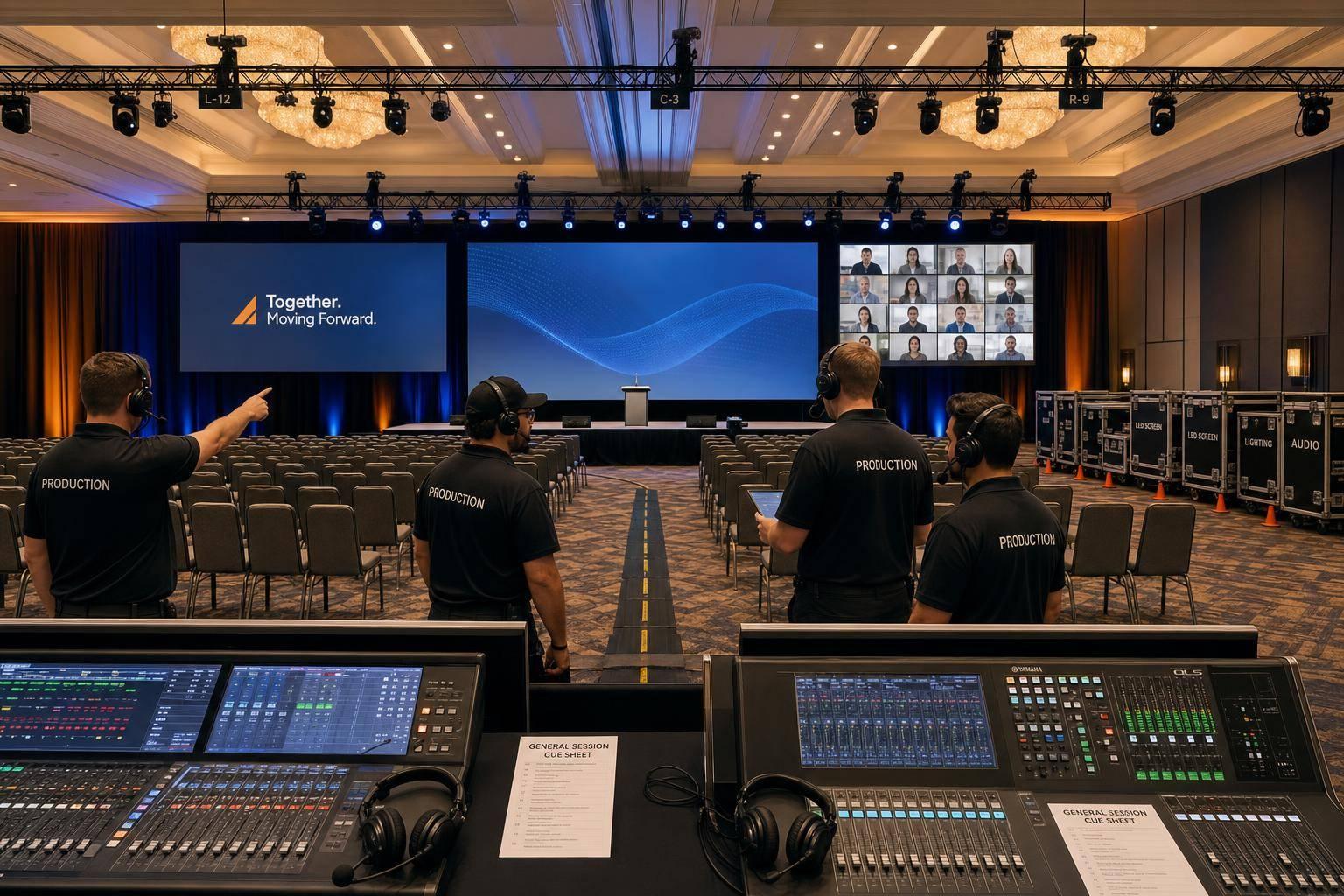
On-site, Corporate Optics uses a tiered crew structure led by a Technical Director (TD) who oversees audio, video, lighting, and staging as one connected system. A dedicated show caller manages cue flow and talent communication over intercom during the event. Department leads run each discipline, while local labor - union or non-union depending on the city - is briefed and lined up through standardized call sheets before load-in.
Two practices help cut risk:
- First, "Day Zero" stress testing runs all hardware at peak capacity for several hours before rehearsals start. That helps surface thermal or electrical issues before they show up during a live keynote. This process is supported by a comprehensive audiovisual equipment checklist to ensure no component is overlooked.
- Second, a "Rapid Response Kit" stays on-site for the full event. It includes spares for switchers, media servers, and audio consoles so the crew can make fast hot swaps.
National Logistics
Corporate Optics manages multi-city programs through regional equipment hubs in key U.S. markets, which cuts freight time and lowers shipping risk. For roadshow-style programs, the company can keep the same Project Manager and Technical Director across stops. That carries show knowledge and client preferences from city to city instead of resetting each time.
Standardized "Show Kits" and signal flow diagrams help keep the stage look and signal flow steady at each venue, even when the local crew changes. Real-time GPS and inventory tracking watch gear movement between cities, so delays can be spotted and corrected fast.
That kind of continuity matters when one program has to land cleanly in multiple venues.
Risk Controls
Corporate Optics uses dual redundancy on critical signal paths, with backup switchers, playback servers, and power distribution units ready to take over when needed. UPS units protect control racks, and redundant internet backhauls protect streaming.
Site surveys done 60 to 90 days before the event map power distribution, rigging points, and network infrastructure, which helps spot single points of failure before load-in. For sensitive sessions, encrypted stream connections and password-protected recordings help address the data security requirements common in enterprise meetings.
2. National Full-Service AV Partner Profile A
Encore handles national and global AV production for large corporate meetings. That means creative strategy, technical direction, and show management under one roof. For planners, the big issue isn’t size by itself. It’s whether that size leads to clean cueing, steady show flow, and load-ins that don’t go sideways.
Technical Scope
Encore covers audio, video, lighting, staging, and technical engineering for large corporate meetings. Its video work includes large-format LED video walls, panoramic screens, digital displays, and live switching. For hybrid programs, Encore ties in streaming platforms, manages remote presenters, and supports real-time interpretation for multilingual audiences.
That kind of scope sounds good on paper. In a live corporate setting, though, the test is simple: can the crew run the show without missed cues, awkward handoffs, or screen issues at the worst possible moment?
On-Site Execution
On-site delivery is backed by technical directors, stage managers, and show callers who build the run of show and lead cue-to-cue rehearsals. Encore also points to its Service Excellence training, which supports high client satisfaction scores. The company says it has nearly 12,000 global team members and logs more than 420,000 training hours each year.
In plain terms, the setup is built for shows that need tight timing and steady coordination from rehearsal through show close.
National Logistics
Encore uses local market inventory first and ships freight only when a program calls for it. Internal production managers help oversee local execution and support consistency across multi-city programs.
That matters because freight can be a headache. A local-first model can cut some of that risk, but it still depends on sharp venue coordination and solid infrastructure planning.
Risk Controls
Encore follows standards for rigging, power, and venue infrastructure. It also serves as the in-house partner for more than 2,200 hotel and venue partners worldwide. That level of venue familiarity can help limit load-in surprises and smooth coordination with hotel teams.
3. National Full-Service AV Partner Profile B
Eleven Eleven Audio Visual is a San Diego-based corporate event production team with 11+ years of nationwide experience, 500+ enterprise clients, and 400+ events across 18+ states. The company is built for planners who need general sessions to stay on schedule, load-ins to run cleanly, and show flow to stay steady from one city to the next.
This profile makes the most sense for planners who want a process-led national team for leadership meetings and SKOs.
Technical Scope
Eleven Eleven handles end-to-end production for enterprise corporate events. That includes staging and set design, audio, video, lighting, and hybrid support.
On the audio side, the team uses scalable sound backed by redundant systems. Video support covers multi-source switching, LED walls, projection, confidence monitors, and recording for post-event edits. Lighting is planned around brand-aligned color palettes, stage wash, and architectural uplighting. For hybrid programs, the team uses secure workflows and bonded internet connections so in-room and virtual audiences can be supported at the same time.
On-Site Execution
The team works through a five-step workflow, starting with strategy alignment and continuing through post-event review. The goal is simple: fewer surprises during load-in, rehearsal, and show call.
To keep the show tight, dashboards track each cue in real time and support show calling. Technical rehearsals and layout simulations are also finished before load-in, which helps surface conflicts early instead of dealing with them on the floor.
For large programs, the main point isn’t just the system itself. It’s how that system is protected once the event is live.
Risk Controls
Risk controls focus on redundant AV, bonded internet, pretested workflows, and coordinated venue logistics. The company reports 99% technical soundness and lower operational risk through these practices, while on-site leads keep stakeholders updated in real time.
That puts execution discipline at the center when comparing this profile with the others below.
4. National Full-Service AV Partner Profile C
This profile is a good fit for multi-venue corporate programs that need one consistent standard of execution.
Technical Scope
Encore handles creative, technical, and show operations across large corporate programs. If you're planning a multi-city or multi-venue schedule, that matters. Its venue relationships and standardized production model can help cut down on the setup drag that tends to grow from one stop to the next.
On-Site Execution
Show management is part of the package. Encore assigns dedicated staff for stage direction, run-of-show development, and cue-to-cue rehearsal management. Technical direction also extends to executive speaker support.
Risk Controls
Training sits at the center of Encore's operating model. The company logs 420,000 annual training hours across its technical workforce, with required training in rigging, power infrastructure, and safety protocols. For planners running high-stakes general sessions across several venues, that level of preparation is a strong sign of consistency on site.
5. National Full-Service AV Partner Profile D
This profile puts the focus on cue control, pre-event engineering, and steady delivery across multiple cities.
Technical Scope
Eleven Eleven builds its production approach around clear executive messaging at every technical layer. Audio systems are set up for strong clarity and uptime. The company uses large-format LED video walls, content capture, and executive messaging support to keep presentations tied to leadership goals. Lighting is used to support brand visibility across stage looks and architectural treatments. For hybrid programs, bonded internet and redundant systems connect in-room and virtual audiences across platforms.
On-Site Execution
On site, the team relies on live cue sheets and production dashboards to track each segment and transition in real time. Redundant AV systems and pretested workflows are built in to cut mistakes and keep the show moving as planned.
National Logistics
Eleven Eleven operates in major convention markets, including Las Vegas, Chicago, Dallas, Orlando, and New York City. Its five-stage workflow covers Strategy Alignment, Creative & Technical Design, Pre-Event Engineering, Show Execution, and Post-Event Optimization. That structure helps multi-city programs stay aligned to the same production standard.
Risk Controls
Risk controls include redundant system architecture, display compatibility checks for hardware integration, and strategy-first planning that spots technical risks during pre-production.
Side-By-Side Comparison Across Core AV Delivery Criteria
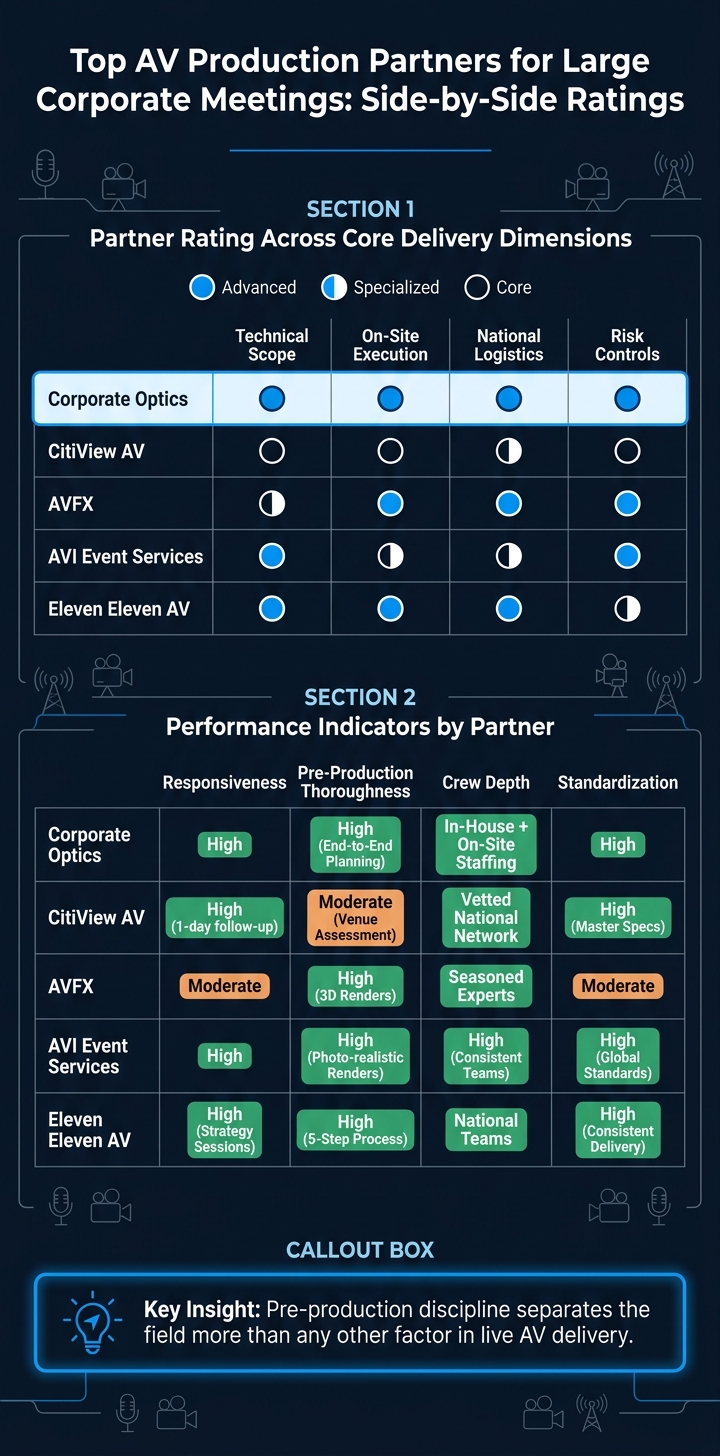
Top AV Production Partners for Large Corporate Meetings: Side-by-Side Ratings
The profiles above looked at each partner on its own. These tables put them side by side on the factors that matter most for live corporate events.
That makes it easier to see who is most likely to deliver a clean general session, a steady hybrid feed, often requiring multi-camera streaming for remote engagement, and a smooth load-in from city to city.
Each rating uses the same four filters applied across the article: technical scope, on-site execution, national logistics, and risk controls.
Partner Rating Across Core Delivery Dimensions
| Partner | Technical Scope | On-Site Execution | National Logistics | Risk Controls |
|---|---|---|---|---|
| Corporate Optics | Advanced | Advanced | Advanced | Advanced |
| CitiView AV | Core | Core | Specialized | Core |
| AVFX | Specialized | Advanced | Advanced | Advanced |
| AVI Event Services | Advanced | Specialized | Specialized | Advanced |
| Eleven Eleven AV | Advanced | Advanced | Advanced | Specialized |
There are a few clear standouts here. AVFX leads on technical scope. AVI Event Services stands out on execution and logistics. Eleven Eleven AV leads on risk controls. And CitiView AV stands out for national coverage.
The next table shifts from raw capability to day-to-day operating discipline.
Performance Indicators by Partner
| Partner | Responsiveness | Pre-Production Thoroughness | Crew Depth | Standardization |
|---|---|---|---|---|
| Corporate Optics | High | High (End-to-End Planning) | In-House + On-Site Staffing | High |
| CitiView AV | High (1-day follow-up) | Moderate (Venue Assessment) | Vetted National Network | High (Master Specs) |
| AVFX | Moderate | High (3D Renders) | Seasoned Experts | Moderate |
| AVI Event Services | High | High (Photo-realistic Renders) | High (Consistent Teams) | High (Global Standards) |
| Eleven Eleven AV | High (Strategy Sessions) | High (5-Step Process) | National Teams | High (Consistent Delivery) |
If one pattern jumps off the page, it’s this: pre-production discipline separates the field more than anything else. In live AV, that early planning work often decides whether show day feels controlled or avoids common production mistakes.
Pros And Cons By Partner Type
The right fit comes down to event scope, complexity, and how much can go wrong if execution slips. The comparison above helps line up each provider model with the kind of meeting you're running. This summary turns those delivery patterns into the buying models most teams use.
| Partner Type | Best-Fit Use Cases | Main Advantages | Likely Drawbacks |
|---|---|---|---|
| Full-Service Production Partner | High-stakes executive meetings, hybrid programs, leadership conferences, and shareholder meetings | conference event production including AV design, staging, speaker support, live streaming, and vendor coordination | Custom pricing requires consultation |
| National Full-Service Partner | Multi-city roadshows, national SKOs, and franchise conventions | Single point of contact; standardized specs across U.S. markets; vetted national crew network | Crew quality depends on how tightly local networks are managed |
| Technical Engineering Specialist | Product launches, tech keynotes, and broadcast-quality town halls | Cinema-grade gear; strong technical depth; equipment ownership can reduce sub-rental markups | More execution-focused than strategic; broader messaging support may be limited |
| Convention and Trade Show Specialist | Large conventions, association meetings, and expos with up to 15,000 attendees | Built for high-attendance events; deep expertise in convention-center logistics and load-in | Less emphasis on executive messaging alignment or boutique creative design |
| Strategic Enterprise Partner | Executive town halls, global leadership summits, and revenue-focused SKOs | High redundancy; integrates closely with internal planners for high-stakes presentations | Higher cost and tighter booking windows |
A Full-Service Production Partner tends to make sense when you need one team to run the whole show. That usually matters most for executive-facing meetings, hybrid sessions, and high-pressure events where speaker prep, staging, streaming, and vendor management all need to work together.
A National Full-Service Partner is often the safer pick for programs that repeat across multiple U.S. cities. You get one main contact and more consistency from market to market, though the end result still depends on how well the partner manages its local crews.
If the event leans hard on gear, show flow, and broadcast-level output, a Technical Engineering Specialist can be a strong match. This model is usually less about upstream planning and more about tight technical delivery, especially for launches, keynotes, and polished internal broadcasts.
For very large expos and association events, a Convention and Trade Show Specialist is built for the pace and scale of convention-center work. That includes load-in, large attendee counts, and venue logistics, though this type of partner may put less focus on executive narrative or boutique show design.
A Strategic Enterprise Partner fits best when the presentation itself carries major business weight. Think executive town halls, leadership summits, and revenue-focused SKOs where backup systems, close planner coordination, and low failure tolerance matter most .
Conclusion
For large corporate meetings, picking an AV partner is a risk call. If the tech fails or the on-site team loses control, the whole program can take a hit.
Look at partners through four lenses: technical depth, on-site execution, national consistency, and risk controls. Redundant AV systems and tight logistics can cut operational risk in a big way.
Before you sign, ask for:
- staffing plans
- run-of-show timelines
- backup gear
- pre-event engineering documentation
Choose the team that can protect execution, not just provide equipment. For more guidance, see our guide to planning with production support.
FAQs
How do I vet AV execution risk before signing?
Treat pre-production as a technical discipline, not just admin work.
Start with one simple question: Who will be your show caller? Talk to that person before you sign anything. If they’ve handled your type of event before, that’s often a strong sign of how the live show will run when the pressure hits.
It also helps to dig into the team’s backup plans. If something fails mid-show, what happens next? Ask for an itemized proposal too, so you can see where the money is going instead of dealing with a vague top-line number.
Pay attention to how the team acts during the sales process. Are they prompt? Clear? Organized? The way they respond before the contract often tells you a lot about how they’ll operate on show day.
And one more smart move: ask for recorded production communications from past events. Hearing real comms gives you a direct look at how the crew works under pressure - whether they stay calm, speak clearly, and keep the show moving.
What backup systems should a large meeting require?
Large corporate meetings should require documented backup systems and contingency plans as a standard part of the production process.
That means planning for failure before it happens, not scrambling after something breaks.
At a minimum, this should include:
- Backup microphones
- Redundant technical systems
- Pre-event validation
- Structural checks
- Integrated testing
The goal is simple: catch and fix problems before the event begins.
When does a meeting need a national full-service AV team?
A national full-service AV team matters when your meeting runs across multiple cities, venues, or regions and you need the same production quality, brand look, and technical dependability in every location.
This becomes even more important for complex programs like roadshows, multi-city conferences, and leadership summits. One central team can handle venue-to-venue differences, travel schedules, and local tech rules while keeping staging, audio, video, and lighting consistent from start to finish.
Related Blog Posts


Streamline your workflow, achieve more

Lorem ipsum dolor sit amet, consectetur adipiscing elit. Maecenas ac velit pellentesque, feugiat justo sed, aliquet felis.



Lorem ipsum dolor sit amet, consectetur adipiscing elit. Maecenas ac velit pellentesque, feugiat justo sed, aliquet felis.