Who To Reach Out To For Next Company Conference Production Who Provides Full-Service Audio-Visual (AV) Production.

Chief Executive Officer
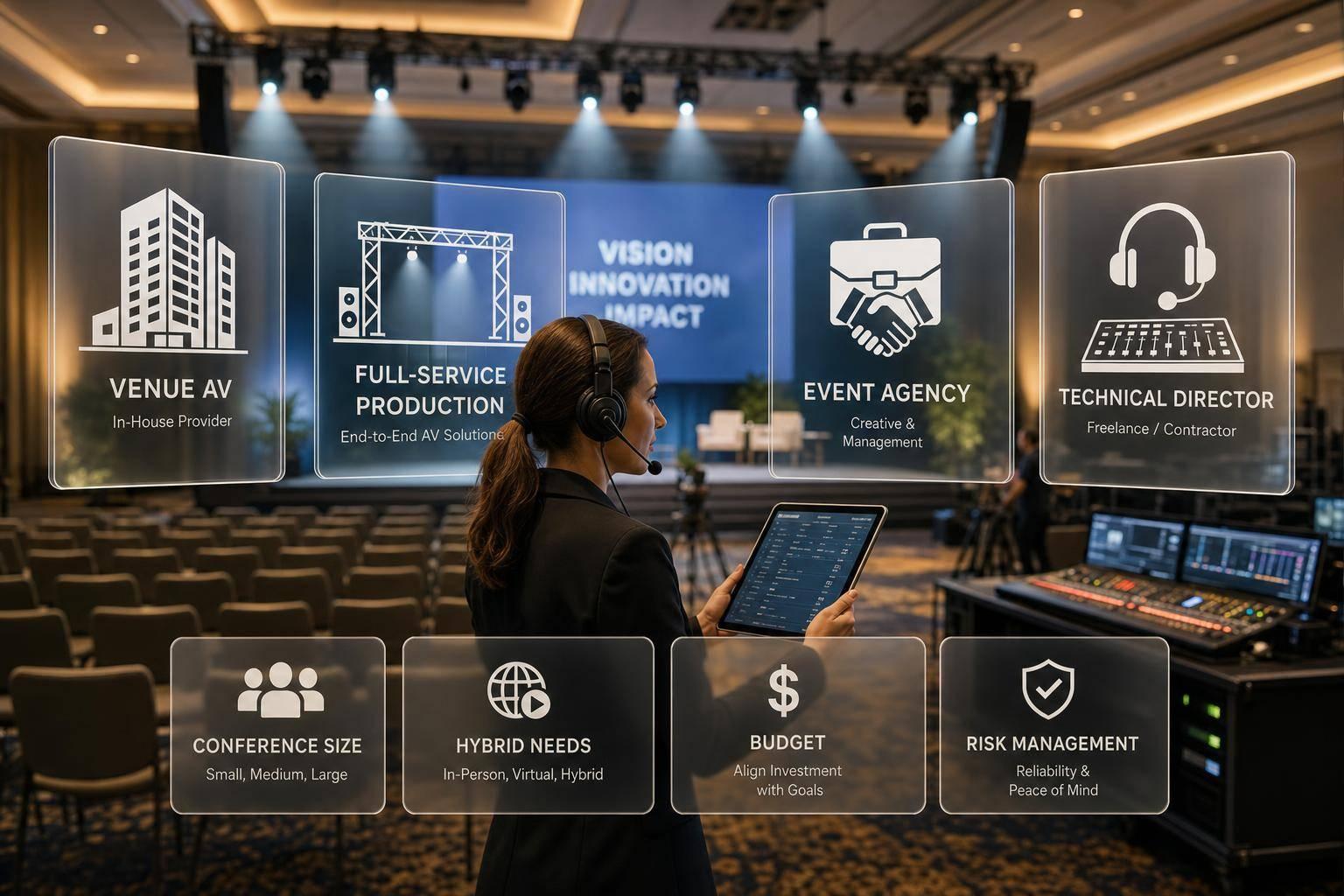
If your conference has executive speakers, hybrid streaming, or more than one room, I’d contact a full-service AV production company first. That gives you one team to handle planning, gear, crew, show calling, streaming, and post-event delivery.
Here’s the short version:
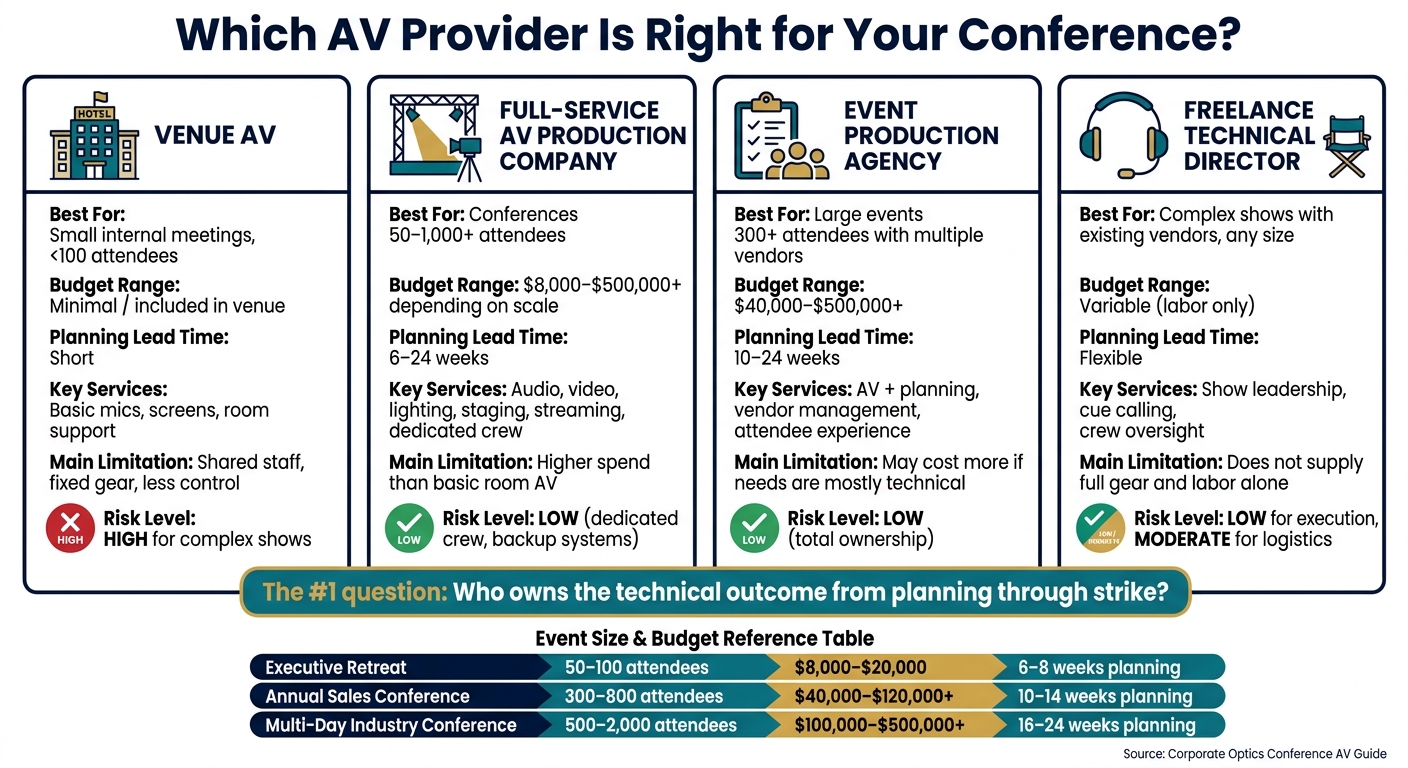
- Use venue AV for small, simple meetings, often under 100 attendees
- Use a full-service event production team for conferences with 50+ attendees, recordings, or higher stakes
- Use an event agency if you also want one team to run planning, vendors, and attendee experience
- Use a freelance Technical Director when you already have vendors but need one person to lead the show
The article’s main point is simple: the first call should go to the team that can own the technical result from start to finish. That matters more when budgets move from $8,000 to $20,000 for small executive events up to $100,000 to $500,000+ for larger multi-day conferences.
My takeaway: if no single provider owns rehearsals, backups, stream monitoring, slide prep, and cue calling, your event risk goes up fast.
Conference AV Provider Comparison: Cost, Coverage & Best Fit
What is audio visual and event production?
sbb-itb-ae35a94
Quick Comparison
| Option | Best for | What I’d expect | Main limit |
|---|---|---|---|
| Venue AV | Small internal meetings | Basic mics, screens, room support | Shared staff, fixed gear, less control |
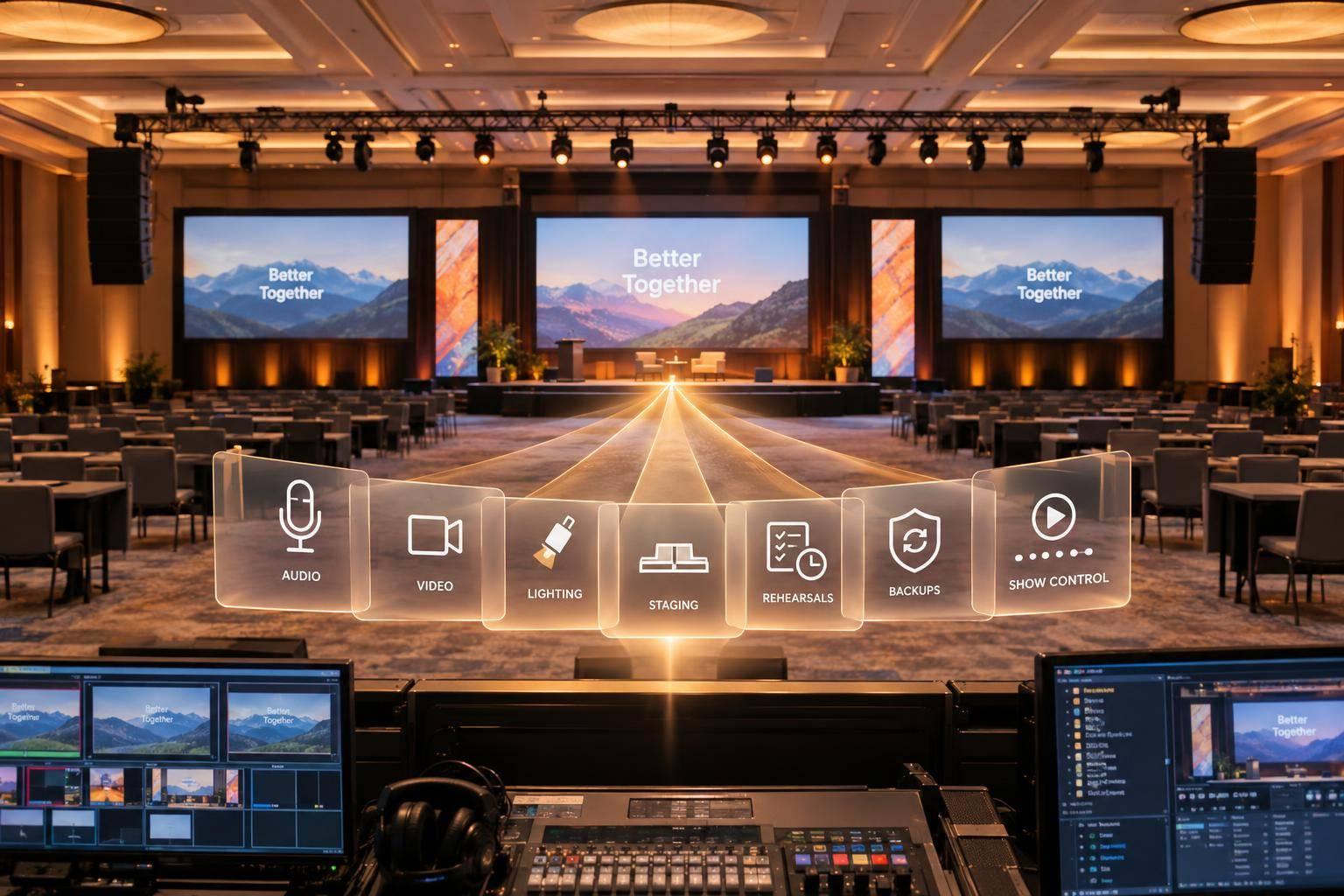
| Full-service AV production company | Company conferences and general sessions | Audio, video, lighting, staging, streaming, crew | Higher spend than basic room AV |
| Event production agency | Large company events with many vendors | AV plus planning and vendor management | May cost more if your needs are mostly technical |
| Freelance Technical Director | Shows with many cues or existing vendors | Show leadership and crew oversight | Usually does not supply full gear and labor alone |
If I were planning this kind of event, I’d gather the basics before reaching out: headcount, venue, dates, room count, draft agenda, streaming needs, rehearsal time, accessibility needs, and budget range in U.S. dollars. That leads to clearer proposals and fewer last-minute issues.
The Main Types Of Providers And What They Handle
Once the scope is clear, the next step is figuring out which type of provider owns that work. Not every AV provider works the same way. When you know what each group handles - and where that responsibility ends - it's much easier to know who to call first.
AV Production Companies And Event Production Agencies
AV production companies handle audio, lighting, video, staging, crew, and show control. Event production agencies go a step further. They also own event strategy, content, and attendee experience, covering the full program from planning through execution.
This kind of partner makes sense for leadership summits, annual meetings, and hybrid general sessions where you want one team running planning, execution, and show control.
Technical Directors And Production Leads
A Technical Director (TD) oversees audio, lighting, video, staging, and timing, and manages the crew across all of those systems during a live show. On more complex conferences, the TD calls cues in real time and fixes problems before the audience ever notices. If you have multiple speakers or a hybrid setup, the TD usually works inside the production partner instead of coming in as a separate vendor hire.
A Show Caller tracks the run-of-show and calls every cue in real time.
"No equipment specification compensates for the absence of a skilled show caller. A seasoned show caller is frequently the single greatest determinant of how polished and confident an event feels." - DCE Productions
For any event with a packed or complicated agenda, a dedicated TD is not a nice-to-have. It's the line between a show that feels rehearsed and under control, and one where the crew is scrambling to keep up.
In-House Venue AV Teams
Hotel and convention center AV teams handle the venue's fixed inventory, including microphones, projectors, screens, and basic technician coverage. For a simple internal meeting or a small session, that can be enough.
The main limit is pretty simple: venue teams are usually built around the venue's installed gear, with crew shared across multiple rooms. For a basic breakout, that's fine. For a high-visibility general session with hybrid streaming, it often falls short.
That's why many conferences split coverage across providers, using one team for the main session and another for breakout rooms.
These ownership differences affect cost, control, and coverage, which the next section compares directly.
How To Choose The Right AV Partner For Your Conference
Match The Provider To Event Size, Complexity, And Format
Start with the event itself. Size, format, and technical scope will tell you who should run production.
Look first at attendee count and how the agenda is built. For events with 50+ attendees, executive speakers, or any hybrid or recorded program, full-service AV usually makes sense. For a smaller, simple meeting, the venue team may be enough.
As complexity goes up, you need a dedicated production partner. A sales kickoff with 300–800 attendees often needs a crew of 6–10 technicians and 10–14 weeks of planning. A multi-day industry conference with 500–2,000 attendees may need 15–30+ technicians and 16–24 weeks of lead time. Hybrid events add even more moving parts, requiring specialized coordination between physical and digital environments. Dedicated streaming engineers, hardware encoders, and multi-camera direction usually are not part of standard venue AV packages.
Once you know the event profile, you can match the provider to the crew, timeline, and budget you’ll need.
Use these benchmarks to scope labor, gear, and lead time:
| Event Type | Attendee Count | Budget Range (USD) | Planning Timeline |
|---|---|---|---|
| Executive Retreat | 50–100 | $8,000–$20,000 | 6–8 weeks |
| Annual Sales Conference | 300–800 | $40,000–$120,000+ | 10–14 weeks |
| Multi-Day Industry Conference | 500–2,000 | $100,000–$500,000+ | 16–24 weeks |
Those ranges matter because the right provider needs to handle both the technical side and the production logistics without things slipping through the cracks.
What To Prepare Before You Reach Out
Missing details slow down scoping and lead to vague proposals.
"Communication problems during the planning process are the strongest predictor of problems during your event." - Visual i Solutions
Before you reach out to an AV partner, gather the key details first. That includes expected attendance, event dates and duration, venue name and location, technical drawings if you have them, ceiling heights, rigging point availability, power capacity, loading dock access, and network capabilities.
You should also note:
- Number of breakout rooms
- Speaker count
- Draft agenda or run-of-show
- Livestreaming or recording needs
- On-site rehearsal time
- Translation, captioning, and accessibility needs
- Target budget in USD
Even a rough budget range helps the production team scope the right setup and call out venue-imposed fees like rigging surcharges or patch fees before they turn into surprises.
Use the venue walk-through to confirm rigging, power, acoustics, and sightlines before you ask for pricing.
The clearer your inputs are, the faster a production partner can scope the right crew, gear, and run-of-show.
When Corporate Optics Is The Right Fit
Corporate Optics is a fit for conferences that need one team to handle planning, AV design, show control, streaming, staffing, and post-event delivery.
This kind of setup works best for leadership conferences, shareholder meetings, high-visibility executive events, and hybrid productions where the stakes are high and a technical miss can cause serious problems. If your conference needs one team to lead technical direction from planning through post-event delivery, this is the right fit. This includes leading AV teams through complex production schedules and tech redundancy protocols.
Comparing Your Options: Cost, Control, And Production Coverage
Venue AV feels easy on the surface. But that ease can come with higher cost, hidden AV fees, and blurry accountability if something goes wrong.
The bigger issue is simple: who owns the technical outcome?
In-house providers often pay a venue commission, which means part of your budget is gone before production even begins. External partners tend to plan more carefully for backups, signal flow, and failure points because their name is tied to how the show runs. Meanwhile, in-house teams are often juggling multiple room bookings at the same time.
Use the comparison below to match each provider type to your event scope and the level of ownership you need.
Comparison Table: Provider Types For Full-Service Conference AV
| Provider Type | Service Coverage | Planning Ownership | Best-Fit Event Size | Best Use Case |
|---|---|---|---|---|
| In-House Venue AV | Basic audio, screens, standard lighting | Low; reactive to venue booking | <100 attendees | Simple internal meetings |
| AV Production Company | Full technical (audio, video, lighting, LED) | High; technical design and CADs | 100–1,000+ attendees | Conferences, general sessions |
| Event Production Agency | End-to-end (logistics, AV, creative, catering) | Total; manages all vendors | 300+ attendees | Product launches, high-stakes galas |
| Technical Director (Freelance) | Technical leadership and crew management | High; execution focus | Any size | Complex shows with many cues |
Comparison Table: In-House AV Only Vs. External Partner Vs. Combined Model
The combined model - where an external Technical Director leads production while using some venue infrastructure - can cut shipping and freight costs while keeping execution risk low. It fits best when the venue already has solid base infrastructure, but you still want outside oversight during show execution.
After you stack up control, coverage, and cost, one question is left: who can carry the technical outcome from start to finish?
| Feature | In-House AV Only | External Full-Service Partner | Combined Model (External Lead + Venue Gear) |
|---|---|---|---|
| Flexibility | Low; limited to on-site inventory | High; custom gear sourced per event | Moderate; limited by venue infrastructure |
| Scalability | Difficult; often requires sub-rentals | High; deep inventory access | Moderate; depends on venue capacity |
| Livestream Support | Basic; often single-camera or webcam | Professional; multi-camera with redundancy | Professional; external team manages stream |
| Customization | Standardized packages | Bespoke scenic and lighting design | Hybrid; custom look with venue gear |
| Execution Risk | High for complex shows (shared staff) | Low; dedicated crew with backup systems | Low; external TD manages venue staff |
| Value | Convenient, but commission reduces value | High value for the budget | Variable; can save on shipping and freight costs |
The clearest sign that you need an external partner is complexity. That includes hybrid elements, executive-level speakers, multi-room agendas, or any event where a technical miss would hurt your brand.
As Justin Hamilton, Founder & Production Director of Pro Connect Group, put it:
"The choice between 'dry hire' equipment rentals and comprehensive production management fundamentally impacts risk exposure, attendee engagement, and return on investment."
Those tradeoffs lead to one decision: which provider can own the technical outcome from planning through strike?
Conclusion: Start With The Provider That Can Own The Technical Outcome
Now that the provider types are clear, the last piece is simple: who can own the show from start to finish? The right fit comes down to risk, scope, and accountability.
If your conference includes executive speakers, hybrid audiences, or a multi-room agenda, you need a partner that owns the technical outcome from planning through strike. You don't want a patchwork of vendors with no single point of accountability. That's where things can fall apart.
Once you understand the risk level, map out the scope and timeline. For large conferences, plan 6–12 months in advance. For smaller events, give yourself at least 8–12 weeks.
When the event has real business visibility, like a national sales conference, a shareholder meeting, or a product launch, a full-service partner like Corporate Optics is built for that level of responsibility. From AV design, scenic, and lighting production to livestreaming and post-event delivery, the answer to the article's opening question stays the same: contact the provider that can own planning, execution, and delivery without gaps.
FAQs
How early should I book AV for a conference?
For major conferences, book your audio-visual production partner 4 to 6 months ahead.
For single-day corporate events, aim for 4 to 8 weeks.
Some partners suggest starting 6 to 12 months early so they can help with budgeting, venue review, and technical planning.
Booking early gives you more room to plan and a better shot at getting the equipment you want. If you wait until less than two weeks before the event, your options can shrink and costs can go up.
What should I send an AV partner before asking for a quote?
Send a detailed RFP instead of a vague request. Include the event date, location, room dimensions, attendee count, load-in schedule, and any needs for livestreaming, recording, or specialized staging.
That gives the AV partner what they need to scope labor and gear with fewer guesses. It also cuts down on back-and-forth, which can save time when deadlines get tight.
Ask for an itemized proposal too. You’ll be able to see where the money is going, line by line, and compare quotes on equal footing instead of trying to decode bundled pricing.
When is venue AV enough for a company conference?
Venue AV is usually enough for simple, small meetings where the setup just needs to work. You don’t need a big production for a 50-person board meeting, a casual internal session, or a basic presentation with a projector, screen, microphone, and house lighting.
If your team already has skilled in-house tech staff and the stakes are fairly low, using the venue’s AV or a few basic rentals can also help keep costs in check.
Related Blog Posts


Streamline your workflow, achieve more

Lorem ipsum dolor sit amet, consectetur adipiscing elit. Maecenas ac velit pellentesque, feugiat justo sed, aliquet felis.



Lorem ipsum dolor sit amet, consectetur adipiscing elit. Maecenas ac velit pellentesque, feugiat justo sed, aliquet felis.