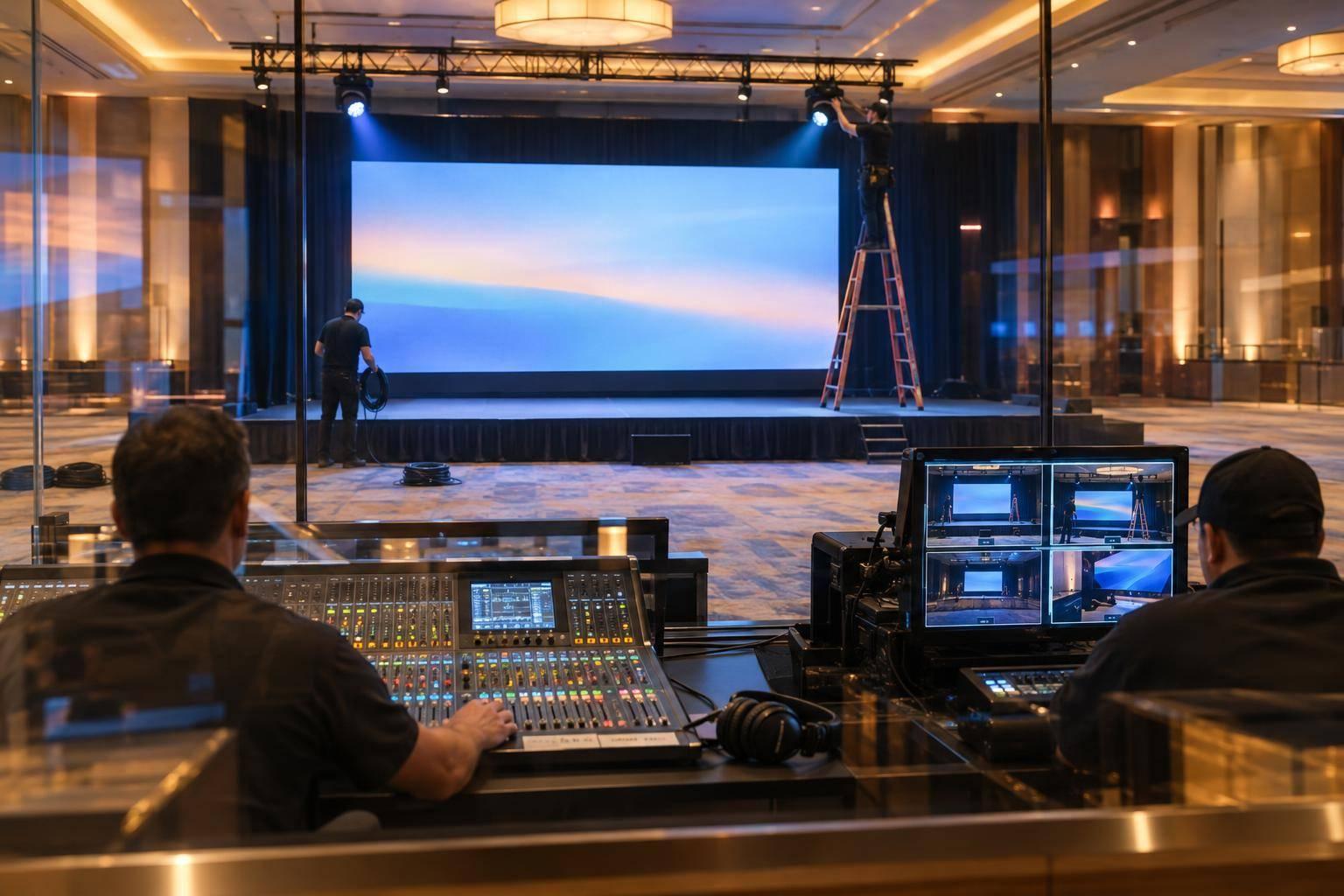
What To Look For In An AV Production Quote: A Guide For Corporate Meeting Planners

Chief Executive Officer

Before I approve an AV quote, I check 5 things: meeting requirements, equipment, staffing, extra charges, and contract terms. I compare each against a written meeting brief - not just the quoted total.
Here’s my checklist:
- Meeting requirements: Do the rooms, attendance, schedule, presenter needs, and hybrid sessions match the plan?
- Equipment: Are quantities, rental periods, accessibility needs, and backups spelled out?
- Staffing: Who covers setup, rehearsals, each session, and teardown - and when does overtime start?
- Services and costs: Are delivery, venue fees, travel, recordings, captions, taxes, and add-ons accounted for?
- Contract terms: Are payments, cancellations, rescheduling, substitutions, liability, and recording rights clear?
A lower price doesn’t always mean a lower final bill. For example, a $1,000 fee adds 10% to a $10,000 quote before taxes. I compare the same scope across vendors and <u>get missing details and approval rules in writing before signing</u>.

AV Quote Approval: 5 Checks Before Signing
How to Source an A/V Vendor for Your Next Event - Part #2: My Evaluation Process - Logan Clements
2. Check Equipment Against Your Meeting Brief
Check every line item against your brief and room layout. Ask for equipment details, not just bundle names. Each line should include the category, type or model where relevant, quantity, purpose, rental period, and whether setup, operation, and strike are included. Have the vendor list every included component by line item, and confirm who supplies stands, spares, operators, and replacement equipment.
Review Audio, Video, Lighting, and Staging
For audio, match the console’s input count to every source: presenters, Q&A, playback, and remote callers. Check microphone types, receivers, batteries, stands, monitors, and recording or streaming feeds. Confirm whether a technician runs the system. Ask how speaker placement will cover the room. Large or irregular spaces may need delay speakers in addition to the main system.
For video, request screen or LED-display dimensions, projector brightness, screen size or LED pixel pitch, switcher inputs and outputs, and presentation playback equipment. Include presenter confidence monitors or overflow screens where needed. Cameras for image magnification (IMAG) need suitable lenses and operators. Brightness alone doesn’t tell you whether attendees can see the screen - screen size and ambient light matter, too.
Lighting details should cover presenter front light, stage wash, scenic lighting, the lighting-control console, and cueing. Staging details should list risers, lecterns, drape, steps, accessibility provisions, mounts, and hardware.
Check Streaming Systems, Connections, and Backups
Look for separate line items for cameras, encoders, recorders, remote-speaker audio return, and the primary upload path. Check signal routing, adapters, cables, power distribution, rigging hardware, and safety equipment. Confirm whether the venue or vendor supplies power and approved rigging points.
Ask where replacement equipment will be kept and who will put it into service if a microphone, laptop, encoder, internet connection, or signal path fails. Request a test of the complete audio, video, and streaming paths before doors open.
Match Each Requirement to a Quote Line Item
For example, review this line item:
4 wireless handheld microphones, receivers, batteries, and frequency coordination; 1 show day
This covers four microphones, the listed accessories, and one day of service. It doesn’t confirm stands, spares, console inputs, an operator, or rehearsal coverage. Ask whether “show day” includes load-in and strike, who handles interference, and who replaces a failed microphone.
Mark each requirement as included, optional, excluded, client-provided, or venue-provided. Send a written clarification request for any blank cell. With the equipment list clarified, check the crew, rehearsal time, and labor hours needed to run it.
3. Verify Staffing, Hours, and Rehearsal Support
Assign Crew Coverage to Each Production Phase
Once the equipment list is clear, assign the crew to run it. An included operator is not a staffing plan. Ask for roles, head counts, work dates, call times, end times, and responsibilities for each production phase.
Confirm who will be on-site. Match crew coverage to the rehearsals, speaker changes, remote presenters, and simultaneous rooms in your meeting brief. The show caller runs cues; the production manager handles logistics, scheduling, vendors, and crew.
Name backups for breaks, meals, and overlapping sessions. If one technician has duties that overlap, ask for a written coverage plan that states which task comes first. Also confirm whether setup and teardown use the show crew or separate labor, whether breaks are billable, and whether crew members must stay on-site between sessions.
Check Labor Rates and Overtime Rules
For each role, require the billing unit, minimum call, shift length, regular rate, and overtime rate. Clarify what triggers overtime, along with late-night and holiday premiums, travel time, and any required venue or union labor.
Billable hours may differ from scheduled hours. Check how minimum calls, billing increments, and overtime affect each labor line. Ask the vendor to explain any differences.
Confirm Rehearsal Hours and Speaker Support
Match the rehearsal date, location, duration, and assigned crew to the speaker schedule. Confirm microphone and slide checks, playback, confidence monitors, remote-speaker connections, and cue timing. Make sure coverage accounts for late speakers, revised media, and multiple rooms.
Require the quote to spell out when longer rehearsals or schedule changes trigger added hours, overtime, or minimum calls. It should also name who can authorize a written scope change before added work begins.
Check which labor hours and support items are included - and which carry extra charges.
sbb-itb-ae35a94
4. Identify Included Services and Extra Charges
Once labor and rehearsal hours are clear, check what the quote covers - and what it leaves out. Build a responsibility matrix that labels each service included, excluded, or conditional and names the party responsible. Check each service against the meeting brief and venue rules. If a required service is missing, treat it as excluded until confirmed.
Check Logistics, Venue Charges, and Deliverables
Check delivery, freight, pickup, storage, setup, testing, programming, and teardown as separate line items. Confirm who supplies and pays for site visits, drawings, insurance certificates, venue coordination, rigging, lifts, power distribution, internet, and permits.
Read the venue contract alongside the AV quote. Venue-required labor, patch fees, and outside-vendor penalties may appear on a separate bill. Before approving the quote, get the venue’s production guidelines covering exclusive providers, patch fees, built-in equipment, rigging, and labor rules.
Confirm whether recording, editing, captions, transcripts, accessible formats, and file delivery are included. Specify the file format, resolution, editing scope, turnaround time, correction policy, and ownership or usage rights.
Also confirm who pays for travel, meals, parking, lodging, and per diems. Are these expenses billed at cost, covered by an allowance, or subject to markup? State whether receipts are required.
Keep required services separate from add-on charges.
Clarify Fees for Delays and Schedule Changes
For access delays, waiting time, added equipment, and same-day revisions, require clear charge triggers, rates, and billing increments. Keep these charges separate from administrative, coordination, technology, environmental, energy, credit-card, delivery, and similar fees.
For every fee, specify the dollar amount or percentage, what it’s calculated on, and whether sales tax, rental tax, or venue tax applies. Name one person authorized to approve add-ons. Require written approval before extra work starts, except in documented safety emergencies.
Use these agreed assumptions to compare itemized and bundled quotes on equal terms.
Compare Itemized and Bundled Quotes
Compare scope first, then price.
| Quote format | Pros and risks |
|---|---|
| Itemized | Shows quantities, unit prices, labor, taxes, and responsibilities clearly, but may still leave out required services. |
| Bundled | Makes budgeting simpler, but can hide missing services without a complete scope, equipment list, labor schedule, and exclusions list. |
Compare proposals against the same meeting requirements, schedule, staffing assumptions, rehearsal hours, deliverables, and venue assumptions.
5. Review Contract Terms Before Approval
Once scope and pricing are agreed on, put them in the contract. Review the quote and contract side by side. Attach the meeting brief and final scope, and specify which document takes priority if the proposal, statement of work, venue agreement, purchase order, or invoice conflicts.
Don’t sign while any items remain unresolved. Have your organization’s counsel review broad liability terms or large cancellation exposure. The contract should match the brief without leaving details open to assumptions.
Check Payment, Cancellation, and Rescheduling Terms
Check the quote date, expiration date, pricing in U.S. dollars, taxes, deposit refundability, payment milestones, balance due, and consequences of late payment. Require full dates for cancellation deadlines. Each deadline should list how charges are calculated, the refund amount, and when the refund will arrive.
Handle postponement separately. Confirm whether the deposit carries over to the new date, when credits expire, rescheduling fees, revised rates, and equipment and crew availability. Force majeure terms should spell out qualifying events, notice requirements, duties to limit losses, and how refunds or credits will be handled.
Set Rules for Substitutions, Changes, and Liability
Require same or higher equipment specs and written planner approval for substitutions, except in a genuine emergency. Confirm final quantities, deadlines for attendance changes, and any overtime those changes create.
Change orders should identify the requester and approver and list revised equipment, labor, taxes, and total cost. Assign responsibility for damage, loss, delays, insurance, and venue compliance to prevent unexpected costs. Don’t accept unlimited planner liability.
Also document who owns recordings, how they may be used, how long they’ll be kept, when they’ll be deleted, and their delivery dates.
Conclusion: Complete Your Quote Approval Checklist
Before signing, check scope, backups, deliverables, crew, rehearsals, overtime, venue responsibilities, approved cost changes, substitutions, and cancellation terms. Resolve remaining scope gaps in writing. Document any scope change and issue a revised quote before approval.
FAQs
How can I tell if my AV quote is overbuilt?
Check the quote line by line against your standardized meeting brief. Flag equipment you don’t need, excess staff or labor hours, and padded service fees. Each charge should match your needs, room constraints, and rehearsal and show schedule.
Bundles and vague descriptions can hide unnecessary items. Ask the vendor to explain unclear or unusually high charges and itemize equipment, labor roles, and service fees.
How much should I budget for unexpected AV costs?
Include a separate contingency line item in your budget. There’s no fixed percentage, but a common industry approach puts 70% toward fixed production costs, such as equipment and labor, and 30% toward design elements and possible adjustments.
Spell out how change orders and overtime will be handled in your agreement. Ask for an itemized proposal that separates audio, video, lighting, staging, labor, and facility fees. That way, you can spot gaps before they turn into extra costs.
Which AV contract terms should I negotiate first?
Require written approval for change orders that affect scope, price, or schedule. Negotiate separate cancellation and postponement policies that spell out notice periods, nonrefundable costs, and how deposits can be credited.
Build in options to adjust services as your event changes without penalty fees. Clarify labor terms upfront, including overtime rules, meal breaks, and setup and teardown windows, so you’re not caught off guard by extra costs.
Related Blog Posts
- Need A Quick AV Technical Production Quote For Next Corporate Conference? Reach Out To These 3 Companies.
- In Need Of An AV Partner For Stage Design & Production For An All-Associates Meeting? Reach Out To These Companies Today.
- Need A Quote For Conference Audiovisual Production? Why To Reach Out To Corporate Optics Today.
- Need An AV Quote For Your Conference? Reach Out To These Experienced Companies.



Streamline your workflow, achieve more

Lorem ipsum dolor sit amet, consectetur adipiscing elit. Maecenas ac velit pellentesque, feugiat justo sed, aliquet felis.



Lorem ipsum dolor sit amet, consectetur adipiscing elit. Maecenas ac velit pellentesque, feugiat justo sed, aliquet felis.