5 Reasons To Partner With Corporate Optics To Produce Your Next Conference.

Chief Executive Officer
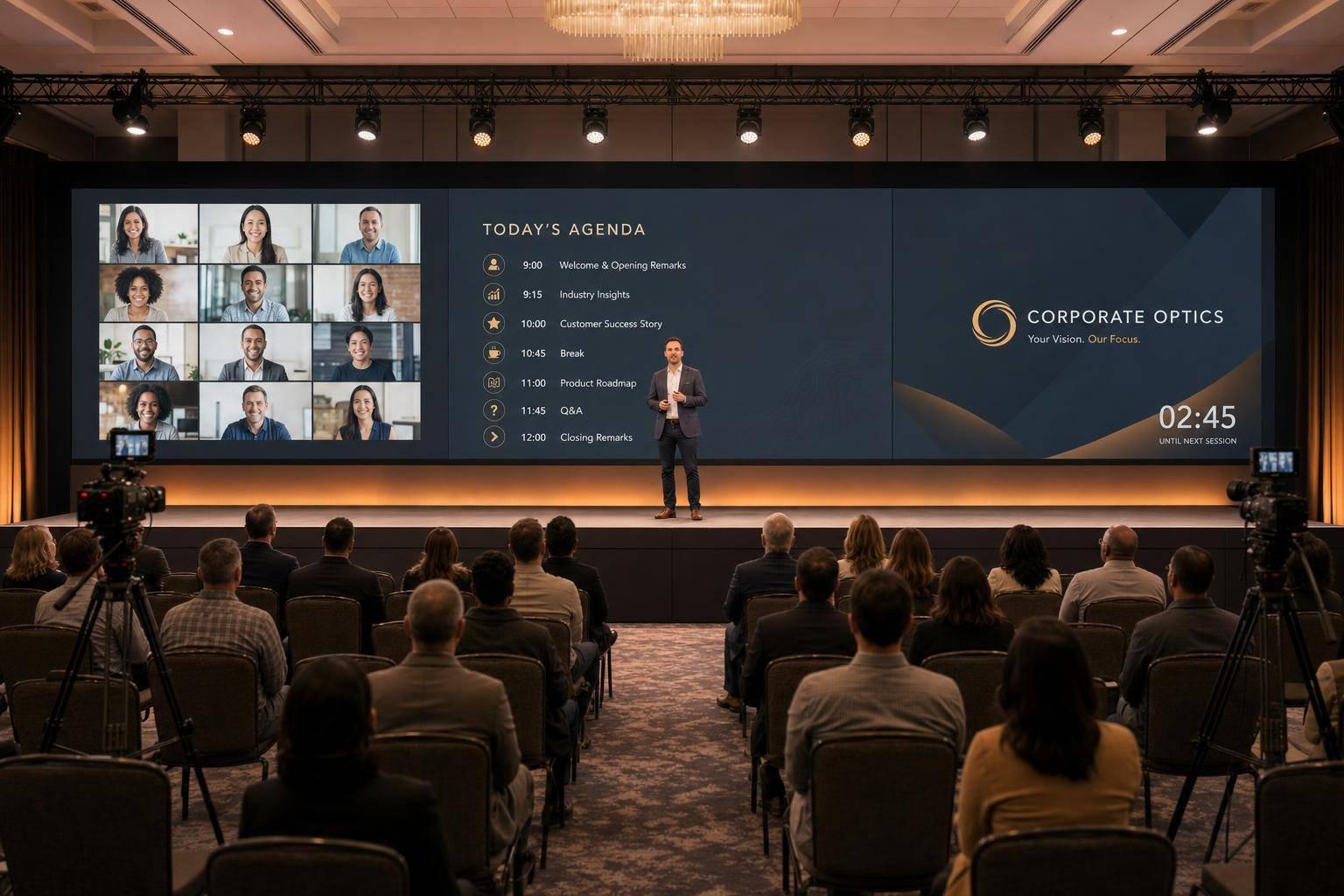
If your conference has live speakers, remote viewers, and tight timing, one point is clear: production mistakes cost you fast. This article comes down to five reasons teams work with Corporate Optics: strong AV and stage design, one team for planning and logistics, hybrid and livestream support, audience engagement data, and backup plans for show day.
Here’s the short version:
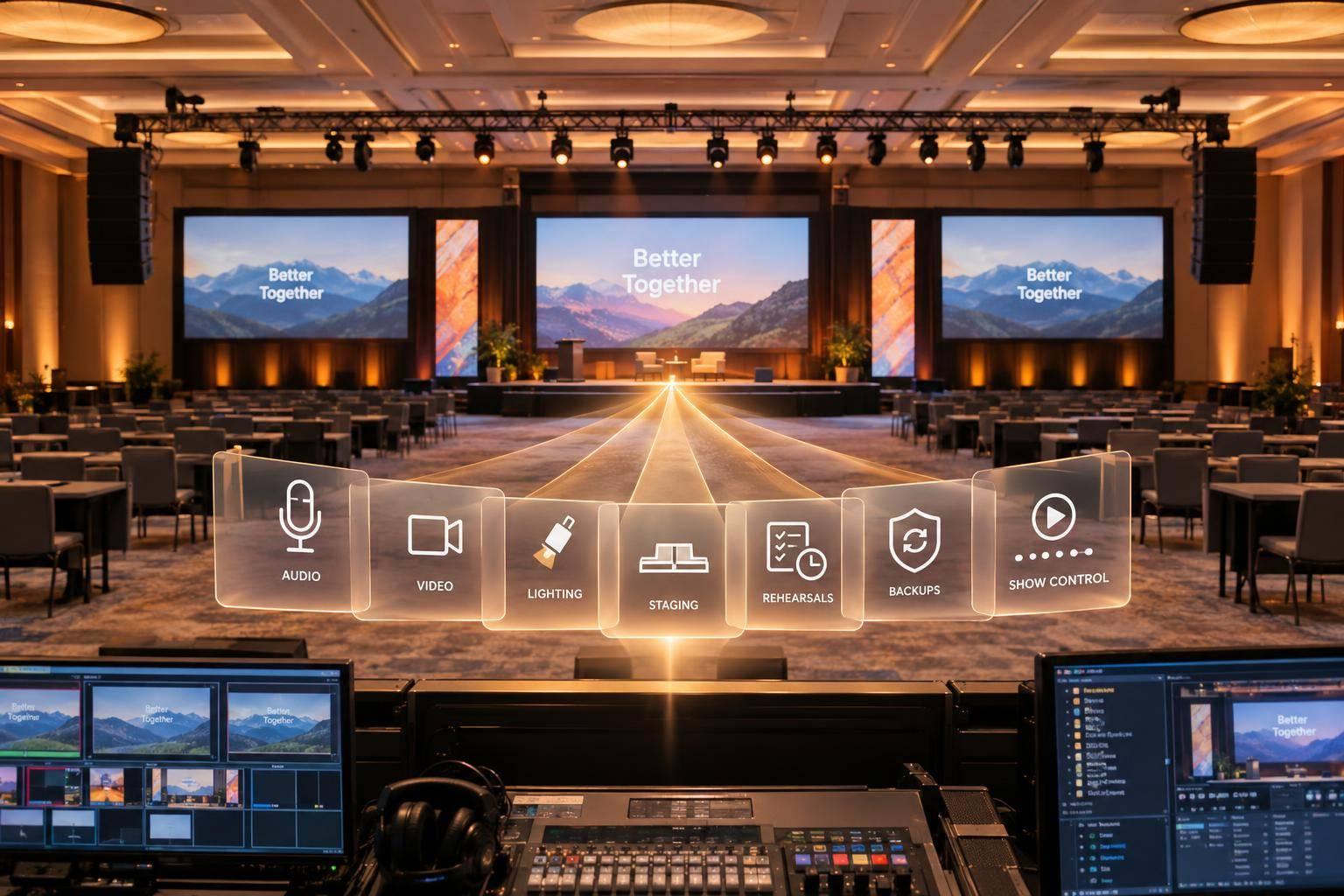
- AV and stage support: clear sound, sharp screens, lighting set for both the room and cameras
- Planning and logistics: one team handles run-of-show, vendors, breakouts, and room changes
- Hybrid delivery: multi-camera streaming, remote speaker support, and backup feed paths
- Engagement and reporting: live polls, Q&A, chat support, and session data
- Show-day backup plans: spare gear, failover steps, and on-site crew roles
A few numbers stand out:
- 81% of corporate event attendees rated main-stage audio as an event plus
- 82% of event planners report AV issues at events
That’s why I’d sum it up this way: if you want to follow best practices for conference event production to stay on time, look polished, and avoid avoidable tech problems, Corporate Optics offers the main support areas organizers usually need.
📡 Behind the Scenes: Pro AV Setup for 3-Day Corporate Conference #AxientDigital #YamahaDM7
sbb-itb-ae35a94
Quick Comparison
| Area | What you need | What Corporate Optics provides |
|---|---|---|
| AV | Clear audio, strong visuals, lighting for room and camera | Audio engineering, visual systems, stage lighting, cue control |
| Planning | Fewer vendors and less internal stress | One team for [hybrid meeting planning], logistics, rehearsals, and show flow |
| Hybrid | More than a basic webcam stream | [Multi-camera coverage], stream mix, remote speaker workflows |
| Engagement | Ways to measure session response | Polls, moderated Q&A, chat, and reporting |
| Risk control | Backup when gear or internet fails | Spare systems, tested failover steps, and on-site support |
If you’re comparing conference production options, this article gives you a plain-English view of where Corporate Optics fits and why organizers bring them in.
What Conference Organizers Need From A Production Partner
Conference formats change, but the main production needs don't. Organizers usually need five things from a production partner: dependable AV, centralized planning, hybrid support, audience engagement, and risk control. And all of that starts in one place: strong audiovisual and scenic design.
Reliable AV is the baseline. Conference content happens live, so there’s almost no room for mistakes during a keynote or executive announcement. If the audio cuts out, the slides look weak, or the lighting feels off, the speaker’s message takes a hit. Clean sound, sharp visuals, and well-planned stage lighting shape how people judge the speaker and the event itself.
For multi-day programs, organizers need one team to own show flow, venue coordination, and technical schedules. When too many vendors are involved, things slip through the cracks. Messages get missed. Small issues turn into last-minute problems. That’s why production depth matters early, not just on show day.
Hybrid conferences add another layer. A basic webcam feed won’t cut it. Organizers need broadcast-quality audio and video, with redundant streaming paths, multi-camera setups, and clean slide integration. Just as important, all of it needs to be run by people who’ve handled live pressure before.
Engagement and analytics matter more now, too. Organizers have to show stakeholders what the conference produced: which sessions kept attention, how audiences responded, and where the program can get better. A production partner that supports live polling, Q&A moderation, and session analytics gives organizers clear results they can act on.
First up: deep audiovisual and scenic design expertise.
1. Deep Audiovisual And Scenic Design Expertise
Corporate Optics uses AV and scenic design to make conference sessions look and sound polished from the first cue to the last. The team brings deep know-how across four core areas: stage and scenic design, audio engineering, visual systems, and live cue management. That work shapes the live experience before a single session even begins.
On the audio side, there’s very little room for error. AVIXA research found that 81% of corporate event attendees rated main-stage audio as an "enhancement," which puts it near the top of the list for how people judge a session. Corporate Optics handles that with room analysis, digital signal processing, and careful microphone selection - lapel mics for presenters, handheld mics for Q&A, and boundary mics for panel tables - so people across the room hear the same clean, steady sound.
Scenic and lighting design shift based on the kind of conference being produced and the message behind it. An executive summit may need a low stage, tight lighting, and restrained branding. A national sales meeting may need multi-screen content, bold graphics, and dynamic cues. Lighting is also set with cameras in mind, using controlled color and intensity for clean livestream and recording results. Once the room design is locked, rehearsals and cue timing help each session run cleanly.
Presenter support is part of the process, not an afterthought. Corporate Optics provides teleprompter services, slide deck management, and structured rehearsals before sessions go live. These run-throughs catch issues like missing fonts, wrong aspect ratios, or uneven audio levels on embedded videos before attendees arrive - not in the middle of a keynote. A dedicated show caller manages every cue in real time, so the organizer’s team doesn’t have to run technical timing from the back of the room.
Scenic design also turns brand guidelines into a custom stage environment through color, materials, and layout. For first-time conference planners, Corporate Optics takes a guided approach, walking teams through selecting the right venue, equipment choices, and technical requirements so nothing gets missed before load-in day. That same production discipline also makes planning and logistics easier to handle, which leads into the next reason organizers choose Corporate Optics.
2. End-To-End Conference Production And Logistics Support
Stage design is only part of the job. Corporate Optics also handles the planning and logistics that keep the whole event moving.
Instead of having your team juggle the venue, AV crew, and outside vendors, Corporate Optics puts conference planning, vendor management, and show flow under one production team. That means fewer handoffs, fewer crossed wires, and less back-and-forth for your staff.
Corporate Optics leads the production team from discovery through debrief. That includes pre-planning, design, on-site execution, and post-event review. By the time load-in starts, the run-of-show, room diagrams, gear lists, and staffing plans are already set. And that prep tends to show up on site in the form of smoother execution.
During the event, the team manages showcalling, stage management, speaker room prep, and live content control across every session space. They also handle breakout room standardization, with consistent audio, projection, and signage across all rooms. So whether someone is in the general session or sitting in a breakout, the experience feels aligned.
Corporate Optics can also take care of:
- Registration area AV
- Overflow room feeds
- Between-session room changes
On the budget side, costs are broken out by equipment, labor, scenic, streaming, and contingency. Corporate Optics also flags venue surcharges like rigging, power, or union overtime before they turn into unwelcome surprises. That same level of coordination helps support dependable hybrid and livestream delivery.
3. Hybrid Event And Livestream Capabilities
Hybrid conferences don’t stop at the venue. Corporate Optics approaches hybrid delivery as one show for two audiences from the start, with a single production plan built for both. That shifts hybrid from a last-minute tech layer into a planned part of conference production.
Camera placement, audio routing, and content formatting are set up for the room and the livestream at the same time. In most cases, the setup includes multi-camera coverage, a separate audio mix for the stream, and wired network support to help keep the feed steady. That means remote attendees get polished video and clear sound, while people in the room get smooth screen support and clean speaker handoffs - all managed by the same production team.
Remote speakers and panelists are handled with the same level of care. Corporate Optics takes on the details that often trip up event teams, including:
- Pre-event checks
- Presenter guidance
- Virtual green rooms for remote speakers
Remote presenters are brought into the same live switching and audio workflow as in-room speakers. So instead of feeling patched in from the outside, they feel like part of the same program.
Corporate Optics also works with streaming platforms based on audience size, security needs, and interaction requirements. Branding pieces like lower-thirds, intro slates, and holding slides are set in advance, so the livestream looks polished the second it starts. Redundant feeds, failover paths, live monitoring, and local recording help protect the live broadcast and any on-demand content.
That setup also makes polling, Q&A, and session tracking much easier to run.
4. Audience Engagement Tools And Event Analytics
Building on the hybrid and session-tracking setup above, Corporate Optics adds tools that keep both in-room and remote audiences involved. Live polling, moderated Q&A, and on-screen prompts are built into the run of show, so presenters know exactly when to use them and attendees know how to join in. A dedicated producer filters questions, groups similar topics, and sends the strongest ones to the stage.
On the analytics side, Corporate Optics uses session reporting tools to help organizers measure engagement and review results. Teams can track:
- session check-ins
- time in session
- poll participation rates
- Q&A volume
- chat activity
- on-demand views and downloads
Post-event archiving is also available for recorded sessions. That data shows which sessions held attention and which formats worked best, giving organizers a clear way to refine agendas and improve future planning.
The same visibility helps the production team catch issues early and make adjustments before they affect the show.
5. Contingency Planning And On-Site Execution Support
That same live-production discipline matters most when something breaks. Once doors open, issues happen. MeetingNet research found that 82% of event planners run into AV problems at their events, and audio/video sync issues are one of the most common trouble spots. Corporate Optics plans for that from the start instead of treating it like a surprise.
Before the event begins, the team runs a pre-event technical risk assessment to map likely failure points, including projectors, microphones, switchers, power circuits, and livestream connections. Then they assign a response protocol to each one. Backup systems are staged on site and kept ready to go, including frequency-coordinated spare microphones, a backup presentation computer, backup video and network paths, and a redundant encoder that can switch live from the control room in seconds.
"Our team utilizes professional streaming solutions with switching systems, broadcast platforms, and redundant signal feeds." - Corporate Optics
What matters here is practice. The crew drills backup moves before showtime, from laptop swaps to audio reroutes to streaming failover tests. On-site staff are also briefed on exact roles when something goes wrong:
- who troubleshoots the gear
- who communicates with the client
- who handles attendee messaging
Annotated show flows also include "Plan B" notes for key sessions. That can cover things like a remote speaker losing connection or a panel starting without a missing panelist.
If the internet drops or a presenter laptop dies, preloaded show machines and backup connectivity help keep the session on schedule. The goal is simple: keep disruptions offstage and keep the program moving.
Conference Production: DIY Approach vs. Partnering With Corporate Optics
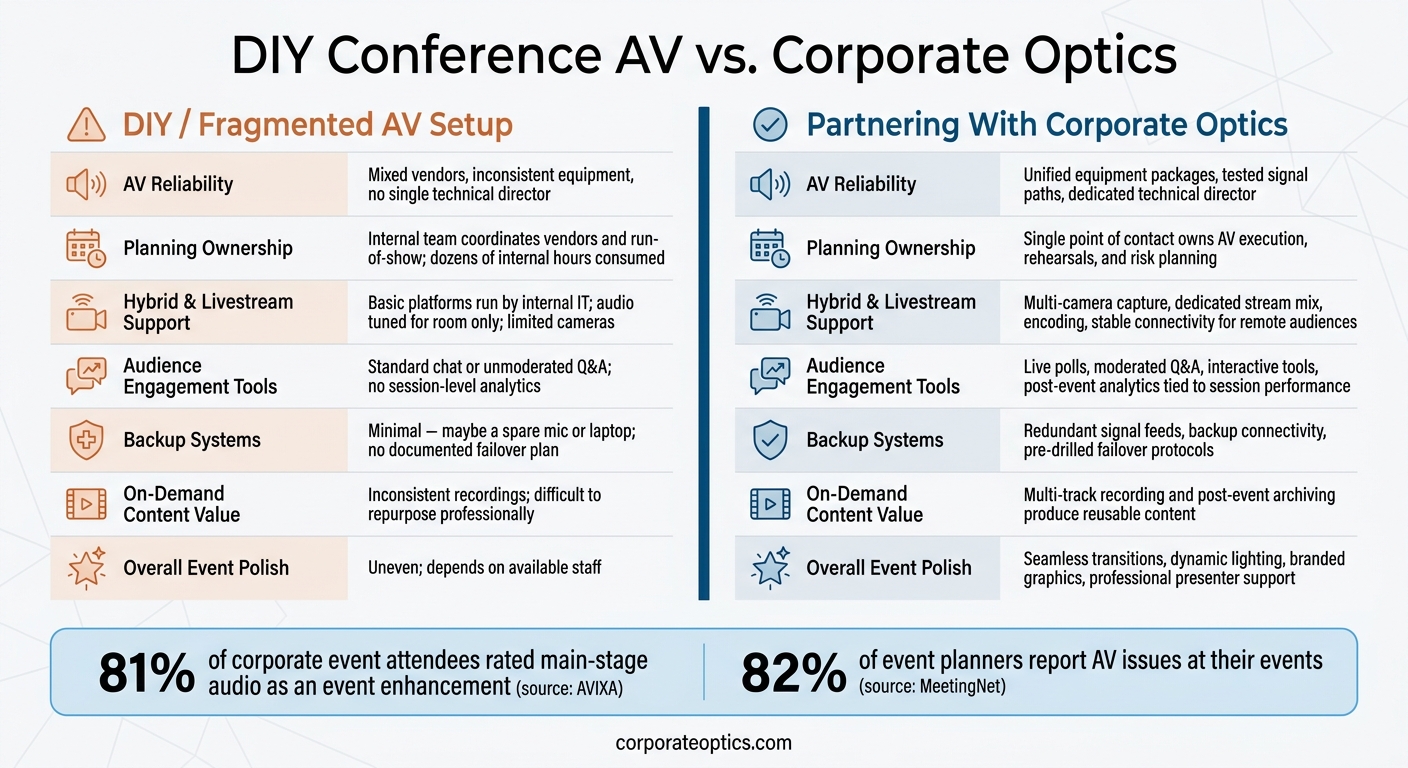
DIY Conference AV vs. Corporate Optics: Full Production Comparison
Handling AV in-house can look like the lower-cost option at first. But once you factor in staff time, vendor wrangling, and show-day pressure, the math changes for your conference ROI. And if a keynote mic cuts out or a livestream fails for remote viewers, your team is the one putting out the fire.
That’s the big gap between a pieced-together AV setup and working with one team that runs the whole show. When a single production partner owns planning, gear, rehearsals, and backup plans, things tend to run a lot smoother.
Here’s how that difference plays out in practice:
| Dimension | DIY / Fragmented AV Setup | Partnering With Corporate Optics |
|---|---|---|
| AV Reliability | Mixed vendors, inconsistent equipment, no single technical director overseeing audio/video routing or redundancy | Unified equipment packages, tested signal paths, and a dedicated technical director managing the full show |
| Planning Ownership | Internal team coordinates vendors, gear lists, and run-of-show documents; can consume dozens of internal hours | Single point of contact; Corporate Optics owns AV execution, rehearsals, and risk planning |
| Hybrid & Livestream Support | Basic platforms run by internal IT; audio tuned for the room, not the stream; limited multi-camera coverage | Multi-camera capture, dedicated stream mix, encoding, and stable connectivity built for remote audiences |
| Audience Engagement Tools | Standard chat or unmoderated Q&A; no session-level analytics | Live polls, moderated Q&A, interactive tools, and post-event analytics tied to session performance |
| Backup Systems | Minimal - maybe a spare mic or laptop; no documented failover plan | Redundant signal feeds, backup connectivity, and pre-drilled failover protocols |
| On-Demand Content Value | Inconsistent recordings; difficult to repurpose at professional quality | Multi-track recording and post-event archiving produce reusable content |
| Overall Event Polish | Uneven; depends on available staff | Seamless transitions, dynamic lighting, branded graphics, and professional presenter support |
The short version? A DIY setup often spreads responsibility across internal staff, outside vendors, and IT. That can work, but it also leaves more room for missed cues, uneven audio, patchy streaming, and last-minute stress. With Corporate Optics, one team handles the moving parts together, from signal flow to speaker support to the stream your remote audience sees.
Conclusion
Running a high-stakes conference means juggling speakers, schedules, AV, remote audiences, and stakeholder expectations at the same time. With that many moving parts, production quality shapes audience trust and brand perception. It also becomes part of your organization's reputation and event outcomes.
Corporate Optics brings those functions together under one team, which cuts down on complexity and helps conferences run better. Put simply, these capabilities make Corporate Optics a practical choice among full-service event production companies that need steady execution.
For U.S. organizations, that kind of support helps protect brand reputation and keeps the program on track.
If your conference is important enough to represent your organization, it's important enough to have a full-service production partner behind it. Corporate Optics supports your team with clearer communication, stronger engagement, and more dependable execution. When execution matters, Corporate Optics helps deliver a cleaner, more controlled result.
FAQs
How early should I bring in Corporate Optics?
Bring in Corporate Optics as early as you can, ideally right at the start of planning or while you're choosing the venue.
That early start gives the team time to handle site surveys, check the tech setup, and match your goals with the venue's logistics. And that matters. It helps you avoid expensive last-minute surprises that can throw the whole event off course.
As a general guide:
- 12+ months for large-scale events
- 4–6 months for large conferences
- 8–16 weeks for executive summits or custom environments
Can Corporate Optics support both in-person and remote speakers?
Yes. Corporate Optics supports both in-person and remote speakers. That includes speaker coordination, coaching, scriptwriting help, and technical rehearsals.
For hybrid events, the team uses virtual green rooms to test remote speakers’ audio, video, and timing before they go live. On-site, they provide teleprompters and confidence monitors. Technical teams also manage signal flow and backup systems to keep the experience smooth.
What happens if AV or internet fails during the conference?
Corporate Optics builds in backup layers so the event can keep moving without a hitch. For hybrid conferences, that usually means dual internet paths, failover routers, and a backup encoder running on a separate network path.
If the main stream drops, the backup steps in and keeps the broadcast live. And if things get messy, the team can switch to phone dial-in audio or roll pre-recorded content to stay on track.
Related Blog Posts


Streamline your workflow, achieve more

Lorem ipsum dolor sit amet, consectetur adipiscing elit. Maecenas ac velit pellentesque, feugiat justo sed, aliquet felis.



Lorem ipsum dolor sit amet, consectetur adipiscing elit. Maecenas ac velit pellentesque, feugiat justo sed, aliquet felis.