Why Corporate Optics Is A Great Event Production Company To Work With In Grand Rapids, Michigan.

Chief Executive Officer
If I’m planning a corporate event in Grand Rapids, I don’t just need gear. I need a team that can plan the show, run the tech, and fix problems fast.
Grand Rapids hosted 261 meetings and 175,914 attendees in 2023, so event teams here often work in high-visibility settings. From what this article shows, Corporate Optics stands out because it handles the parts that often go wrong: planning, AV setup, staging, lighting, hybrid streaming, speaker support, and live show control.
Here’s the short version of why that matters to me:
- One team handles production from start to finish
- Planning is tied to the venue, agenda, speakers, and budget
- Audio, screens, lighting, and stage layout are matched to the room
- Hybrid and livestream events get separate attention, not an afterthought
- On-site tech staff help keep the program moving when changes happen
What I like most is the simple idea behind it: fewer handoffs usually mean fewer mistakes. Instead of splitting work across rental vendors and internal staff, the article points to one group managing the full production flow so the client can stay focused on the audience and message.
That makes this a strong fit for meetings, conferences, awards shows, town halls, and hybrid programs in Grand Rapids.
The AV Playbook Part 5: The Corporate Event Production Timeline
sbb-itb-ae35a94
Coordinated Planning That Reduces Production Risk
When the agenda lives in one place, the venue in another, the budget in a spreadsheet, and speaker details in a separate thread, production risk climbs fast. One person may be locking in the speaker lineup, working with the venue, tracking spend, and fielding executive questions about the run-of-show - all before the first technical walkthrough even happens.
Now add separate vendors and internal teams with no shared workflow. That’s when cracks start to show. And those cracks usually don’t wait politely. They show up on event day. A structured production workflow helps close those gaps early.
Managing Agendas, Venues, Vendors, and Budgets in One Workflow
Corporate Optics uses a four-step planning process to line up goals, venue needs, technical requirements, and budget before production starts. The first two steps are often where coordination issues get stopped before they grow.
At the start, the team focuses on the event’s main goals before booking a venue or drafting a technical plan. Then they work through venue logistics, speaker needs, technical requirements, and budget alignment together. That way, production choices are tied to what the program actually needs, not guesswork or last-minute fixes.
This is especially important for Grand Rapids events held across different venue types. One room may have sightline issues. Another may create power, acoustics, or load-in problems. Keeping venue, vendor, and logistics coordination inside one workflow means clients don’t have to sort out those moving parts on their own.
Production Itineraries and Contingency Planning
This is where the plan turns into something the team can run. Corporate Optics builds a detailed event schedule that puts access, delivery, setup, rehearsals, speaker transitions, breaks, and livestream windows on one timeline. Each item has an owner and a next step. That keeps responsibilities clear and helps stop the classic problem where two teams assume the other one has it covered.
Contingency planning is part of this phase from the start, not something tacked on later. The team identifies likely disruptions ahead of time - like a delayed presenter, missing slides, or weak internet - and assigns a backup resource and decision owner to each one before the event begins. On-site teams can then adjust as needed, so the program keeps moving if conditions shift. Each backup option is assigned before the event starts.
Once the plan is locked, the next step is matching audio, video, lighting, and staging to the room and the program.
Audiovisual, Staging, and Lighting That Support Clear Communication
Once the plan is locked in, the AV, staging, and lighting need to carry that plan in the room without friction. If people can't hear the speaker, read the slides, or see the stage, even a strong agenda loses impact. That's the difference between a plan that looks good on paper and an event that feels clear in the room.
Audiovisual Systems Matched to the Room and Program
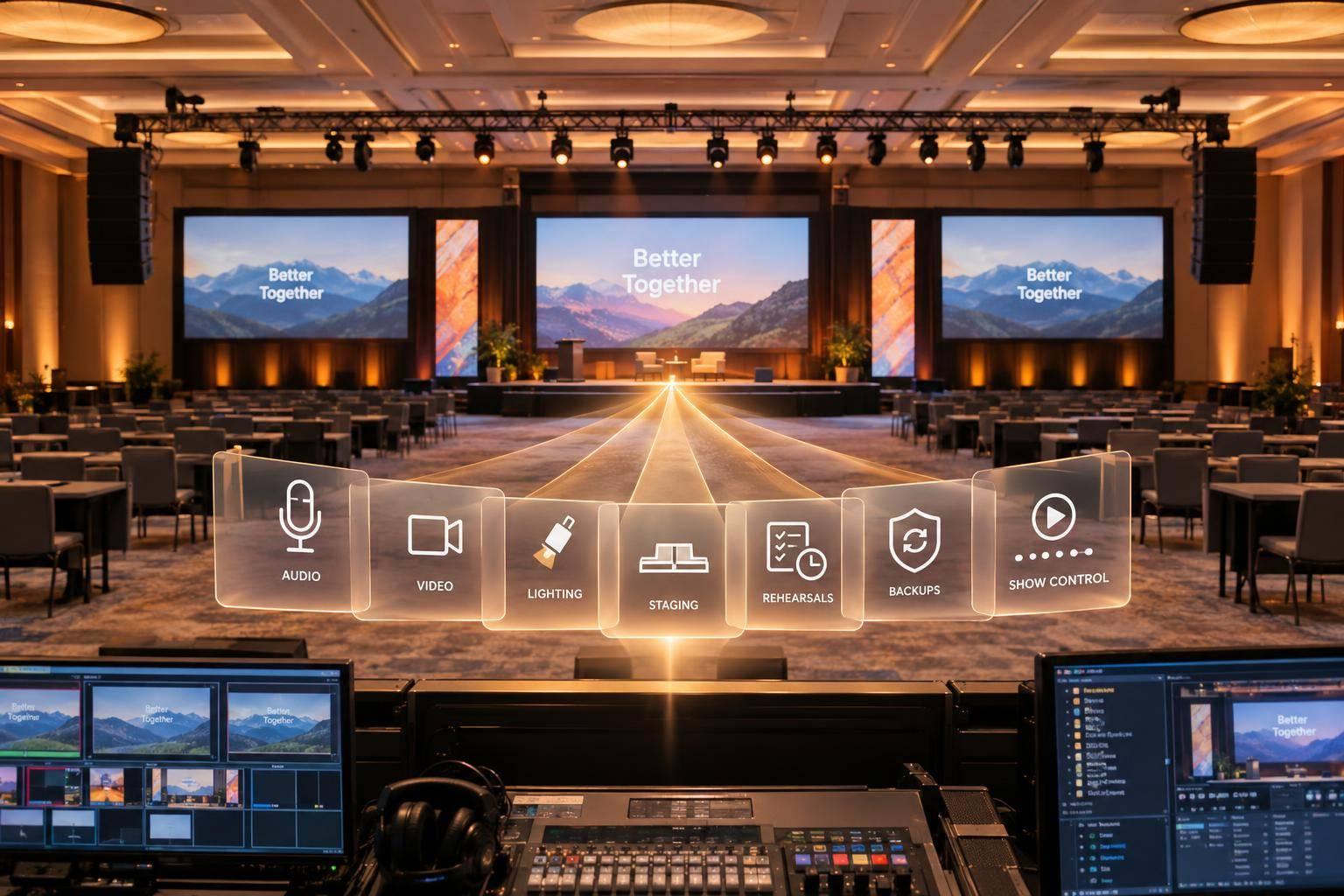
Corporate Optics matches each AV system to the event's purpose, audience size, room layout, and presentation format instead of dropping the same package into every space. Things like ceiling height, ambient light, seating orientation, and rear-row sightlines shape what equipment makes sense. A general session may call for distributed audio and large-format displays. A breakout room may need a smaller presentation system. A panel may need individual microphones and camera coverage. An awards program may depend on synced playback and lighting cues.
Stage Design and Lighting That Improve Visibility and Focus
Staging and lighting help steer attention, keep speakers easy to see, and improve camera visibility for remote viewers.
Corporate Optics coordinates scenic design and lighting with the rest of the production. Front lighting keeps faces readable for the in-room audience and livestream cameras. Controlled stage washes help create more even exposure. Accent lighting can support branded scenic elements without fighting the presentation content. Cue-based changes for keynotes, panel transitions, or award reveals make program shifts easy to follow.
Lighting also has to work in step with projection and LED content. A stage can be bright enough for cameras and still wash out a screen if the system isn't calibrated together. An integrated setup keeps the visual experience steady from the front row to the back of the room and on the remote feed. That same consistency also helps livestreaming and live show control run more smoothly.
Hybrid Delivery and On-Site Support for Reliable Execution
Common Event Challenges vs. Corporate Optics Solutions
Livestreaming and Hybrid Production for Connected Audiences
Covering the room is only half the job. The stream needs to meet that same bar.
hybrid meeting planning ensures events work for the people in the room and the people watching elsewhere. That means video, audio, and streaming can't operate like separate parts. They need to function as one system.
Corporate Optics supports livestreaming and hybrid events with encoding, platform integration, recording, stable internet, and a dedicated streaming operator who watches the outbound signal separately from the in-room video director. If even one part slips, the stream can suffer. That's why the setup works best when remote viewing is part of the plan from day one.
Remote participation tends to work better when it's built into the agenda early, not added at the last minute. Q&A, polls, chat, and captions help keep online viewers involved across the full session. For Grand Rapids organizations running a town hall, leadership conference, or annual meeting for employees or partners who can't be there in person, that kind of planning helps the whole event feel connected instead of split in two.
On-Site Technicians, Speaker Support, and Show Calling
Corporate Optics keeps technical staff on-site during rehearsals and live sessions to handle setup, operation, and troubleshooting. Speaker support starts before the program begins: file checks, microphone fitting, confidence monitor checks, and walk-throughs for entrances and exits. During the event, a show caller cues presenters, video playback, slide changes, lighting states, and camera shots based on the production itinerary. If the plan shifts, the team adjusts without dragging the client into a technical call in the middle of the show.
That on-site control helps keep timing, cues, and speaker transitions from throwing the program off course. As one client said, the team stays calm, prepared, and supportive under pressure.
This kind of support matters even more when the program includes executives, panel discussions, prerecorded video segments, or remote guests. In those moments, timing and sequence aren't small details. A missed cue is obvious to everyone in the room and everyone watching the stream.
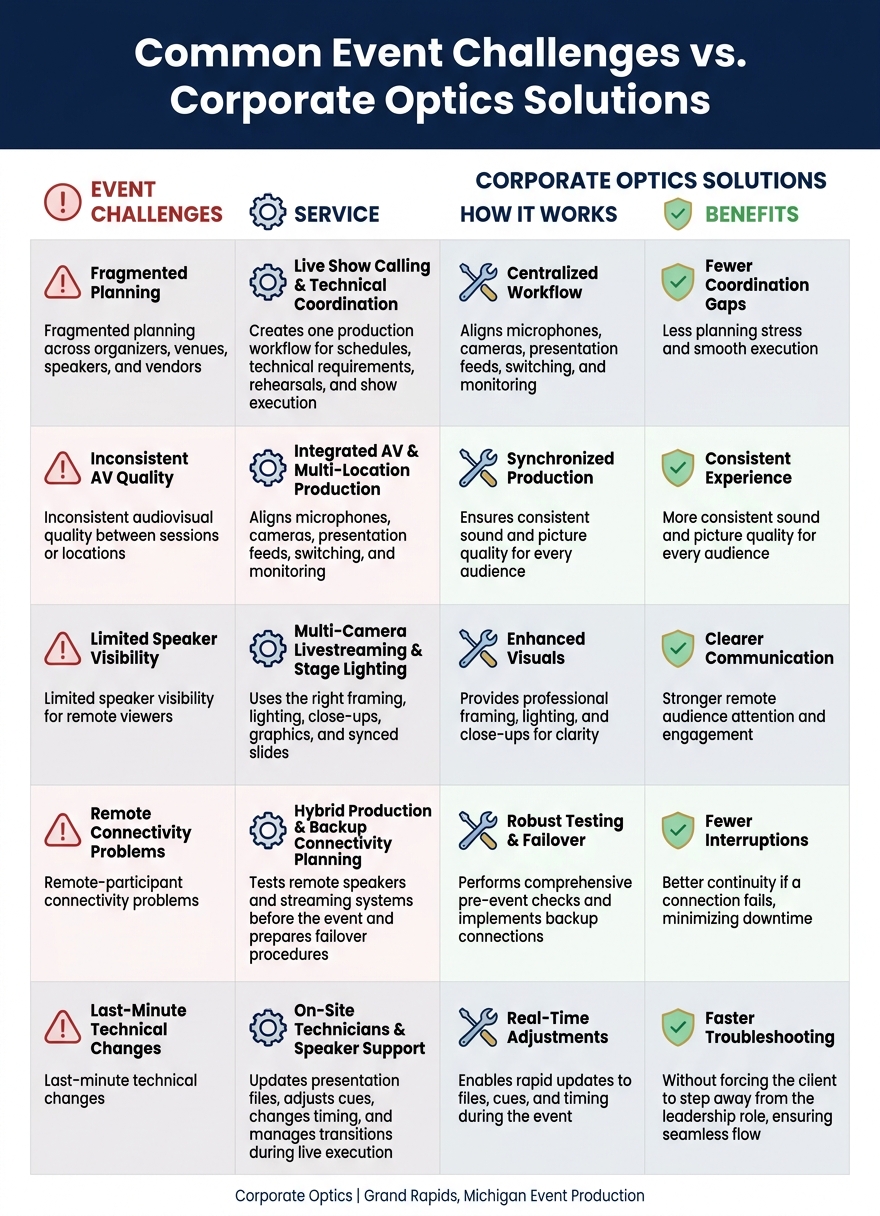
Problem-Solution Table: Common Event Challenges and Corporate Optics Services
| Event-planning problem | Corporate Optics service | How the service addresses the problem | Practical client benefit |
|---|---|---|---|
| Fragmented planning across organizers, venues, speakers, and vendors | Live show calling and technical coordination | Creates one production workflow for schedules, technical requirements, rehearsals, and show execution | Fewer coordination gaps and less planning stress |
| Inconsistent audiovisual quality between sessions or locations | Integrated audiovisual, broadcast, and multi-location production | Aligns microphones, cameras, presentation feeds, switching, and monitoring | More consistent sound and picture quality for every audience |
| Limited speaker visibility for remote viewers | Multi-camera livestreaming, stage lighting, and presentation integration | Uses the right framing, lighting, close-ups, graphics, and synced slides | Clearer communication and stronger remote audience attention |
| Remote-participant connectivity problems | Hybrid production, platform integration, technical checks, and backup connectivity planning | Tests remote speakers and streaming systems before the event and prepares failover procedures | Fewer interruptions and better continuity if a connection fails |
| Last-minute technical changes | On-site technicians, speaker support, and show calling | Updates presentation files, adjusts cues, changes timing, and manages transitions during live execution | Faster troubleshooting without forcing the client to step away from the leadership role |
Conclusion: Why Corporate Optics Is a Strong Fit in Grand Rapids
After the coordination gaps, AV issues, and hybrid risks covered above, the main upside is simple: one team owns production. In Grand Rapids, a corporate event often means juggling venue logistics, speakers, audiovisual setup, hybrid streaming, and live execution all at once. Corporate Optics is built to handle that moving puzzle from early planning through post-event follow-up.
That matters for a simple reason. When one team runs the workflow, there are fewer handoff problems, clearer ownership, and more confidence before show day.
Key Takeaways for Decision-Makers
The biggest gains are practical. Unified planning lowers the load on internal teams. Using a corporate event checklist can further streamline this process. Professional AV, staging, and lighting help keep the message clear for people in the room and for viewers on the stream. Hybrid production support helps remote audiences stay connected. And on-site technical staff help keep the event moving when plans shift.
Corporate Optics supports the full event lifecycle - from pre-production planning and stage design to venue management, live technical support, and post-event analytics. For Grand Rapids organizations planning a corporate meeting, conference, live event, or hybrid program, that kind of coverage helps keep the program on track while letting the team stay focused on the message.
FAQs
What kinds of events can Corporate Optics support in Grand Rapids?
Corporate Optics supports a wide range of event types in Grand Rapids. That includes corporate annual meetings, leadership conferences, shareholder and board meetings, executive town halls, award ceremonies, sales meetings, training sessions, and social or pop-up events.
They also work across in-person, hybrid, and virtual event formats. Support can include multi-camera live streaming, audience engagement tools, and secure audiovisual setups for executive events.
How early should I involve Corporate Optics in event planning?
Bring in Corporate Optics as early as you can. For smaller meetings, give yourself 6–10 weeks. For large conferences, plan 3–6 months ahead. And for major events, you may need 12 months or more.
Getting us involved during venue selection can save a lot of trouble later. It gives you time to sort out power, rigging, and ceiling-height limits before they turn into problems. It also helps lock in equipment, finish site surveys, and put backup plans in place so the event runs more smoothly.
What happens if something changes on event day?
If something shifts on event day, Corporate Optics handles it through one internal workflow. That means you’re not stuck coordinating with a bunch of separate vendors while the clock is ticking.
Your technical director and show caller confirm what can be done, then share updated cue sheets with the audio, lighting, and video teams in real time.
That setup helps the crew adjust transitions and speaker needs without missing a beat. The program stays on track, with fewer awkward pauses and fewer dropped handoffs. Backup systems and contingency plans are also in place, so if something unexpected happens, the team can respond fast.
Related Blog Posts



Streamline your workflow, achieve more

Lorem ipsum dolor sit amet, consectetur adipiscing elit. Maecenas ac velit pellentesque, feugiat justo sed, aliquet felis.



Lorem ipsum dolor sit amet, consectetur adipiscing elit. Maecenas ac velit pellentesque, feugiat justo sed, aliquet felis.