How Speaker Rehearsals Improve Executive Presentations At Corporate Conferences

Chief Executive Officer

I use rehearsals to catch unclear messages, rushed delivery, and AV problems before an executive takes the stage. For a 20-minute slot, I plan an 18-minute talk - a 10% time buffer for audience reactions and transitions.
My rehearsal plan covers four checks:
- Content: Set one takeaway and one audience action, then time the talk.
- Delivery: Review recordings to refine pauses, eye contact, and movement.
- Technical setup: Test microphones, monitors, slides, and cues with the event team.
- Full-show practice: Run from entrance to exit, including delays, time cuts, and microphone changes.
The goal isn’t word-for-word memorization. I focus on <u>clear delivery, shared cue ownership, and a tested recovery plan</u> - then assign and retest each correction.

Executive Presentation Rehearsal Workflow
How to rehearse for delivering an amazing presentation
sbb-itb-ae35a94
Step 1: Clarify the Message and Set the Timing
Before rehearsing, write one primary takeaway and one action. Support them with up to three points, each backed by evidence. Cut anything that doesn’t advance the message, address an objection, or help the audience act. This gives you fewer explanations to rush through and makes the takeaway easier to remember. A focused message also makes weak sections easier to spot - and timing easier to control.
Practice the Message Without Slides
Use your outline to practice transitions and the closing action aloud. Make sure the opening establishes the business issue, transitions connect your points, and the closing gives a specific next step. Ask a colleague to repeat the takeaway and intended action so you can spot gaps.
Remove repeated claims, simplify dense explanations, and move secondary details to backup slides to reduce confusion during the presentation. Check figures, dates, terminology, and pronunciation. In your speaker notes, place pause markers, slide changes, and video cues just before the actions they trigger.
Once the message works without slides, time each section and trim anything that runs long.
Time Each Section and Allow a Buffer
Rehearse in content, delivery, and timing passes. First, check logic and accuracy. Then refine wording and transitions. Finally, run the full talk with a stopwatch. Record planned and actual times for the opening, main sections, audience interaction, and closing.
For a 20-minute slot, target an 18-minute presentation, leaving two minutes for audience reactions and slower transitions.
Confirm whether questions must fit within that time. Address the biggest overruns by cutting repeated explanations, shortening setup language, or moving supporting details to backup slides. Protect time for audience interaction and the closing action. Then rehearse again - don’t speak faster or rush the close.
With the message and timing set, move to stage presence in Step 2.
Step 2: Refine Stage Presence With Feedback
Once the message and timing are set, rehearse how the presentation looks and sounds onstage.
Wear the planned footwear, use the actual clicker, and follow the marked stage path. Decide where the executive starts, moves, and stops so each movement supports the delivery. This rehearsal helps catch rushed phrasing, stiff movement, and awkward slide timing before the live event.
Practice Eye Contact, Movement, and Vocal Emphasis
Move on transitions, stop on key points, and keep gestures tied to the message. Maintain a balanced stance rather than pacing or repeating the same motions.
Toastmasters recommends purposeful movement rather than pacing while speaking.
Ask an observer to watch for rocking, repeated hand movements, or facial tension that pulls attention away from the point.
Make eye contact with listeners in the left, center, right, and back rows. Hold your gaze with one person for a complete thought, then shift during a pause. Keep monitor glances brief, and look back at the audience before continuing.
Vary your pace, pitch, and emphasis around key words. Project your voice clearly without forcing the volume. Record the rehearsal to spot habits you might miss while speaking.
Review Recordings for Clarity and Body Language
Review the recording in three passes. First, listen to the audio for rushed phrases, fillers, and unclear explanations. Next, watch the muted video for posture and distracting gestures. Finally, use full playback to check whether eye contact, vocal emphasis, and slide changes land at the right moments. Aim for a delivery that looks and sounds controlled, clear, and confident from the audience’s seat.
For most presentations, 100–165 words per minute is a useful speaking range, not a fixed target. Dense charts or complex recommendations may need slower delivery.
Focus the next run on two or three fixes. Ask the observer to identify the exact passage, the distracting behavior, and what to do instead.
For example, stop pacing during the recommendation, plant your feet, and pause for two seconds.
Repeat that section right away, then test the changes in the full talk. Keep the executive’s own wording while making movement and emphasis more deliberate.
Step 3: Check AV Cues and Rehearse the Full Show
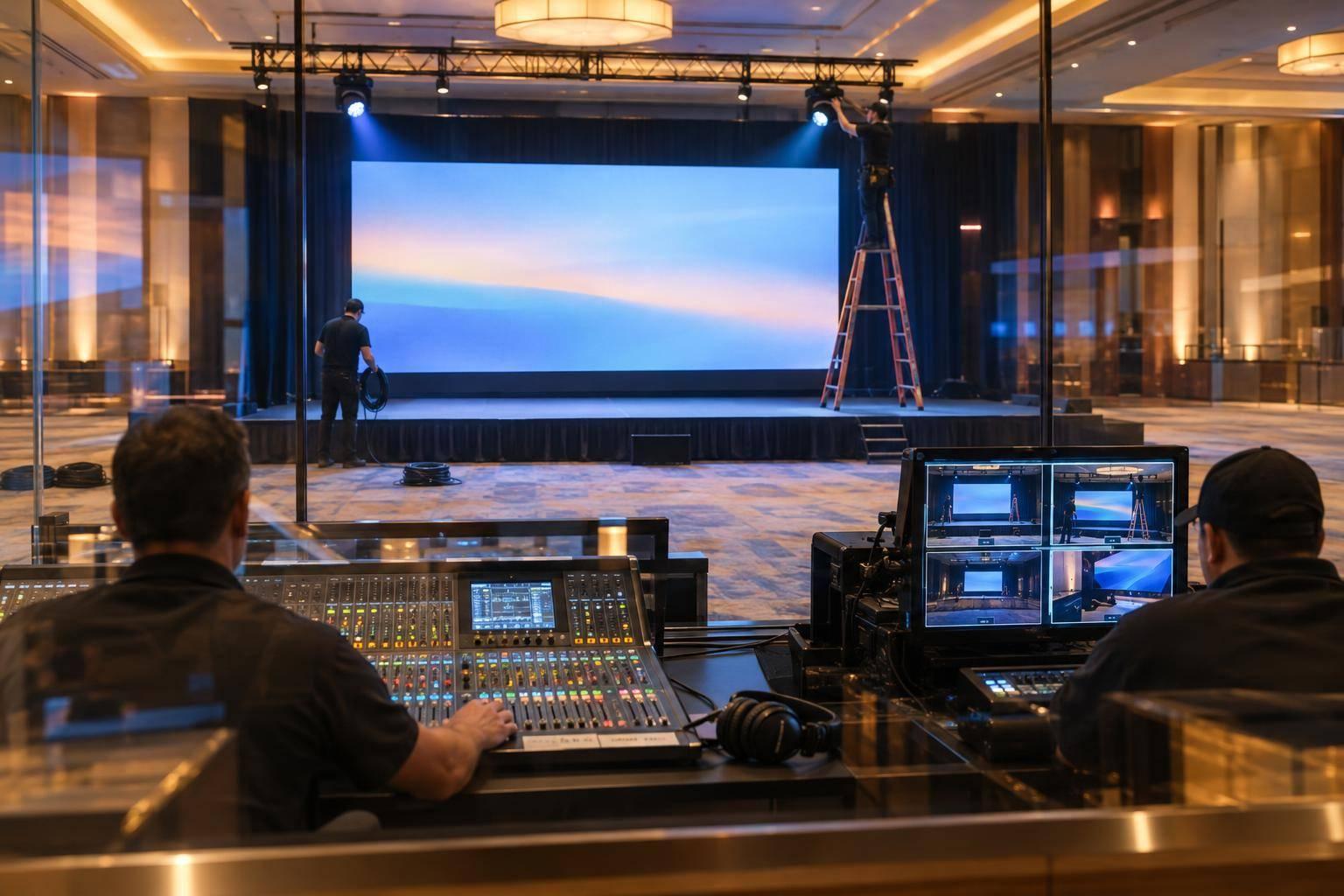
Once the message and delivery are rehearsed, run the full production to check timing, clarity, stage presence, and AV coordination. Bring the executive, producer, stage manager, presentation operator, and AV team together around one cue sheet. It should list triggers, owners, actions, backups, and sign-off status.
Make each role clear: the executive owns delivery, the producer owns timing, and the presentation operator handles assigned slide advances. The AV team handles technical execution, while the stage manager directs entrances, exits, and live changes.
Test Microphones, Monitors, and Slide Cues
Test the microphone while the speaker talks, turns their head, gestures, and moves between stage marks. Check microphone placement, clothing noise, dropouts, levels, and battery status. At every stage mark, confirm that the confidence monitor is readable, the timer is visible, and the correct slide view appears.
Test the clicker, slide transitions, video, lighting cues, and signal paths to screens, recordings, and streams. Decide who advances the slides, then rehearse entrances, video cues, handoffs, and exits.
Before doors open, agree on a recovery procedure: pause, stay composed, follow the stage manager’s direction, and resume from the last confirmed slide or script point. The speaker should not troubleshoot equipment onstage.
Simulate Live Conditions and Assign Corrections
Match the show’s stage, marks, seating, lighting, audio, screens, aspect ratio, and confidence monitor. Then run the final file from entrance to exit.
Practice three disruptions: a delayed video, a shortened slot, and a microphone replacement. Rehearse when to retry or skip playback, which optional material to cut, and how to resume once the replacement microphone works.
Assign every correction to one owner and require a retest. The executive verifies message and delivery changes; the producer verifies timing; the presentation operator checks the corrected deck; the AV lead checks equipment; and the stage manager checks revised cues.
Before doors open, record sign-off for the presentation version, microphone, clicker, confidence monitor, timer, playback, lighting, communication channel, and recovery plan.
Compare the 4 Rehearsal Types
| Rehearsal type | Objective | Speaker practice | Event-team checks | Problems prevented |
|---|---|---|---|---|
| Content rehearsal | Confirm message, wording, and timing | Practice without slides; separate required content from optional material. | Review agenda fit and content order | Overruns, unclear messages, missing transitions |
| Delivery rehearsal | Refine delivery and stage presence | Practice pace, emphasis, eye contact, movement, and body language. | Review clarity and audience-facing behavior | Rushed delivery, weak emphasis, distracting gestures |
| Technical rehearsal | Verify cues and equipment | Practice with the mic, clicker, monitor, timer, and stage marks. | Test AV, slide cues, signal paths, communications, and cue ownership | Missed cues, feedback, playback errors, unreadable monitors |
| Full-show simulation | Verify the complete show sequence | Deliver the full presentation under realistic timing and stage conditions. | Run final files, transitions, and contingencies with the show team | Timing drift, awkward handoffs, technical gaps, recovery confusion |
Conclusion: Follow a Repeatable Rehearsal Plan
Use the same sequence every time: message, timing, delivery, AV, full run, retest. After the full run, rehearse only the sections that changed.
Give each run one clear goal. For new speakers or unfamiliar rooms, schedule solo time before the group rehearsal so speakers can learn the stage layout, marks, and AV setup.
Coordinate speaker prep, AV production, lighting, on-site staffing, and stage management as one show, rather than separate speaker and AV workflows.
FAQs
How many rehearsals should an executive schedule?
Schedule a technical walkthrough 2–3 days before the event and a full dress rehearsal 1 day before. For complex presentations or strict timing requirements, also include a full run-through.
Short on time? Prioritize a technical rehearsal 48–72 hours before the event. Then practice high-risk moments, such as transitions and handoffs, 30–60 minutes before doors open.
How can I rehearse when stage access is limited?
When stage access is limited or executives can’t attend full rehearsals, production teams can provide focused coaching, polish scripts, and set up teleprompters.
Test audio, video, and file compatibility 48–72 hours before the event. Then run a short rehearsal of transitions and handoffs 30–60 minutes before it starts. On show day, the production team handles technical cues and stage movements, leaving the executive free to focus on delivery.
How can I avoid sounding over-rehearsed?
Rehearse to feel comfortable, not to memorize every word. Work with the production team to set the teleprompter’s scroll speed and font size to suit your speaking style and keep your delivery conversational. Practice deliberate gestures and eye contact, too. Knowing the technical setup and presentation flow helps you focus on your message, speak with confidence, and sound like yourself.
Related Blog Posts



Streamline your workflow, achieve more

Lorem ipsum dolor sit amet, consectetur adipiscing elit. Maecenas ac velit pellentesque, feugiat justo sed, aliquet felis.



Lorem ipsum dolor sit amet, consectetur adipiscing elit. Maecenas ac velit pellentesque, feugiat justo sed, aliquet felis.