Top Meeting Planners In Event Production That Travel To You.

Chief Executive Officer
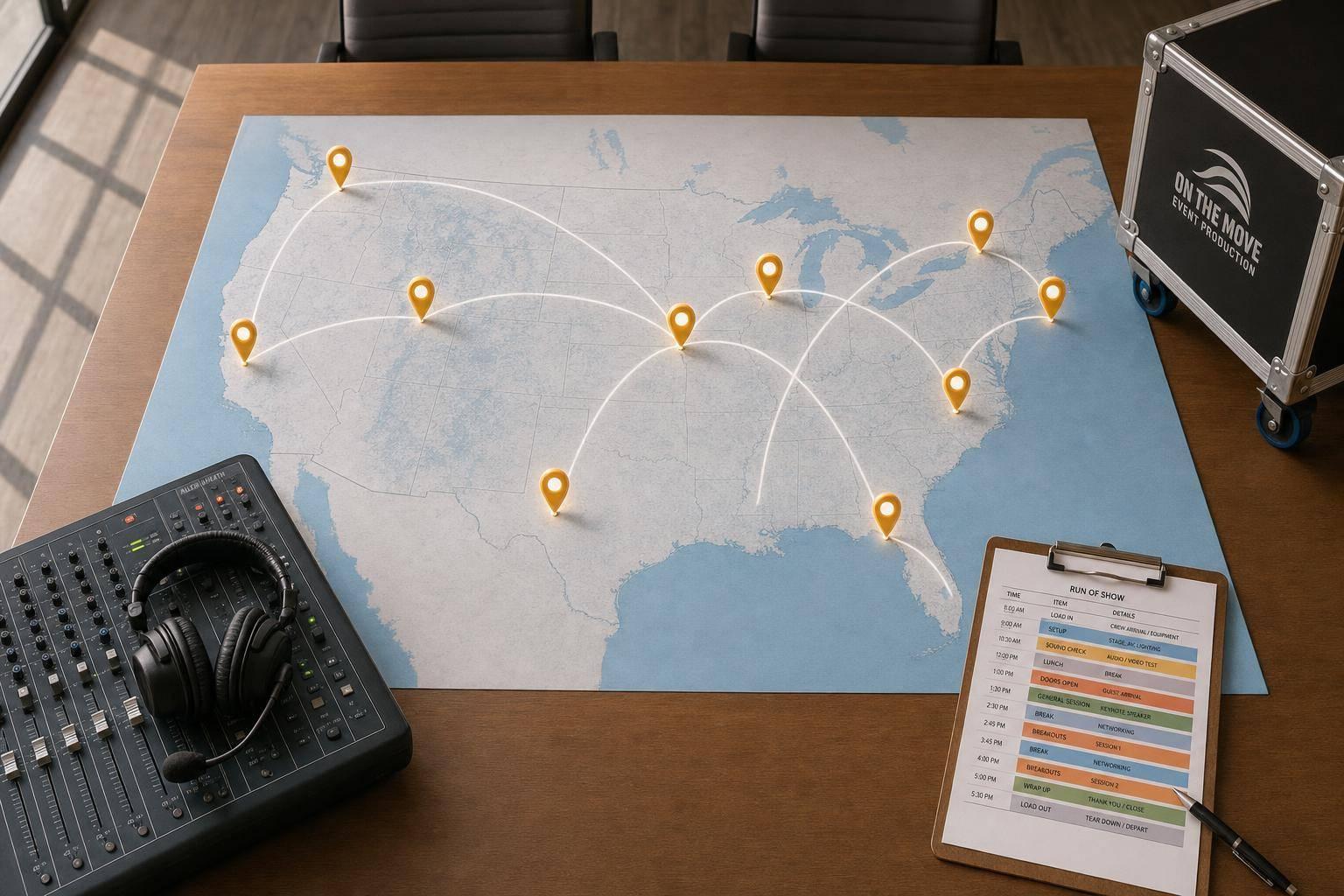
If you run events in more than one city, the main goal is simple: make each stop feel the same. This article reviews 10 U.S. event partners that travel to your venue and handle show flow, AV, speakers, vendors, and hybrid meeting planning needs on-site.
Here’s the short version:
- A traveling planner helps keep staging, timing, and speaker support consistent from city to city
- They often manage run-of-show, rehearsals, cue calling, vendor coordination, and livestream setup
- This article covers 10 providers: Corporate Optics, Encore, Freeman, BCD Meetings & Events, PRA, MCI USA, Maritz, HELMSBriscoe, Bishop-McCann, and Meeting Tomorrow
- It also explains when to hire one, what deliverables to expect, and how they reduce quality drift across locations
- Scale varies a lot: for example, Encore works across about 2,200 venues, BCD has 2,000+ staff in 60+ countries, and PRA has 32 U.S. offices
If I were choosing, I’d sort providers by three things first:
- Event type: roadshow, leadership meeting, trade show, incentive trip, or hybrid town hall
- On-site scope: just AV support, or full show control
- Multi-city needs: one-stop travel support versus venue-by-venue help
Quick Comparison
| Provider | Best fit for | Main focus |
|---|---|---|
| Corporate Optics | Traveling corporate productions | AV, scenic, stage execution |
| Encore | Hotel-based meetings | Venue-linked AV and hybrid support |
| Freeman | Large expos and conventions | Exhibits, logistics, show-site production |
| BCD Meetings & Events | Global company meetings | Meeting delivery, logistics, production |
| PRA | Destination programs | Local logistics, room readiness, hybrid support |
| MCI USA | Travel-heavy conferences | Attendee travel and on-site movement |
| Maritz | Incentives and employee events | On-site teams, registration, show flow |
| HELMSBriscoe | Venue-first programs | Sourcing, contracts, on-site support |
| Bishop-McCann | Executive and corporate meetings | Logistics plus live production |
| Meeting Tomorrow | Multi-city AV consistency | Traveling oversight with local crews |
Bottom line: if your event has high stakes, hybrid needs, executive speakers, or more than one city, a traveling planner can help you keep the show on time and the attendee experience steady.
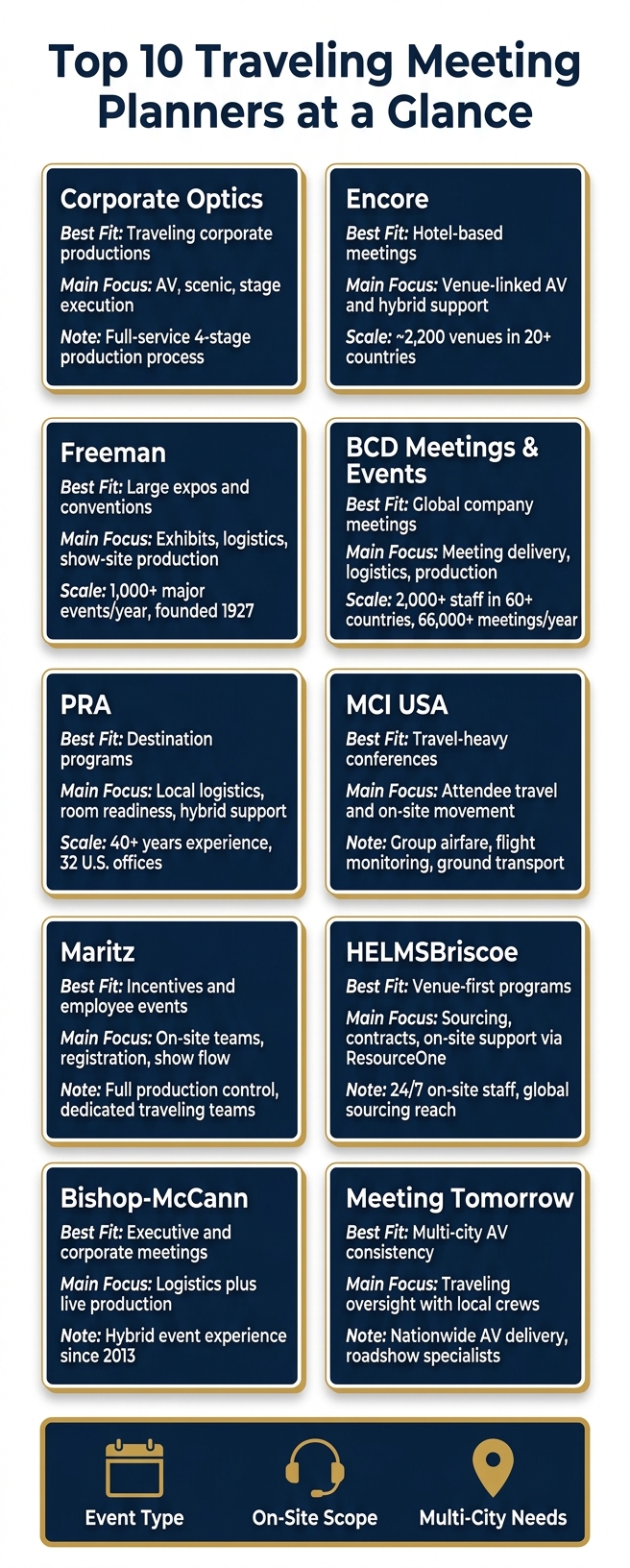
Top 10 Traveling Meeting Planners: Side-by-Side Comparison
What Traveling Meeting Planners Handle On-Site
At a new venue, the planner starts with a site walk-through. They check the room layout, traffic flow, AV, staging, load-in paths, power access, sightlines, and back-of-house areas. They also confirm venue rules around in-house AV, union labor, fire codes, and permits. Those details shape the production schedule, which maps load-in, tech checks, rehearsals, attendee flow, show time, and teardown in cue-level order. That first pass gives the team a repeatable production standard in any city.
Next comes the run-of-show: the cue-by-cue plan for every speaker, transition, and technical moment. This covers slide advances, video rolls, lighting changes, mic handoffs, and walk-ons. During rehearsals, the planner calls cues over comms to AV, lighting, and stage crews. If slides change, timing moves, or a speaker needs more runway, they update the cue sheet on the spot. That's how the planner keeps each stop lined up to the same show standard. It also shapes the speaker experience from the start.
Speaker support usually includes pre-session briefings, slide checks, speaker room prep, and coaching on confidence monitors, timers, and mic handling. This matters most at sales kickoffs and leadership meetings, where executive delivery can shift how the room reacts.
For hybrid and livestreamed events, planners also work with AV and IT teams on bandwidth, encoding, camera positions, and audio feeds. They build virtual Q&A, remote presenter segments, and polling into the run-of-show, then monitor both the room and the platform in real time. The same on-site control still applies when part of the audience joins remotely. Once those hybrid cues are locked in, the planner keeps the room and platform moving together.
On event day, the planner becomes the main on-site contact for vendors, staff, and production crews. They manage caterers, decorators, transportation, and staffing against the master schedule. And when plans shift - as they almost always do - they make the call in the moment. That's what allows one team to deliver the same experience across different cities.
"Such a tremendous team and group to work with. They always remain calm (with a smile), have our back, and are prepared for anything."
With those responsibilities in place, the next section looks at the top traveling partners.
sbb-itb-ae35a94
1. Corporate Optics
Corporate Optics is a full-service technical event production partner built for travel. Founded by Steven P. Simmons, the company brings AV, scenic production, and event planning together in one on-site team. On event day, that means fewer handoffs, tighter coordination, and one group keeping the whole show on track.
On-Site Travel Support
Corporate Optics uses a four-stage process: Discover, Design, Develop, and Deliver. This framework ties production to event goals, venue logistics, vendor coordination, and backup planning. The point isn't just putting more people in the room. It's using the same process from one event to the next, so execution stays steady.
AV and Technical Production
The team handles conference event production by managing AV, lighting, and scenic work as one plan instead of separate pieces. If a venue has its own AV provider, Corporate Optics still manages the full production plan to keep the program in line with brand standards and event goals. For hybrid and streamed events, the company also provides switching systems, broadcast platforms, and redundant signal feeds.
Run-of-Show and Stage Management
Corporate Optics keeps scripts, awards, multimedia, entrance music, lighting cues, and slide decks moving in sync. Presenter support covers rehearsals, script prep, and teleprompter services. That same cue-by-cue control carries over to hybrid and streamed programs, where timing errors can snowball fast.
Hybrid and Multi-Location Execution
Corporate Optics has supported programs ranging from divisional meetings to national dealer meetings and company-wide events across multiple destinations. For organizations running events in more than one city, that's a big deal. The main edge of bringing in a traveling production partner is consistency from one destination to the next.
2. Encore
Encore supports events across about 2,200 venues in more than 20 countries, including Hilton, Marriott, Hyatt, IHG, and Accor properties. That kind of reach matters when a program needs to look and run the same way across several cities.
On-Site Travel Support
Encore stands out by pairing a traveling lead team with local venue crews. It assigns a traveling lead producer to work with on-site teams at each venue, so one accountable group stays in charge from stop to stop.
AV and Technical Production
Encore manages audio, video, lighting, LED walls, rigging, power distribution, staging, and scenic design under one plan. In plain English, that means fewer handoff problems when production needs change from one venue to the next.
Run-of-Show and Stage Management
Encore creates detailed cue sheets during pre-production and uses show callers and stage managers to keep speakers, video, and AV cues in sync on site. That setup works across general sessions and breakout rooms without piling on extra management layers.
Hybrid and Multi-Location Execution
Encore is among the best production and AV companies for live, hybrid, and virtual events through its Cvent partnership and connected venue teams. For simultaneous programs across multiple U.S. locations, that link helps standardize the production package and keeps each site running to the same show standard.
3. Freeman
Freeman, founded in 1927, brings together Events & Exhibit Services and AV Production for exhibit support, logistics, and technical production. That setup matters most when a program needs exhibit support and technical production handled by one on-site lead.
On-Site Travel Support
Freeman sends show-site operations teams to manage logistics and production on location. These teams lead crews, coordinate logistics, and enforce standards on site.
AV and Technical Production
Freeman AV supports more than 1,000 major events each year.
Run-of-Show and Stage Management
Freeman uses show callers and stage managers to keep cues, transitions, and departments in sync on site. Those teams help keep big programs moving cleanly from rehearsal to live show.
Hybrid and Multi-Location Execution
Freeman supports hybrid programs by keeping in-room and digital elements synchronized on site. This helps keep brand and technical standards consistent across destinations. That makes Freeman a good fit for destination-based meetings that need the same standard carried from one location to the next.
4. BCD Meetings & Events
BCD Meetings & Events is a Chicago-based global agency that plans and produces corporate meetings, conferences, and branded events on site. With 2,000+ people in 60+ countries, the company supports large programs across many destinations and executes more than 66,000 meetings each year. For companies running multi-city programs, BCD brings global staffing and a standardized way of handling production. This often starts with a corporate event checklist to ensure no detail is missed during the planning phase.
On-Site Travel Support
BCD M&E manages event delivery on location through venue coordination, supplier oversight, attendee logistics, and crew coordination. It also has a long-running partnership with Plannernet, which extends freelance support across many markets.
That on-the-ground support also shows up in technical production, where timing and cue control can make or break a live program.
AV and Technical Production
BCD's production team handles audio, lighting, video, show calling, and technical coordination for live events. The team also manages presentation support, speaker coaching, and streaming. That's a big deal when an event includes several presenters or needs to work well in a hybrid format.
Run-of-Show and Stage Management
BCD's meetings management model connects program planning, timeline alignment, on-site delivery, and coordination across suppliers and stakeholders. In plain terms, it helps keep the run-of-show and event agenda tight. Their show calling and technical coordination also help sessions stay on cue and transitions move cleanly, which matters a lot at multi-session corporate conferences.
When both in-room and remote audiences are part of the same event, that level of control matters even more.
Hybrid and Multi-Location Execution
BCD's production team supports live, virtual, and hybrid event production, including platform selection, broadcast production, audience tools, and reporting. In 2026, BCD M&E launched Strategic Production Management (SPM) in North America, a standardized production workflow built to standardize production processes across client portfolios. That model gives clients a more consistent way to run production across many programs and locations.
5. PRA
PRA has been in the business events space for 40+ years and operates from 32 U.S. offices, which gives it a strong footprint for destination meetings.
On-Site Travel Support
PRA’s on-site approach focuses on transportation, risk control, security, vendor check-ins, and room readiness for destination events. In plain English, they handle the moving parts on the ground so the show doesn’t get bogged down by load-in delays or crossed wires with the venue. That’s a big deal when access windows are tight, shuttles run on strict schedules, or security rules add extra steps.
AV and Technical Production
PRA manages AV, lighting, staging, microphones, confidence monitors, and pre-show testing. If a program includes hybrid or webcast elements, a traveling producer helps keep in-room and remote cues tied to the same cue sheet. The result is simple: presenters, slides, and live cues stay in sync from one city to the next.
Run-of-Show and Stage Management
PRA’s event producer roles include site inspections and coordination with supplier partners. On show day, that turns into cue management, speaker transitions, rehearsal flow, and live timing control. When one production lead already knows the plan inside and out, it’s much easier to keep the run-of-show on track even if changes come in at the last minute.
Hybrid and Multi-Location Execution
PRA’s Digital + Hybrid Programming capability supports consistent production standards for hybrid town halls, regional roadshows, and multi-city programs. That helps keep both in-room and remote audiences on the same page, with the same level of production from market to market. For teams traveling from city to city, that kind of consistency is the whole point.
6. MCI USA
When travel issues can throw off an event schedule, MCI USA puts the focus on logistics control. The company supports on-site meeting logistics and attendee travel for corporate meetings and conferences. That matters when attendee movement, venue timing, and last-minute schedule shifts shape the live experience.
On-Site Travel Support
MCI USA’s on-site team provides travel assistance to help keep programs on schedule. In plain terms, its role is to keep travel and venue movement lined up with the event timeline.
Travel Coordination and Change Management
MCI USA manages group airfare, flight monitoring, and same-day changes to help attendees stay on time.
Hybrid and Multi-Location Execution
For programs that run across more than one city, MCI USA also coordinates ground transport between airports, hotels, and venues.
7. Maritz

Maritz takes on-site planning a step further and moves into full production control. Its traveling teams manage event flow and on-site execution across destinations, which makes Maritz a full-service event partner that shows up at client sites and runs the program on the ground.
On-Site Travel Support
Maritz sends dedicated teams, including Meeting Event Managers and registration specialists, straight to the event site. They handle check-in, wayfinding, venue coordination, and live issue resolution. So instead of juggling a dozen moving parts alone, clients have a team there to keep things on track.
When a global event needed a sudden location change, Maritz sourced a new destination, renegotiated arrangements, and still delivered the program on a tight timeline.
That same on-site leadership also carries over to the technical side of the event.
AV and Technical Production
Maritz coordinates scenic, audio, camera, video, lighting, and production crew support through specialized production partners. It also manages on-site registration technology.
Run-of-Show and Stage Management
Maritz uses early cue sheets, rehearsals, and on-site cue control to keep speakers, transitions, and technical moments in sync.
Hybrid and Multi-Location Execution
Maritz supports face-to-face, hybrid, and digital formats with tools for virtual lobbies, session management, and polling. That matters when the same program needs to deliver the same level of execution across multiple cities.
The end result is one production standard that can travel from one destination to the next without losing consistency.
8. HELMSBriscoe
Some travel partners focus first on output. HELMSBriscoe comes at it a bit differently. The company is best known for venue sourcing and contracting, and that same base is backed by on-site event support through its ResourceOne division.
On-Site Travel Support
ResourceOne sends uniformed on-site staff directly to the event location, with support available 24/7 during the event. These teams handle supplier coordination, contracting support, and ground transportation. For multi-city programs, ResourceOne centralizes contracting and deploys the same on-site team across each stop, which helps keep execution steady from one location to the next.
Because HELMSBriscoe starts with sourcing, the team can spot room limits early, before AV plans are locked in.
AV and Technical Production
ResourceOne can turn room size, layout, and event timing into AV needs, then coordinate those details with the venue or outside providers. Its Event Solutions portfolio includes production, entertainment, speakers, and virtual meetings, so the team has a clear scope before technical planning starts.
Once that technical scope is in place, ResourceOne uses it to lock in timing, speaker flow, and cue order.
Run-of-Show and Stage Management
ResourceOne's traveling team takes contract details, speaker timing, and room logistics and turns them into a live working schedule. On-site staff manage speaker arrivals, rehearsal timing, and stage changes, while making adjustments in the moment as the program unfolds.
Hybrid and Multi-Location Execution
HELMSBriscoe offers virtual and hybrid meeting support through ResourceOne, including registration support via STOVA. For multi-site programs, HELMSBriscoe's global sourcing reach helps teams find and contract venues that can meet hybrid technical needs. ResourceOne staff can then be deployed to key hubs, giving clients one production standard across cities.
9. Bishop-McCann
Bishop-McCann is a full-service meetings, incentives, and events agency with a clear focus on corporate meetings and events. That makes them a strong fit for destination meetings that need both tight logistics and live production on site.
On-Site Travel Support
When Bishop-McCann's team travels to a client location, they handle on-site program execution and staffing. Their support includes room blocks, attrition, transportation, VIPs, and keynote speakers. They also manage group air travel, which can make destination event coordination a lot less messy for attendees and planners alike.
AV and Technical Production
Bishop-McCann's live production services cover technical direction, stage design, lighting, and on-site production support. In practice, that means the production side and the logistics side work together during the event instead of running on separate tracks.
Run-of-Show and Stage Management
For session flow, Bishop-McCann's teams manage timelines, registration, tech support, and keynote speaker coordination on site. That's the kind of behind-the-scenes work that helps a program stay on time and keeps speakers, staff, and attendees moving in sync.
Hybrid and Multi-Location Execution
Bishop-McCann has produced hybrid events with both virtual and in-person parts since 2013. Their hybrid support can include strategy, creative, content, platform management, registration, tech support, and post-event reporting. Put together, those services help keep multi-city programs aligned across destinations.
10. Meeting Tomorrow
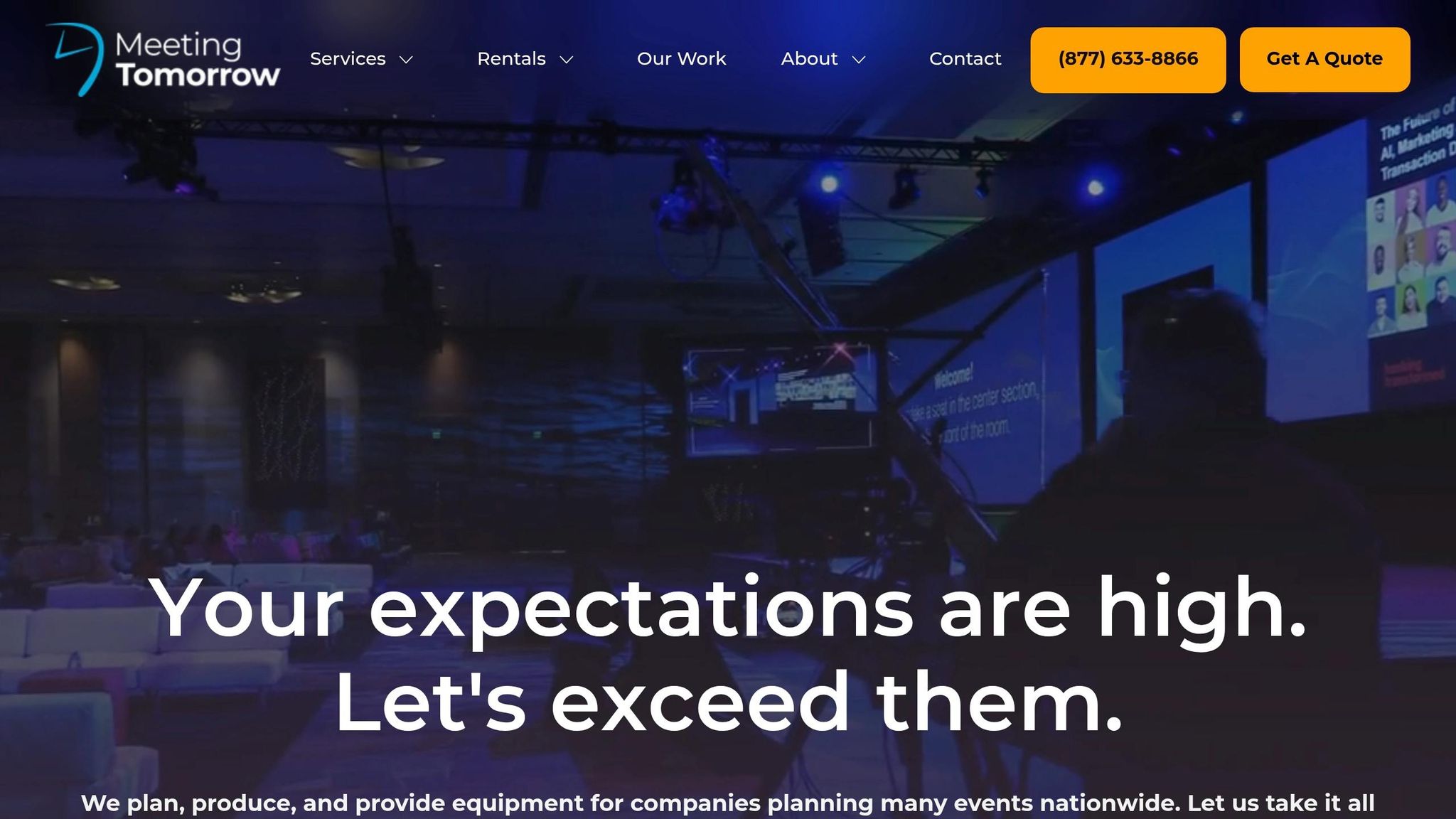
For teams that want one production standard across many locations, Meeting Tomorrow is built around traveling oversight and repeatable AV delivery. The company provides nationwide AV and event support through traveling event managers, local crews, and shared equipment. The goal is simple: keep production consistent across venues so the show feels the same in every city.
On-Site Travel Support
Meeting Tomorrow sends event managers on-site to oversee production and act as the main point of contact for the client. Local or regional technicians handle setup, live show operation, and teardown, with staffing matched to the size and complexity of the event. That setup works well for roadshows, sales meeting production, and annual conferences that need the same production approach from city to city.
AV and Technical Production
Meeting Tomorrow supports staging, audio, lighting, projection, screens, drape, and stage sets. It also offers large-scale technology rentals for training days and sales kickoffs. On-site crews handle audio mixing, video switching, slide playback, and live troubleshooting, which cuts down on venue-by-venue vendor management.
Run-of-Show and Stage Management
Meeting Tomorrow can build or tighten the run-of-show and manage show flow, including cues for speakers, videos, Q&A, and transitions. Their team can run the entire show or step in only for technical support, which gives clients room to keep as much internal control as they want.
Hybrid and Multi-Location Execution
For hybrid and multi-site events, Meeting Tomorrow provides on-site encoding, streaming platform integration, remote attendee support, registration systems, and contingency planning. For multi-site programs, the company can support live streaming, remote attendee access, and consistent on-site AV at each location. After the event, it can provide analytics like viewer counts and engagement metrics to help with future planning.
When comparing Meeting Tomorrow with other partners, the most useful points are service scope, staffing depth, and hybrid support. Those areas make it easier to judge staffing model, technical depth, and multi-site readiness.
Side-by-Side Comparison of the Top 10 Traveling Meeting Production Partners
Start with your event type. Then look at how much help you need on the ground. That makes it much easier to pick the right travel-based production setup.
Here’s a quick side-by-side view:
| Provider | Best Use Case | Core Services | Ideal Event Type |
|---|---|---|---|
| Corporate Optics | Full-service technical event production for traveling corporate programs | Full-service AV production, scenic, lighting | National dealer meetings, product launches, government seminars |
| Encore | In-venue AV support and hybrid event technology | AV production, digital event platforms | Hotel-based conferences and hybrid meetings |
| Freeman | Large-scale exhibitions and trade shows | Exhibit logistics, event technology | Major industry conventions and expos |
| BCD Meetings & Events | Global corporate meeting strategy and logistics | Meeting strategy and logistics, venue sourcing, attendee management | Global corporate summits and internal meetings |
| PRA | Destination-specific experiences and local logistics | Destination logistics, themed events | Incentive trips and city-specific corporate outings |
| MCI USA | Association management and large-scale global conferences | Association management, event production | Professional association annual meetings |
| Maritz | Employee engagement and incentive travel | Engagement-focused event design, incentive programs | Sales incentive trips and large-scale recognition events |
| HELMSBriscoe | Events where site selection and contracting come first | Venue sourcing, contract negotiation | Any event requiring venue procurement expertise |
| Bishop-McCann | Executive retreats and specialized corporate meetings | Full-service planning, incentive travel, creative production | Executive retreats and pharmaceutical meetings |
| Meeting Tomorrow | Consistent AV and production across any U.S. location | AV rentals, technical production, nationwide logistics | Multi-city roadshows and mid-to-large corporate meetings |
Use the table to line up your event type with the right support model. Once you narrow the fit, the next step is figuring out which on-site deliverables that partner should handle.
Deliverables to Expect From a Traveling Meeting Planner
A good traveling meeting planner should hand off clear production docs and usable day-to-day workflows. That’s what keeps an event on track from one city to the next, even when venues, local crews, and timing shift. In most cases, the handoffs fall into three areas: schedule control, tech prep, and professional production support.
These are the core deliverables to put in scope.
The run-of-show maps the content and cues. The production schedule maps load-in, rehearsals, staffing, and teardown.
| Deliverable | What It Covers | What It Delivers |
|---|---|---|
| Run-of-show (ROS) | Minute-by-minute show flow | Cues, transitions, owners |
| Production schedule | Load-in through load-out timing | Crew, vendor, and venue alignment |
| AV prep plan | Gear and file readiness | Approved presenter file formats |
| Stage cue sheets | Lighting, audio, and video cues | Precise show caller instructions |
| Speaker prep packet | Timing and stage prep | Stage blocking, mic type, monitor use |
| Crew and vendor coordination docs | Roles, contacts, escalation | Accountability across on-site teams |
| Vendor oversight matrix | Arrival windows, scope, change approval | Contact list and change workflow |
| Rehearsal plan | Tech checks and run-throughs | Contingency exposure before show day |
| Hybrid test plan | Stream and remote cue validation | Load tests, camera and mic checks |
| Day-of checklist | Live-room and wrap-up tasks | Attendee flow checkpoints and wrap steps |
AV prep is usually where the most risk piles up. Tests should happen during load-in, not five minutes before the keynote. The best traveling teams bake that work into the schedule so it doesn’t get dropped when the day gets tight.
For hybrid events, platform testing is not optional. That means:
- Load tests
- Camera and mic checks
- A full rehearsal of room-to-virtual transitions
Use these deliverables to assign ownership, track approvals, and spot gaps before show day. They make it clear what the planner owns and what your team still needs to supply.
When to Hire a Traveling Planner Instead of In-House or Venue Support
Once the deliverables are clear, the next step is simple: decide whether you need a traveling lead at all.
Bring in a traveling planner when the event has enough complexity, enough business risk, or enough geographic spread that steady on-site execution gets hard to control. That’s the line.
For a simple internal training with basic AV and catering, in-house or venue support is usually enough. But for multi-city programs, hybrid broadcasts, or executive-stage events, the stakes shift. At that point, consistency matters more than convenience.
A traveling lead keeps AV, show flow, and vendors lined up at every stop. That helps you avoid uneven execution from one city to the next - and keeps the attendee experience from feeling weaker in some locations than others.
The table below shows when a traveling planner does a better job of protecting consistency than local support.
| Event Scenario | Traveling Planner | In-House / Venue Support |
|---|---|---|
| Multi-city roadshow or town hall series | ✅ Recommended - ensures consistent staging, AV, and messaging across all stops | ❌ Risk of quality variation between cities |
| Destination conference in an unfamiliar market | ✅ Recommended - bridges gaps in local vendor capabilities and venue limitations | ❌ Venue team may lack full-program visibility |
| Executive presentation or C-suite town hall | ✅ Recommended - manages rehearsals, timing, and on-stage logistics so executives focus on content | ⚠️ Possible if the event is simple and single-location |
| Hybrid broadcast with a large or high-value remote audience | ✅ Recommended - brings streaming workflows, redundancy plans, and platform experience | ❌ Venue AV may only partially support broadcast-quality needs |
| Program requiring one consistent production lead across locations | ✅ Recommended - single lead protects brand, content versioning, and show flow continuity | ❌ Local teams reset each time, creating inconsistency |
Before you lock the budget, score the event on three things:
- Risk
- Complexity
- Geography
If a failure would hurt sales, employee engagement, or investor confidence, hire the traveling planner. If the stakes are low and the production is simple, local or in-house support is the more efficient move.
This is where teams often get hybrid events wrong. A small Zoom session can stay in-house. But a town hall or product launch with a large remote audience is a different animal. It needs broadcast-level redundancy, encoding, and contingency planning if you want the show standard - and the attendee experience - to stay the same across every location.
Those are exactly the problems traveling planners are brought in to handle across destinations.
How Traveling Planners Solve Consistency and Logistics Problems Across Destinations
The main issue with multi-city events is drift. Every time work passes to a new local team, small changes start to creep in. Stage setup shifts. Cue timing slips. Speaker prep gets handled a bit differently. Before long, the event no longer feels like the same program from one city to the next. The fix is simple: one traveling lead who holds the same production standard at every stop.
A traveling planner keeps that drift in check by bringing the same master run-of-show, cue sheet, and brand standard from city to city. They act as the single point of contact, which keeps the attendee experience steady while local crews deal with venue rules and labor needs. So even if the venue changes, the parts guests notice most stay the same:
- Registration flow
- Stage cues
- Speaker transitions
- AV standards
- Branding
This matters even more in places where union AV rules, venue policies, and load-in windows can vary a lot, sometimes even within the same city. A traveling production lead turns those local limits into site-specific notes without letting them spill over into the attendee experience. For bigger programs, sending site briefings about 36 hours before each stop can help every crew stay lined up on the latest timeline and cue sheet.
Speakers feel the difference too. If presenters walk into the same on-site speaker support workflow in each city, they can prep with less stress and fewer last-minute fixes. That steady setup matters a lot for executive keynotes and customer panels, where one missed cue or AV problem can hurt credibility.
It also takes pressure off internal teams. When traveling planners handle destination-specific coordination, corporate staff don't have to chase scattered handoffs from city to city. They can stay focused on stakeholders, content, and business outcomes instead of getting pulled into logistics.
Conclusion
The best traveling meeting planners bring the same production standard from the first planning call to show day. And that kind of consistency matters even more when the format leaves little room for mistakes.
For complex, multi-session conferences, you need a partner with strong on-site leadership and tight run-of-show control. For hybrid programs, look for redundant signal feeds and a team that can manage both in-room and remote audiences without losing continuity. For high-stakes executive events, the right partner protects the brand while handling venue logistics and vendor coordination on-site.
For destination meetings, that consistency is the edge. A traveling meeting planner keeps logistics from splintering across cities and delivers a repeatable audience experience at every stop.
That’s the value of a meeting planner who travels to you.
FAQs
How much does a traveling meeting planner cost?
Costs can vary a lot. It all comes down to your event’s size, how much is involved, and the tech setup you need.
That’s why most professional production partners don’t offer flat-rate pricing. Instead, they provide custom quotes built around each event.
As a rough guide:
- Smaller boardroom meetings can start at around $5,000
- Mid-sized corporate events often fall between $50,000 and $250,000
- Larger multi-day summits may go beyond $75,000
Can a traveling planner work with our in-house team?
Yes. A traveling meeting planner acts as an extension of your in-house team, taking care of technical details, logistics, and vendor coordination.
That gives your internal staff more room to stay focused on event strategy and leadership, while the planner handles expert on-site support and helps keep quality and brand experience consistent from one location to the next.
How early should we hire a traveling planner?
It depends on your event’s size and complexity.
For large conferences or events with a lot of moving parts, hire a traveling meeting planner 4–6 months ahead. In some cases, it makes sense to book them as early as 9 months in advance.
Smaller corporate meetings usually need less lead time. In most cases, 4–8 weeks is enough.
For hybrid events, plan on booking 45–90 days out. That gives you enough time for platform integration, prep work, rehearsals, budgeting, and logistics.
Related Blog Posts
- 4 Meeting Production Companies That Excel At Seamless AV (audio/video), Lighting, and Stage Design for Corporate Conferences, and events
- End-To-End Annual Meeting Production Companies For Your Next Company Conference
- Best Meeting Planners In Event Production Near Detroit, Michigan
- Looking For A Conference Production Company To Handle Venue Logistics, Layouts, And AV Needs? Reach Out To These 3 Companies Today.


Streamline your workflow, achieve more
Lorem ipsum dolor sit amet, consectetur adipiscing elit. Maecenas ac velit pellentesque, feugiat justo sed, aliquet felis.



Lorem ipsum dolor sit amet, consectetur adipiscing elit. Maecenas ac velit pellentesque, feugiat justo sed, aliquet felis.